
House of Rolf is a residential project designed by Studio Rolf. It is located in Utrecht, The Netherlands. House of Rolf by Studio Rolf: “‘House of Rolf’ is an ambitious transformation of a late nineteenth century coach house into a spectacular home and workspace. What is truly unique about this project is that all the materials used to carry out this transformation originated from a demolished office building that was..
London needs to address its profit-and-loss skyline, says Antony Gormley

London’s latest crop of skyscrapers don’t give enough back to the city according to British sculptor Antony Gormley, who claims the British capital is growing at the expense of its citizens (+ interview). (more…)
Hamonic Masson Envisions a New Casablanca When Redesigning its Financial District

© Luxigon
Hamonic Masson is envisioning a new Casablanca via the redesign of its financial district, Casa Anfa. The Paris-based firm, which just won a city-sponsored competition to pioneer a transformation of the area, has unveiled big plans for Lot 65-2. The plans respond to questions on the urban scale as well as preservation and sustainability.
“Form and urbanity” underscore the project’s drive for reimagining the links between high-rise entities in the Moroccan city.
© Luxigon
The firm stresses the powerful architectural heritage of Casablanca as a driving force in thinking of the project as a means to bring a new form and new identity – along with heightened attention to biodiversity – in Casa Anfa.
Hamonic Masson’s proposal for the renewal of Casa-Anfa draws upon the cultural heritage of Morocco in addition to the sustainability and form of the project. Lot 65-2 presents new ways of living for residents in the district, but, more broadly, challenges citizens across Casablanca to reconsider the area as a focal point of the city.
© Luxigon
News Via: Hamonic-Masson
Community of Municipalities’ Offices / Atelier du Pont

© Takuji Shimmura
- Architects: Atelier du Pont
- Location: 85500 Les Herbiers, France
- Area: 2880.0 sqm
- Project Year: 2016
- Photographs: Takuji Shimmura
- Associate Architect: Michel Joyau
- Structure Engineering: Arest
- Fluids Engineering: Area
- Construction Economics: ECB
- Acoustics: Serdb
- Landscape Designer: Paula Paysage
- Sustainable Engineering: Plan02
© Takuji Shimmura
History and context
The Community of Municipalities of the Pays des Herbiers was created in 1995. It enables eight municipalities in the region of Vendée to share resources and competencies in the fields of economic development, town planning, environment, and standard of living. Like the rest of the Vendée, the Pays des Herbiers is a rural area with a strong sense of identity. It is also economically very robust and home to numerous companies active at the national level.
© Takuji Shimmura
Ground Floor Plan
© Takuji Shimmura
The new Hôtel des Communes (Community of Municipalities offices) was built as an extension of the Herbiers City Hall, a mid-19th century mension situated in a public park. The contemporary architecture of the new building provides its citizens with a custom, high-performing tool that reconciles landscape, architectural heritage, and modernity. It is an expression of the region’s territorial influence and of the high level local cooperation.
© Takuji Shimmura
Landscape Sculpture
A Building that approaches Land Art
The Hôtel des Communes represents a sculptural kind of architecture that approaches Land Art. It is a smart and spectacular building that capitalizes on the strengths of its site – the public park, the trees, and the current city hall – to insert itself gently into the landscape.
© Takuji Shimmura
Supple and athletic, it coils around the existing trees, surrounding them to preserve them. It pushes up into the sky and outward into the park, finding its place without upsetting the harmoniousness of the place. It slaloms lightly and gracefully, and its skin uses the path of the sun to its best advantage.
© Takuji Shimmura
Section
© Takuji Shimmura
Despite its size, it only reveals part of its whole. The visible sides, which are proportionate to the surrounding buildings, blend into the urban landscape, while its curves and texture make the building a singular event in the town. As an installation, it hides from view under the reflection of the surrounding landscape on its skin, as if it were a chameleon.
© Takuji Shimmura
Working among the trees
The intelligence of the building’s form resides in the way it increases the size of the façade and thus the workspaces while reducing the technical areas to their necessary minimum. Offices in the Hôtel des Communes are grouped into compact, effective clusters to create greater work synergies. The ground floor hosts the offices that provide public services (civil registrar, marriage hall, etc.). The spaces on the upper floors were designed to be effective and flexible, on the basis of the principle of modular offices. The curving and counter-curving circulations connect one space to another. They allow people to walk through the building or enter the existing town hall fluidly, with a sense of continuity, all the while remaining immersed in the surrounding park’s greenery.
© Takuji Shimmura
Alfonso Ideas Designs a Private Residence in Taiwan

Space With Flow is a private residence located in Taiwan. It was designed by Alfonso Ideas. Space With Flow by Alfonso Ideas: “This is an mezzanine space that has 3 bedroom ,one dining kitchen and one living area it consists of 3 different floor level where the living area is 2.8 m (918ft) high, master bedroom down below is 1.95m (6.4ft) high , 2 other bedrooms upstairs are 1.9m (6.2ft)..
Max Gerthel Studio covers former junkyard in Beijing hutong with inflatable canopy
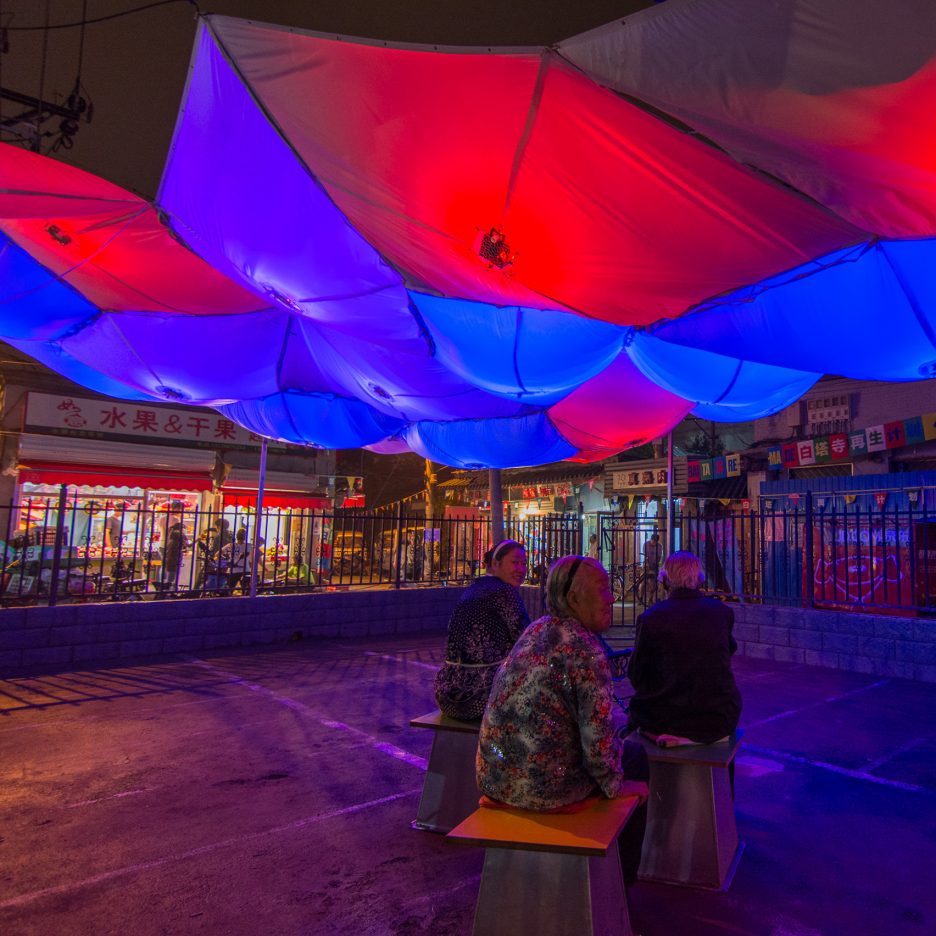
Beijing Design Week 2016: Max Gerthel Studio has created an events pavilion that inflates and deflates to mimic a breathing octopus – joining the ranks of design practices to have made inflatable pavilions (+ movie). (more…)
A Scaffolding System for a Temporary Facility / Peris+Toral.arquitectes

© José Hevia
- Architects: Peris+Toral.arquitectes
- Location: Plaça de les Glòries Catalanes, Barcelona, Spain
- Architects In Charge: Marta Peris, José Manuel Toral
- Area: 300.0 sqm
- Project Year: 2015
- Photographs: José Hevia
- Client: BIM/SA
- Collaborators (Students): Izaskun González
- Stracture: Manel Fernández
- Installations: Jaume Pastor ; Eletresjota tècnics associats
- Collaborators: Ana Espinosa, Leticia Soriano
- Construction: Benito Arno e Hijos
- Cost: 168.579 €
© José Hevia
From the architect. In response to both the temporality of the facility and the context where is located, Peris+Toral stands up for a detachable and reusable construction that minimizes the trace on the territory: a scaffolding system as structure and formal solution of the project.
This temporary facility built a year ago by the Catalan practice Peris+Toral, is part of the provisional urbanization of the Glòries Square in Barcelona. With this project, the studio reasserts a new way of working and enhances its search for new solutions and constructive processes.
© José Hevia
Section
© José Hevia
The facility is thought to be an information point, an exhibition area about the proposed project of the square and rental point of electric bicycles. Is located in a crossroads of pedestrian circulations; which crosses the square towards the sea-mountain and another which transversely connects the two nearby facilities: nursery oaks and the new pergola.
Axonometric
Axonometric
In its temporary condition, the construction is subtly integrated into the transformational environment of Glòries Square. Its linear shape, materials and its structural system highlight both their ephemeral character and the idea of permeability. Along these lines, scaffolding acts as a support of the three envelopes necessary to provide habitability to the construction: an impermeable and translucent polycarbonate skin, a shade mesh and a metal mesh as a protection.
© José Hevia
The areas which host the internal program and services are solved by two structural prefabricated modules of site hut, whereas wood on the pavement and on the transverse thresholds provide warmer areas in the facility.
© José Hevia
YLAB Arquitectos Barcelona Design a Home in Cataluña for a Scandinavian Family

Single Family House Vallès Oriental is a private home located in Spain. Completed in 2016, it was designed by YLAB Arquitectos Barcelona. Single Family House Vallès Oriental by YLAB Arquitectos Barcelona : “Located in a beautiful valley in the south of the Maresme Mountains, this home was designed to capture the magnificent views of the coastal mountain range with pine and holm oak forests. The clients, a Scandinavian family, wanted..
Jey Official Building / Sarsayeh Architectural Office

© Farshid Nasrabadi
- Architects: Sarsayeh Architectural Office
- Location: Isfahan, Isfahan Province, Iran
- Area: 1100.0 sqm
- Project Year: 2016
- Photographs: Farshid Nasrabadi
- Lead Architect: Behnam Sefidi
- Design Assist: Hengameh Akbari
- Contractor: Farhad Bahramipour
- Client : Javad Shakeri
© Farshid Nasrabadi
This project referred to our office when its structure was totally built. And according to client’s demand the ground and basement floor were assigened as commercial spaces and every other levels designed as official saloons with enough flexibility to be divided into different patterns.
© Farshid Nasrabadi
After visiting the project site one point attracted all attentions and it was the constant green line of trees across the street that they were hiding the most part of all neighbor buildings façade behind itself. But because of our building extreme height it was appearing as a disharmonious spot across the street and trees were unable to hide its face.
© Farshid Nasrabadi
So minimizing this disharmony and adopting our building with its context was the main goal in designing procedure.
Section
We decided to choose a linear and vertical geometry for the main division of façade as we had this geometry in trees standing across the street. And also we tried to find a way for continuing the greenery of trees on building’s face. After primary division on building facade we assigned some parts as green zones. And by transforming the surfaces to volumes we had some double skin and semi-opened spaces for making greenery in there.
© Farshid Nasrabadi
So with this method not only we had many freshness inside, but also the movement of plants toward outside and running on building face could create some relation between building and its context in people minds.
© Farshid Nasrabadi
We chose brick as main material because of historical characteristic of our city and we used wood as a complementary for having more harmony with environment.
© Farshid Nasrabadi
Pauline van Dongen designs clothes that correct your posture
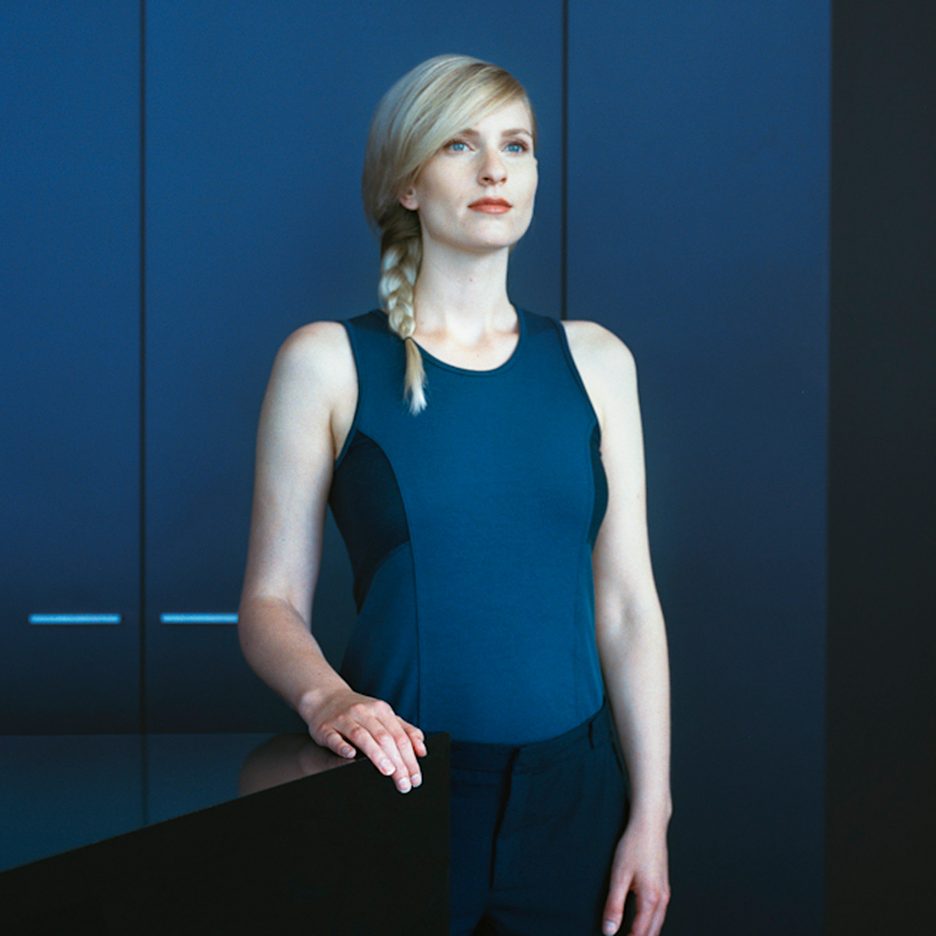
Dutch fashion designer Pauline van Dongen has created a smart top that vibrates in response to bad posture (+ slideshow). (more…)
 Sig Nordal