
SP_Penthouse is a residential project designed by Studio MK27. It is located in São Paulo, Brazil. SP_Penthouse by Studio MK27: “The architectural interiors project for the penthouse sp_penthouse sought to attend to the demands of the program with the minimal division of space possible, shaping spatial continuity and amplitude for the apartment. Infinite circulations accentuate the fluidity between the spaces and configure functional pathways – of a clear understanding to..
Studio UUffie captures wood grain in metal for Echo tables
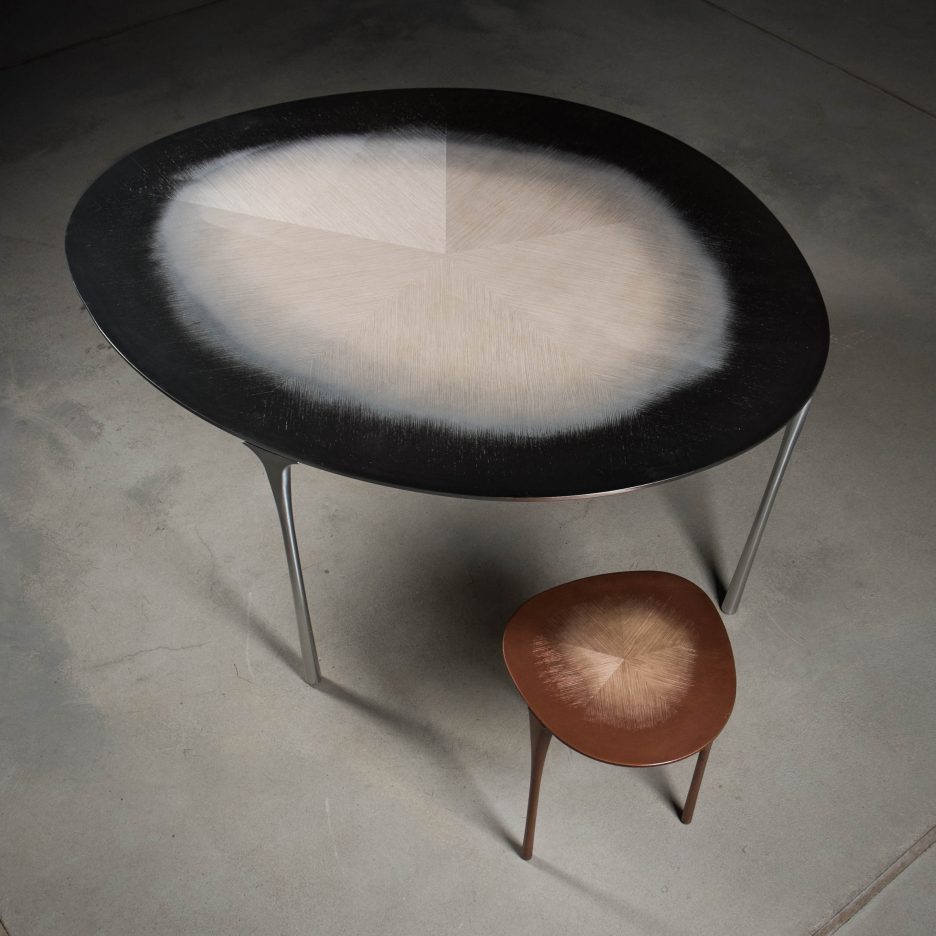
London Design Festival 2016: Canadian studio UUffie has embedded metal into the growth lines of wood to create a set of textured tables (+ slideshow). (more…)
Studio Toggle Designs a Minimalist Home in Kuwait City, Kuwait

F.LOT is a residential project completed by Studio Toggle in 2016. The home is located in Kuwait City, Kuwait. F.LOT by Studio Toggle: “The F.LOT house can be described as a minimal composition of 2 seemingly floating masses intersecting at right angles. A 5m (16ft) cantilever adds drama and gives the composition its unique character. The challenge was to cater for the clients need for a clean open design at..
Niloofar Apartment / Alidoost and Partners

© Parham Taghioff
- Architects: Alidoost and Partners
- Location: Tehran, Tehran Province, Iran
- Architects In Charge: Shahab Alidoost, Sona Eftekharazam
- Area: 2000.0 sqm
- Project Year: 2016
- Photographs: Parham Taghioff
- Assistant Technical Architect: Amir Niknafs
- Team: Hamideh Raoufzadeh, Mehdi Beheshti, Behnaz Behbahani Client: Mika Group
- Client: Mika Group
© Parham Taghioff
From the architect. When the employer began discussions about the project with the architectural group in May 2015, he intended to have a building designed with details as follows: a seven-storey building with steel structure consisting of one underground floor for parking lots, storerooms, boiler room; the ground floor allocated to parking lots; as well as five other floors with one apartment of 165 sqm in area and with three bedrooms on each floor, creating a total built area of 1365 m2 with an external view in compliance with necessary standards to improve qualities of living spaces, allocating a limited budget and accelerating the project to sell the apartments as soon as possible.
© Parham Taghioff
At first we embarked on designing plans taking into consideration the preset steel structure, which was in process of construction, and protection of the access box and heights of floors. Next, because of the budget allocated by the employer, we planned split units as chilling facilities and private packages of heating systems for independent use of every apartment.
Courtesy of Alidoost and Partners
Finally, as the considered building is blocked on three sides and the building can use the sun light only from the south side, and as the employer decided to sell the apartments at soonest possible time, not only we were to pay attention to the planning and spatial relationships, but also to create a distinguished beautiful external view.
© Parham Taghioff
With a glance at the invaluable Iranian architecture, we presented the design with objectives as follows:
To use traditional patterns to create an architecture consistent with needs of the today’s community; to pay attention to simplicity and homogeneity with the surrounding texture; to use functional elements of Iranian architecture, such as “SHOBAK” and “OROSI” to adjust light and to create privacy at home; and to pay attention to appropriate outside views from inside.
© Parham Taghioff
After summing up of the above, the design was made with three steps: (1) To allow light to go to the apartments; (2) To create privacy; and (3) To create appropriate outside views from inside. Therefore, a transparent module and a latticed module were used on every floor to adjust the rate of light penetration into the apartments. On the other hand we considered penetration rate of sunlight into the apartments, adjusted light, created shades, and diversified internal areas by using aluminum latticed plates together with a texture cut by CNC to reduce sunlight during the day and to create pleasant varied spaces for inhabitants with adjustments of shades.
Courtesy of Alidoost and Partners
Finally, we paid attention to the ramps existing in the courtyard to access the ground and underground floors as parking lots and, as there was no sufficient green space, we tried to increase the per capita green space. Therefore, we decided to distribute flower boxes on floors not only to provide the least green space but also to create a relatively nice space in accordance with the urban texture. Therefore, we tried to bring back some part of the external finishing in order to create a place for a small tree to provide the apartments with green spaces. This contributed to create a nicer view for passers-by, on one hand, and to provide the inhabitants with the green space created in their own homes.
© Parham Taghioff
Product Description:
To use traditional patterns to create an architecture consistent with needs of the today’s community; to pay attention to simplicity and homogeneity with the surrounding texture; to use functional elements of Iranian architecture, such as “SHOBAK” and “OROSI” to adjust light and to create privacy at home; and to pay attention to appropriate outside views from inside.
Dezeen’s latest Pinterest board is bulging with inflatable structures
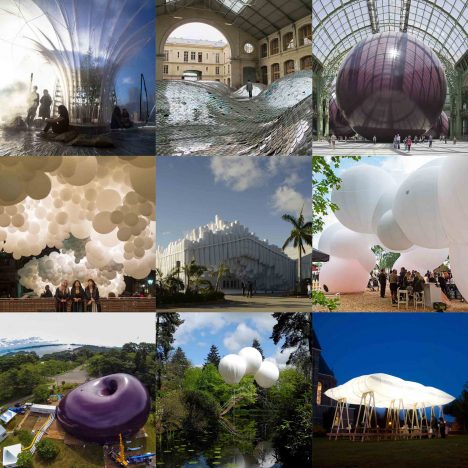
From a blow-up mobile concert hall to an inflatable PVC nightclub, architects have been experimenting with a variety of balloon-like structures. We’ve pinned the most unusual examples to a new Pinterest board.
Follow Dezeen on Pinterest | See more inflatable design on our archive
Altaïr House / Bourgeois / Lechasseur architectes

© Adrien Williams
- Architects: Bourgeois / Lechasseur architectes
- Location: Cap-à-l’Aigle, QC G0T, Canada
- Project Year: 2016
- Photographs: Adrien Williams
- General Contractor: Construction des Grands-Jardins
© Adrien Williams
From the architect. This house, whose name refers to the brightest star in the Aquila constellation, is located in Cap-à-l'Aigle, in the region of Charlevoix. Altaïr means “The Flying Eagle.” What makes the house stand out is its “V” shape and long facades that are suspended over nature. While discrete from the street and closed to the north, it unfolds toward the river, as though to take flight.
© Adrien Williams
Regarding the form, two longitudinal prisms are laid up one on top of the other. A voluntary misalignment allows contemplation of the scenery. The long glass facades provide different perspectives and framings of the river, the forest, and the city of Malbaie below.
1st Floor Plan
2nd Floor Plan
Close up, the house remains mysterious, as it is camouflaged by the trees. The second floor massing casts over the entrance for protection. The hall faces a large south-facing window with a view onto the cement pool, which seems to extend out to the river. The first floor has a guest wing, as well as a living room. The expended steel staircase is inviting and bright, and leads to the living areas.
© Adrien Williams
The second floor is cantilevered and protrudes toward the river. The living areas succeed one another, and the completely open space provides a breathtaking view of the horizon. A vast terrace was built on the roof of the lower floor. The master suite is also located on this floor, slightly set back in the woods.
© Adrien Williams
In terms of material, both storeys are covered with a grey wooden facing. The facades that are hidden or protected by the roof over-hangs are covered with Western cedar. This warm wood extends indoors to the ceiling, emphasising the continuation effect from the inside out.
© Adrien Williams
This house promotes peacefulness and contemplation of the view. There is now a new shining star in the scenery of Charlevoix.
© Adrien Williams
Montana house by HUUM sits beside the Yellowstone River
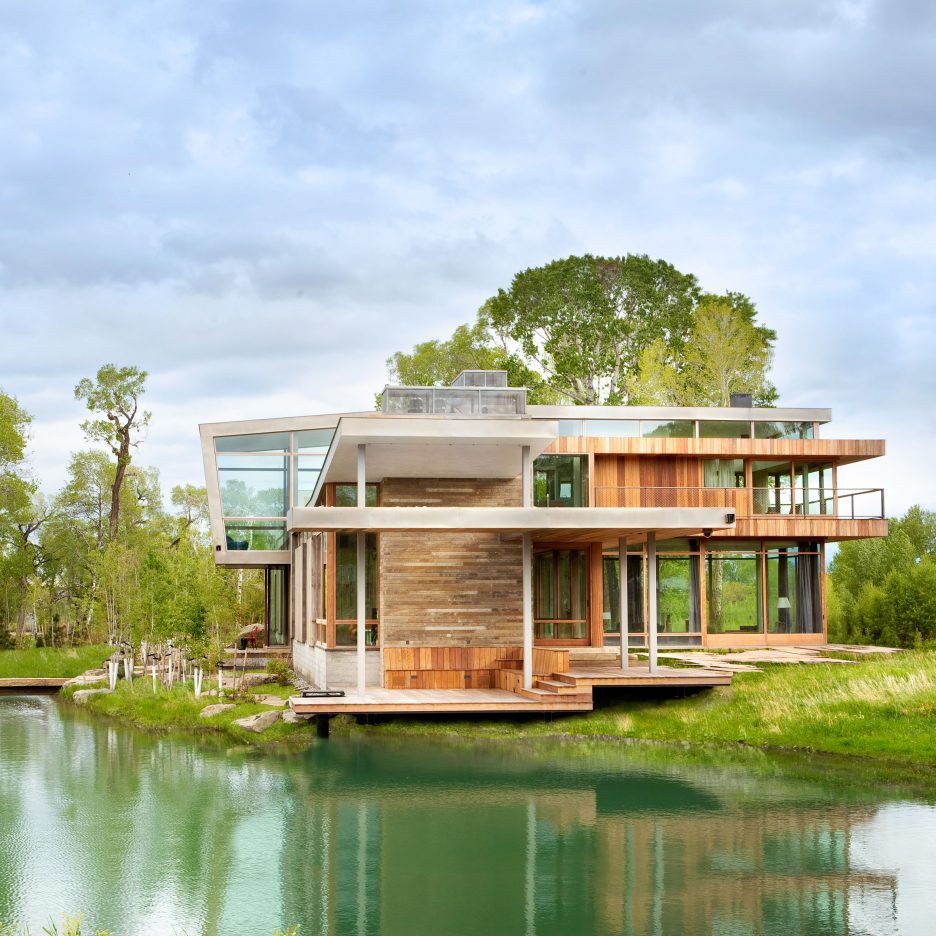
Ponds fed by the Yellowstone River provide natural water features around this home by Hughes Umban Hower Architects, located on a ranch in Big Timber, Montana (+ slideshow). (more…)
Not Ready for BIM? Here are 5 Reasons You May Be Wrong

OHSU/PSU/OSU Collaborative Life Sciences Building by SERA Architects and CO Architects. Image © SERA Architects
Committing your firm to BIM may seem daunting, especially with the time and cost investments that come with adopting new sets of software and a new workflow. There are hidden parallels however, between BIM and other processes within a firm, and therefore these changes to a new way of working may not be as demanding as they first seem. Here are five ways you may already be halfway to BIM.
Courtesy of Autodesk
1. BIM Works More Like Your Brain
When you draw a wall, you don’t think of it just as a set of lines, but as a real wall; BIM works the same way. The object-based system used by BIM means it shares the same understanding you have of the real-world translations and behaviors of 2D representations. More than just a collection of lines, BIM knows there’s more than just one dimension to building components, helping you accurately model and understand how each element works in your design. For a quick overview of BIM, watch this BIM 101 video.
2. BIM Can Add to Your Communication Systems
There have been a plethora of improvements to communication taken up by firms over the years. From familiar old-school aids like speed dial to more recent platforms like Google Chat, Facebook groups and Slack, office communication has come a long way since the Rolodex. Whatever systems you are using in your firm, chances are they are already improving communication. BIM could easily be considered a part of this improvement – the engineer may only be a speed dial away, but the sharing of changes within a collaborative model can be just as instantaneous, and often more accurate.
Courtesy of Autodesk
3. You’re Already Making the Wise Investments Required
Time and cost investments are an inevitable part of adopting a new system. But from small changes such as a new computer operating system to big moves such as a new office, investing smartly is a natural part of any firm’s growth. A switch to BIM often involves three key changes: new hardware, new software and staff training, and for many firms, one or more of these three things is probably already high on the wish list. It may therefore be possible to make these investments with BIM in mind. You can learn more about the strategic ROI of BIM for architecture firms here.
4. Clients Are Ready for BIM
In architecture, things that once seemed like new, useful but ultimately unnecessary additions to your practice can quickly become indispensable tools; this is rarely as true as when the new tool helps you communicate with your client more effectively. If your clients aren’t aware of BIM and the advantages it brings, they can’t tell you how much of an improvement it would be. By providing clients with accurate visualizations and 3D models they can understand more easily, you might find out just how ready they were for BIM, even if they didn’t realize it. Just as clients these days expect emails instead of snail mail and computers instead of (or at least alongside) drawing boards, BIM is the latest step in expectations of technology.
Courtesy of Autodesk
5. Someone’s Doing the Boring Stuff
Whether it’s you or someone else, or even a whole variety of people depending on the project, there are people in your firm who are carrying out the boring jobs – changing annotations, checking scales, updating page numbers and sheet indexes. It is almost certain that they are very much ready to give these tedious jobs to someone else – or to BIM. Ask around your colleagues; by taking care of the housekeeping with automatic, coordinated updates across drawing sets, someone in the firm is likely to be especially ready for BIM.
Download the Definitive Guide to Growing your Architecture Firm with BIM to learn how to build your business with BIM.
This article was sponsored by Autodesk
Nature-Inspired Design Named Winner of Sylvan Theatre Competition

Courtesy of Eric Rodrigues
The Fallen Leaf, designed by Eric Rodrigues, has been named the first-place winner of the competition for the new Sylvan open air theatre in Cherkasy City Park, Ukraine. With a plan to demolish the old building, the new theatre is inspired by nature: it integrates into the landscape of the Cherkasy municipal park and uses only natural and locally sourced stone and wood. The form of the glue laminated timber roof is that of a falling leaf, whose organic slope helps to enhance the theatre’s acoustics.
Courtesy of Eric Rodrigues
Further strengthening the design’s acoustics and relationship to site, the theatre works below ground level, with an auditorium that holds 700 people. On the lower level, a courtyard provides natural light and ventilation and can also accommodate a bar setup. Also underground is the backstage area, including storage, changing rooms, and restrooms. Two areas accommodate guests with disabilities at the ground and lower levels.
Courtesy of Eric Rodrigues
The design uses the natural slope of the site to augment seating capacity, which spans from the built theatre onto the green slope. The seating area is defined by concrete-supported soil and vegetation, blending the building into the landscape.
New via: Eric Rodrigues
India Mahdavi uses pink and yellow velvet for first RED Valentino store in London
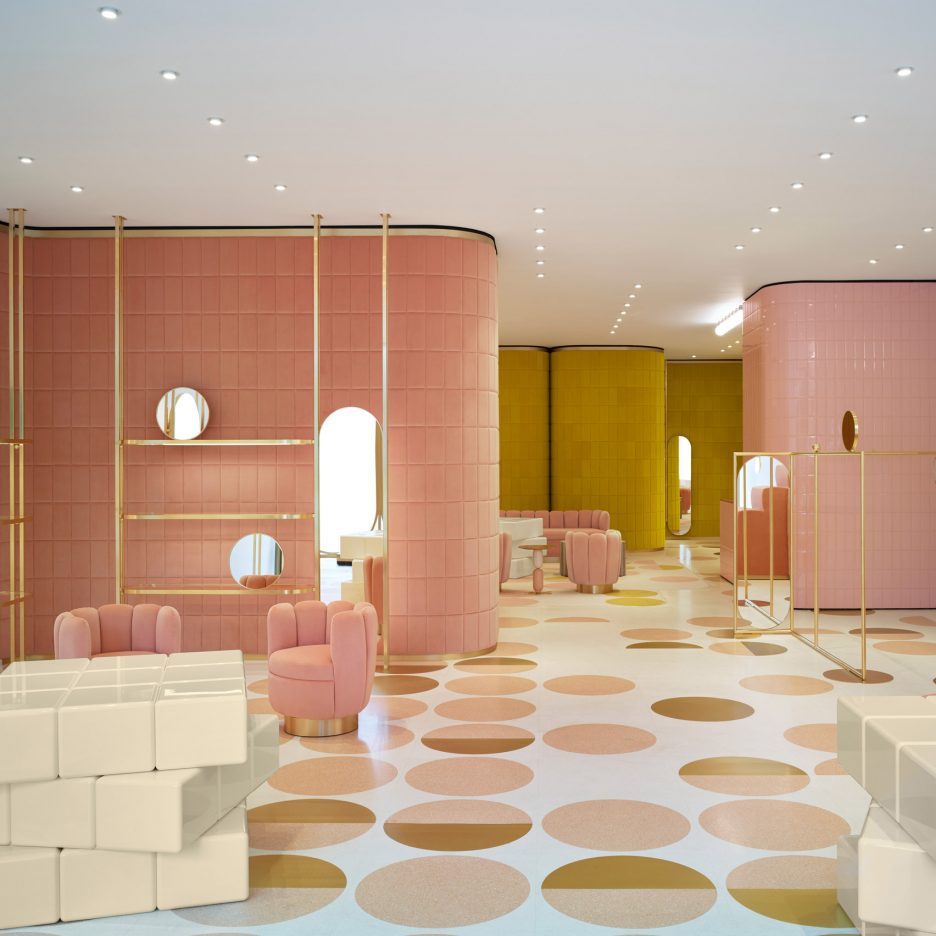
French architect India Mahdavi has used bubblegum-pink and mustard-yellow velvet panels for the interior of this London fashion boutique for RED Valentino. (more…)
 Sig Nordal