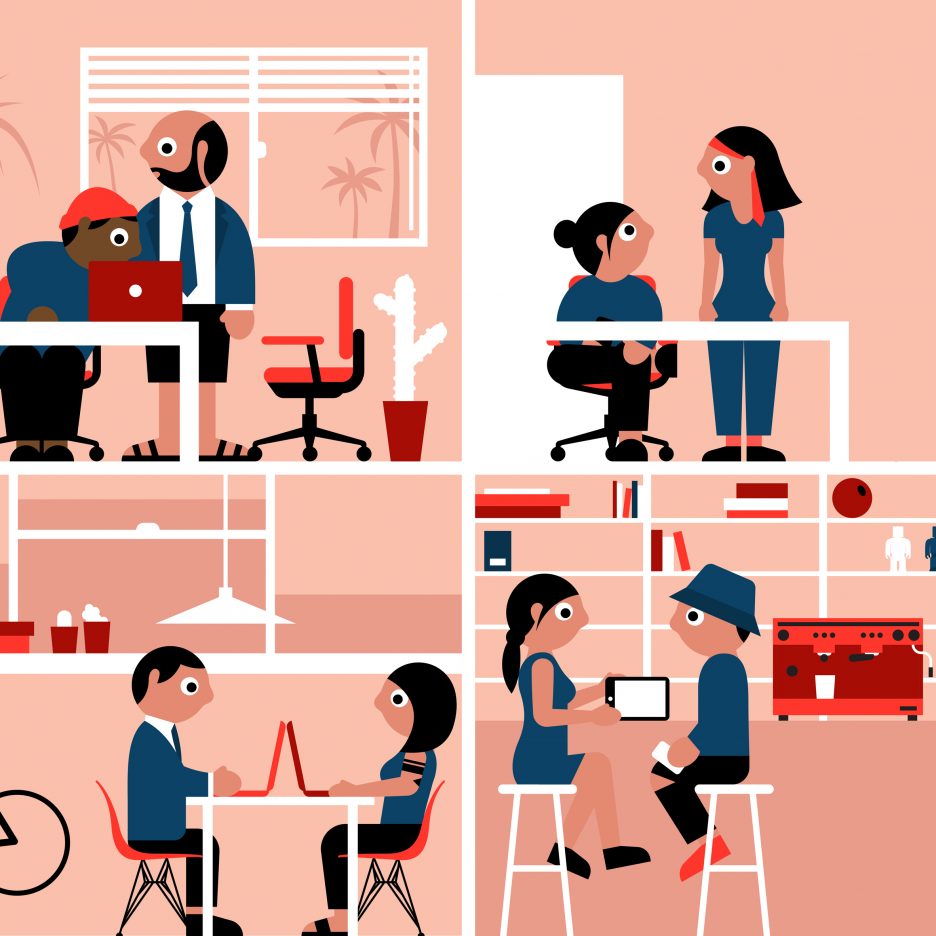
Haworth white papers: co-working spaces popular with small companies and individual workers could help large corporations be more innovative, according to a report by office furniture giant Haworth. (more…)
Haworth white papers: co-working spaces popular with small companies and individual workers could help large corporations be more innovative, according to a report by office furniture giant Haworth. (more…)
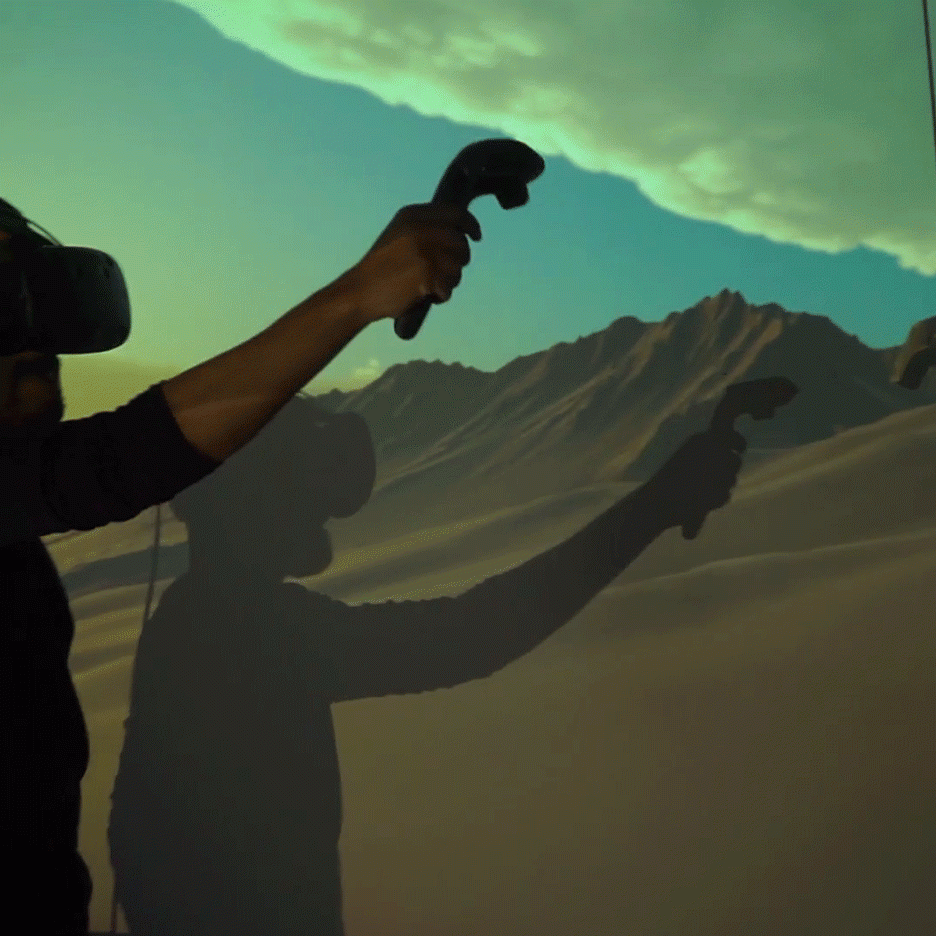
The team behind the Gravity Sketch iPad app have launched new cross-platform software, which gives designers the option to draw and manipulate 3D objects in a virtual reality environment (+ movie). (more…)

Located on Montjuic hill in Barcelona and designed by the rationalist style architect Josep Lluis Sert, the Fundació Joan Miró (Joan Miró Foundation) is a unique space imagined by Miró with a dream of bringing art to the entire world.
The construction of this museum in 1975 was a major event in Barcelona because at the time there was a lack of cultural infrastructure in the city. Now 40 years have passed and the Foundation’s spaces host the work of Joan Miró as well as temporary exhibitions of emerging artists of the 20th and 21st centuries.
The Foundation is the perfect match between the unique works of Miró and the building designed by Sert. The relationship between their work is evident despite the formal differences that seem obvious due to their different professions. Great friends who shared the same interest in the Catalan folk arts, bringing a human side to their works. Their pieces showcased similar recurring themes such as balance, space, color, light, substance and love of nature.
Josep Lluís Sert was the first internationally renowned Spanish architect and founder of GATPAC in 1929 (Grup d’Arquitectes i Tècnics per the Progrés de l’Architecture Contemporània). He was strongly influenced by the ideologies adopted by Wright, Groupuis, Mies Van Der Rohe and Le Corbusier, which led to the rationalism and avant-garde architecture in his works.
Sert’s building is a work that subtly blends ratios based on the Modulor with an architectural language present in the Mediterranean culture.
Its volumetric composition enriches the space, internally providing a dynamic of levels and thus creating spacious, double height rooms with great qualities of indirect natural lighting. Additionally, it offers outdoor patios, connecting elements between rooms providing transparency to the entire space.
The idea of movement and spatial continuity are key elements in the building. There is flexibility between spaces, both in the different showrooms as well as between outdoor spaces, whether it be the gardens, patios or terraces.
Sert chose a solution strongly inspired by the works of Le Corbusier, distributing the exhibition rooms around a central courtyard.
This allows for a spiral path and a circulation in which there is no need to go through the same showroom twice, in addition to connecting the different levels of the museum and offering visitors the chance to admire Miró’s works from different angles.
The Miró Foundation reveals a unique spatial richness through its proportions, flexibility and overhead lighting of internal spaces.
A solution that is bold, functional, rational and Mediterranean; features that make this building remain relevant today.

Igralnaya is a residential project designed by Geometrium. The 344-square-foot home comfortably accommodates all the necessary functionalities. Igralnaya by Geometrium: “The apartment with an area of 34 m2 (344 ft2), was acquired customers for temporary residence. The owners will live in it during the repairs in the apartment, or to place their friends and relatives, sometimes flat to be used as a working space and rest. The interior’s customers no doubt and understand that they need in choosing the style. When they approached us and..
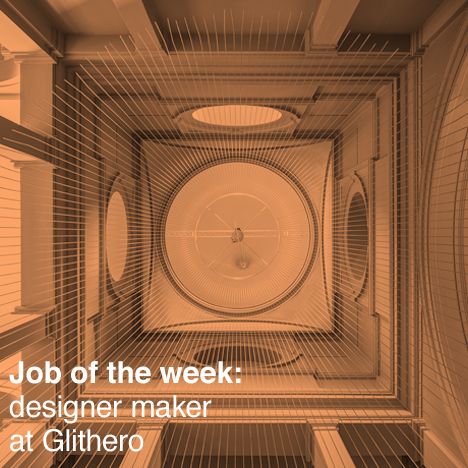
Our job of the week on Dezeen Jobs is for a designer maker at London studio Glithero, which recently installed a kinetic “abstract clock” inside a stairwell at London’s V&A museum (pictured). Visit the ad for full details or browse more architecture and design opportunities on Dezeen Jobs.

The project involved the revitalization and expansion of the quarter building at Wilcza Street 72 in Warsaw, Poland and conducting dialogue between the old and the new tissue housing. It was important to giving a second life of the building, which was witnessed Polish history and supplementing it with elements of contemporary architectural matter, according to the rules applicable thoughts conservation.
The building is situated in Warsaw Street Wilcza surrounded by pre-war buildings. Adjacent to the five-star hotel Rialto and a complex of buildings of Warsaw University of Technology. Besides special surrounding the building has retained on the facade holes after shelling in the war covered the glass and highlighted as a trace of history.
The building complements the dense fabric of downtown Warsaw and enriches the frontage of the existing building, which not only survived World War II, but it was also a witness to historical events.
In his classic style facade of the building raises the prestige of frontage and introduces architectural detail, which previously did not have a house. Light plaster and woodwork introduces a feeling of freshness. Summit of the front facade hides terrace apartment on the top floor. Simple in form of dormers in the roof bring French chic, and the ground floor encased in stone emphasizes the importance of town-sites, which enliven the space, inviting passers-by to your interior. Each of the apartments in the building have a balcony. Cured courtyard contains a small number of fixed elements due to its universal character. This is the place to integrate the inhabitants of the organization of various events. The building outside of the apartments have a private place all kinds of services: in the annexe is an architectural office in the ground floor facing the street hairdresser, pharmacy, in the space of housing: notary, dentist, lawyer, interior architect. A surprising feature is the two cantilever wooden blocks in the yard. One of them is the outbuilding architectural office, and the other two-storey apartment. An important element of the interior staircase is a glass lift and exposed brick.
These buildings remember the hard times of the war and it is why investor and architect wanted to emphasize the memorie by leaving traces of bullet holes on the front elevation, protected by glass and illuminated at night. The respect with which the investor came to the painful times in our history has been recognized in a number of articles devoted to building Wilcza 72. After 6 years of completion of the facility is still appreciated and collecting numerous accolades from users, guests and media, proving that the future is timeless architecture, which does not go blindly on the trendy styles, and adapts to the context and positively affects the prestige of the area.

The Dovrefjell mountain range, which divides the north and south of Norway, holds “a unique place in [the] Norwegian consciousness.” A constellation of myths and legends are connected to these mountains which have, over recent years, born witness to hunting, mining and military activity. But it is also the home of a large wild reindeer population. At Hjerkinn, on the edge of the Dovrefjell National Park, Oslo-based Snøhetta have created an observation pavilion for the Wild Reindeer Foundation. In this film by Alejandro Villanueva, the building and the surrounding landscape are revealed through time-lapse and in astonishing detail.
According to the architects, “the building design is based on a contrast between ideas – a rigid outer shell and a soft, organic inner core. The wooden core is shaped like rock or ice that has been eroded by natural forces like wind and running water, and is placed within a rectangular frame of raw steel and glass.”
Find out more about the work of Alejandro Villanueva, here.

Villa Hindeloopen is a residential project designed by Lautenbag architectuur in 2015. The 43,055-square-foot home is located in Hindeloopen, The Netherlands. Villa Hindeloopen by Lautenbag architectuur: “A sustainable and luxurious barnhouse “Villa Hindeloopen” is located in Hindeloopen in The Netherlands, situated in an area of outstanding natural beauty surrounded by Friesian cows this development has been created from an existing house and small dairy barn. The client is an ambitious..
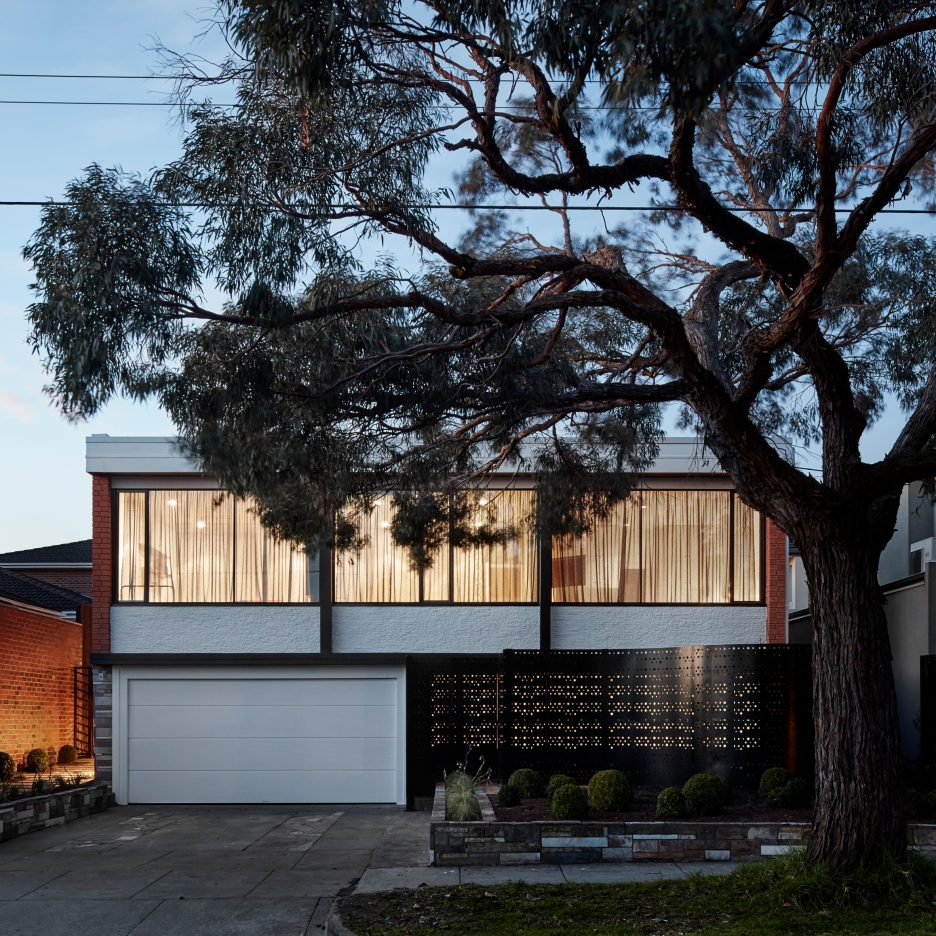
This 1960s house in suburban Melbourne has been overhauled by Branch Studio Architects to create a contemporary home for the original owners’ granddaughter (+ slideshow). (more…)

Our vision of successful living always leads us to two-sided considerations: to “on the one hand, and on the other” scenarios. For example, we want to feel secure and snug, knowing we can close the door on the world, and at the same time feel liberated. So the question arises of how we can combine and balance both needs. Is there a way from “on the one hand, and on the other” to “not only, but also”? A fusion born out of the spirit of our times.
The first question that arises is that of the ideal location. And even this consideration involves bridging differences. People are sociable and have a need for solitude. They want to be in the big city and in a village, they want to enjoy the excitement of urban life and feel like they can lose themselves in nature.
This begins with the search for a building site that reflects a genius loci allowing for the realisation of many visions. It was found at the summit of Pötzleinsdorf mountain. You are up above with a view over the city and at the same time nestled into a natural basin. You are living in the metropolis of Vienna, but situated at the city’s perimeter where there is a village atmosphere and it is green and countrified.
The garden is a kind of “secret garden” thanks to the surrounding green belt (splendid isolation) and is only connected to the public sphere by way of an alley (flag). The treetops have an enlarging effect on the space, encompassing the natural surroundings. The property lines are therefore only of relevance up to the height of the Sky-Frame glazed ground floor; above this, you are in an open green space.
This single-family home has three floors. It provides the opportunity to fulfil these seemingly opposing wishes. The gently sloping hill-side location on the ridge and the property configuration have allowed for an inset building construction, creating a secluded, intimate situation and sense of security. Thanks to the Sky-Frame frameless sliding windows, an unobstructed view over Vienna can be enjoyed from the first and second floor. The interplay between water surfaces and a waterfall is a feature of the ambiance. The interior of the building brings to mind a wellness oasis, with a sauna and indoor pool.
The facade is defined by the dominating element of a robust frame that floats over the terrace like the architrave of a Greek temple. This beam serves as the leitmotif while transforming the accessible area into an imaginary room. The counterpart to this is a reference to the atrium: the facade is set back on the ground floor and suggests a courtyard situated adjacent to the pool. The motif of the atrium, the antique style of a windowless villa, has been realised by means of the modernistic design of a fully-glazed and seemingly windowless structure. The architecture is both extroverted and centred. The frame design optimally presents the space – opening and enclosing it simultaneously.
The membrane of the suspended frame is featured in the view of the facade, where the terrace is bordered at its corners with perforated steel plates. These suggest the semi-transparency that has actually been created in the interior of the building using state-of-the-art technology.
Not only do the perforated steel plates indicate the borders of that space belonging to the house, they also convey the sensation that there is a wider exterior mantle that is equally perforated and chaotic, namely the wall of leaves of the surrounding natural environment, the trees and bushes that fringe the structure. This wall of foliage is also part of the membrane in a wider sense. The various permeable layers that allow continuity between the interior and exterior are integral to the free-flowing design concept.
Further, the house is heated and cooled with a heat pump (ground probes), equivalent to a low-energy house (specific heating demand 32 kWh/[m2 a]). Domestic ventilation has been installed. All functions are bus-controlled and flexibly expandable. A natural swimming pond has been created in the garden that functions without technology. An indoor pool is heated by the heat pump. Cabling for a PV system on the roof allows for upgrading that would make the house energy self-sufficient (in combination with electric cars and battery charger in the garage).
 Sig Nordal