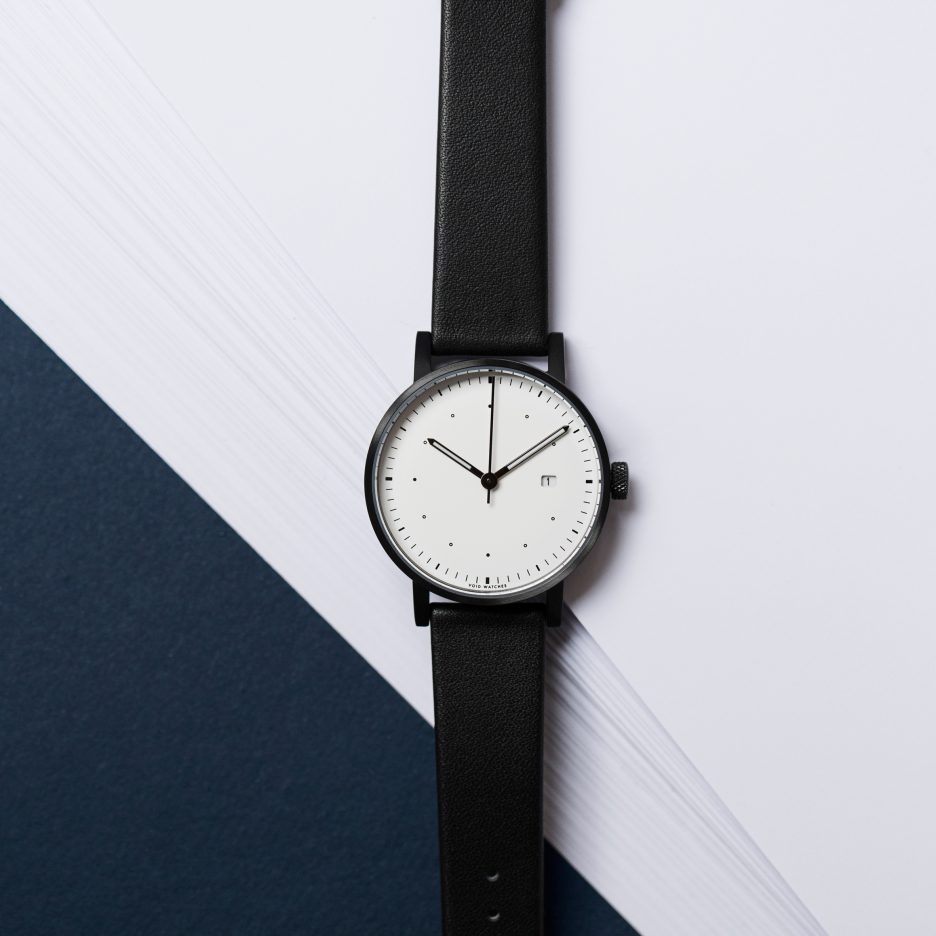
Dezeen Watch Store: a meeting in Hong Kong in 2008 led to the launch of the first Void watch on Dezeen and, shortly after that, the creation of Dezeen Watch Store. As we unveil our first limited-edition collaboration with the watch brand, founder David Ericsson explains how the elegantly minimal timepiece came about (+ interview). (more…)
The government of Lithuania announced today the 3 winning architecture firms of a competition to design a new National Science and Innovation Center, to be known colloquially as “Science Island,” in the city of Kaunas, Lithuania. The competition, organized by Malcolm Reading Consultants, saw entries from 144 teams, making it the largest design content ever held in Lithuania.
Nestled in the heart of the UNESCO designated and celebrated university city, Kaunas, the science center will be located on a 13,000 square meter (140,000 square foot) site on Nemunas Island in the Neman River, adjacent to the Žalgiris Arena and within short walking distance to Kaunas’ historic Centras district. The new €25M complex will “celebrate recent achievements in science and global technologies with the aim of inspiring visitors to expand their knowledge and support innovation,” and will focus on research on the environment and ecosystems.
The three winning teams will now undergo a Negotiated Procedure without Publication of a Contract Notice with Kaunas City Municipality, who will select one of the designed to be realized through to completion on site. Each of the 3 winners will receive an honorarium of €15,000.
In addition, five honorable mentions were also awarded to the following practices:
• Amid.cero9 / Elsewhere (Spain)
• Mark Foster Gage Architects (USA)
• Salon (Turkey)
• UAB Architektų biuras G. Natkevičius ir partneriai (Lithuania)
• Wolfgang Tschapeller ZTGmbH (Austria)
The competition jury which met in Kaunas over the preceding two days included Audrius Ambrasas, Director, Audrius Ambrasas Architects; Jonas Audėjaitis, Dean of Vilnus Academy of Arts’ Kaunas Faculty, and Member of Kaunas City Council; Paul Baker, Director, WilkinsonEyre; Sumit Paul-Choudhury, Editor-in-chief, New Scientist; Povilas Mačiulis, Vice Mayor, Kaunas City Municipality; Rainer Mahlamäki, Professor and Founder, Lahdelma & Mahlamäki Architects; Rolandas Maskoliūnas, Chief Press Officer, Lithuanian Academy of Sciences; and Christos Passas, Associate Director, Zaha Hadid Architects. The Jury was chaired by Malcolm Reading.
Construction on the Science Island project will begin in 2017, with an opening date anticipated in early 2018.
The three winning designs will be showcased on the competition website during the month of October. For more information, visit the website, here.
Opinion: the UK’s housing crisis is no accident, but has been carefully orchestrated to become a catch-all excuse for self-serving projects, argues Phineas Harper in his first Opinion column for Dezeen. (more…)
From the architect. The tourist information devices are situated in different strategic places along the city:
Plaza del Callao, Paseo de Recoletos, Museo del Prado, Museo Nacional Reina Sofía and in Paseo de la Castellana avenue, close to Santiago Bernabeu´s stadium.
Locations
Designed as special pieces in the urban city structure, these five small pavilions are situated within some of the most cultural and commercial city areas. Offering information, as well as different touristic products (ticketing, etc ), the pieces have been created using the last available technology.
Each one has three different attention points where the services are offered. Parting from this point, these necessities generate the possibility of making three different spaces according to the different functions needed. Thus, the pavilion is configured as a clover ground floor which, in fact, is the one that offers the biggest possible perimeter. At the same time, the division of the roof geometry in two different planes makes an indispensable shadow area created for the raining and hot days.
To the end of including the pieces within the visual city structure, the pieces have been thought following principles of transparency and visual lightness. From the interior, the workers can feel they are, in fact, in an exterior space and, therefore visually included in the city.
Section
Structure
The object is prefabricated, mounted and assembled in a short period of time, being its structure an ensemble of metallic tubes and screwed structural profiles. All the rest constructive elements are either fixed directly to this main structure, or to different substructures arising out of the main one. The support on the ground it is made through adjustable elements which permit the object adaptation to different places. The rain water is collected in the roof, driven through an interior object´s tube and finally directly dewatered to the street.
Designed in 2006, and under construction since 2009, Toyo Ito & Associates much anticipated Taichung Metropolitan Opera House has finally officially opened. The design is notable for its cavernous, curved and folded interior forms, which produce a dramatic and complex section that is neatly resolved into a rectilinear exterior form. Taiwan-based photographer Lucas K Doolan visited the new Opera House to study its impressive internal spaces and its presence in the surrounding urban environment.
From the architect. Two main goals have led the design process: [1] not touch the ground; [2] to create an outside platform where topography, with 50% of slope, has provided any flat piece of land.
This volume was placed properly detached from the street, where the ground level was deep enough to accommodate two enclosed floors and an open space underneath.
Section
Its rooftop provides that outside platform as a belvedere welcoming people to the house. Downstairs we first reach the bedrooms level and below it the living room and kitchen. Underneath, attached to the ground level, the portion sheltered by the house was taken as a veranda.
This main volume was complemented with two satellites, two small side volumes: the first one plays as the extension of both street and rooftop providing a platform for parking are and custodian house bellow it; the second one is an extension of the veranda to make the swimming pool and a mechanical space at the bottom.
Floor Plan
Floor Plan
Floor Plan
From this lower level veranda a winding track through the garden provides access to the beach.
During the 2015 school year, fourth-year students of the Ceip Praza de Barcelos primary school in Galicia (Spain) had the opportunity to take an introductory architecture course during school hours, thanks to the initiative of a local project called “Arquitectura Para Niños” or “Architecture for Children”.
Society today is under information overload, children need to learn to locate and filter it through and develop their own content, explains the initiative team led by Ana Barreiro, Marta Guirado and Africa Martinez.
Session 1. Image Courtesy of Taller Abierto
The project’s success is also due to students, teachers, and parents who have been very receptive to this innovative idea and are now struggling to extend the educational project. Through hands-on experience, children are able to observe and reflect on architectural content and learn about Natural Sciences, Geography, Mathematics, Art Education and English all at the same time.
The project was selected for the EducaBarrié scholarly program from 2014 to 2015 and it was with the support of the Barrié Foundation that this new model of education in the public school in Galicia was made possible.
The program was developed under a methodology of active learning where children learn through activities designed to explore specific content more deeply. Within seven units, children explore the characteristics of materials, make observations about space and discover the areas where they live.
Through guided play and learning through discovery, the children learn critical thinking and become more aware of their environment.
Session 1: Shelter. Animal and human behavior
Session 1. Image Courtesy of Taller Abierto
Building a shelter: starting from a set of bars and nodes children work together in building a shelter to understand structural systems.
Session 2: Housing. Territorial and social factors.
Session 2. Image Courtesy of Taller Abierto
Construction of a model: Each child builds a model of an imaginary house from a cardboard box using colored paper, markers, scissors and glue.
Session 3: Anthropometry. Measure and proportion
Session 3. Image Courtesy of Taller Abierto
Staking a standard room, starting from a standard room plan drawn on graph paper, each child recreates a room at a 1:1 scale using colored tape.
Measurements of everyday objects: each child receives a tape measure to take measurements of the chair and desk that they use every day.
Planning out your room: each child draws the floor of his room on a grid of 30 x 30 cm. They need to place the major aspects of their bedroom (doors, windows, furniture) and record their dimensions.
Session 4: Scale and basic architectural vocabulary
Session 4. Image Courtesy of Taller Abierto
The scale game: With different sized objects each child draws a stick figure person to demonstrate the appropriate size.
Architecture for kids: Each student writes an essay using some words from an assigned vocabulary list (at least 6 of the 30 words). It is a story with an architectural theme titled “My favorite house”.
Session 5: Tools of the architect: Models and plans
Session 5. Image Courtesy of Taller Abierto
Fieldwork: This time, the children go from plans to the real word because task is to identify objects on plans in reality and then correct the plans to include objects that didn’t appear on their sheets.
Session 6: Immediate surroundings. Observations
Session 6. Image Courtesy of Taller Abierto
A group brainstorming session on an up to date model of the Plaza de Barcelos made at 1: 100 scale, where each student makes a list of advantages and disadvantages of the space […] After this activity the students move on to a related exercise where, over the course of two weeks, they work individually on a new proposal for the space.
Session 7: Immediate surroundings. Action
Session 7. Image Courtesy of Taller Abierto
All of the individual proposals made by students to transform the environment are collected, the most commonly repeated aspects are combined, attempting to solve the problems of the square and also those of the school, producing a final proposal made by different contributions of the children.
The students explain how their proposals have been integrated into a common project and a debate in expressing their views on the outcome, plus doubts and clarifications takes place.
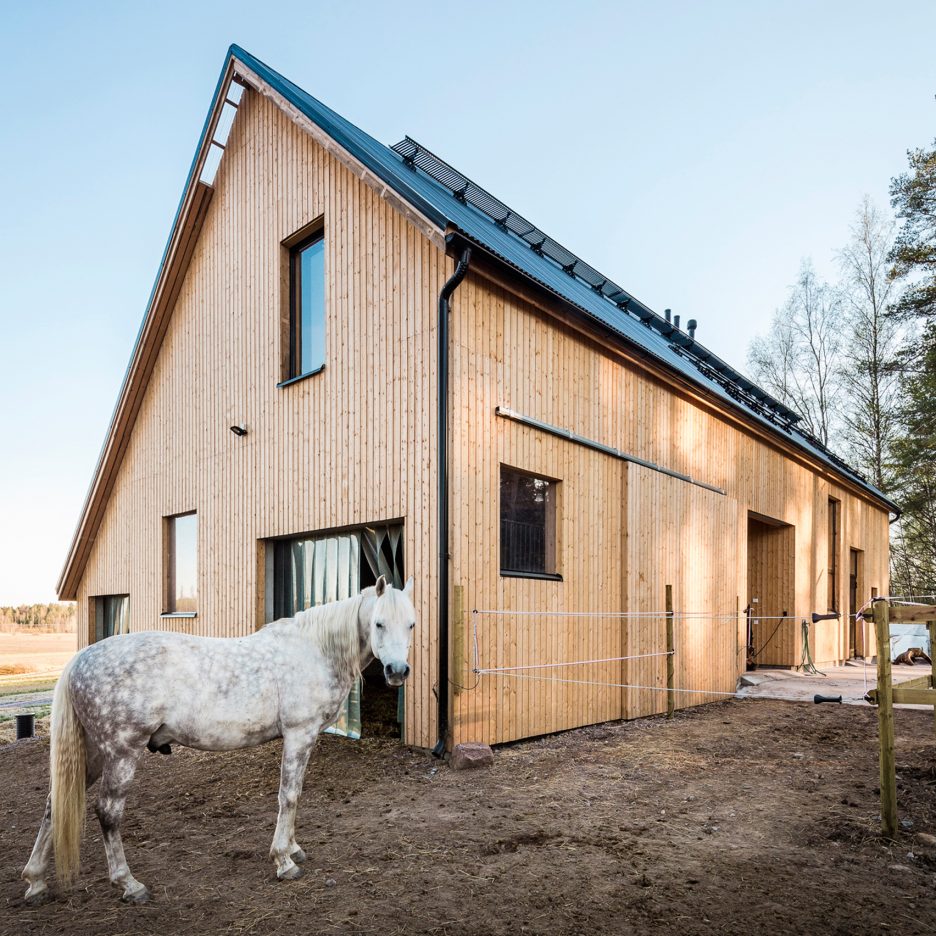
This wooden stables on the edge of a Finnish forest features an asymmetric gabled roof which covers stalls for the horses and a lowered barn containing manure (+ slideshow). (more…)




 Sig Nordal