
As his giant thumbs-up sculpture Really Good is unveiled in Trafalgar Square, David Shrigley explains how his work straddles art, graphics and cartoons (+ interview + slideshow). (more…)
As his giant thumbs-up sculpture Really Good is unveiled in Trafalgar Square, David Shrigley explains how his work straddles art, graphics and cartoons (+ interview + slideshow). (more…)

Dezeen promotion: materials company DuPont has added three baths and two shower trays to its Corian range (+ slideshow). (more…)

From the architect. Barretts Grove is an archetypal Victorian street of two storey brick terraced houses later interrupted by detached apartment buildings, a tall red gabled LCC school and rubble walled church. The new addition sits amongst these later stand alone structures.
If the overall building form is intended to help complete the parade, it and its detailing is also architectonically driven by a choice of superstructure suited to residential use then developed to a smaller domestic and tactile scale. The tall red brick gable facing the street echoes those of the LCC school and is formed in plan by a 1 bedroom apartment with a second smaller block engaged at the rear to create the second 2 bedroom plan. The double stacked and open bond of brickwork states the envelope is not load bearing (of superstructure) but a screen enveloping the whole building including the roof. That is set out with an unbroken grid of large window and door openings to maintain the strength of form despite its slenderness. Wicker woven steel balconies are hung from every other aperture softening that material palette. These are large enough for dining and are alternated to allow neighbours the opportunity to develop the limited social space above and below them when communal gardens are not available. For similar reasons the front door is an extruded version of the bronzed window reveals, becoming a port-cochere with a bench made of the same CLT as the superstructure inviting use when meeting neighbours as well as being convenient to rest yourself and grocery bags while fumbling for keys.
On entering it is apparent the exposed Cross Laminated Timber (CLT) acts as the superstructure for all walls, floors and the roof with visible construction joints expressing the method of assembly. Insulation with vapour barrier and protecting sheeting are applied to the outside face before a self-supporting brick rain-screen completes the exterior thermal and protective overcoat. Ceilings are also left exposed with the use of a fire retardant clear varnish and acoustic performance achieved using resilient boards, insulation and a floating timber floor above; these also accommodating the underfloor heating, power, data and hot/cold water services. The ability of the CLT to serve as structure and finish removed the need for plasterboarded walls, suspended ceilings, cornices, skirtings, tiling and paint; reducing by 15% the embodied carbon of the building, its construction cost and time on site. Timber also has inherently more robust and is perhaps a better and warmer domestic aesthetic. Window seats, timber cabinetry and full height doors some with leather handles, others with bespoke and articulated metal locks continue the sense of home.
The project required a comprehensive understanding of the different materials involved and their structural properties as well as careful detailing because many of the loadbearing elements are exposed. The concrete basement provides a solid foundation for the building and supports the change in level across the site. The ground floor thickness was kept to a minimum by using the internal masonry walls as loadbearing structure and its soffit left exposed. The superstructure is six storeys of loadbearing CLT panels, spanning up to 6.0m with various voids for the stair and services. The roof is also solid CLT panels, carefully balanced against each other to form the open loft space. Cladding all of this is a staggered masonry façade that is decoupled from the rest of the building to allow it to expand and contract separately. Each of these materials serves a different purpose; acting and moving in their own way but with careful detailing, together they form the seamless combination of structural form and architectural vision.
As a whole the building aims to sit sympathetically within the roofline and streetscape this side of the street. Though it has a carefully proportioned balance of openings within the brick façade, closer to the Dutch gables ends of the adjacent school than standard London streets it consciously aims to be idiosyncratic with layers of detail and form that are again closer to the Arts and Crafts desire for the organic than Georgian neoclassical order. This application of design and detailing to varying scales is best described by Edward Ford’s identification of ‘articulated’ and ‘autonomous’ details and the reciprocity of social spaces an echo of Hertzberger’s social housing and specifically Aldo Van Eyck’s idiom ‘tree to leaf as city to house’. This combined approach having the benefit of providing coherent streets with the opportunities for social interaction and illustrating how care can make speculative residential developments feel more like homes as opposed to a readymade and identical white painted commodity.

The Royal Institute of British Architects (RIBA) has awarded its 2017 Royal Gold Medal to Paulo Mendes da Rocha. The 87-year-old is among Brazil’s most celebrated architects, known for his special brand of Brazilian Brutalism which has had a dramatic effect in his home country, particularly in the city of São Paulo. The award continues a spectacularly successful year for Mendes da Rocha, who won the Golden Lion for Lifetime Achievement at the 2016 Venice Architecture Biennale in May, and was announced the 2016 Premium Imperiale Laureate just weeks ago. Mendes da Rocha has also previously received the Pritzker Prize in 2006 and the Mies van der Rohe Prize for his Pinacoteca de São Paulo project in 2000.
Mendes da Rocha becomes the second Brazilian to win the RIBA’s Gold Medal, after Oscar Niemeyer received the award in 1998. He joins other luminaries such as Zaha Hadid (2016), Frank Gehry (2000), Norman Foster (1983), and Frank Lloyd Wright (1941).
Born in Vitória, Brazil in 1928, Mendes da Rocha first received acclaim in 1957 for the Athletic Club of São Paulo. Since then, he has built a number of other seminal works in including the Saint Peter Chapel (1987), the Brazilian Sculpture Museum MuBE (1988), Patriach Plaza (1992-2002), the Pinacoteca do Estado gallery (1993) and the FIESP Cultural Center (1997). Outside São Paulo, notable buildings include the Serra Dourada football stadium in Goiás (1973), Lady of the Conception Chapel in Recife (2006) and Cais das Artes arts centre in Vitória (2008). Outside of Brazil, his most notable projects are Brazil’s pavilion at Expo ’70 in Osaka, Japan, and his Museu dos Coches in Lisbon, completed in 2015.
“Paulo Mendes da Rocha’s work is highly unusual in comparison to the majority of the world’s most celebrated architects,” said RIBA President Jane Duncan. “He is an architect with an incredible international reputation, yet almost all his masterpieces are built exclusively in his home country. Revolutionary and transformative, Mendes da Rocha’s work typifies the architecture of 1950s Brazil – raw, chunky and beautifully ‘brutal’ concrete.”
Responding to the award, Paulo Mendes da Rocha said: “After so many years of work, it is a great joy to receive this recognition from the Royal Institute of British Architects for the contribution my lifetime of work and experiments have given to the progress of architecture and society. I would like to send my warmest wishes to all those who share my passion, in particular British architects, and share this moment with all the architects and engineers that have collaborated on my projects.”
The RIBA Gold Medal jury comprises RIBA President Jane Duncan with Sir Peter Cook, Neil Gillespie OBE, Victoria Thornton OBE and the 2015 Royal Gold Medallist Sheila O’Donnell. Mendes da Rocha was nominated by Neil Gillespie OBE and seconded by John McAslan CBE. Read on for John McAslan’s full citation.
I’m pleased to have been invited to prepare the following citation in honour of the eminent Brazilian architect, Paulo Mendes da Rocha, the 2017 RIBA Royal Gold Medal winner. Paulo’s international stature, which has been considerable for decades, arises from a remarkable and sustained combination of architectural originality, social concern, and educational work.
“All space must be attached to a value, to a human dimension,” he said in 2004. “There is no private space. The only private space that you can imagine is the human mind.” He has also said: “Every problem requires thinking, not ready-made solutions. You know that you don’t know, but there is urgency to do something. You have to discover the knowledge – that’s the whole point.” That remark applies not only to the nature of architectural enquiry, but to the way Mendes da Rocha has approached teaching over the decades.
His potential greatness was immediately apparent in 1957 when, as an emerging architect, he designed and built his first major work, the Paulistano Athletic Club. The building immediately confirmed him as an original force among the international modernist avant garde, and established so-called Paulista Brutalism.
Though very different, his architecture projects have the same degree of powerful formal and structural presence as the works of masters such as Louis Kahn and Kenzo Tange. Whilst Mendes da Rocha’s architecture may seem to fit Robert Hughes’ definition of Modernism as “the shock of the new”, his structures are never designed to shock, but rather engage as directly as possible with ordinary people, ordinary lives, and ordinary settings.
The ideas that continue to produce his architecture are still internationally influential. When Mendes da Rocha was awarded the Pritzker Prize in 2006, the citation spoke of his mastery of the poetics of space. And this year, when he was selected for the Golden Lion for Lifetime Achievement at the Venice Biennale, the citation referred to the physical and stylistic timelessness of his buildings and the fact that his “astonishing consistency” was the product of “his ideological integrity and structural genius.” His 2016 citation as an Academician of the Royal Scottish Academy, also refers to these qualities, and whilst highlighting his influence on the post-WWII ground-breaking work in Scotland of Metzstein and MacMillan and others, brings the relevance of his work even closer to me.
A further and recent accolade for Paulo, is this year’s Praemium Imperiale Award by the Japan Art Association, for this lifetime contribution to architecture.
His architecture resists summary, but it very often counterpoises massive concrete formal elements with relatively delicate transition points of structure. This, in itself, is not uncommon. But the way da Rocha assembles the pieces in the geometry of his buildings remains unique; his engineering intelligence has always equalled his formal originality.
For example, his Brazilian Pavilion at Expo 70 in Japan was effectively balanced on a single point of terrain. At the gymnasium of the Paulistano Athletic Club, six concrete blades supported the thin, pre-stressed concrete circular roof; the blades anchored 12 cables which held up a central cap to the roof: a riveting combination of heavy elements and relatively delicate structural details that added something new to modernist architecture.
The same originality of form, and social connection, can be seen in his Brazilian public buildings in the 1970s and 80s, which included Estádio Serra Dourada and the Museum of Contemporary Art at the University of São Paulo in 1975; and the Forma Furniture showroom and the Saint Peter Chapel in 1987; the latter a concrete structure with two-storey glass facades, and a single concrete column anchoring the centre.
In the 1990s, in his Mies van der Rohe Award-winning scheme, Mendes da Rocha transformed Sao Paulo’s oldest fine arts museum, the neoclassical Pinacoteca do Estado, with internal bridges, a central canopy and an architectural language which magnificently retains, to this day, a freshness and quality of raw beauty and remains, in my view, one of his finest works.
Among his other important works are the Cais das Artes, Vitoria; the Brazilian Museum of Sculpture, Sao Paulo; and the dramatic canopy structure at the Patriarch Plaza, Sao Paulo. His domestic architecture – such as the Casa Mendes da Rocha, Casa Masetti, and Casa King – reflect the same explorations of strikingly clear compositions involving heavy structures and finer details.
Most recently, the scale and articulation of the 2015 National Coach Museum in Lisbon is continuing proof that the humane integrity and structural boldness of Mendes da Rocha’s approach to architecture is absolutely intact.
On a personal note, when I first met Paulo, with his family in Sao Paulo in 2012, I found him to be very clearly, deeply concerned with how architects can improve peoples’ lives and with an unfailing commitment to the art of architecture. He certainly did not consider himself as an heroic designer of iconic architectural objects, which makes this highly-engaging and modest innovator even more engaging and relevant today.
I would like to end my citation by quoting something da Rocha wrote in 2003: “Unlike many people who are afraid of poverty, I have always been attracted to it, to simple things, without knowing why. Not hardship, but the humility of simple things. I think everything superfluous is irritating. Everything that is not necessary becomes grotesque, especially in our time.”
In the increasingly closely bound worlds of architecture, consumerism and corporatism, the resonance of that remark has increased through time. Paulo Mendes da Rocha’s particular genius may have originated in the mid-1950s, but he unquestionably remains an architect – and specifically not a “starchitect” – for our own times. This is surely the essential mark of his greatness.

75 buildings have been announced as the winners of the 2016 American Architecture Awards by The Chicago Athenaeum: Museum of Architecture and Design and The European Center for Architecture Art Design and Urban Studies. Now in its 22nd year, the American Architecture Awards recognize “the best new buildings designed and constructed by American architects in the U.S. and abroad and by international architects for buildings designed and built in the United States.”
This comprehensive and even-handed overview of new American Architecture for 2016, allows you (as a viewer) to witness the enormous diversity in the American practice of architecture today, said Christian Narkiewicz-Laine, Museum President, The Chicago Athenaeum. This year’s selection by the Denver jury was more interested in discussions concerning the problems of the environment, social context, technical and constructive solutions, the responsible use of energies, restoration and adaptive- reuse, and the sensitive use of materials and ecology.
The 75 winners of the 2016 American Architecture Awards are:
GALEWOOD ELEMENTARY SCHOOL, Chicago, Illinois, 2012 by UrbanWorks, Ltd.
COAST AT LAKESHORE EAST, Chicago, Illinois, 2013 by bKL Architecture LLC.
HILL HOUSE 3, Los Altos Hills, California, 2013 by Michael Lustig & Associates, Inc.
MILL VALLEY COURTYARD RESIDENCE, Mill Valley, California, 2014 by Aidlin Darling Design
U.S. COURTHOUSE IN AUSTIN, Austin, Texas, 2012 by Mack Scogin Merrill Elam Architects, Inc.
BERKLEE TOWER OF MUSIC/ BERKLEE TOWER, Boston, Massachusetts, 2014 by William Rawn Associates, Architects, Inc.
OSF SAINT FRANCIS MEDICAL CENTER CHILDREN’S HOSPITAL OF ILLINOIS, Peoria, Illinois, 2010 by CannonDesign
HEALTH NEUROSCIENCE CENTER OF EXCELLENCE, Indianapolis, Indiana 2012 by CannonDesign
THE ZACHARY HOUSE, Ramseur, North Carolina, 2012 by Stephen Atkinson Architecture
PLEATED HOUSE, Door County, Wisconsin, 2015 by Johnsen Schmaling Architects
THE KNOXVILLE BOTANICAL GARDEN AND ARBORETUM VISITOR PAVILION, Knoxville, Tennessee 2015 by De Leon & Primmer
Bi(H)OME, Los Angeles, California, 2015 by Kevin Daly Architects
RED BARN, Connecticut, 2015 by Roger Ferris + Partners
RENTON PUBLIC LIBRARY, Renton, Washington, 2016 by The Miller Hull Partnership
MERCER ISLAND FIRE STATION #92, Mercer Island, Washington, 2015 by The Miller Hull Partnership
CHK | CENTRAL BOATHOUSE, Oklahoma City, Oklahoma 2015 by Elliott + Associates Architects
ST. ANN’S WAREHOUSE, Brooklyn, New York, 2015 by Marvel Architects
SL11024, Los Angeles, California, 2015 by Lorcan O’Herlihy
TONGVA PARK AND KEN GENSER SQUARE, Santa Monica, California, 2013 by James Corner Field Operations
BURBANK WATER AND POWER ECOCAMPUS, Burbank, California, 2013 by AHBE Landscape Architects
BRUCE C. BOLLING MUNICIPAL BUILDING, Boston, Massachusetts, 2015 by Mecanoo architecten and Sasaki Associates, Inc.
THE ROW – MELROSE PLACE, Los Angeles, California, 2014 by Montalba Architects, Inc.
NATIONAL SAWDUST, Brooklyn, New York, 2015 by BUREAU V
STOCKING HALL REHABILITATION AND ADDITION, CORNELL UNIVERSITY, Ithaca, New York, 2015 by Mitchell | Giurgola Architects, LLP.
SAWYER LIBRARY, Williamstown, Massachusetts, 2014 by Bohlin Cywinski Jackson
ZEREGA AVENUE EMS STATION, Bronx, New York, 2013 by Smith-Miller+Hawkinson Architects LLP.
LAWRENCE PUBLIC LIBRARY, Lawrence, Kansas, 2014 by Gould Evans
ACE HOTEL, Los Angeles, California, 2013 by Killefer Flammang Architects
WYOMING RESIDENCE, Jackson Hole, Wyoming, 2013 by Abramson Teiger Architects
WESTMORELAND MUSEUM OF AMERICAN ART, Greensburg, Pennsylvania, 2015 by Ennead Architects, LLC.
TOM BRADLEY INTERNATIONAL TERMINAL AT LAX, Los Angeles, California, 2013 by Fentress Architects
FALLING LOTUS BLOSSOMS: EON IT PARK, Maharashtra, India, 2014 by Form4 Architecture
BLACK DESERT HOUSE, Joshua Tree National Park, Twentynine Palms, California, 2013 by Oller & Pejic Architecture
EAST BOSTON BRANCH BOSTON PUBLIC LIBRARY, Boston, Massachusetts, 2013 by William Rawn Associates, Architects, Inc.
RUTH CAPLIN THEATRE UNIVERSITY OF VIRGINIA, Charlottesville, Virginia, 2014 by William Rawn Associates, Architects, Inc.
GUGGENHEIM MUSEUM, Helsinki, Finland, 2014 by Myefski Architects
MR. ROBINSON, San Diego, California, 2015 by Jonathan Segal
AEP FITNESS CENTER, Oklahoma City, Oklahoma, 2015 by Allford Hall Monaghan Morris
PUBLIC MEDIA COMMONS, St. Louis, Missouri, 2015 by DLANDstudio Architecture + Landscape Architecture pllc.
STAR APARTMENTS, Los Angeles, California, 2014 by Michael Maltzan Architecture, Inc.
EMBASSY OF THE USA, Helsinki, Finland, 2014 by Moore Ruble Yudell Architects & Planners
UNIVERSITY OF HOUSTON UNIVERSITY CENTER TRANSFORMATION, Houston, Texas, 2015 by EYP, Inc
TEXARKANA ART PARK, Texarkana, Arkansas, 2014 by University of Arkansas Community Design Center
WHITETAIL WOODS REGIONAL PARK CAMPER CABINS, Whitetail Woods Regional Park, Farmington, Minnesota, 2014 by HGA Architects and Engineers
VAULT HOUSE, Oxnard, California, 2013 by Johnston Marklee and Associates
PTERODACTYL, Culver City, California, 2015 by Eric Owen Moss Architects
SALFORD MEADOWS BRIDGE COMPETITION, London, United Kingdom, 2013 by Standard LLP.
MENIL DRAWING INSTITUTE (MDI)), Houston, Texas, 2017 by Johnston Marklee and Associates
THE SCHNABEL FAMILY RETREAT, Palm Springs, California, 2015 by Studio AR&D Architects
7 BRYANT PARK, New York, New York, 2014 by Pei Cobb Freed & Partners
CONWAY URBAN WATERSHED FRAMEWORK PLAN: A RECONCILIATION LANDSCAPE, Conway, Arkansas, 2015 by University of Arkansas Community Design Center
BANDERSNATCH, 2013 by Steven Christensen Architecture
LIEPAJA THERMAL BATH, Liepaja, Latvia 2014 by Steven Christensen Architecture
DIXON WATER FOUNDATION JOSEY PAVILION, Decatur, Texas, 2014 by Lake | Flato Architects
OCEAN AVENUE SOUTH, Santa Monica, California, 2014 by Moore Ruble Yudell Architects & Planners with Koning Eizenberg
VARNA LIBRARY, Varna, Bulgaria , 2015 by XTEN Architecture
STANFORD CENTRAL ENERGY FACILITY, Palo Alto, California, 2015 by ZGF Architects LLP.
THE UNIVERSITY OF ARIZONA CANCER CENTER AT DIGNITY HEALTH ST. JOSEPH’S HOSPITAL AND MEDICAL CENTER, Phoenix, Arizona, 2015 ZGF Architects LLP.
POLE PASS RETREAT, San Juan Islands, Washington, 2013 by Olson Kundig
UCSD BIOMEDICAL RESEARCH FACILITY UNIT 2, La Jolla, California, 2014 by ZGF Architects LLP.
NASA ORBIT PAVILION, 2015 by StudioKCA
HEAD IN THE CLOUDS PAVILION, New York, New York, 2013 by StudioKCA
ARMENIAN AMERICAN MUSEUM DESIGN COMPETITION, Glendale, California, 2015 by Yazdani Studio of CannonDesign
SANTA MONICA PARKING STRUCTURE #6, Santa Monica, California, 2013 by Behnisch Architekten
AMPAS (ACADEMY OF MOTION PICTURE ARTS AND SCIENCES), Los Angeles, California, 2015 by Studio Pali Fekete architects [SPF:a]
THE JOHN ANSON FORD AMPHITHEATRE, Los Angeles, California, 2016 by Levin & Associates
OLAN G. AND AIDA T. HAFLEY HOUSE RESTORATION, Long Beach, California, 2015 by Kelly Sutherlin McLeod Architecture, Inc.
THE KILLINGSWORTH OFFICE BUILDING RESTORATION, Long Beach, California, 2015 by Kelly Sutherlin McLeod Architecture, Inc.
KOREATOWN GATEWAY, Los Angeles, California, 2016 by John Friedman Alice Kimm Architects
HWASEONG SPORTS COMPLEX + STADIUM, Hwaseong, Gyeonggi Province, Republic of South Korea, 2011 by DRDS
WILSHIRE TOWER, Los Angeles, California, 2015 by Platform for Architecture + Research
LOS ANGELES MUSEUM OF THE HOLOCAUST, Los Angeles, California, 2015 by Belzberg Architects
SANFORD CONSORTIUM FOR REGENERATIVE MEDICINE, La Jolla, California, 2012 by Fentress Architects
LOS ANGELES RIVER URBAN AGRICULTURE PLAN, Los Angeles, California, 2014 by Perkins+Will
ACADEMY MUSEUM OF MOTION PICTURES, Los Angeles, California, 2017 by Renzo Piano Building Workshop, with contribution to concept design by Studio Pali Fekete architects and Gensler as executive architects
News via The Chicago Athenaeum.
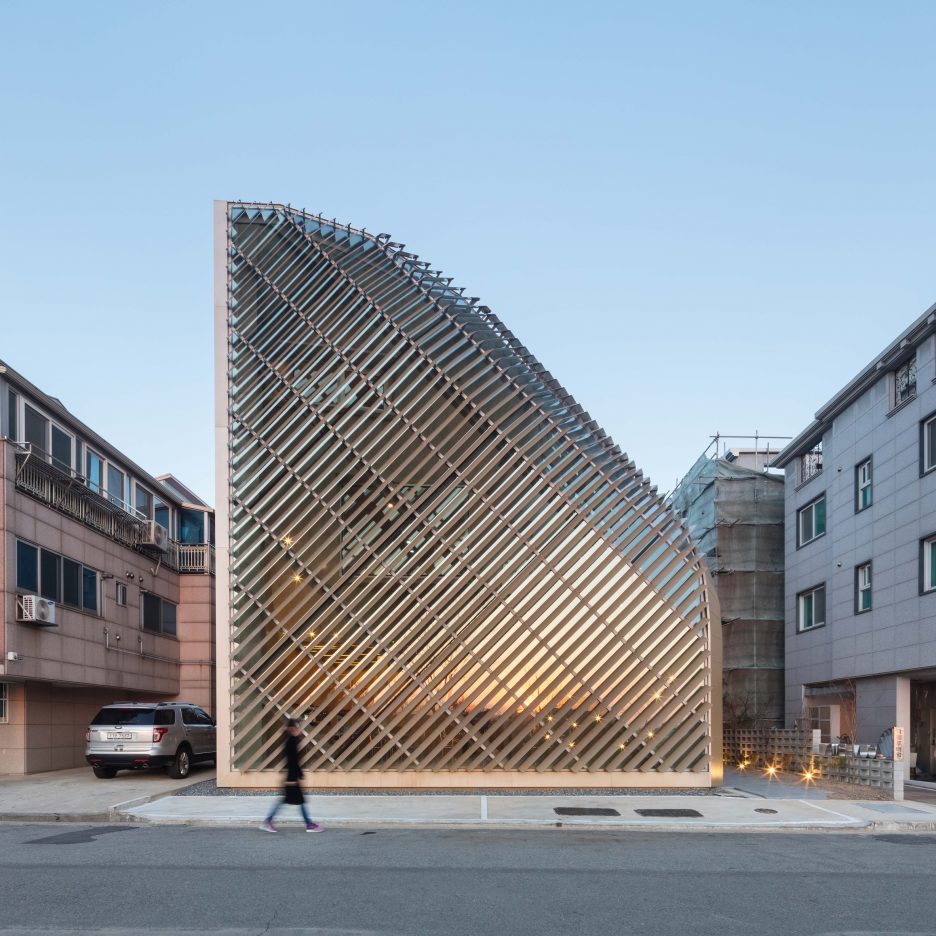
Slanted slats of aluminium cover the irregular, curving form of this house and cafe in Gyeonggi Province designed by South Korean architecture practice AND (+ slideshow). (more…)

Altaïr house is a private home located in Quebec, Canada. Completed in 2016, it was designed by Bourgeois/Lechasseur architects. Altaïr house by Bourgeois/Lechasseur architects: “This house, whose name refers to the brightest star in the Aquila constellation, is located in Cap-à-l’Aigle, in the region of Charlevoix. Altaïr means “The Flying Eagle.” What makes the house stand out is its “V” shape and long facades that are suspended over nature. While..
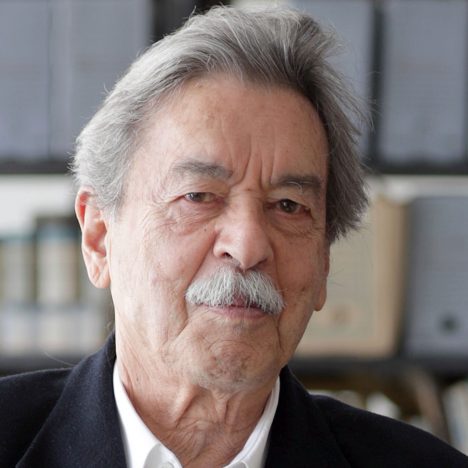
Breaking news: Brazilian architect Paulo Mendes da Rocha has been named as the 2017 recipient of the Royal Gold Medal for architecture, after winning both the Praemium Imperiale prize and the Venice Architecture Biennale Golden Lion this year. (more…)

Design firm Benoy has just revealed its design for “Gala Avenue Westside,” a future mixed-use structure set within the iconic Lujiazui HARBOUR City development of Shanghai. Benoy (who recently created a green architectural design for Taiwan’s High-Speed Rail’s Hsin Chu Station Mall) have been appointed as the Masterplanner, Architect and Interior Designer of the Gala Avenue, set for completion in 2018.
HARBOUR City’s progressive redevelopment comprises 250,000 square meters of riverside land that was formerly an industrial shipyard region. As an integral component of the overall scheme, Gala Avenue Westside will serve as a commercial and entertainment space inspired by both “historical elements and modern materials.”
We have embraced the history of the site and built upon this as we conceived our design which celebrates the themes of ‘New and Old’, ‘East and West’ and ‘Traditional and Modern’, said Qin Pang, Director and Head of Benoy’s Shanghai Studio.
Allowing scenic views of the Huangpu River and Pudong cityscape, the Gala’s plan encompasses a 100-meter office tower and 12 interlocked retail hubs linked by a chain of squares (above and below ground). In maintaining modern materials, the interior design components maintain a minimalist aesthetic and palette, motivated by the traditional Shikumen style.
Alongside Mango West Bund Plaza and Vanke Xuhui Center, Gala Avenue Westside will be one of many projects Benoy has completed in Shanghai.
News via: Benoy
 Sig Nordal