After working for OMA, BIG, FR-EE and REX, architect-turned-artist Se Yoon Park has dedicated the last three years to Light, Darkness, and the Tree, a sculpture series employing digital fabrication techniques to express an allegory for life. With assistants, Vladislav Markov, Kelly Koh, David Temann Lu, Ramon Rivera, Kara Moats, and Insil Jang, Park uses dynamic light and shadow to capture movement on surfaces that contort, split and disappear into each other.
In Light and Darkness, Park capitalizes on a variety of material qualities: wood, steel, and polyurethane resin provide structure, while ceramic and 3D printed Polyamide capture and diffuse light. Tree of Life is composed of multiple cast and hand-dyed units of Light and Darkness, delicately aggregated in a bond-free cantilever system. This balance is emblematic; for Park, the duality of the light and shadow in the sculpture recall the duality of life, while the tree, continuously and cyclically consuming and producing, captures divinity in nature.
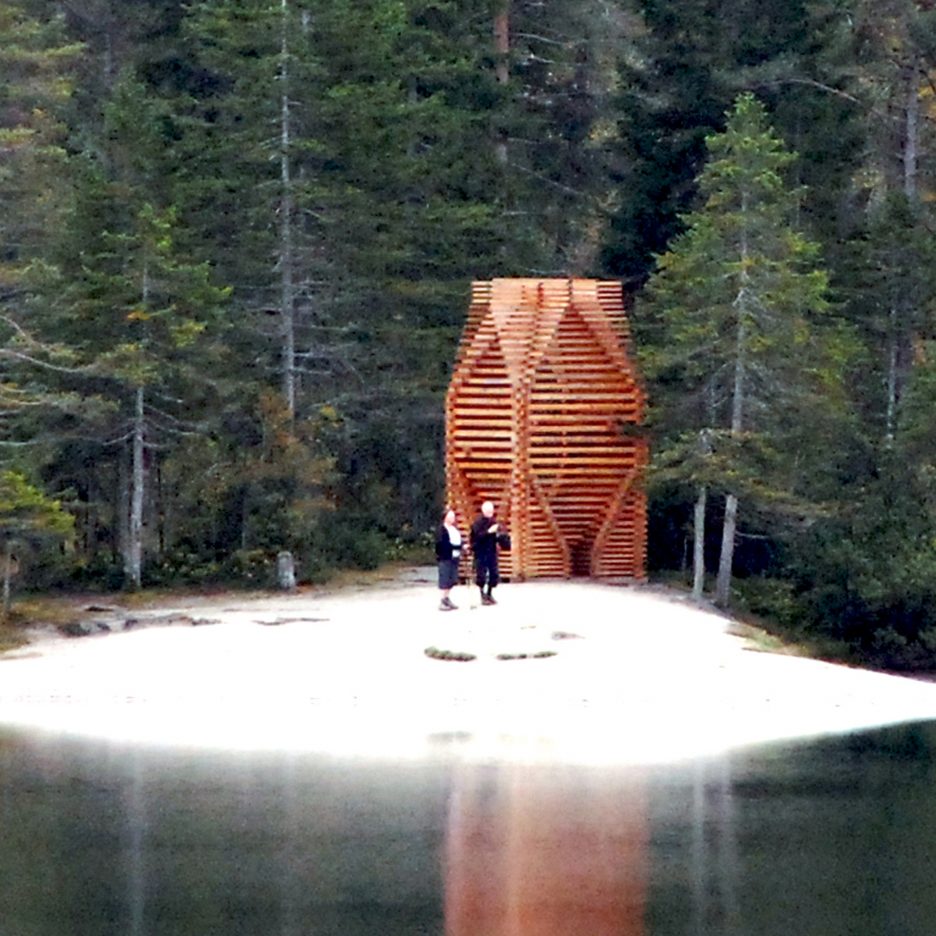
This tiny slatted timber pavilion is intended as a space for contemplation, and was designed by Milanese architect Giovanni Wegher to tour Italy’s largest national park (+ slideshow). (more…)
Opening to much fanfare earlier this week, Zaha Hadid Architects’ Port House holds a commanding presence over the port of Antwerp. The design combines a listed and formerly derelict fire station, which was restored as part of the project, with an eye-catching glass extension which rises out of the older building’s courtyard and thrusts itself towards the water in a dramatic cantilever. In the context of the port, where large infrastructure and colossal machines form the backdrop to everyday functions, the building boldly stakes its claim as the operational centerpiece, providing a space for the Port of Antwerp’s 500 employees. Photographer Thomas Mayer visited the building, capturing its striking external presence and investigating how its structural gymnastics translate to the building’s internal space.
Globe by Michigan Station, Detroit. Image Courtesy of The Container Globe
All the world’s a stage – quite literally so, in the case of the Container Globe, a proposal to reconstruct a version of Shakespeare’s famous Globe Theatre with shipping containers. Staying true to the design of the original Globe Theatre in London, the Container Globe sees repurposed containers come together in a familiar form, but in steel rather than wood. Founder Angus Vail hopes this change in building component will give the Container Globe both a “punk rock” element and international mobility, making it as mobile as the shipping containers that make up its structure.
Globe by the Brooklyn Bridge, New York. Image Courtesy of The Container Globe
The project has been spearheaded by Vail, with Nicholas Leahy of Perkins Eastman acting as the project’s lead architect and Michael Ludvik as structural engineer. The two have previously worked together on the TKTS Booth in Times Square, and Leahy also has previous experience working on the London Globe in the 1980s. Additionally, the Container Globe team has enlisted the New York branch of Arup for the theater’s environmental performance studies.
The assembly of the Container Globe is kept logically simple, as seen in an animated video released by the team. The bulk of the theater is made up of the shipping containers forming the seating gallery, which are all modified in the same way and stacked into a tower of three such modules. Interestingly, while steel sheets are not usually the material of choice for performance spaces, the design team found that the containers’ corrugation, and its effect on acoustic reflection, actually lends itself well to housing live performances. The rest of the shipping containers are also cut through and added to, forming the backstage and balconies, with stairwells connecting the separate areas. The entire structure is then draped with a “tough industrial mesh,” providing shelter from wind and rain while also letting in daylight. The mesh will also help soften the sound of rain for those inside the theater.
Globe in Central Park, New York. Image Courtesy of The Container Globe
Though currently unbuilt, plans are underway for the first Container Globe to be constructed in Detroit, where it would be used for performances of not just the Shakespearean persuasion, but also for live music, dance, and in winter as a sculpture garden. After this, Vail hopes to reproduce the Globe in other places around the world, anywhere the team can gain access to the shipping containers required–“ie everywhere,” as Vail puts it. In particular, Vail is interested in mobilizing the Globe to communities lacking in cultural infrastructure in order to increase accessibility to the arts.
How the Globe fits together
The theatre is clearly a labour of love for Vail, who accredits the Sex Pistols and King Lear as equally formative influences in a TEDx Talk on the project. Having funded the project himself thus far, a Kickstarter will be launched in 2017 to help reach the project’s estimated cost of $6 million. It is an ambitious number to reach, in tune with the ambitious nature of the project itself.
Globe in Waitangi Park, Wellington NZ. Image Courtesy of The Container Globe
In the hopes of connecting people and performance, the Container Globe also connects several creative tropes–Kickstarter, shipping containers and pop-ups, making it easy to dismiss as another passing trend. With the air of an eccentric uncle invested deeply in a hobby, Vail’s own passion makes one want to believe in his vision, regardless of whether or not one actually does. However, with its solid design backing and support from the London Globe, the Detroit community and across social media, the path towards a place to “party like it’s 1599” is set to continue.
‘Perspectives’is an organic pavilion structure covered with Cedar Shingles, whichsits atop the beautiful Surrey Hills at Winterfold, and throws itself evocatively into the vista that has been opened up below.
Commission by Surrey Hills Arts and the Mittal Foundation, the project aimed to create places of quiet and restful contemplation along a beautiful scenic route on the Hills of Surrey, south of London.
Inspired by the words and messages etched by people in public places, on trees, benches and elsewhere, Giles Miller has collated poetry, messages, initials and messages of love and memory from local schools, residents and other contributors to the project. These messages have been etched onto the surface of the organic cedar shingles that cover the piece, and appear to throw themselves out towards the front of the sculpture as if voicing their sentiments to the world that opens up below.
At its core, the shingles overlap and the sculpture functions architecturally to protect and shield the user from the elements, but at its mouth the surface flattens and evocatively opens out in dissipation as the shingles appear to fly out towards the waiting valley.
In this video from CNN Style, London designers Edward Barber and Jay Osgerby discuss Forecast, a wind-powered installation they created in collaboration with V&A Museum for the first London Design Biennale. With the intent to help city residents find their way “at a time of turbulence,” the installation responds to the Biennale’s theme “Utopia by Design.”
As everyone knows, the British are obsessed with weather, Osgerby said. It’s completely intrinsic to our way of life, and that’s why I think we talk about it incessantly.
Courtesy of Barber & Osgerby
Forecast — inspired by traditional weather instruments — is composed of three elements: a weathervane measuring wind direction, an anemometer measuring wind speed, and a turbine to harness wind power. In celebration of the 500th anniversary of Thomas More’s Utopia, the Biennale’s theme encouraged Barber and Osgerby to reflect on Britain’s past and future, settling on the idea of wind. Showcased along with works from 37 other countries, the UK’s Forecast is partially meant to incite political reaction and challenge the status quo, stated the designers. Their piece’s elements move with the wind to continually show a different direction.
Courtesy of Barber & Osgerby
The Biennale runs from the 7th to 27th of September.
Recent years have seen a rapidly increasing interest in the architecture of the former Soviet Union. Thanks to the internet, enthusiasts of architectural history are now able to discover unknown buildings on a daily basis, and with the cultural and historical break caused by the collapse of the Soviet Union, each photograph of a neglected and decaying edifice can feel like an undiscovered gem. However, often it can be difficult to find more information about these buildings and to understand their place in the arc of architectural history.
That was the reason behind the creation of Socialist Modernism, a research platform started by BACU – Birou pentru Artă şi Cercetare Urbană (Bureau for Art and Urban Research) which “focuses on those modernist trends from Central and Eastern Europe which are insufficiently explored in the broader context of global architecture.” Soviet Modernism already consists of a website on which BACU has cataloged a number of remarkable and little-known buildings. However, now the team is raising funds on Indiegogo’s Generosity platform for the next step in their research project. With this money they hope to create an app on which users can add new sites and buildings to the database.
On their fundraising page, BACU describes the background to the project as follows:
The architecture of the Socialist period and more precisely the modernist tendencies of the period between 1955 and 1991, as a concept, is becoming more and more popular in specialists circles […] Modernism in architecture first arose in the capitalist societies of Western Europe, following a series of essential principles such as “form follows function,” the use of mass-produced materials, the adoption of industrial aesthetics, simplicity and formal clarity, and the elimination of unnecessary details. In the socialist countries of Eastern Europe, on the other hand, modernist trends manifested themselves as a result of their influence over professionals, an influence that was able to penetrate beyond the borders and the limits imposed by the Socialist ideology.
In Central and Eastern Europe there is a number of important architectural monuments that are representative of the post WWII identity of each county in which they are located, and express the aspirations of socialist era architects […] Most of these buildings are found today in an advanced state of decay. Through this initiative we would like to encourage stylistic and architectural discipline and we invite the involvement of local authorities and civil society, so that the architectural value of these buildings would be acknowledged and, along with the surviving social and cultural tissue, be taken into account in the context of urban planning.
Speaking about the app they hope to create, they explain:
All the important socialist modernist landmarks would be included in this platform, allowing them to be accessed by anyone interested in these vestiges. Your contribution would help us create the interactive map and an application that would be made available in app-stores to be downloaded to any mobile device.
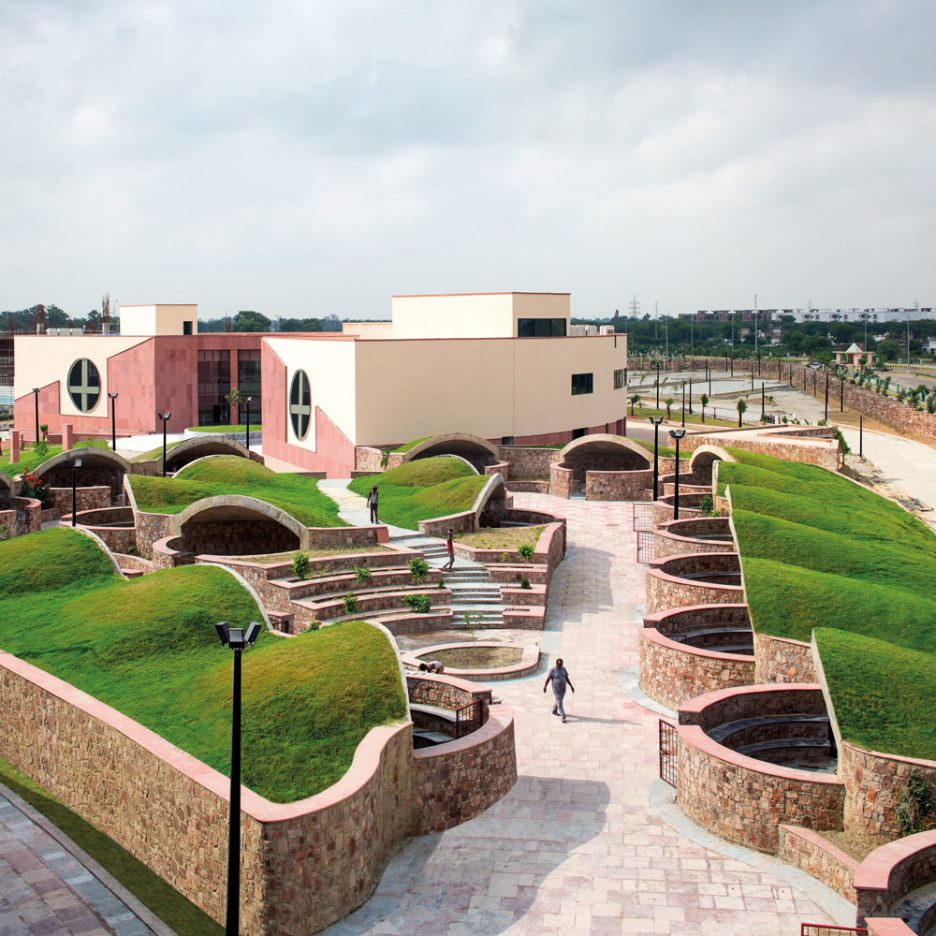
Architecture studio Archohm has completed a campus for promoting crafts in the Indian city of Lucknow, featuring a cluster of grass-roofed workshops and a spiralling shopping arcade (+ slideshow). (more…)
A Big LITTLE Nest is a residential project designed by Mickaël Martins Afonso & L’atelier miel in 2014. It is located in Bordeaux, France. A Big LITTLE Nest by L’atelier miel: “This small apartment on two levels is located in a stone building, in the heart of the historical centre of Bordeaux. The challenge of this rehabilitation was to design a small space in which all the functions of a..






 Sig Nordal