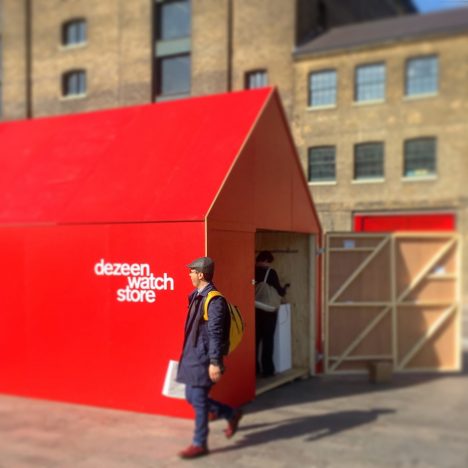
London Design Festival 2016: today is the last day of our temporary watch store at designjunction in London – and readers can save ten per cent on any watch by showing this article on their smartphone when they buy! (more…)
London Design Festival 2016: today is the last day of our temporary watch store at designjunction in London – and readers can save ten per cent on any watch by showing this article on their smartphone when they buy! (more…)

La Cité des arts is an artistic island located in the heart of an evolving area, to the East of the town of Saint-Denis, in Reunion Island. New lighthouse in town, it has been designed as a multidisciplinary village, with a concert hall of 350 seats (expandable to 600 via retractable seats), workshops for artists, studios for dance and theatre, studios for resident artists, an administration building, a bar, a restaurant and a cultural shop.
Under this monolith carved by the winds, small streets and courtyards punctuate the City, where the implementation of confined strips creates shady alleyways and private patios, which are refreshed by plantations, thus offering to the general public, as well as artists, places of relaxation, artistic encounters and workshops.
A landmark at the entrance of the town
La cite des arts has a strong challenge; that of being a landmark at the entrance of the town, in a large ensemble dedicated to culture, recreation and sports in Saint-Denis on Reunion Island.
A city that reconnects the town to the coast
Restrained by a major road, which separated it from the town and from the ocean, the site has been subjected to an architectural work of urban reconnection. The project of La cite des arts, with its new links with the coastal path and surrounding neighborhoods, reconnects the town to the ocean, by creating a meeting point, an artistic confluence.
Footsteps of history
Although the program entailed some novelty, there was no point in erasing the history of this emblematic place, a former industrial site converted into a cultural and artistic place, and which recently hosted workshops for artists and a theater, the Palaxa. This one is preserved and renovated, like former industrial walls that make the link with the past, symbolizing the freedom of creation.
A mineral architecture
The project presents itself as a mineral project, as a monolith carved by the wind, the rain and the sun, like the ravines of Reunion Island. Its raw lines and angular concrete works interchange with the smooth and rough materials similar to rock strata found on the cliffs of the island.
A signal architecture
From this monolith emerges the volume of the auditorium (the Fanal), dressed in a double polycarbonate skin, illuminated at night. This volume is a real lighthouse, which has become an urban signal and the symbol of the city’s radiancy.
A set of double skin
The North and South facades form an envelope which protects the heart of the island: one in concrete, the other one made of glass. They allow interior facades to open up outdoor areas, offering all possibilities for contribution natural light and cross ventilation. These monolithic façades consist of a double skin that plays with bare interior façade either move away and create patios bringing freshness and green places, either to arrange for real visual openings to the coast or the city.

Spacious Compact Bungalow is a private home located in Kuala Lumpur, Malaysia. It was designed by INTERLINK DESIGN SOLUTIONS. Spacious Compact Bungalow by INTERLINK DESIGN SOLUTIONS: “This bungalow located at Kuala Lumpur, Malaysia. he designed and built this 7,000 square feet residence from ground up. Built on a comparatively small plot of land-about 5,200 square feet, James maximized space by designing a rather squarish structure with usable space spread across..

Apartmen Z is a private home located in Bucharest, Romania. Completed in 2016, it was designed by KiwiStudio. Apartment Z by KiwiStudio: “Apartment Z. is a residential project designed by KiwiStudio in 2016. The apartment is located in Bucharest, Romania, and consists of 3 bedrooms, a large living room with a dining, a small kitchen and two bathrooms. Our main goal was to provide a space that was comfortable, cosy..

From the architect. The Rosenberg Ricky & Golan home in Kibbutz Yehiam was designed in natural woodlands in a young residential neighborhood which is being built on the outskirts of town. The House was built on a sloping topography across the field..
The formal concept of the plan was the creation of two boxes located opposite to each other. One box is placed on the ground and the other raised in the air on a thin steel columns on one part and on the other part on a stone foundation. The floor of the ground floor is in unified level and the house is partly dugged into the mountain. The space created between the ground and the floating white box, is glazed and used in public areas of the house- kitchen, living room and dining area.
The volume built on the ground, covered with stone similar in color to the local stone. In this area are designed the children’s bedrooms, safe room, and various service rooms. The dining area was located in a place that connect the small patio and the main space which includes the living room and kitchen. The outside area in the east side of the house, continues the public space that includes an outdoor kitchen, terraced seating area and a dining table. constant eye contact between inside and outside is maintained thanks to the use of wide glazing systems and installing hidden shading systems. The separation between the volumes and the insertion of natural light deep into the house, emphasizes the distinction between private and public and allow insertion of light deep into the house, which is wide in proportion.
Doubled and framed space escort the visitor which going up the steel stairs to the second floor while above glanced a piece of sky from the length Skylight window. The second floor overlooking the view and includes a wide master bedroom with an open porch, similar in size to the master bedroom , and above the porch a defined and enclosed pergola in roof prism. The terrace protected and allows privacy to the residents from their neighbours, while opening a framed and directed look to the far view of “Ein Yaakov”. At the back of the master bedroom glazed shower with unrestricted bath tab installed on the background of exposed concrete boards . On this floor also a sewing studio of the owner , that works in fashion design.
Inside the house, length , width and opened views are created from the front door to the landscape, in the opposite direction from the patio, which is located in the covered in stone volume toward the outdoor kitchen.
The design allows constant invasion of the greenery and the view to the inside of the house, while maintaining privacy to the tenants from the neighbours in the neighbourhood.
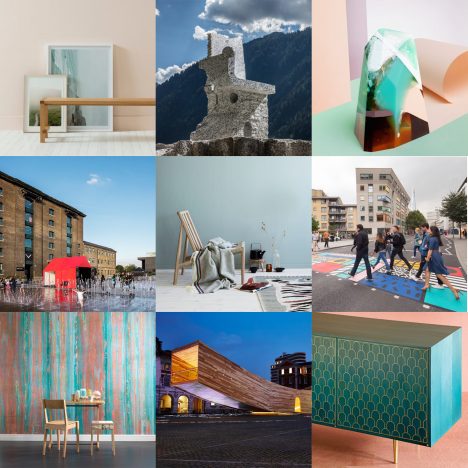
From Benjamin Hubert’s V&A installation featuring rippling steel to an exhibition full of crystal-shaped resin sculpted by scent, we’ve pinned all the highlights from this year’s London Design Festival to a new Pinterest board.
Follow Dezeen on Pinterest | See more from London Design Festival 2016 in our archives

The project is located in the financial center. The designer intends to create a natural, warm, relaxed and uncindtrained office space among the concrete and glass-curtainwall building. The original space floor height is 5.4 meters, so the designer decides to implant a wooden cabin to divide the original space into two floors: the upperfloor would be mini office area and the art sharing area, the lower floor would be open office area. the designer work on the function complexity,the layout fluxility and the ductility of the space.
The layout try to present more complexities of the space. The first floor is mostly office area and a small kitchen. The large meeting room is close to the small kitchen, so the meeting area can be quickly turned into a small dinning area, increasing the activity of the studio. The reading area is near the discussion area, providing convenient information access,also an area to relax and communicate. Stairs combining the reception area can enrich the entrance space and express the link between space and circulation.
The spatial relation is the focus of the design,the 2nd floor has 2 patios on it, to improve the space perception of 1st floor. The large patio is covered with wooden roof. By the multiple linear beams, supplemented with lighting, the main space get a certain sense of ceremony. The corresponding position under the roof can be use as an exhibition space. there’s aback-step processing to expand the space of the 2nd floor, form a “stepped-roof” to sit and to place objects,give the space the functions of salon, games, and movie watching. Above the reading area is the small “patio”,connecting to the large “patio” by a skywalk which providing special angles to watch the roof truss and the office area. Also the people on the skywalk become a scenery for the people below, enhancing interactivity of those spaces.
A precast concrete staircase connects the two floors formed by Z-shaped units fastening with each other. It is a good structure solution and contribute tube spaces can place decorations.
The natual colors of materials applys including wood, concrete and white painting. To break the oppression Finger-jointed wood board is appled. concrete is used on the ground and stairs, so 2 floors can have a relation in common material.The white painting is used to make the room brighter. Such processing in coordinating with wooden furniture, make wood-colored “stepped roof” more natural.

Take a walk through the Hub Performance and Exhibition Center, designed by Neri&Hu Design and Research Office, in the dynamic Hongqiao District of Shanghai, China. The video, produced with Pedro Pegenaute, showcases the Center’s nature-inspired interior, featuring dramatic lighting and views framed by walnut- and oak-covered aluminum branches recalling forest canopies.
The interior concept draws inspiration from landscape, said architects Lyndon Neri and Rossana Hu, creating a retreat from the heavily built context and visual overload of contemporary culture.
The Performance and Exhibition Center is the centerpiece of the Hub, a mixed-use commercial development planned to span 250,000 square meters. Directly connected to the Hongqiao Transportation Hub, the Center is the new epicenter of art and culture of Shanghai’s expansion.
News via: Neri&Hu Design and Research Office
The Hub Performance and Exhibition Center / Neri & Hu Design and Research Office
//cdn.embedly.com/widgets/platform.js
 Sig Nordal