4th Lisbon Architecture Triennale: “Choreographies” by Pedro Alonso and Hugo Palmarola


Courtesy of Pedro Alonso & Hugo Palmarola

Courtesy of Pedro Alonso & Hugo Palmarola

Choreographies, an installation at the 4th Lisbon Architecture Triennale by Pedro Alonso and Hugo Palmarola, presents the construction of building sites as cultural and political archetypes. By critically contesting comic films and animated cartoons released in the United States and the Soviet Union between 1921 and 1980, it presents construction sites as places in which ideology and imagination were combined through the choreographic movements of hanging steel-beams in the US, and flying concrete-panels in the USSR. These building components symbolize the construction of the modern world, the technological optimism of industrialization, the relevance of the building process over the completed building, and the standing of workers—welders, riveters and crane operators—against the vanishing figure of the architect.

These Choreographies are presented by a simultaneous projection of two looping films, screening selected fragments from movies and animated cartoons in order to stress both the symmetries and differences between the USA and the USSR in, for example, opposing beams to panels, riveters to welders, and skyscrapers to housing blocks. This selection highlights the mise-en-scène of buildings sites in film, including visual gags on Taylorism, parodying the industrial production of steel beams and concrete panels.

In America, Harold Lloyd’s silent comedy Never Weaken (1921) was the first comic film presenting a steel beam that casually comes through the window of a building. As it does, Lloyd performs all sorts of acrobatic movements in the context of the skyscraper construction boom and the economic prosperity of the 1920s. This film later became a fundamental reference to the work of various animation studios including Looney Tunes, Walt Disney and Fleischer, each having their own well-known characters to conduct feats similar to Lloyd’s. This is the case of Bosko, Mickey Mouse, Popeye, Olive Oyl, Porky, Mr. Magoo, Bugs Bunny, Tom and Jerry, Daffy Duck, and Droopy, in short animations such as Hold Anything (1930), Building a Building (1933), A Dream Walking (1934), Bridge Ahoy (1936), Porky’s Building (1937), The Riveter (1940), Rhapsody in Rivets (1941), Nix on Hypnotricks (1941), Construction Mayhem (1949), Homeless Hare (1950), Child Sockology (1953), Tot Watchers (1958), Cat Feud (1958), Pent House Mouse (1960), Base on Bawls (1960), Bad Day at Cat Rock (1965), Skyscraper Caper (1968), Droopy’s Restless Night (1980), and Droopy’s Good Luck Charm (1980).


Courtesy of Pedro Alonso & Hugo Palmarola

Courtesy of Pedro Alonso & Hugo Palmarola

In the Soviet Union, it was Cheryomushki (1963)—a film based on an operetta by Dimitri Shostakovich—which praised the newly established policy towards the use of large-concrete panel construction, a building technology promoted in the 1950s by Nikita Khrushchev. This movie had a climax in the frenetic dance of a couple on top of a panel while being transported through the air. Cheryomushki and the later comedies Operation Y and Shurik’s Other Adventures (Operatsiya Y i drugie priklyucheniya Shurika, 1965), were followed by many other short animations that took the theme of the flying panel, such as The Story of a Crime (Istoriya odnogo prestupleniya) (1962), How the House Was Built to the Kitten (Kak kotenku postroili dom) (1963), Granny’s Umbrella (Babushkin zontik) (1969), At the Port (V portu) (1975), the opening animated cartoon of The Irony of Fate, or Enjoy Your Bath! (Ironiya sudby, ili S lyogkim parom!) (1975), and I’ll get you! (Nú,! pogoduí!) (1976).


How the House Was Built to the Kitten (Kak kotenku postroili dom), URSS, 1963, producida por Soyuzmultfilm y dirigida por Roman Kachanov.. Image Courtesy of Pedro Alonso y Hugo Palmarola

How the House Was Built to the Kitten (Kak kotenku postroili dom), URSS, 1963, producida por Soyuzmultfilm y dirigida por Roman Kachanov.. Image Courtesy of Pedro Alonso y Hugo Palmarola

 In these animations, steel-beams and reinforced-concrete panels are denoted as weightless elements that reach the sky thanks to technology, construction and architecture. In the United States these cartoons gave value to skyscrapers and their role in the development of capitalism. In Soviet Russia these films took the choreographic movements of panels carried by cranes, symbolizing egalitarianism and a raw aesthetic that took up some principles of constructivism, intended to replace the Socialist Realism of Joseph Stalin. In both, beams and panels were key elements of the plot of the films, reflecting the two most representative structural paradigms of the twentieth century. Because its primary function was to amuse, the films were successful in presenting in a simple way construction sites as belonging to the daily life of cities, but without the burdens assigned to them by the histories and theories of modern architecture and urbanism.


A Dream Walking, EE.UU., 1934, producida por Fleischer Studios y dirigida por Dave Fleischer.. Image Courtesy of Pedro Alonso y Hugo Palmarola

A Dream Walking, EE.UU., 1934, producida por Fleischer Studios y dirigida por Dave Fleischer.. Image Courtesy of Pedro Alonso y Hugo Palmarola

At the Port (V portu), URSS, 1975, producida por Soyuzmultfilm y dirigida por Inessa Kovalevskaya.. Image Courtesy of Pedro Alonso y Hugo Palmarola

At the Port (V portu), URSS, 1975, producida por Soyuzmultfilm y dirigida por Inessa Kovalevskaya.. Image Courtesy of Pedro Alonso y Hugo Palmarola

In both the United States and the Soviet Union beams and panels never stop moving. Such endless motion is not accidental but central to the comic plot, as well as the jokes that are all too similar. The only substantial change is the preferred building component chosen by capitalist America and communist Russia: fearless acrobatics high up in the structures, jumping or dancing from beam to beam and from panel to panel, characters chasing each other, somnambulism, unconscious walks, or sudden vertigo that may be taken as tokens of utter the confidence on the technologies and their sustaining ideologies, subtlety admitting they are at the same time teasing danger. As long as they were addressing general public and children, the building sites of dancing beams and panels were battlefields in the construction of a certain consciousness displaced towards politics, ideology and education. Beams and panels were not only sustaining structural loads, but also a whole range of cultural weights.


Cheryomushki, URSS, 1963, producida por Lenfilm Studio y dirigida por Gerbert Rappaport. Image Courtesy of Pedro Alonso y Hugo Palmarola

Cheryomushki, URSS, 1963, producida por Lenfilm Studio y dirigida por Gerbert Rappaport. Image Courtesy of Pedro Alonso y Hugo Palmarola

Never Weaken, EE.UU., 1921, protagonizada por Harold Lloyd y dirigida por Fred Newmeyer.. Image Courtesy of Pedro Alonso y Hugo Palmarola

Never Weaken, EE.UU., 1921, protagonizada por Harold Lloyd y dirigida por Fred Newmeyer.. Image Courtesy of Pedro Alonso y Hugo Palmarola

Outside cinema, however, one of the most famous images on a steel-beam is Lunch atop a Skyscraper (1932), in which eleven workers are having lunch on a large metal beam on the 69th floor, during construction of the RCA Building in Rockefeller Centre in New York. The image, although staged, reflects the job insecurity caused by the Great Depression when risky tasks were accepted without proper safety standards. Coincidentally, within the same decade, and in contrast to that image, animated cartoons started to portray an opposite imagery. In A Dream Walking (1934) Olive Oyl sleepwalks on the moving beams of a building site. Wearing only a nightshirt that was transparent to the moonlight, she puts her bare feet on beams as they appeared on her way, making a remarkable choreography. Virtually every of the American cartoons of this series seem to insist that the beam is a safe way to walk in, even if their starring characters are, for different reasons, absolutely unconscious. These characters, in Giorgio Agamben’s words, are the ones “who can walk on thin air as long as they don’t notice it; once they realize, once they experience this, they are bound to fall” [in: Infancy and History: The Destruction of Experience]. Quite like the irrational walking choreography of Olive Oyl, we shall never fall because that was the time of total confidence in the structural paradigms of beams and panels, elements forming solid imaginary structures that created reliable ways for Americans and Soviets to face the dangers of industrialization and progress, even in state of unconsciousness.

Pedro Ignacio Alonso and Hugo Palmarola, Choreographies. Simultaneous animated loops, 2:56 min. Compiled, edited and produced by Paulina Bitran. Credits: Pedro Ignacio Alonso and Hugo Palmarola, 2016. Music: Akai 47 by Nortec Collective presents: Bostich & Fussible (Courtesy of Nacional Records and Canciones Nacionales). Work sponsored by DIRAC of the Ministry of Foreign Affairs of Chile, and the Dirección de Artes y Cultura, Vicerrectoría de Investigación de la Pontificia Universidad Católica de Chile.

http://ift.tt/2cTPoxt

ZROBYM Architects Draw From Scandinavian Inspiration to Design This Two-Story Residence

Monocle 24 Reports From the 2016 Oslo Architecture Triennale, After Belonging


After Belonging – 2016 Oslo Architecture Triennale. Image © David Jiménez Iniesta, Ma Ángeles Peñalver Izaguirre, Javier Jiménez Iniesta (Studio Animal)

After Belonging – 2016 Oslo Architecture Triennale. Image © David Jiménez Iniesta, Ma Ángeles Peñalver Izaguirre, Javier Jiménez Iniesta (Studio Animal)

In the latest edition of Section DMonocle 24’s weekly review of design, architecture and craft, Henry Rees-Sheridan visits Oslo to speak to Hanna Dencik Petersson, Director of the 2016 Oslo Architecture Triennale, and Alejandra Navarrete Llopis and Ignacio González Galán – two members of its curatorial team, the After Belonging Agency. The show explores the concept behind the exhibitions of the Triennale, what it means to be located in Norway’s capital, and how the event’s trajectory is both a symptom and cause of Oslo’s development as a design city. ArchDaily’s James Taylor-Foster weighs in on After Belonging’s significance.

http://ift.tt/2co1qDo

After Belonging is the sixth incarnation of the Triennale and the first one in which a single curatorial thread has woven all of the festival’s activities together, including the international conference. The goal of the two primary exhibitions—On Residence and In Residence, including a series of Intervention Strategies—is to develop platforms with the aim of “rehearsing research strategies,” providing new ways for architects to engage with “contemporary changing realities.”


"In Residence" Exhibition (National Museum – Architecture, Oslo). Image Courtesy of Oslo Architecture Triennale

"In Residence" Exhibition (National Museum – Architecture, Oslo). Image Courtesy of Oslo Architecture Triennale

"On Residence" Exhibition (DogA, Oslo). Image Courtesy of Oslo Architecture Triennale

"On Residence" Exhibition (DogA, Oslo). Image Courtesy of Oslo Architecture Triennale

Atelier Bow-Wow, OMA, and Amale Andraos Live From the 2016 Oslo Architecture Triennale
//cdn.embedly.com/widgets/platform.js

http://ift.tt/2co0oaE

Peris + Toral Arquitectes uses scaffolding to create temporary pavilion in Barcelona


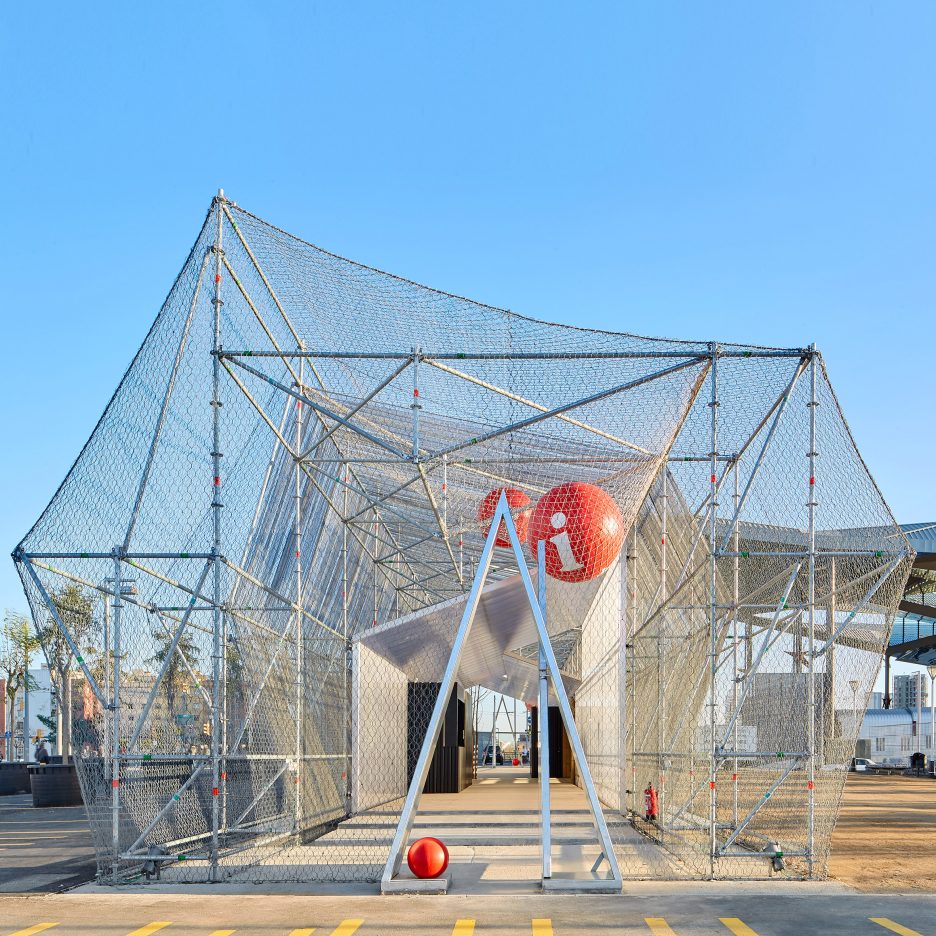
Layers of polycarbonate, netting and metal mesh wrap the scaffolding structure of this temporary visitor centre, designed by Peris + Toral Arquitectes for a public square in Barcelona (+ slideshow). (more…)

http://ift.tt/2d7yPPx

Syros House / Katerina Tsigarida Architects


© Yiorgis Yerolympos

© Yiorgis Yerolympos


© Yiorgis Yerolympos


© Yiorgis Yerolympos


© Yiorgis Yerolympos


© Yiorgis Yerolympos

  • Structural Engineer: Dimitris Michalovits
  • Building Contractor: Andreas Politis

© Yiorgis Yerolympos

© Yiorgis Yerolympos

The residence is situated in Delphini, a location along a small gulf at the North-West part of the Cycladic island of Syros in the Aegean Sea. The gulf surrounds a small uninhabited island. As the site extends towards the gulf, the small island becomes its focal point, its point of reference. 


Site Plan

Site Plan

The property belongs to a Greek five member family which is based in London and has links to the textile and shipping industries of the island.


© Yiorgis Yerolympos

© Yiorgis Yerolympos

The residence consists of five independent wedge-shaped volumes divided in two complexes of two larger and three smaller buildings and a later addition of one rectangular volume, the owner’s studio.


© Yiorgis Yerolympos

© Yiorgis Yerolympos

Each complex’s functions and large openings are organized around a courtyard and altogether oriented towards the sea. The axes of the intervening courtyards point to the small island. For the external sides of the complexes small, random openings provide privacy.  


Plan

Plan

The two volume group, the first one to be built, is designed as an autonomous residence, containing spaces for all the main activities of the family. 


© Yiorgis Yerolympos

© Yiorgis Yerolympos

The construction is based on traditional methods. 

Local stone is used throughout the volumes in order to enhance the sense of solidity such as the sense that the buildings emerge from the earth. 


© Yiorgis Yerolympos

© Yiorgis Yerolympos

Natural materials are used, such as timber ceiling beams, local soil mixed with cement for the external floors, untreated internal plastering made of lime and local sand, etc


© Yiorgis Yerolympos

© Yiorgis Yerolympos

The construction methods, the choice of natural materials, the gradation of closed, open and semi open spaces in combination with the building’s orientation provide natural ventilation and lighting, shadow and protection from the strong wind, enabling the house to operate in balance with the nature throughout the year.


Section

Section

Syros House could be seen as a descendant of  Mitato,Kalivi and Themonia, the basic monolithic stone shapes that were always been on the island, and as the ideal of  Primitive Hut , man’s longing to go back to the essential  and the continuity through landscape and memory.


© Yiorgis Yerolympos

© Yiorgis Yerolympos

http://ift.tt/2d3A8mI

Trumpf Poland Technology Center / Barkow Leibinger


© David Franck

© David Franck


© David Franck


© David Franck


© David Franck


© David Franck

  • Architects: Barkow Leibinger
  • Location: Warsaw, Poland
  • Architects In Charge: Frank Barkow, Regine Leibinger
  • Area: 3200.0 sqm
  • Project Year: 2016
  • Photographs: David Franck
  • Design Team: Heiko Krech (Project Architect), Christian Coburger, Gustav Düsing, Antje Steckhan, Annette Wagner
  • Client: Trumpf Polska (Warsaw, Poland)
  • Contact Architect: Artchitecture, Mark Kubaczka (Warsaw, Poland)
  • Management: Portico (Warsaw, Poland)
  • Structural Engineer: Abatos (Warsaw, Poland)
  • Mechanical Engineering, Energy Performance, Hvac, Electrical Engineering: Büro Happold (Warsaw, Poland)
  • Façade Engineering: Knippers Helbig (Berlin, Germany)
  • Lighting Design: Studio Dinnebier (Berlin, Germany)

© David Franck

© David Franck

From the architect. Trumpf Poland’s new headquarters in Warsaw, housing offices and exhibition areas, represent a prototype for an economically constructed industrial building combining a simple form with complex surfaces and differentiated interior spaces.


© David Franck

© David Franck

As if wanting to tell a story about the inner workings of the building, gleaming stainless steel fins cover the façades of the new Trumpf Poland Technology Center in a soft gradient. Produced from high-grade sheet steel, the fins are laser-cut and folded to widen and narrow over their 10-meter length — a direct architectural application of the machine tool- and laser technology for which the company is known.


First Floor Plan

First Floor Plan

With this new two-story, almost 3,000 square meter building, the company gains office space for about 50 employees, as well as a distinctive showroom for the presentation of flatbed laser cutters, bending machines and punch presses.


© David Franck

© David Franck

Strategically located on an arterial road, with highway access and close to the airport, the building plugs into a suburban district filled with commercial and industrial enterprises, parking lots, and available land for development. It is positioned in the northern area of a 10,000 square meter lot bordered by roads to the north and south, and by further commercial lots to the east and west, enabling potential for further expansion.


Section

Section

The new building pulls from this heterogeneous context with a corresponding internal organization and a somewhat prototypical outward appearance: its box-like exterior is de ned by the strong stainless steel façades on the north and south sides of the building, facing the roads as if billboards, presenting an image that is notably powerful yet graphically elegant at the same time. On the interior, carved out of the upper floor is a 16 x 16 meter courtyard-like roof garden, an unexpectedly charming and intimate space for work breaks and for small customer events. A warm, dark grey granite floor and large potted Juneberry plants create atmosphere.


© David Franck

© David Franck

The building’s interior configuration is oriented circumferentially around the slightly o -centered courtyard garden on the upper floor, and an enclosed block with utility and storage rooms lying beneath it: towards the north and east stands a double-height, L-shaped showroom, while towards the south and west, the building is split into two levels housing o ces, conference rooms, and an employee cafeteria. At the intersection of these differentiated zones, the southeast corner of the building houses the foyer with the reception desk. Opposite, in the northwest corner, the open showroom is stepped down into a single-height space displaying an array of products and machining heads alongside examples of their application. Above this, reachable via an open staircase, a glass- enclosed gallery provides a spacious room for client meetings and receptions, allowing views into the showroom below, also connected to the upstairs o ces and courtyard. The showroom’s double height connects it visually with the courtyard garden and thus constantly receives light from two sides.


© David Franck

© David Franck

Both the interior and exterior of the building are characterized by an economic use of industrial materials. The courtyard roof garden is bordered towards the showroom with U-pro le translucent thermally insulated glass, and the load-bearing structure is left visible from within the building. In the o ce area, where the cores and emergency staircases can be found, the frame has been executed in solid reinforced concrete, while the double-height open area is constructed with a black-painted steel skeleton. Beyond creative and aesthetic concerns, another advantage of this design was the quick, twelve-month construction time it enabled.


© David Franck

© David Franck

Aluminum and stainless steel were used for the outside shell of the building. Trapezoid-pro le corrugated aluminum covers the two functional and understated side façades facing east and west: one side with cutouts for the glazed entry door and a large delivery gate, while on the opposite façade, two long bands of windows allow natural light into the training and o ce spaces. A system of polished stainless steel fins have been installed over the post-and-beam glass façades that front the showroom towards the main road as well as frame the building to the south, turning these views into a calling card of sorts for the company and its products.


Detail

Detail

The fins are made from laser-cut, square-edged stainless steel sheets, produced in varying widths and mounted to oat slightly o of the building on an intricate, at-pro le scissor construction, giving the appearance of gently opening and closing waves. Cut and applied in increasing widths, a soft progression from relatively open to almost closed louvers is created, responding to the demands of the interior uses of the building: on the north side, narrow slats grant ample views into and out of the showroom, while they widen towards the single-height display area, facilitating the dimmer light demanded by display screens. On the south side of the building, the louver system is predominantly closed, providing the o ces situated alongside it steady protection from the sun. After darkness falls, the illuminated interiors appear from the outside as a shimmering screen.


© David Franck

© David Franck

The surrounding grounds are landscaped with a loose arrangement of birches and delphiniums, their natural structure contrasting with the strict geometry of the gleaming metallic building.

http://ift.tt/2d14gMB

A Private Residence in Hanoi by iHouse

The CK House by iHouse (3)

The CK House is a private residence renovated by iHouse. It is located in Hanoi city, Vietnam and was completed in 2015. The CK House by iHouse: “I met the home owner on a rainy afternoon. He introduced me to his house, which, though a bit old but was spacious, had three floors, a front yard and a backyard and was fully functional for the whole family of three generations..

More…

The Shit Museum brings various poo-related designs to London


London Design Festival 2016: a “liberating” adult nappy, poo tableware and an event space furnished with manure are among the offerings at one London Design Festival exhibition (+ slideshow). (more…)

http://ift.tt/2dfGw6Q

K22 House / Junsekino Architect and Design


© Spaceshift Studio

© Spaceshift Studio
  • Interior Architect: Kultawatch Ananrattanasuk
  • Structural Engineer: Nares Kamplaew
  • Builder: Vorachart Wisethpalitpol, Witthaya Termjitcharoen
  • Cost Of The Construction: 5,000,000 THB

© Spaceshift Studio

© Spaceshift Studio

From the architect. K22 is a house of 3 siblings, each of them begins to be grown-up subsequently but they all have the same intention to live together with their parents and taking care of each other like they did previously. The house is located in the inner zone of Bangkok “Huay Kwang”, they all decided to live together in the familiar district better than settling down separately which would result in more costs for land and construction. The main concept of the house is to design sharing spaces for all family members while providing privacy for each one of them. It could be compared as a family’s apartment where each of them has their own living unit, and the common space that perfectly fits the needs and activities of people from two different generations. Consequently, the house promotes all members to spend their time and share their moments together as one big family.


© Spaceshift Studio

© Spaceshift Studio

First Floor Plan

First Floor Plan

© Spaceshift Studio

© Spaceshift Studio

Since the site is in rhombus shape, the house is only accessible from the front, leaving the other sides to be suitable for being a private garden. The entrance is linked to the main corridor which is surrounded by common functions; kitchen, working space and living room. Besides, there is another living area facing the private garden, where all members could spend their relaxation time together. The corridor is also connected to the service area, which is located next to the parking space.


© Spaceshift Studio

© Spaceshift Studio

Each family member can access to their own unit on the second level through the staircase locating in the middle of the common corridor. The house is divided into two sides, one with single-volume and another with double-volume. The single-volume side contains rooms for their parents and one of the siblings. The double-volume side has two units for the other two siblings and their upcoming new family members. With the distinctiveness of double-volume space, it consequently appear to have imprecise number of the storeys.


© Spaceshift Studio

© Spaceshift Studio

Second Floor Plan

Second Floor Plan

© Spaceshift Studio

© Spaceshift Studio

In each double-volume unit, the programming of the main floor and the mezzanine are flexible and adaptable; allowing the family to create their own preferable space. The structure and layout of the house also offer opportunities to further adjust or extend the units in the future to support the change in lifestyle and the growth of family.


© Spaceshift Studio

© Spaceshift Studio

http://ift.tt/2d3d3kb

Courtyard House / Dotze Innovations Studio


© Tze-Chun Wei

© Tze-Chun Wei


© Tze-Chun Wei


© Tze-Chun Wei


© Tze-Chun Wei


© Tze-Chun Wei

  • Architects: Dotze Innovations Studio
  • Location: Taiwan
  • Architect In Charge: Tze-Chun Wei
  • Design Team: Zhi-Rui Haung, Chi-Fung Yeh, Zhe-Xun Yang, Chun-Li Wang
  • Area: 1132.0 sqm
  • Project Year: 2014
  • Photographs: Tze-Chun Wei
  • Collaborators: ARJR Architects, iTemdesign, Ospace Architects
  • Contractor: Tze-Chun Wei, ARJR Architects
  • Structural Engineer: Wu-Long Huang
  • Interior Design: Tze-Chun Wei
  • Lighting Design: Vivie Lin
  • Construction Consultants: Zhi-Rui Haung, Yu-Cheng Tang

© Tze-Chun Wei

© Tze-Chun Wei

This is an ambitious project for a 3-generation family in Changhua, Taiwan. The site is located on the roof of an existing one-story factory building.


© Tze-Chun Wei

© Tze-Chun Wei

The initial idea was to create a contemporary Chinese courtyard house with a “回” shaped volume, a layout with individual living units and shared family spaces. They are connected by a looped corridor and separated by small light wells.


Diagram

Diagram

“Sky-Voids” are distributed in the corners of the building to provide natural lighting and ventilation and are designed as individual small courtyards. 


© Tze-Chun Wei

© Tze-Chun Wei

Exploded Axo

Exploded Axo

© Tze-Chun Wei

© Tze-Chun Wei

“Inner-View” is the idea of creating private garden views for the occupants’ pleasure and blurs the visual boundary between inside and outside.    


© Tze-Chun Wei

© Tze-Chun Wei

Plan

Plan

© Tze-Chun Wei

© Tze-Chun Wei

Big glazing facing the central courtyard is designed and “Sky Voids” provide inner-views of the garden. This is a project trying to re-define a modern Chinese courtyard house and explore how space can be divided individually but stay closely connected


© Tze-Chun Wei

© Tze-Chun Wei

http://ift.tt/2cSvKBQ