Design: Miguel Ángel Maure Blesa (Spain), Carlotta Franco (Italy), Arian Lehner (Austria), Javier Guerra Gómez (Spain)
Project Team: Alexsei Snetkov (Russia), Andrea Aleksic (Serbia), Andreas Daniel (Cyprus), Anna Brosalova (Russia), Ariane Etienne (France), Daria Kleymenicheva (Russia), Elena Ischimji (Moldova), Georgi Stoyanov (Bulgaria), Gintarė Petkevičiūtė (Germany), Hannah Dalton (England), Jack Vickerman (England), Mark Cauchi (Malta), Marton Peto (Hungary), Michael Hammerschick, (Austria), Oana Dăscăloiu (Romania), Tijana Škrivanek (Croatia)
The Living Boom is a public space on a pier in the Curonian lagoon of Lithuania, acting as a new enhancement to the public life of the city of Nida. Behind a 5-meter-high wooden wall “hides” an outdoor living room fitted with adapted local furniture from the Soviet era. The entire space of The Living Boom is painted in red, generating a unique public space in the middle of the natural attractions of the Curonian region.
Nida is one of the most popular summer vacation destinations of Lithuania, resulting in high touristic density in summer. During these months Nida’s existing public spaces are filled with visitors around the commercial areas of the city. The Living Boom therefore provides a public space, far off the busy, hectic scenes of the city and focuses on the main attraction of this region, it’s vast nature of lagoon, sand dunes and forest.
A pier is a dead end. How can one change the ‘end of this long path’ and celebrate its end as a new space? Being already set into boundaries on three sides by the element of water, the start of the project was to construct a fourth wall that creates a new space. As one walks along the pier, approaching the wall in the middle of the plain landscapes of lagoon and sand dunes, one yet has to find out what the space behind the wall offers. Only after physically walking through, one can see and grasp the new space, with furniture shining in red, generating an unseen space in the middle of water, sky, sand dunes and forest.
Plan
Elevation
Being five meters tall, the wall is the most striking element of the new public space. Built as a timber construction, fixed into the concrete floor by metallic bolts and planked with long thin wooden elements, the wall is generating the border between the in- and the outside of The Living Boom.
The space is fitted with local furniture from the Soviet era which have been adapted with new elements to allow further functions. This public space offers a three-meter-long table, multiple benches with different characters, a fireplace, a giant wooden chair as well as a traditional wind vane, which was handed to the workshop as a present from the municipality.
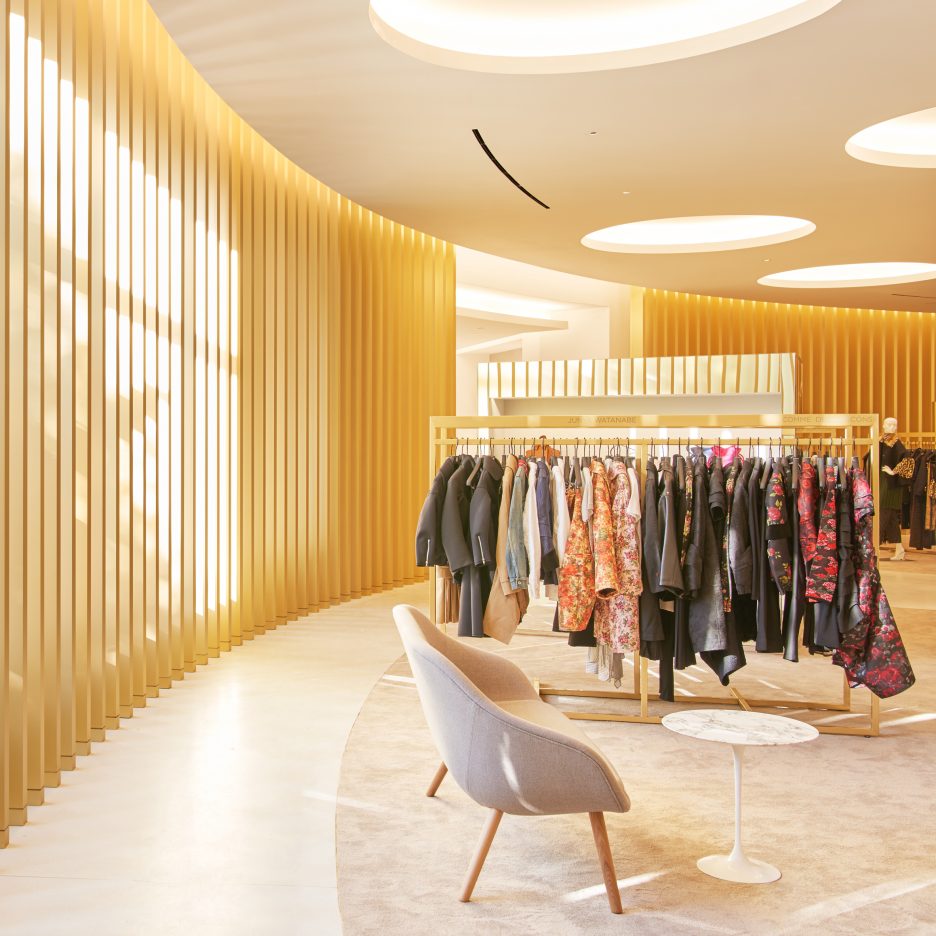
A branch of luxury department store Saks Fifth Avenue has opened close to the World Trade Center site in New York, with interiors designed by London studio Found (+ slideshow). (more…)
Throughout the past century, architecture’s relationship with water has developed along a variety of different paths. With his “Fallingwater” house, for example, the American master Frank Lloyd Wright confronted the dramatic flow of water with strong horizontal lines to heighten the experience of nature. Since then, architecture’s use of water has become more varied and complex. A space made almost purely of water emerged with Isamu Noguchi‘s design at the Osaka World Expo: glistening water appeared to fall from nowhere and glowed in the dark. Later with digitalization and fluid forms as design parameters, the focus shifted towards liquid architecture made of water and light. The interpretations have ranged from architectural forms modeled after literal drops of water, like Bernhard Franken´s visionary “Bubble” for BMW, to spectacular walk-in installations made of lines of water, transformed into pixels by light.
NOX fueled the discussion about the fluidity of water and light with their exhibition of real and virtual water at the Htwo0expo at Neeltje Jans, Netherlands, in 1997. Here, in a windowless and amorphous interior structure, Lars Spuybroek assigned the real water the role of being non-interactive, creating a sprayed mist that drained over the floors. As a counterpoint NOX introduced virtual water through interactive projections with sensors, which transformed wave patterns into ripples and blobs culminating in fascinating viewer experiences of water and light.
In contrast, the Iceland pavilion at Expo 2000 welcomed visitors with a water façade. Iceland, surrounded by water and boasting numerous spouting geysers on the island, presented a striking blue membrane cube in Hanover. A flowing film of water turned the pavilion into a cubic waterfall. With the sun shining on the cascading ripples and thereby reflecting the moving clouds, the façade generated a fresh and sparkling impression of the environment. In addition, the Icelandic pavilion revealed an artificial geyser in the interior, where guests could climb up a spiral ramp to admire the power of water. Thus the installation played with the a strong polarity of bright, brilliant falling water outside versus a dark geyser illuminated with stage lighting effects inside. After the Expo, the 28-meter-tall blue cube was recycled to present natural phenomena at the Universe amusement park in Nordborg, Denmark.
In comparison to the falling water theme at Hanover, the Swiss Expo in Yverdon-Les-Bains in 2002 gained international recognition with the remarkable “Blur Building” by Diller Scofidio + Renfro. Fine mist from 35,000 high-pressure nozzles created an artificial cloud, which changed with the strength and direction of the wind, altering where the tourists could walk in order to explore the effect of an optical white out. By opening their mouths, the visitors could actually drink the building. After ascending to the deck, a view opened softly into the blue sky. In that way the architects confronted the public with extreme interplays of light and water, from a diffuse white in the inside to brilliant fine water droplets in the sun and ultimately colorful rainbow effects. After sunset, another image appeared when the architecture turned into a powerful and mystical luminous cloud on Lake Neuchâtel.
However, several other architects and artists have also explored the effects of light and water in a strictly controlled interior environment. The Danish-Icelandic artist Olafur Eliasson tried to generate an image of freezing water drops in 2002. Deep down in the cellar of a former brewery, Eliasson benefited from a completely dark room as a black background at the Centre for International Light Art in Unna, Germany. Two parallel curtains of water frame a corridor made of water falling 5 meters to the ground. Due to bright strobe lights with a cold color temperature, the falling drops seem as if they are frozen. The mix of the loud sound of falling water droplets in the live space and the harsh contrast of white drops in a dark space definitely captivates the viewers.
Intrigued by digitalization, the MIT professor Carlo Ratti, together with his team at Carlo Ratti Associati and researchers from MIT Media Lab and MIT Senseable City Lab, created the “Digital Water Pavilion” for the Zaragoza Expo, Spain, in 2008. The digitally controlled water droplets enabled him to create two-dimensional patterns with water pixels, and to liquidate the traditional building wall. For visitors the curtain of water opened interactively, and the vertically moving curtain exposed a fascinating playful pattern. In the evening the illumination intensified the contrast of the bright falling curtain against the dark background.
Random International went beyond these two dimensional water curtains with their three-dimensional water installation “Rain Room” at the Barbican Centre in London in 2012. The visitor could actually walk through the falling water without getting wet, Thanks to a series of cameras which created a 3D-map of the presence and movement of visitors, a section of “dry pixels” was created in the Rain Room wherever there was a human presence. A bright spotlight at eye level at the end of the dark curving corridor attracted the viewers with a glaring light and sharply rendered all vertical lines of rain for an experiment that was rich in contrast.
When bringing the stroboscopic light effect, used by Eliasson in Unna, together with the constant illumination in the Rain Room by Random International, a new dimension of light experience emerges, where the water can transform from droplets into lines. DGT Architects used this approach in their rectangular installation “Luce Tempo Luogo” for the Toshiba Milano Salone in 2011. With an interval of seven microseconds they materialized a single point of light with water. However, over several minutes the viewers could follow the gradual transformation of water pixels into lines while the room changed from a dimly lit room to a space exclusively made of illuminated water. In 2015 DGT Architects adapted this concept to a circular layout for the “Light in Water” installation, as part of the exhibition “Lumière – The Play of Brilliants” in Paris. In addition, this project included a subtle light change regarding the color temperature, from a warm white to neutral white for the outer ring while the inner ring stayed constant in neutral white.
In comparison to the walk-in and self-contained installations by the artists and architects mentioned above, Shiro Takatani and the light artist Christian Partos regard the “3d Water Matrix” cube as a medium and not as a piece of art – comparable with the way a piano is a medium for the music it sends. The digitally controlled waterfall with a luminous ceiling enables numerous compositions in which the water pixels form lines, planes or amorphous volumes merging fluently from one graphical pattern to the next and thereby creating a dancing liquid sculpture. However, Takatani involved the frequency of light as another parameter for compiling patterns in his “ST/LL” work in 2015. Based on the light intervals of the field overhead he generated extraordinary images, where the liquid pixels seem to freeze in planes and volumes.
With the digitalization of falling water the element has relinquished its natural flow and ripples, and turned into sophisticated pixel patterns for liquid spaces. The response to the distinction of water pixels and non-pixel spaces has led to high-contrast installations of white droplets against black rooms. Consequently the fascination for digital process has extended to include light as well, with designers often preferring electrical light instead of natural daylight for its option of precise control. Due to the modulation of these droplets from pixels to falling vertical streams, attention has shifted from conventional light parameters like brightness or color temperature towards the timing and frequency of lighting. As the interplay of digital water pixels and digital light control has just started, we might therefore expect many more solutions for smart flying pixels which glow in the future.
Light matters, a monthly column on light and space, is written by Thomas Schielke. Based in Germany, he is fascinated by architectural lighting and works as an editor for the lighting company ERCO. He has published numerous articles and co-authored the books “Light Perspectives” and “SuperLux”. For more information check www.erco.com, www.arclighting.de or follow him @arcspaces.
The Caramão neighborhood in Lisbon, was built between 1940 and 1945 on the slope of Ajuda facing the Tagus and above the Restelo neighborhood.
Along with other social housing in Lisbon, such as Caselas, this neighborhood was designed to represent small villages that provided, in the style of adjustment, a similar type of life of the more humble part of society, to which they were accustomed to and also occupied at the date of its construction.
It is characterized by townhouses of two floors with about 40m2 each and two backyards. One in front, smaller, and the other in the back, that is, mostly, a good part of each plot.
Characterized by very small and compartmentalized spaces the main challenge of these houses is the adaptation to a contemporary experience and the need for larger spaces with a relationship with the outside.
The project was developed based on an organizational principle of hierarchically house, floors. Each floor corresponds to a particular program so that the areas could be exploited to the maximum, generating spaces with quality.
The organization and distribution of spaces was based on the idea of privacy and garden usage for the social spaces of the house.
Section
The project adapts the existing construction to a contemporary house respecting the morphology of the neighborhood and the characteristic front elevation.
The intervention is mainly made in the back of the house with the addition of a volume with 3 levels, which increases the area to the double.
On the ground floor of house after the entrance, we can find the living room, dining room and kitchen. A large and continuous space that leads you into the garden.
In the basement floor we can find a bathroom and an office open to a patio and in the upper level bedrooms and a bathroom also open to the patio.
Section
Opening yards, strategically placed inside the house, ensures the legally required areas, good lighting and privacy of the close and friendly neighbours.
CannonDesign and NEUF architect(e)s have unveiled the design for the Centre Hospitalier de l’Université de Montréal (CHUM), the largest healthcare construction project in North America and one of the largest current healthcare projects in the world, which has been in the works for almost a decade.
Spanning over 3 million square feet, the 22-story complex will merge three aging hospitals into one, creating a space with 772 single-bed patient rooms, 39 operating theaters, and more than 400 clinics and examination rooms.
Courtesy of CannonDesign
Now nearing completion of its first phase, the CHUM teaching hospital is also the largest public-private partnership (P3) healthcare project in Canadian history, set to revitalize an entire sector of Montréal’s urban core – explained the architects.
Courtesy of CannonDesign
Courtesy of CannonDesign
Through this first phase, the hospital’s core capabilities will become available, including all patient rooms, operating theaters, diagnostic and therapeutics, as well as the oncology program, thus leaving offices, a conference center, and ambulatory spaces for Phase 2.
Courtesy of CannonDesign
In order to break down the massive scale of the project, a public space component has been interwoven into the design to make it as open, transparent, and welcoming as possible. “Our team recognized the importance of creating a human experience that draws people in, to interact with the building in a variety of ways, without it feeling overbearing to visitors and patients. We wanted to completely redefine Montrealers’ image of what a hospital feels like” said Azad Chichmanian, partner, and architect with NEUF architect(e)s.
Courtesy of CannonDesign
The new CHUM campus will feature 13 large-scale works of art, far surpassing the Quebec government’s requirement of dedicating a minimum of 1% of a public development’s budget to the integration of art. Through these artworks, the hospital seeks to provide a “more human” experience for visitors and staff.
Courtesy of CannonDesign
CHUM has already won several awards, including an A’ Design Award in Italy, recognition at the Healthcare Design Forum in London, and a position as a finalist for the World Architecture Festival to be held in Berlin in November.
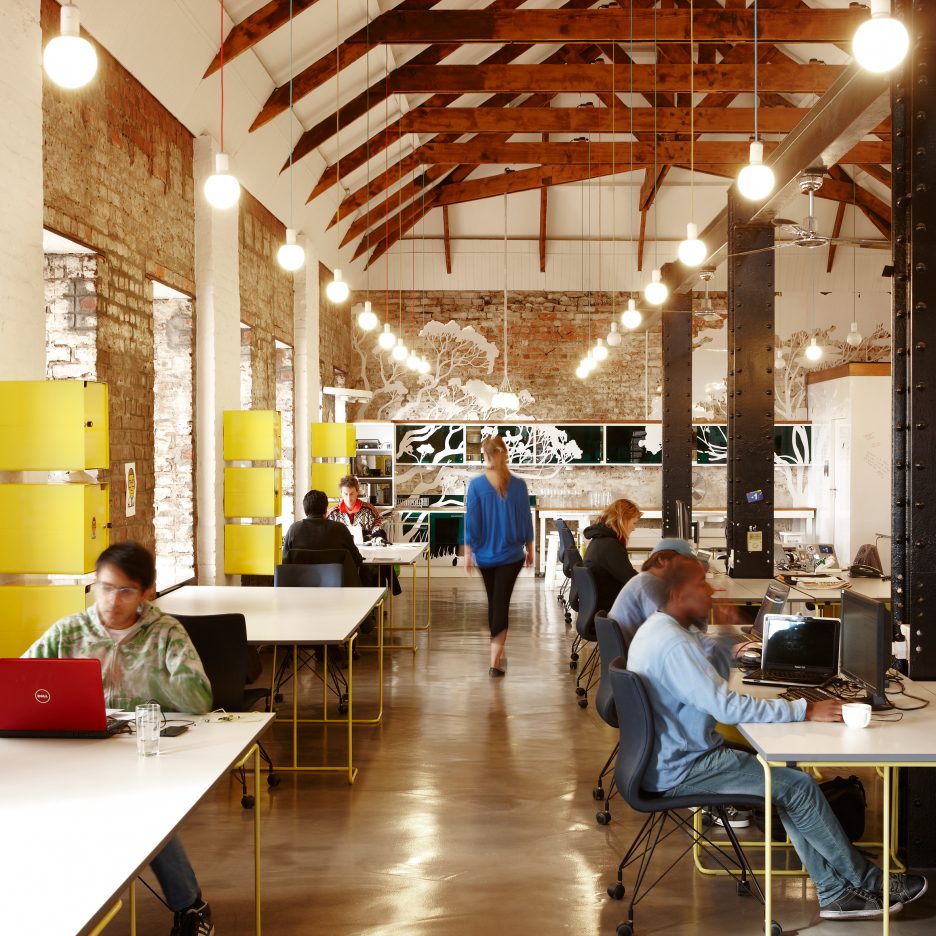
Workers in open-plan offices are more distracted, unfriendly and uncollaborative than those in traditional workplaces, according to the latest industry survey. (more…)
Lily Pond House is a private home located in Biddeford, Maine, USA. Completed in 2015, it was designed by Theodore + Theodore Architects. Lily Pond House by Theodore + Theodore Architects: “Located on the a granite knob 30′ above a lily pond the house overlooks the Atlantic Ocean to the south. It is an optimal orientation that combines water views with a positive solar aspect. The house replaced an existing..
Kengo Kuma is the latest high-profile name to create a tea service for Georg Jensen, basing his design on traditional Japanese sets (+ slideshow). (more…)
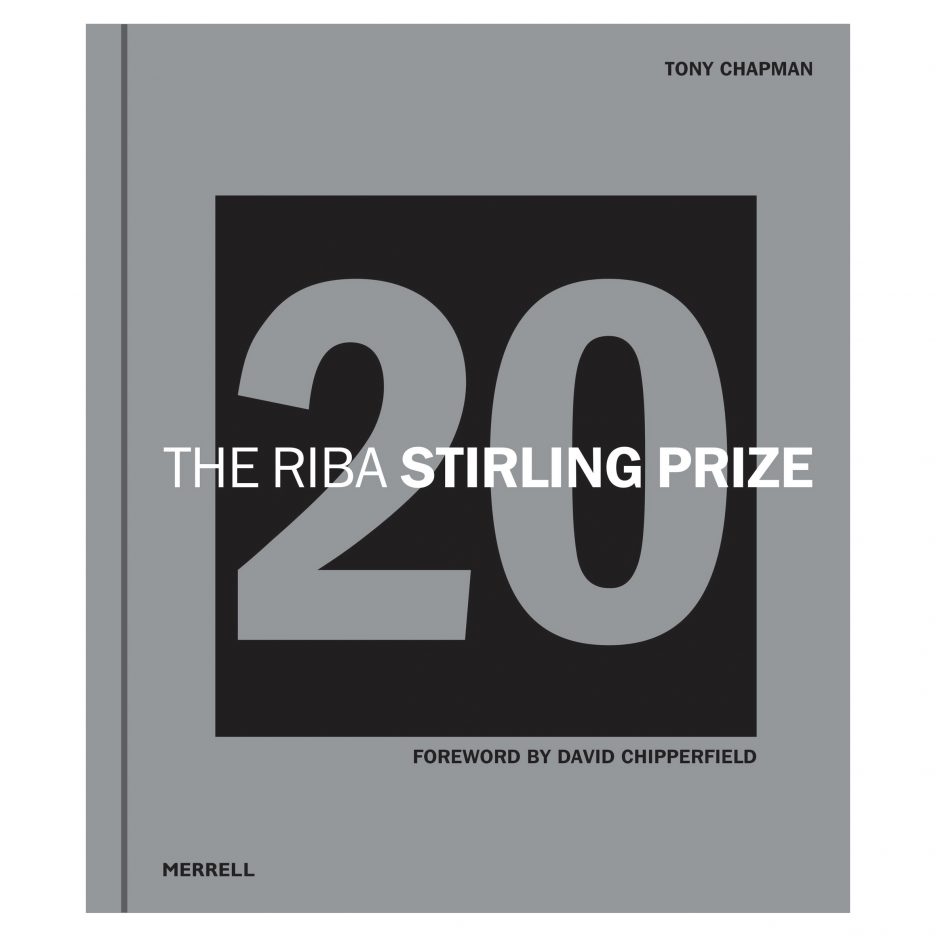
Competition: Dezeen has teamed up with Merrell Publishers to give away five copies of a book profiling each of the RIBA Stirling Prize shortlisted and winning projects (+ slideshow) (more…)
Urban Agency and OUALALOU+CHOI have drawn heavily from local inspiration for the design of a new adult education center in south-west Morocco. The isolated site is set against a harsh environmental backdrop, and in response the proposal only uses 10 000 of the allocated 22 000 square meters to create a compact building centered around an internal courtyard. This will allow it to be expanded upon in the future, as the building fulfills its intent as a world class education facility.
The project uses the traditional “Medersa” (first universities) as precedent, incorporating a dynamic internal courtyard and a simple exterior envelope. The Medersa, known for their “social, cultural and climatic ingenuity,” not only foster communal activity in their internal spaces but are protected from harsh sun, winds and sandstorms, creating a climatically controlled interior zone.
The interior courtyard and the open spaces adjacent to the university are densely planted to provide shading and reduce the impact of harsh northerly winds. The plantation strategy also assists with passive temperature control, as the hot air is filtered and cooled before it hits the building. Aside from its functional importance, the planting also assists the building in achieving the “magical ambient atmosphere” of a desert oasis.
Courtesy of Urban Agency
The program is arranged in a perimeter ring around the courtyard, with the teaching facilities at ground level and the accommodation on the first and second. The social and communal spaces, including an amphitheatre, restaurant, and a shop, protrude out within the courtyard as a series of large volumes. These interlink with the dominant courtyard, creating a series of smaller courtyards which the circulatory paths wind around, resembling the narrow streets of the Medina.
Courtesy of Urban Agency
In their press release, Urban Agency explain the importance of designing for an ageing building: In this particular project, ageing and weathering serve as a critical design tool for thinking about how the architecture might intercept with the changing state of the weather on site. The architectural expression of the building makes reference to the traditional local Berber architecture and more specifically to the “Kasbah” (ancient fortress) with its austere and solid monochrome exterior.
Those traditional structures have a sandy ochre yellow colour palette; the new training centre in turn is made from board marked concrete pigmented with local sand – a subtle and modern reinterpretation. The exterior finish is raw and horizontally patterned so that over time as the sand and dust from storms accumulates, they will highlight the patterns and embellish the building.
Courtesy of Urban Agency
In order to protect the inhabitants from this dust, the external envelope is relatively closed, also preventing excess solar gain. The interior climate is also controlled through natural ventilation strips which span the external faces, marking out the levels of the building. These strips express the horizontality of the building and further reference the open plains on which it lies.