2016 Design Matters Conference presented by the Association of Architecture Organizations


The Design Matters Conference presented by the Association of Architecture Organizations is the world’s only dedicated annual meeting that seeks to bring top designers, journalists and civic leaders into exploratory dialogue with those not-for-profit professionals and volunteers charged with creating cultural programs (exhibitions, tours, lectures and symposia, festivals and films, youth outreach) to spur broader public interest in architecture and design.

If you’re involved with a not-for-profit architectural, design or educational institution, come join your peers at the Design Matters Conference and enjoy 2.5 days of workshops, presentations, tours and networking events.

Conference Schedule

Wednesday, November 2—Pre-Conference Day

12:30pm–2:00pm: Tour of Design Architecture Senior High (DASH)
All Pre-Conference day participants are invited to tour DASH

2:30pm–5:00pm: A+DEN Workshop
Host: Jennifer Masengarb, Chicago Architecture Foundation

2:30pm–5:00pm: International Directors Council
Host: Peter Murray, New London Architecture

5:30pm–7:30pm: Opening Reception & Member Shorts
AAO hosts cocktail reception for all Conference attendees at the de la Cruz Collection. We will also hear about projects from four of the Conference’s international delegates: “Scotland’s Urban Past” by Rebecca, Bailey, Historic Environment Scotland; “Countdown to the New DAC” by Tanya Lindkvist, Danish Architecture Center; and “Vocabulary of Hospitality” by Merve Bedir and Jason Hilgefort, Land+Civilization Compositions.

8:00pm: Dine-Arounds

Thursday, November 3—Conference Day One

Morning Sessions: Miami Center for Architecture and Design (MCAD)

8:30am: Registration Opens

9:00am–9:15am: Welcome Remarks

9:15am–10:00am: Opening Address
“Miami Rising”: Manny Diaz, Former Mayor of Miami (2001–2009)

10:00am–10:30am: Coffee Break

10:45am-12:00pm: Morning Plenary
“Shaping Cities and the Built Environment through Philanthropy”: Ron Bogle, American Architecture Foundation; Benjamin de la Peña, Knight Foundation; Stuart Kennedy, Miami Foundation; Elizabeth Lynn, van Beuren Charitable Foundation

12:00pm–1:15pm: Lunch

1:15pm: Buses depart MCAD to Miami Beach

Afternoon Sessions: Miami Design Preservation League (MDPL)

1:45pm–2:45pm: AAO Members Meeting
Michael Wood, Association of Architecture Organizations

2:45pm-3:45pm: Connecting with AAO Membership: Notes from the Field
A rapid pitch share out of innovative, inspired approaches by Conference delegates solving programming and management challenges old and new: “Crafting Center Identity” by Rick Bell, NYC Department of Design and Construction; “The Minnow & the Whale: Building Partnerships for Mutual Benefit” by Angela Kyle, PlayBuild; “No Small Plans” by Gabrielle Lyon, Chicago Architecture Foundation; “Curating the City: LGBTQ Historic Places in LA” by Adrian Fine, Los Angeles Conservancy; and “Peacebuilding through Design Thinking” by Maryam Eskandari, Harvard University & MIIM Designs LLC.

4:00pm–5:30pm: Walking Tour
Art Deco Walking Tour

5:30pm: Buses depart MDPL to Miami

6:30pm-8:00pm: Evening Public Program
“Resilience and Citizen Action”: Tom Dallessio, NextCity; Otis Rolley, Rockefeller Foundation; and Susanne Torriente, City of Miami Beach.

8:00pm: Dine-Arounds

Friday, November 4—Conference Day Two

Morning Location: Yve Hotel

8:00am: Breakfast

8:00am–9:00am: Resilient Miami
Irvans Augustin, Urban Impact Lab; Gretchen Beesing, Catalyst Miami; Margie O’Driscoll, Bay Area Resilient by Design Challenge; Marta Viciedo, Urban Impact Lab.
Rapid Pitch – “Resilient Boston: Architect to Student to Citizen”: Benjamin Peterson, Boston Architectural College; Gretchen Rabinkin, Boston Society of Architects & BSA Foundation.

9:00am: Buses depart for Resiliency Tour

9:30am–12:30pm: Tour
Miami Beach Resiliency and Preservation Tour

Afternoon Location: HistoryMiami

1:15pm–2:00pm: Lunch

2:00pm–2:45pm: Tour of HistoryMiami
Conference attendees will be treated to a brief tour of the museum and cultural complex designed by Philip Johnson (commissioned 1972; completed 1983). Free time will be allotted to browse the museum’s upcoming exhibition, The Discipline of Nature: Architect Alfred Browning Parker in Florida.

3:00pm–4:00pm: Afternoon Plenary
“Diversity & Cultural Production in Miami”: Meg Daly, Friends of the Underline; Cheryl Jacobs, Miami Center for Architecture & Design; George Neary, Associate Vice President of Cultural Tourism for the Greater Miami Convention & Visitors Bureau; Mikhaile Solomon, Founding Director, Prizm Art Fair

4:00pm–5:00pm: Afternoon Plenary
“Miami as a Hub for Design”: Cheryl Jacobs, Miami Center for Architecture & Design; Avra Jain, Vagabond Group; Jessica Goldman Srebnick, Goldman Properties

5:00pm: Buses depart for Wynwood neighborhood

5:30pm–6:00pm: Tour
Wynwood Walking Tour

6:30pm–8:30pm: Closing Party at R+HOUSE

For the full schedule, including further information about each event, see here.

http://ift.tt/2cyNpBR

Eco House / BXBstudio Boguslaw Barnas


Courtesy of BXBstudio

Courtesy of BXBstudio


Courtesy of BXBstudio


Courtesy of BXBstudio


Courtesy of BXBstudio


Courtesy of BXBstudio


© Tomasz Jedrzejczak

© Tomasz Jedrzejczak

This project of sustainable house is located in the protected landscape area Nature 2000, surrounded by beech and oak forests, horse riding meadows and agricultural lands.


Courtesy of BXBstudio

Courtesy of BXBstudio

Number of analysises defined the final shape of the house, among them:
– analysis of functional plan – division into day, night, technical and working zones,
– analysis of solar radiation – to optimize solar gain and to create interiors with proper natural light,
– analysis of exterior views  and plot shape – to take the most advantage of the house location,
– building technology to be used


Courtesy of BXBstudio

Courtesy of BXBstudio

The house in not huge, but there is a spacious day zone inside, that is open up to 5 m height. Its main pride is a conrete wall and bearing mounting stairs. 


Plan

Plan

Plan

Plan

The building is designed in way to optimize the energy gain and loss. Sustainability of the house comes not only from unique technology but also out of architectural form and shape that harmonizes with nature. 


Courtesy of BXBstudio

Courtesy of BXBstudio

Diagram

Diagram

Courtesy of BXBstudio

Courtesy of BXBstudio

Simulations of the sun positions in different periods of a year allowed to create proper arrangement of the house layout and glass partition in way to gain heat in winter and to reduce overwheating in summer. Energy efficient Izodom technology was used to minimize heat loss.


Courtesy of BXBstudio

Courtesy of BXBstudio

http://ift.tt/2ctaJA6

A Home Perched on the Hills of Mosman, Australia

Balmoral House by Fox Johnston Architects (13)

Balmoral House is a private home located in Mosman, a suburb of Sydney, Australia. It was designed by Fox Johnston Architects in 2015. Balmoral House by Fox Johnston Architects: “The project takes the form of a series of platforms, as buildings responding to the rhythm and topography of the site. A long linear form to the west contains sleeping areas and bathrooms at the lower level, a garage space at..

More…

Going Live – Volume #49: Hello World!


A year and a half ago, Uber set up an Advanced Technologies Center (ATC) in Pittsburgh. This month (September 2016) these cars are on the road. Image © Uber

A year and a half ago, Uber set up an Advanced Technologies Center (ATC) in Pittsburgh. This month (September 2016) these cars are on the road. Image © Uber

With the rise of computational networks and power, cognitive models developed and debated over in the postwar decades have finally been able to be put to work. Back then, there was a philosophical debate raging alongside the burgeoning field of computer science theory on the nature of consciousness, in which machines of artificial intelligence served as a thought experiment to question humanity. Yet with the proliferation of data and the centralization of its archives, theoretical practice moved from conceptual experiments to empirical tests.


© Volume

© Volume

The shift is decisive, as along with it moved the criteria of philosophical judgment from abstract reason to pragmatic conjecture. Machines of models of artificial intelligence are still put to the test, but evaluated according to their results, not logical consistency or rationality. Artificial intelligence is both a theory and a practice, which respectively evolved at different times and speeds. The ability to test artificial intelligence has only become recently possible thanks to the internet, which serves as is its prime laboratory and space of experimentation. But increasingly, artificial intelligence is leaving the web, crossing the digital divide, and being applied to cities and the environment.

There are many analogies that can be drawn today between computers and cities. This formal similarity, as rough as it may be, has allowed network-based logics to begin to shape urban development and the way we (want to) live. Logistics is the general term for such processes. Computers stand apart in the history of machines in the sense that it’s not so much a tool as it is a toolbox, one whose contents can be invented with relative freedom and lack of constraint. It’s for all of these reasons that artificial intelligence is resistant to our critical faculties. It’s not so much that we don’t understand it, but paradoxically, it’s that we finally can. Artificial intelligence is real. It’s not the perfect model of consciousness we thought we were aiming for, but it’s close enough.

It’s hard to comprehend the potential impact of artificial intelligence. As a system in need of deployment, AI is plagued by scale and ‘boundary issues’. Take basic income, for instance, which often accompanies recent calls for automation. Small scale tests are currently being developed and rolled out in certain places around the globe, the Dutch city of Utrecht being one of the largest.[1] Yet as soon as the decision needs to be made of who gets it and who doesn’t – be it only nationals, residents, inhabitants, or whatever – a certain political violence needs to be exacted that undermines the rationale behind the effort and the scientific value of its results. Basic income really only works if its universal.[2]

Self-driving cars are another ‘prime’ example of boundary issues facing artificial intelligence. While early public demos and private tests were on closed circuits or even set tracks, tests have begun in ‘dynamic’ urban environments. Last month, Uber reportedly rolled out its first fleet of self-driving vehicles in downtown Pittsburgh, Pennsylvania for an indefinite period (notably, most trials are finite).[3] Yet even before live road tests became a thing, a humbling revelation dawned about the challenges facing the successful implementation of such systems into our cities, our landscapes, and our daily lives: we are the problem. Or in other words, the problem of tomorrow is today.

Left to their own devices, self-driving cars hold immense promise to radically transform urban mobility patterns and upheave the cultures and economies that support them towards more sustainable and equitable ends. But beyond a debate over whether we should be conservative or liberal with the values and practices currently in place today, self-driving cars probe more a fundamental human anxiety about the degree of trust and responsibility we place in the machines we live with. An easy way to wash this problem away is to fabricate a boundary: if we were to remove all other things from the space in which the system is ‘live’ – non-self-driving cars and pedestrians, for example – at least some of this risk would be ameliorated, if not eliminated altogether.

Like most ‘problems’ though, the challenges facing the future of AI are not as simple as erecting a wall. Hybridity is a fundamental problem, yes, but if we were to assume it to be the only one, the future itself would be subsumed and lost within the desire for a very particular kind of progress. Artificial intelligence has given rise to what has come to be known as ‘existential risk’ insofar as it throws humanity itself into question, much like its early models questioned what it meant to be human.[4] AI stands to rewrite the logic by which we have relation with the support systems our lives depend upon. AI is predicated by ‘locking in’ a political cosmology of actors and the rights distributed to them. AI writes politics with code, yet increasingly into stone and the flesh as well.

By throwing it into question, systems of artificial intelligence such as self-driving cars allow us to reflect upon some of the most fundamental questions of humanity, like: not whether to kill or not, but which life to take in in situations where death is unavoidable.[5] Death has always been factored into infrastructure as a negative externality, and design has responded accordingly. Road barriers prevent people from crossing the highway, for example. But how does one implement a safety feature, emergency airbags for instance, in artificial intelligence? Profanity filters – basic script libraries easily drawn in to any chatbot program – are only applicable to so few cases.[6]

Artificial intelligence has finally begun to develop according to models not based on the human brain. Perhaps for this very reason, yet despite the fact that we have perhaps never had such a refined and deep understanding of it, there is great fear over our ability to control artificial intelligence. Accidents and mistakes do and will happen, and while we can be careful, we can’t really predict what will happen when AI systems go ‘live’, and especially not in increasingly large, complex, and fundamental domains. Yet we can speculate and think what we would want to happen in innumerous instances. The anxieties surrounding artificial intelligence are thus not necessarily about control per se, but rather our ability to respond to what the future brings (with or without the help of AI, I might add).

The technologies we use on a daily, hourly basis frame our relation to the world and our experience of it. This is nothing particularly new. We design machines, and machines design us. By using them we change ourselves. Yet today, machines are learning to change themselves based on how we use them. This is where that devilish concept of ‘intention’ comes in. Life is messy; unpredictable and dangerous, filled with sentiment. Social engineering has haunted the dreams of visionaries since the rise of the Soviet state, but never before have the potentials to engineer life’s folds been so great. The machines are not coming; they’re already here. We need to learn about machines because we learn from machines, because we make machines. We need to understand the power and potential they have in order to better form an idea of what we want to do with them, what we want them to do, and what we want them to do to us.

References
[1]
 Tracy Brown Hamilton, ‘The Netherlands’ Upcoming Money-for-Nothing Experiment’, The Atlantic, 21 June 2016. (accessed 26 August 2016).
[2] Alex Williams and Nick Srnicek, Inventing the Future: Postcapitalism and a World Without Work (Verso, 2015).
[3] Max Chafkin, ‘Uber’s First Self-Driving Fleet Arrives in Pittsburgh This Month’, Bloomberg Businessweek, 18 August 2016. (accessed 21 August 2016).
[4] Raffi Khatchadourian, ‘The Doomsday Invention’, The New Yorker, 23 November 2015. (accessed 25 August 2016).
[5] Iyad Rahwan, Jean-Francois Bonnefon, Azim Shariff, et. al, ‘Moral Machine’, Scalable Cooperation, MIT Media Lab. (accessed 21 August 2016).
[6] Peter Lee, ‘Learning from Tay’s introduction’, Official Microsoft Blog, 25 March 2016. (accessed 21 August 2016).

Introducing Volume #49: Hello World!
//cdn.embedly.com/widgets/platform.js

Volume is an independent quarterly magazine that sets the agenda for architecture and design. With going beyond architecture’s definition of ‘making buildings’ it reaches out for global views on designing environments, advocates broader attitudes to social structures, and reclaims the cultural and political significance of architecture. Created as a global idea platform to voice architecture any way, anywhere, anytime, it represents the expansion of architectural territories and the new mandate for design.

http://ift.tt/2ct6On5

Carturesti Carusel / Square One


© Cosmin Dragomir

© Cosmin Dragomir


© Cosmin Dragomir


© Cosmin Dragomir


© Cosmin Dragomir


© Cosmin Dragomir

  • Architects: Square One
  • Location: Strada Lipscani 55, București, Romania
  • Architects In Charge: Adrian Cancer-Zeana, Sabin Dumitriu
  • Design Team: Ioan Vladescu, Vlad Cretu, Andrei Palita
  • Area: 1000.0 sqm
  • Project Year: 2015
  • Photographs: Cosmin Dragomir
  • Restoration : Capitel Avangarde
  • Structure : Pop & Asociatii

© Cosmin Dragomir

© Cosmin Dragomir

The building is located in the old city center of Bucharest and has had a long and intricate history. Built in the 19th century, it started out as a bank and then it became a clothing shop between the `50s and the `90s. In the past 20 years, after the clothing shop closed, the building became slowly a ruin, before it regained life as a bookstore. We saw it as a permanent shell and our intervention as a fragment in its history. Pieces of recent restorations were kept visible in our final design, the concrete walls in the basement and several components of outline beams, as an expression of the building’s continuous metamorphosis.


© Cosmin Dragomir

© Cosmin Dragomir

Being a retail space, the main functional component is the furniture. The height of the floors made possible the addition of intermediary platforms, serving as the stylistic elements that define and shape the space.


Section

Section

We had to play with the existing elements and find ways to create visual impact and sculptural value, while empowering the classical elements of the building. We created an organic fluid form that winds through the existing structural elements, sometimes withdrawn behind the existing pillars and other times emerging in the spaces between them. The platforms have a railing composed of equally spaced metal rods that follows the form and is both opaque and transparent, depending on the angle of view and the curvature of the shape.


© Cosmin Dragomir

© Cosmin Dragomir

We opted for a punctual lighting system with a warm spectrum. Seemingly random, the arrangement of luminaries has been calculated to fulfill the illumination needs of various products. The photometric calculations resulted a number of bodies in the proximity of the furniture and above circulations – purely functional light – and another number of bodies that give the ambient light. The image that inspired the artificial lighting design is that of a starry sky, like the one seen through the central skylight at night.


© Cosmin Dragomir

© Cosmin Dragomir

http://ift.tt/2cKm5SJ

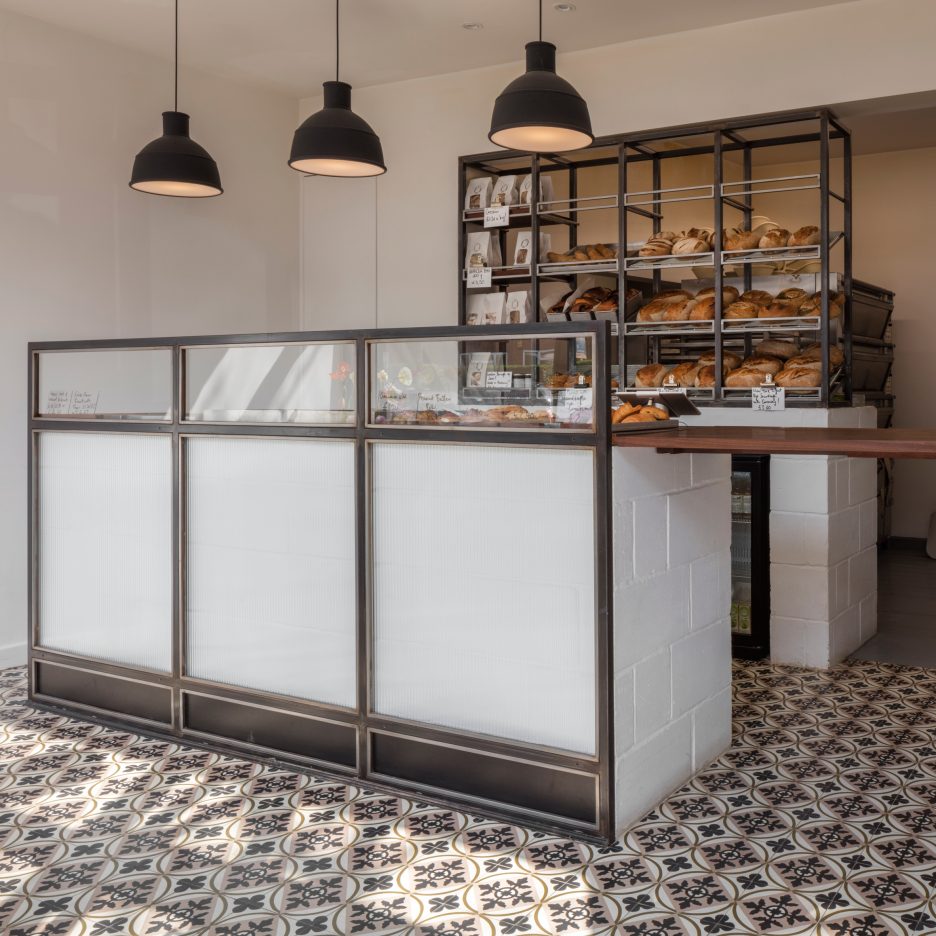
Lucy Tauber converts old London post office into light-filled bakery


Architect Lucy Tauber has transformed a derelict post office in north London into an artisanal bakery with its kitchen on show (+ slideshow). (more…)

http://ift.tt/2cc2Pge

White Interior Design Create a Star Wars-Themed Apartment in Taipei, Taiwan

Danilov Plaza Multifunctional Complex / SPEECH


© Margarita Fedina

© Margarita Fedina


© Alexey Naroditsky


© Margarita Fedina


© Margarita Fedina


© Alexey Naroditsky

  • Architects: SPEECH
  • Location: Novodanilovskaya nab., 6, Moskva, Russia, 117105
  • Project Authors: Sergei Tchoban, Sergei Kuznetsov
  • Principal Project Architect: Igor Chlenov
  • Architect In Charge: Evgeny Lyashkov
  • Area: 39385.0 sqm
  • Project Year: 2016
  • Photographs: Margarita Fedina, Alexey Naroditsky
  • Client: MR Group
  • Principal Project Engineer: Igor Osokin
  • Site Area: 0.53 hectares

© Alexey Naroditsky

© Alexey Naroditsky

Danilov Plaza is a multifunctional complex situated on the first line of buildings on Novodanilovskaya Embankment in Moscow. This area, which was until recently considered lacking in prestige due to its numerous disused industrial buildings, is currently undergoing a transformation into a modern business district. The main driving force in this change of image is the construction of several business complexes designed by leading Moscow architects along the River Moskva.


© Margarita Fedina

© Margarita Fedina

Plan

Plan

© Margarita Fedina

© Margarita Fedina

Danilov Plaza consists of two 13-storey blocks linked by glass passageways. The two-part volumetric composition is reflected in the design of the buildings: the façade of the building which stands closer to the river is clad with unpainted aluminium composite panels, while its sister building is faced in panels with a gold-coloured coating. In addition to using visually striking materials, the complex’s façades employ the kind of ornamental motifs which are characteristic of SPEECH. The frames of the square window apertures – which, thanks to the additional relief contours, resemble perspectival portals – form an unusual geometrical pattern covering the larger part of the buildings. The displacement of the axis of the portals relative to the axis of the windows creates a changing play of light and shadow on the façades and produces the impression of a moving, ‘living’ membrane –a kind of scintillating suit of ‘chainmail’ worn over the powerful ‘torsos’ of the blocks.


© Alexey Naroditsky

© Alexey Naroditsky

Section

Section

© Alexey Naroditsky

© Alexey Naroditsky

The façade theme changes twice: the two bottom and two top storeys of the buildings are of a different design. The bottom part of each building is mostly of glass, making the buildings seem to float above the ground. The top floors differ from the main façade pattern in having taller window apertures, the upper parts of which are additionally divided into three narrow panes. Thus the classical technique for decorating the attic floor of a building works perfectly well in modern architecture too, making the building seem lighter, harmonizing its proportions, and accentuating the cornice.


© Alexey Naroditsky

© Alexey Naroditsky

http://ift.tt/2cPzgho

B&B Italia expands into luxury kitchens with purchase of Arclinea


Business news: Italian furniture brand B&B Italia has bought high-end kitchen maker Arclinea, marking “the first major milestone” in its growth since being acquired by investment firm Investindustrial. (more…)

http://ift.tt/2coUebB

In Progress: Zhang Daqian Museum / Miralles Tagliabue EMBT


Courtesy of EMBT

Courtesy of EMBT


Courtesy of EMBT


Courtesy of EMBT


Courtesy of EMBT


Courtesy of EMBT

  • Architects: Miralles Tagliabue EMBT
  • Location: Neijiang, Sichuan, China
  • Architect In Charge: Benedetta Tagliabue / EMBT
  • Project Year: 2016
  • Photographs: Courtesy of EMBT
  • Design Phase: Daniel Rosselló (Project director) Francesca Origa, Gabriele Rotelli, Verena Vogler, Vaiva Simoliunaite, Susana Oses, Davis Gertners, Ana Isabel Fernandes, Vincenzo Messina, Javier Rivero Carnota, David Mas Trigueros, David Ricardo Ramírez, Evangelia Anamourlogluo, Maria Ioanna Barka, Fabian Vargas, Pauline Suhr, Enrique Franco, Claudia Paola Martinez, Dean Mapeso, Rebeca Pérez Casterà (Collaborators)
  • Construction Phase: Elena Nedelcu (Project director) Wang Lingzhe, Marzia Faranda, Ana Otelea (Collaborators)
  • Embt Shangai Team: Igor Peraza (Project Director) Qiwei Hu, Chen Hao, Dee Liu, Pey Lung, Kathrine E. Thoen, Wei Song, Lorenzo Trucato (Collaborators)
  • Clients: Shen Zhen Excellence Kang He Investment and Development Pty., Ltd

Courtesy of EMBT

Courtesy of EMBT

The construction of Zhang Daqian museum, a project designed by Benedetta Tagliabue / EMBT, has begun a few months ago in Neijiang, China. 


Panels

Panels

Zhang Daqian was one of the best-known and most prodigious Chinese artists of the 20th century. Originally known as a guohua painter, by the 1960s he was also renowned as a modern impressionist and expressionist painter.


Courtesy of EMBT

Courtesy of EMBT

On April 2010, Excellence Group invited EMBT to design Zhang Daqian’s museum in Neijang city, the painter’s hometown. In 1956 Zhang Daqian and Pablo Picasso met in Paris, where they exchanged ideas on art and initiated their friendship.


Courtesy of EMBT

Courtesy of EMBT

Neijiang city would like to continue this friendship between the two artists, and moreover between the two cities where they were born, Neijing and Malaga.


Panels

Panels

The design philosophy behind the museum was to integrate the cultural essence of East and West and build expressing the past and the future. The museum should grow from the existing tea house and extend its pavilions over and around a garden that moves topographically on different levels, enclosing some of the old trees within its scheme.


Courtesy of EMBT

Courtesy of EMBT

The motives and gestures extracted from Zhang Daqian’s painting will shape the ribs of the vertical structure, while the interpretation that the Chinese painter did of Picasso’s face will informs the geometries of the plan. 


Courtesy of EMBT

Courtesy of EMBT

The site is located at the peak of Dong Tong Lu, Yuan Mountain, west of Xi Lin monastery, south of the Tuo River. The museum will be the landmark of the city.


Courtesy of EMBT

Courtesy of EMBT

http://ift.tt/2cPaspD