
Enough House is a residential project completed by MacKay-Lyons Sweetapple Architects in 2015. The 700-square-foot home is located in Upper Kingsburg, Nova Scotia, Canada. Enough House by MacKay-Lyons Sweetapple Architects: “Enough House is the newest addition to architect Brian MacKay-Lyons’ Shobac farm in Nova Scotia. The beautiful property overlooks the Atlantic Ocean and acts as both the satellite rural studio for Mackay-Lyons Sweetapple Architects and as an architectural testing ground…
Philippe Starck designs modular Speetbox wood-burning stove
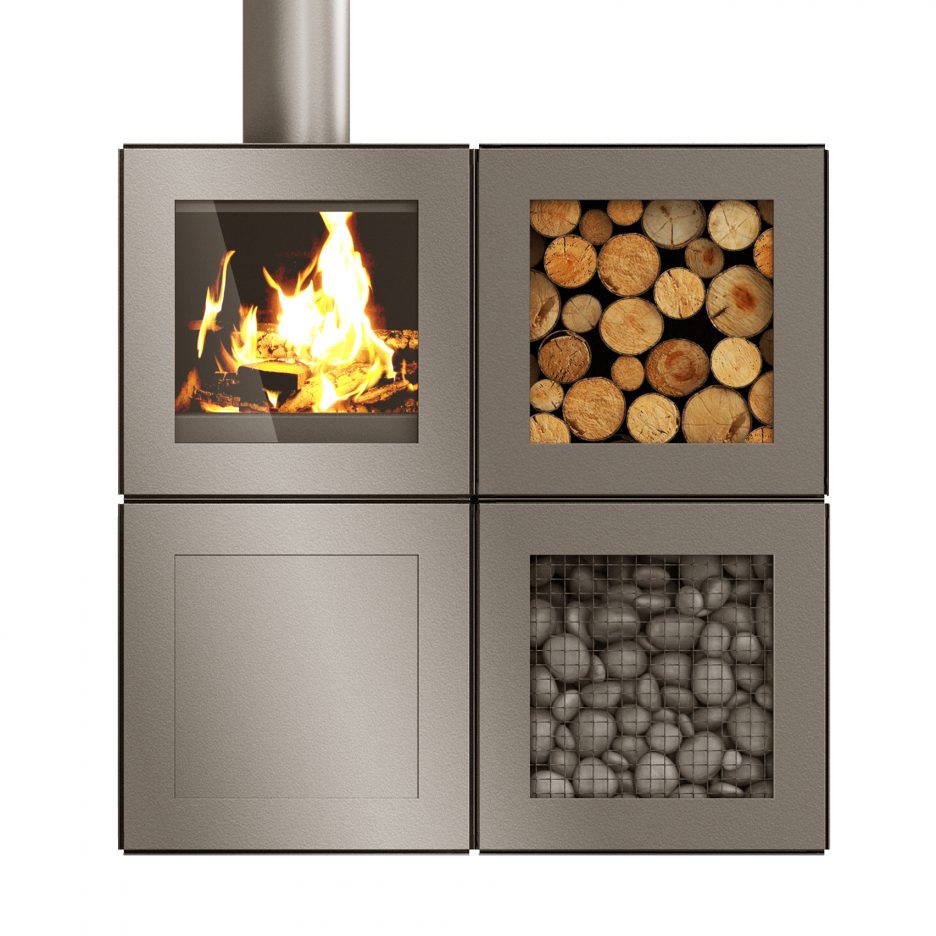
French designer Philippe Starck has created a wood-burning stove for heating brand Speeta that can be customised by combining different modules (+ slideshow). (more…)
The High-Tech Park Bridge / Bar Orian Architects

© Amit Geron
- Architects: Bar Orian Architects
- Location: Be’er Sheva, Israel
- Project Year: 2016
- Photographs: Amit Geron
- Construction: Rokach Ashkenazi – Consulting Engineers
- Lighting Design: Orly Avron-Alkabes Lighting Design
- Landscape Architecture: Eitan Eden
- Head Contractor: Shora (part of the Oron group)
- Steel Contractor: Adi 2000
- Project Management: Ramon Engineering
© Amit Geron
From the architect. The new pedestrian bridge, connecting the high-tech park and the Beer-Sheva Tzafon train station (and Ben-Gurion University), was officially inaugurated and opened on 12 June, 2016. At some 210 meters long, the steel bridge is a scenic point of reference as it spans over the active and operational and railways and the site of future ones. The bridge’s design incorporates over 200 types of different steel beam cross-sections, making up its unique geometry – four steel arches, curling and twisting, creating two broad lenses with openings of 110 meters and 70 meters. The credit for this unique design goes to Bar Orian Architects and Rokach Ashkenazi Engineers.
© Amit Geron
The high-tech park is located within walking distance from the Beer Sheva Tzafon train station. Until recently, employees who had arrived at their jobs in the park by car, and saw their offices just hundreds of meters away, had to take taxis or busses to bypass the train station and the adjacent neighborhood in order to arrive at work. This problem was already a known issue during the park’s design and construction, and to address it, the Municipality of Beer Sheva initiated an architectural competition for the design of the “perfect bridge.” The bridge was to provide a solution for the park’s access problem for pedestrians and bicyclists, as well as become a symbol to the new park and become a unique point of reference in the new emerging landscape. Many firms were invited to submit their suggestions for the future bridge, and Bar Orian Architects won the competition along with Rokach Ashkenazi Consulting Engineers.
Section
The pedestrian bridge provides a useful and convenient connection between the technological park and the train station, as well as a unique and significant point of reference in the evolving scenery. The goal was to create a bridging structure as opposed to a technical element connecting two ends – a structure that is an architectural element, generating movement and change. The engineering and design scheme are based on four steel arches which twist and undulate, creating two “eyes” in the space between them. The arched formation creates a protected space for pedestrians, an experiential and exclusive journey, in which each step reveals a surprising view of shapes, materials, and sights. The bridge embodies movement which can been seen in the design of the arches, the secondary foundations and the connecting elements, movement whose inspiration is suggested by the endless dynamics taking place among the train platforms below. The result is a structure that is a space with three supports – one at each edges of the bridge, the third at the planned train platform.
© Amit Geron
The bridge is 210 meters long. Its upper part is roofed to provide protection and shade from the sun, dust, sand storms, and rain. The sides are open to allow the flow of natural air and eye contact with the surrounding environment. This way, the shell serves as a climatic element, as the natural of the openings allow maximal control over air flow and filtration, shading, and filtering of natural light in the spaciousness of the desert.
© Amit Geron
The lighting design for the bridge was very much derived from the architecture of it; there was no intention of telling a different story at night than during the day. There was a process of deciding what to show at night – what to light. The result is that the bridge almost appears to be hovering at night as if it was lifted off the ground to allow the trains to pass underneath.
North Elevation
The light fittings are all integrated in the structure and are not obvious. The light creates a rhythm that enhances the flow of the structure at night.
© Amit Geron
There is a strong sense of safety and security at night but because what is mainly lit is the structure and not the path there is still a very relaxed and intimate atmosphere on the bridge.
Our new Pinterest board is full of packaging designs you won’t want to throw away

From beer cans to CD players, the trend for Minimalist packaging design isn’t going anywhere. We’ve pinned some of the best examples to a new Pinterest board.
Follow Dezeen on Pinterest | See more packaging design in our achive
Martello Tower Home / Luigi Rosselli Architects

© Justin Alexander
- Architects: Luigi Rosselli Architects
- Location: Clontarf NSW 2093, Australia
- Area: 303.0 sqm
- Project Year: 2014
- Photographs: Justin Alexander , Edward Birch
- Interior Designer: Romaine Alwill, Alwill Interiors
- Builder: Sydcon Building Services Pty Ltd
- Structural & Hydraulic Consultant: Rooney & Bye Pty Ltd
- Joiner: Kitchen Trend
- Landscaper: Secret Gardens
© Edward Birch
From the architect. A Sandstone Coastal Lookout
Situated on the highest point of a ridge overlooking Sydney’s Middle Harbour is a solid, 3 storey brick house built during the between the late 1950s and early 1960s, which has been complemented by contemporary additions bearing all the signature hallmarks of Luigi Rosselli Architecture: the sandstone base, the whitewashed walls, and the aerofoil vertical louvres placed next to “log-cabin” exterior wall cladding.
© Justin Alexander
The front of the house features another Luigi Rosselli Architects key element – a lightwell containing an elliptical stair – framed by the sandstone Martello Tower* entry porch that, in its “partially ruined” state, opens up to the horizontal whitewashed concrete beams and roof lines that complete the new street elevation.
© Edward Birch
Plan 1
© Justin Alexander
Gentle alterations to the existing house have left ninety-five percent of the original structure standing including the 1950s sandstone fireplace in the lounge, while the additions to the front of the house and the new lower ground floor level at the back have enlivened its somewhat bland appearance. Internally, the interiors created by Romaine Alwill incorporated the client’s favourite Mediterranean Blue colour into a timeless palette to create a comfortable and luminous family home that is ready to survive another 50 years.
© Justin Alexander
*Sometimes known simply as Martellos, Martello Towers are small defensive forts that were built across the British Empire during the 19th century, from the time of the French Revolutionary Wars onwards. Most were coastal forts.
© Edward Birch
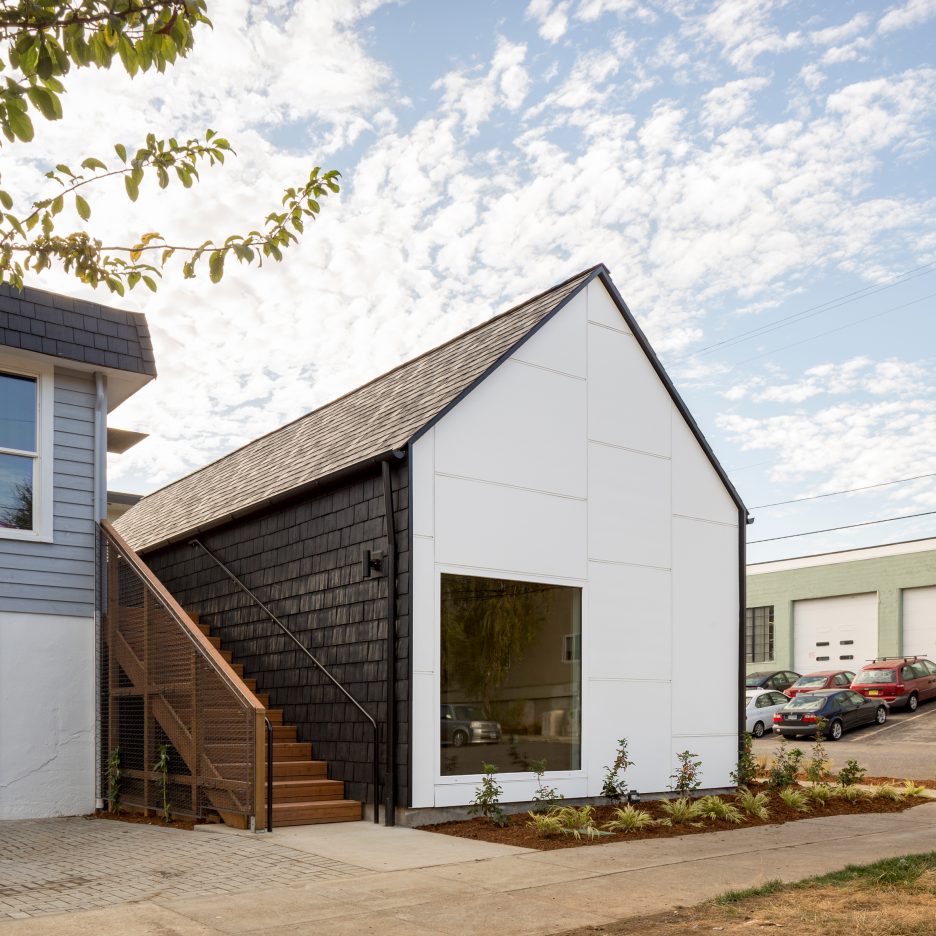
Architecture Building Culture adds housing units to postnatal recovery centre in Portland
Sides Core redesigns minimal hair salon to include library
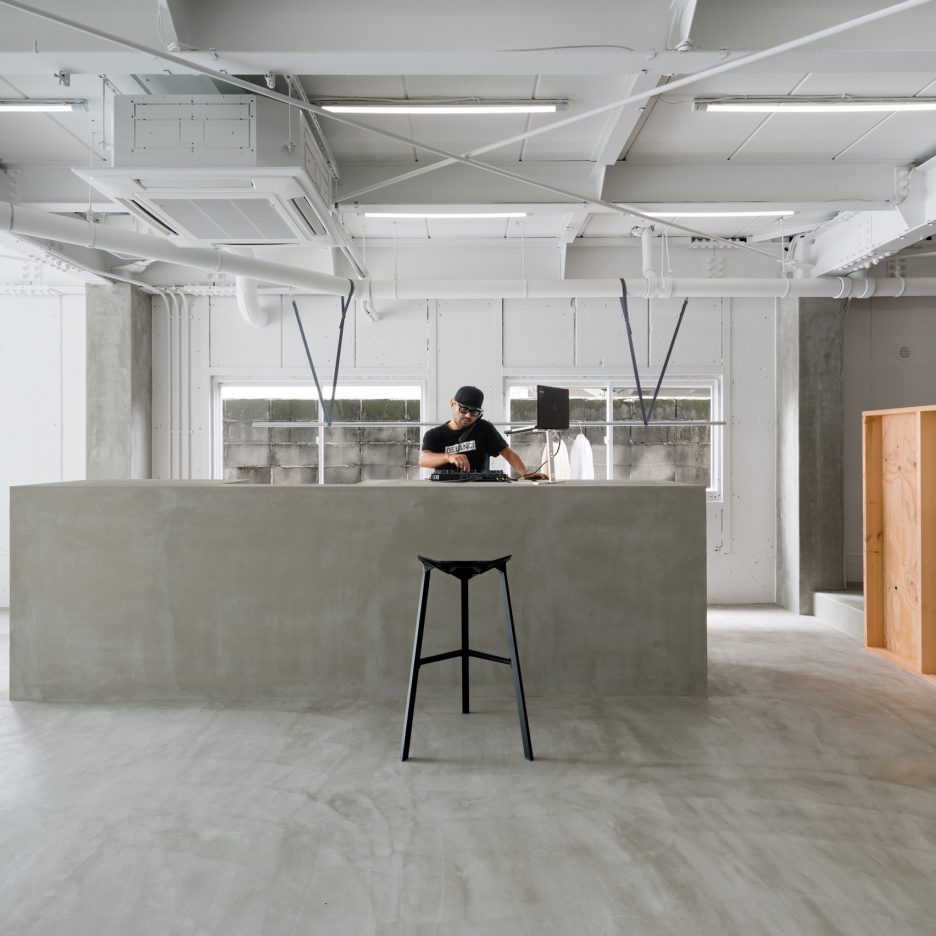
Japanese studio Sides Core has created a space inside a hair salon for the owner’s books, art and music (+ slideshow). (more…)
As.Architecture-Studio and VHA Architects Unveil Green University Campus Plan in Vietnam

Courtesy of As.Architecture-Studio and VHA Architects
As.Architecture-Studio and VHA Architects have unveiled their plans for the urban design and architecture of a new campus at the University of Science and Technology of Hanoi (USTH) in Vietnam. Located 30 kilometers east of Hanoi City, the new campus is designed to be a “New Model University,” and will feature facilities for administration, teaching, research, housing, student activities, services, and infrastructure.
Through its position around and across existing lakes, the project aims to offer researchers and students a living area structured by landscape. “The presence of water, along with the tropical architecture of the buildings and their specific technologies, will embody the unique character of the USTH being a Vietnamese University leading in sustainability and renewable energy.”
Courtesy of As.Architecture-Studio and VHA Architects
This “Water Park” will bring together all campus activities around a core, while also providing a place for quiet thought in a natural environment. The Park will include a variety of spaces, such as a plaza, landscaped banks, an “Isle of Contemplation,” gardens, strolling paths, and events spaces.
Courtesy of As.Architecture-Studio and VHA Architects
The entire campus will be oriented with the four cardinal directions, allowing for solar protection of buildings and natural acceleration of wind between buildings, but also for future possible expansions.
Courtesy of As.Architecture-Studio and VHA Architects
Courtesy of As.Architecture-Studio and VHA Architects
Courtesy of As.Architecture-Studio and VHA Architects
The Learning Center building will serve as the main entity of and gate to the campus. Here, students can access study rooms, reading rooms, and library space on each floor.
Courtesy of As.Architecture-Studio and VHA Architects
Six buildings on the north side of the Water Park will house faculty space, research offices, and classrooms.
Courtesy of As.Architecture-Studio and VHA Architects
Courtesy of As.Architecture-Studio and VHA Architects
On the east side of the Park, a shared facilities complex will feature six amphitheaters located between the ground and first floors.
Courtesy of Architecture Studio and VHA Architects
Courtesy of As.Architecture-Studio and VHA Architects
At the South-West corner of the Waterpark, the dormitories district is organized along the water bank. The lakes naturally isolate this living area from the campus teaching areas, preserving intimacy and creating a village atmosphere. The peripheral gallery provides a pedestrian connection to this district, across three bridges, from the Learning center facilities on the south side, and from the faculties on the north side. Each building is composed of an ‘apartment type’ layout, to create living communities at small scale. Natural ventilation is enhanced, from the ground floor to the roof level, through outdoor corridors and “wind towers”. Along the peripheral gallery, at the dormitories ground floor level, kiosks and small shops bring animation to this living district – said the architects in a press release.
News via As.Architecture-Studio and VHA Architects.
Young Architects Design and Build Iran’s First Free-Form Brick Structure

Courtesy of ADAPt
Using an array of programs available for public use, a group of young architects called ADAPt have designed and realized a unique free-form brick structure in Iran. The complexity of the structure is broken down into several layers and elements, all guided by the analysis and output of their digital toolbox. This iteration, titled “FaBRICKate” is the first in what is intended to be a series of investigations of this contemporary design method.
Courtesy of ADAPt
The FaBRICKate was developed primarily in the McNeel’s Rhinoceros, using a plugin called RhinoVault which enables “funicular form-finding.” RhinoVault works with structures that operate only in compression, and provides organic objects with real-world structural stability. It was developed by the BLOCK Research Group at ETH Zurich and is available for free download here.
Courtesy of ADAPt
The ADAPt team began with a plan and used RhinoVault to generate the 3D form. As the form was investigated, the team came closer and closer to reaching a vertical and horizontal equilibrium in the forces acting on the vault, and after 1410 iterations they hit the sweet spot. By applying the analysis of additional software, they were able to reinforce their original data and produce an extremely stable and visually interesting object.
Both Karamba and Grasshopper were then employed to simulate wind force and material properties, to ensure the effectiveness of the vault in real-world conditions. Two waffle grids – one as an overall grid, and a second, smaller one to help define the areas with more differentiation in their curvature – were applied to the structure as a series of steel rods.
Courtesy of ADAPt
Five different brick patterns were utilized in the design to maximize the flexibility of this traditionally linear material. By laying different sized bricks in different ways, it resulted in an interesting surface pattern.
Courtesy of ADAPt
For more information, including some videos of the FaBRICKate in action, head over to their Instagram.
Courtesy of ADAPt
News via ADApt.
Mailītis AIIM builds scaffolding and timber pavilion at Latvian brewery
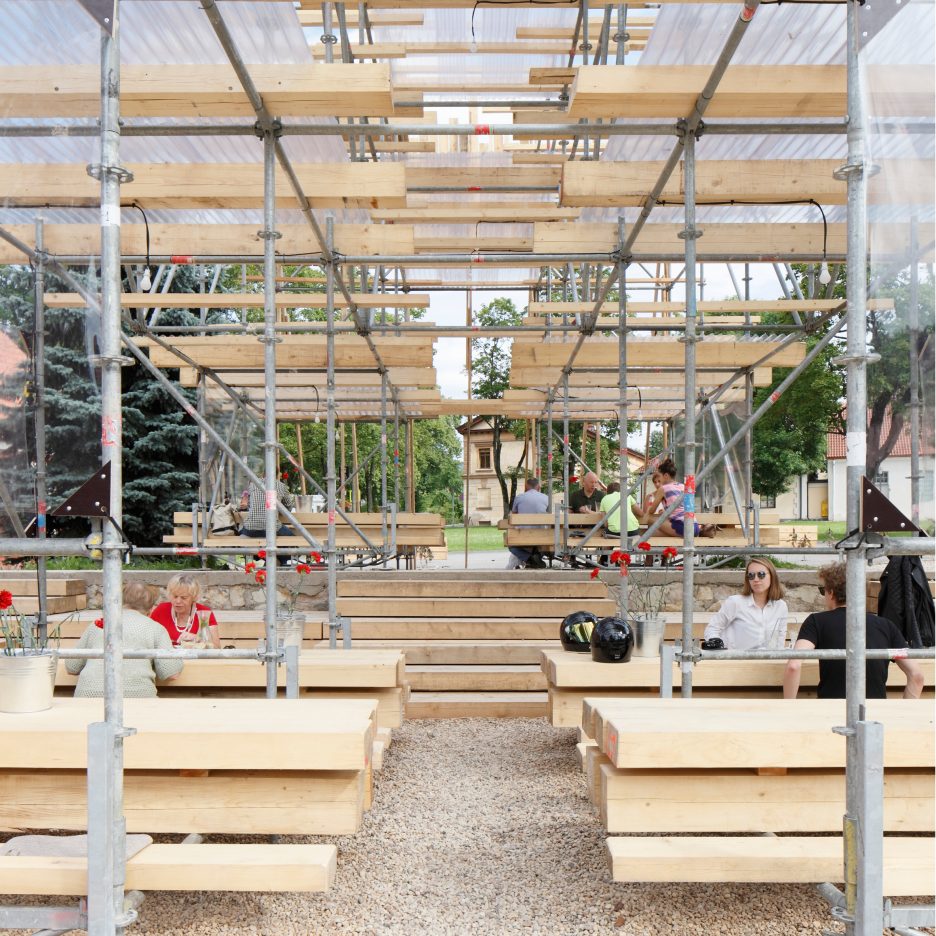
Riga studio Mailītis AIIM has used scaffolding poles, timber planks and corrugated plastic to create this events pavilion – one of three temporary structures built in the grounds of a former brewery in Latvia (+ slideshow). (more…)

