
FMG Monte Alegre is a private home located in Piracicaba, Brazil. It was designed by Urbem Arquitetura in 2015. FMG Monte Alegre by Urbem Arquitetura: “The architectural project thought of a house that should provide plenty of space for a middle-aged couple that often hosts friends and family, spending most time with their kids and grandchildren. The edification was set in as suburban district, in an enclosed allotment, build upon..
Iceland Trekking Cabins Competition Winners Announced

Courtesy of Bee Breeders
Architecture competition organizer Bee Breeders has announced the winners of the international Iceland Trekking Cabins competition, which called for entries to design a cabin with provision for enclosure, place, and social collectivity. As a structure for nomads and backpackers, Iceland Trekking Cabins are associated with cultural folklore and exist within the context of fjords, lava fields, glaciers, mountains, and the respective trekking ethos.
The competition furthermore sought projects that are “a supple and dexterous yet protected architecture, sensitive to the landscape though guarded against its severity, accommodating for the community, but in the company of strangers.”
The winners of the Iceland Trekking Cabins Competition are:
First Prize: Terra Firma / Deagan McDonald, Kelsey Nilsen; Canada
Courtesy of Bee Breeders
First place is awarded to a project distinguished by its clever articulation of the most basic elements of shelter — the roof and wall — to create a fully immersive experience. The shelter presents itself as an expansive roof, allowing the textured landscape to permeate through. Supporting the roof, gabion walls from local stone rise from the ground, appearing as pre-existing relics in the landscape. Arranged into three distinct volumes, the walls create both interior shelter from the elements and exterior gathering space. Elevated wooden platforms are inserted as needed in the interior, providing reprieve from the elements, leaving the local terrain largely untouched. The weight of the roof and walls celebrate permanence, while the porous quality of the material and spatial sequencing open the project to the transitory nature of the landscape.
It is in this delicate balance between rigid structure and an untouched landscape that the project finds resonance. The play between manmade and natural heightens the visitors awareness of surrounding, allowing protection from the elements while still remaining fully engaged within the environment. In a landscape where the temporal patterns of hiking and camping are lauded for a leave no trace transience, the shelter challenges the perception that permanence and obstruction necessarily go hand-in-hand, developing an architectural language that both monumentalizes the act of camping and allows natural systems of the site — animals, hydrology, and fauna — to flow through uninterrupted.
Second Prize: Iceland Trekking Cabins / Robin Krasse, Karl Lagerqvist, Mattias Dahlberg; Sweden
Courtesy of Bee Breeders
The success of the second place proposal for the Iceland Trekking Cabins competition lies in its simplicity and strength of parti. Three aligned and evenly spaced concrete cores contain the circulation, hearth, and bathroom of the cabin and also serve to elevate the structure above the ground. The light touch of these primitive elements on the fragile ecological landscape serves a triple function: allowing for extra shelter beneath the structure, creating a public gathering space, and solving the difficult problem of maintenance under heavy snow conditions. Materially, these cores are rendered as unapologetically raw concrete, an admission of the manmade substance of the structure in relation to the wild nature it sits upon.
The elevated portion of the structure is enclosed in a pitched wooden roof, evoking the dual vernacular of both provisional shelter and agricultural structures indigenous to the region. In addition to the plume of smoke issuing from the hearth and through the roof, the iconic symbol of the circular aperture inscribed in each gable acts as a simple lantern in the distance, beckoning the weary traveler. Once again, the parti presents its strength in the plan of the sleeping quarters: relating the structural bays supporting the roof to the dimension of the reclined human body and ordering the bunks around two shared public spaces flanking the hearth. This interior organization creates a harsh split between the space of the human and the terrain of the land, its interiority evoking the radical absence of the ground plane. The project thus proposes a prototypical shelter, but fine-tunes it to the fragility and potency of the Icelandic terrain.
Third Prize: Heima / Jonathon Donnelly, Jennifer McMaster; Australia
Courtesy of Bee Breeders
The third place entry for the Iceland trekking cabin proposal sets itself apart in the use of cabinetry as a language to create shelter. Through the dimensional unit of the tatami mat, the project creates a modular furniture system that defines the perimeter of the shared central space, creating a gradient between the common dining area and private sleeping cells. The furniture units are comprised of lightweight plywood and are a collection of bed, window, entry, and kitchen modules: each cabin unit can be adjusted, reoriented, and scaled to adapt to the uniqueness of the Icelandic landscape. This kit of parts is clad in polycarbonate skin, a material that in its obscuring translucency and reflectivity, mirrors the mercurial atmosphere of the Nordic sky. At night, it functions as a lantern, marking the terrain through the light that spills from its clerestory.
It is in this simultaneous suppression and celebration of the architectural object that a spatial nuance is added to the proposal. The project is an interrogation of interiority, using the device of the inhabitable cabinet to define and engage the public-private dichotomy of domesticity. A collection of discrete pieces, the furniture modules provide the infrastructure of the living space. Through the system’s logic of aggregation, the modules reinforce the frame of the cabin, leaving a generous space in the center for collective activities. Unifying the assemblage of furniture modules, the polycarbonate shell opens the interior to the landscape, enlarging the volume of the cabin and bringing in light, color, and texture of the Icelandic sky.
News and project descriptions via Bee Breeders.
Plumen designs bulb with faceted gold shade on the inside

Three-Family Home / Pool Architekten

© Ralph Feiner Fotografie
- Architects: Pool Architekten
- Location: Dörflistrasse 32, 8942 Oberrieden, Switzerland
- Area: 736.0 sqm
- Project Year: 2014
- Photographs: Ralph Feiner Fotografie
- Timber Construction & General Contractor: Schaerholzbau
- Landscape Architecture: Studio Vulkan Landschaftsarchitektur
- Construction Engineer: Ingenieurbüro Mathys
- Timber Construction Engineer: Lauber Ingenieure
- Hvac Planning: Gebr. Imbach
- Electrical Planning: Frey electric
- Building Physics: Raumanzug
- Gardening: Leuthold Gärten
© Ralph Feiner Fotografie
Integrated into the town’s ensemble of historic buildings, the three-family home has the look of a self-assured building block in the core zone of Oberrieden. Given the mix of mostly light-coloured stone buildings and dark wooden barns that is still typical of the area, the choice was made to build a house with a similar volumetry in timber construction.
© Ralph Feiner Fotografie
Section
© Ralph Feiner Fotografie
Through a bend in its longitudinal side, the building optimally brings views and sunshine indoors into the living quarters. The staircase inserted at the bend was made of exposed concrete for fire protection. Around this core are arranged prefabricated, rough-hewn wooden elements with visible nailed joints. The façade is made up of alternating vertical clapboards treated with pigmented linseed oil.
© Ralph Feiner Fotografie
Section
© Ralph Feiner Fotografie
Thanks to the open spatial concept, the apartments are suitable for various uses and lifestyles. Polished and oiled dark brown anhydrite screed flooring lends a warm and inviting atmosphere to the flats with their unfinished wood walls and ceilings.
Bernardo Rosello Designs a Family Home in Bahía Blanca, Argentina

House in Palihue is a residential project completed by Bernardo Rosello in 2016. The home is located in Bahía Blanca, Argentina. Photos by: Ramiro Sosa
Mischer’Traxler creates light mobile that dims when unbalanced for London Design Biennale
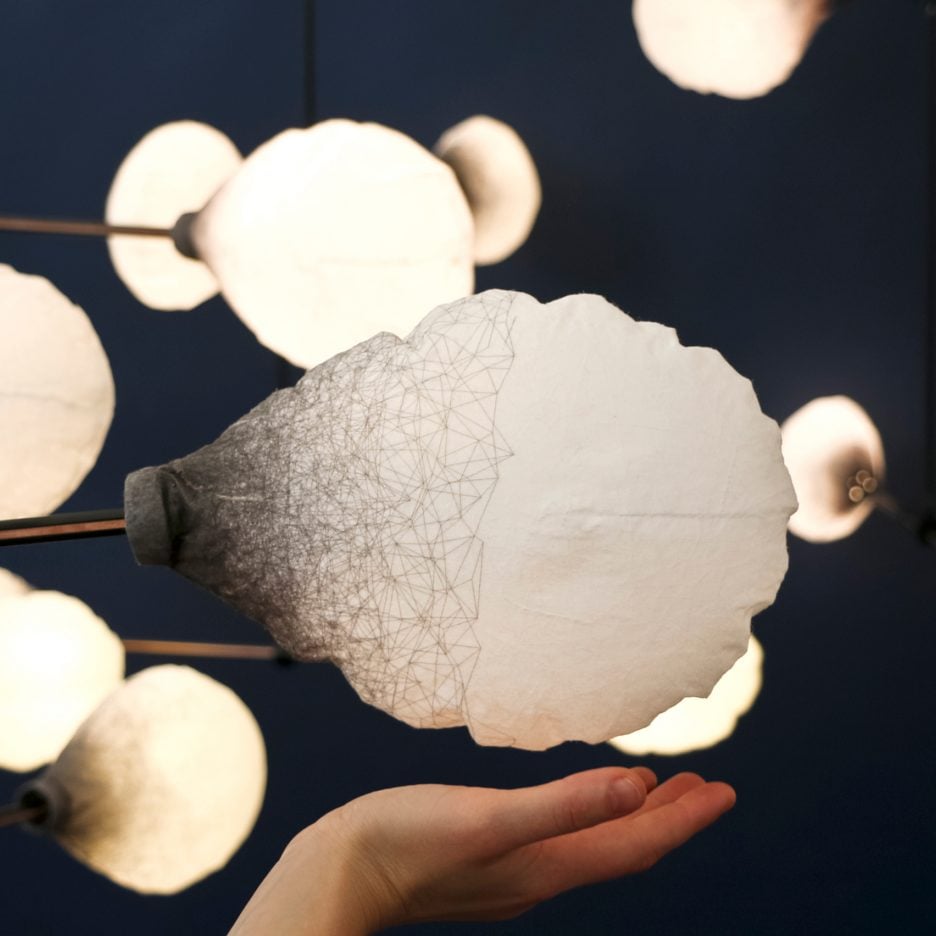
London Design Biennale 2016: Viennese design duo Mischer’Traxler has created a mobile-like light installation for the Austrian contribution to London’s first design biennale (+ slideshow). (more…)
Urban Cabin / DUS Architects

© Ossip van Duivenbode
- Architects: DUS Architects
- Location: Amsterdam, Netherlands
- Area: 8.0 sqm
- Project Year: 2016
- Photographs: Ossip van Duivenbode, Sophia van den Hoek, DUS Architects
- Pocket Park: Delva Landscape & Boomkwekerij Ebben
© Ossip van Duivenbode
DUS architects built an entirely 3D printed mini-retreat, to escape the speed of everyday city life.
© Sophia van den Hoek
The 3D printed Urban Cabin transforms a former industrial area in Amsterdam from a vast empty space into an urban retreat, complete with pocket park and outdoor bathtub. The building is a research into compact and sustainable dwelling solutions in urban environments. It is entirely 3D printed with bio-plastic and can be fully recycled and reprinted in the following years.
© Sophia van den Hoek
3D printed design
The design plays with the relations between indoor and outdoor spaces creating luxury within a minimum footprint. Entirely 3D printed with black colored bio-based material, it showcases different types of façade ornament, form-optimization techniques and smart solutions for insulation and material consumption. The floor and stepped porch are combined with a concrete finish creating a beautiful pattern that extends into a path in the pocket park. In the green around the cabin you can enjoy the sculptural printed bathtub, and watch the sunset surrounded by waving poplar trees.
© Ossip van Duivenbode
Sustainable solutions for the future
The 8 m2, 25 m3 house fits the ‘tiny house’ trend in which small dwelling designs solve large housing issues. The design comprises a mini-porch and indoor space in which a sofa can be doubled up as a twin bed. 3D printing techniques can be used particularly well for small temporary dwellings or in disaster areas. After use, the bio print material can be shredded entirely and re-printed into new designs.
© Sophia van den Hoek
© Sophia van den Hoek
The Urban Cabin is part of the 3D Print Living Lab by DUS architects. It is another step in using the in-house developed 3D print technology to build sustainable, customizable and on-demand housing solutions for the fast growing cities around the globe.
© Sophia van den Hoek
HAO Design Creates a Home with a Deep Sense of Connectedness in Taiwan

Blank is a residential project designed by HAO Design in 2015. It is located in Pingtung County, Taiwan. Blank by HAO Design: “HAO Design strives to achieve an optimal balance between space and lighting, which is why we chose to employ design methods that address the various limitations of the building. First, the partition walls of the mezzanine were removed, so that the 1.5-story floor height became the visual divide..
Villa CD / OOA | Office O architects

© Tim Van de Velde
- Architects: OOA | Office O architects
- Location: Oostduinkerke, Belgium
- Head Designer: Magalie Munters
- Project Architect: Hugo Crombez
- Area: 305.0 sqm
- Project Year: 2015
- Photographs: Tim Van de Velde
© Tim Van de Velde
The house is situated in a residential allotment with “bungalow” houses from the early sixties, surrounded by dunes, not far from the Belgian seaside. To bring the house into accordance with the surrounding houses and the enviroment and to answer to the building regulations, the design of the house was inspired by the bungalow typology. At first glance it looks like a single storey house.
© Tim Van de Velde
Next to the strict building regulations the residents had very specific demands; they wanted to live on the same level as the street, but they did not want passersby to be able to look inside. On the other hand they also wanted the possibility of inviting people, giving them all comfort, without loosing their own privacy.
© Tim Van de Velde
Plan
© Tim Van de Velde
The concept of the residence starts from a horizontal concrete plateau that cantilevers against a concrete conical wall. Underground, on the other side of the wall, two hidden rooms with patios provide a counterweight to the horizontal plateau. This conceptual approach answers the specific and seemingly contradictory demands. The bungalow is situated on the new concrete plateau hidden behind the concrete wall. It is carried by the platform, and can thus extend beyond that of the neighbors. It has a completely open view over the allotment behind the house and seems to release itself from the latter.
© Tim Van de Velde
The original site slopes down a full level compared to the rear of the garden.The platform, a table/land, allows the surrounding terrain to remain naturally rough (another building restriction). The main living areas seem to float over the landscape. On the other side, they are embedded in the gardenscape and connected to the street level.
© Tim Van de Velde
The plateau covers a carport situated on the lower basement level. The ramp with concrete staircase next to the slope leads to the entrance of 2 studios and the carport. For reasons of privacy, the studios with bathroom and kitchen are situated in front of the conical wall. A cutout in the horizontal surface has been made for these rooms that each have a courtyard providing air and light. This way, both studios can have big windows while preserving a sense of privacy and intimacy.
Plan
The positioning of the bungalow on the plateau creates large terraces for the residence (in the back as well as in the front) which can be used as an evening streetside terrace. The terrace is shielded by the conical wall, which is provided with a composition of cutouts devised to provide the residence with ample light, optimal view and elegant passage. This wall ensures the privacy of the residents while guaranteeing well-choosen views towards the street and the dunes.
© Tim Van de Velde
Schemata Architects frames Japanese boutique with gigantic display window

Schemata Architects and KHA Studio have transformed a space in Tokyo to create a minimal fashion boutique that is entirely visible from the street (+ slideshow). (more…)

