The commission arises from the principals need to have an enclosure where they can be isolated from the activity of the house, and then facilitate the development of functions more relaxed and much more connected with the landscape. It was to be an indeterminate space, since its use would also be indeterminate, but it should be comfortable in both winter and summer. This brief program was rounded off with the request of an outdoor bath and a small warehouse.
Starting from successive folds of the concrete enclosure, we managed to give this small building sufficient visual and audio privacy in relation to its surroundings, and thus to fulfill the request for a space to facilitate the realization of quiet activities and introspection. This feature also allowed defining an expansion that is extended to join the landscape, highlighting the access to both the bathroom and the multipurpose space, and leaving the warehouse hidden.
Day View of the Vessel. Image Courtesy of Bart//Bratke
California is suffering through its 5th year of severe water shortage. Aquifers and rivers continue to dry out as the water provided by melting snowpacks is reduced, and even the heavy rain brought by El Niño this year could not relieve the drought. Authorities are wary of the long-term consequences for California and neighboring areas of the Colorado River, and Santa Monica is now seeing a growing number of initiatives to control the use of potable water and find sustainable solutions.
Most recently, the Land Art Generator Initiative (LAGI) asked architects, artists and scientists to conceive sustainable infrastructure projects to improve Santa Monica’s water supply. The competition’s 4th-prize-winning team Bart//Bratke and studioDE developed a raft structure named “Foram” that illustrates the future of floating platforms in sustainable development.
Night View from the Coast. Image Courtesy of Bart//Bratke
Foram aims to desalinate sea water while providing a structure to educate people about water shortages. It is an amphibious pavilion supported on polyethylene boxes that floats along the Santa Monica coastline. The structure swells out into three “functional pockets” where visitors can learn about access to drinking water and the process of water purification. Each of the three protruding areas hosts a distinct activity – an eatery with self-grown food, a space for learning, and another for urban farming. At the pavilion’s center, a water bar also serves freshly desalinated H₂O.
Interior of the Pavilion. Image Courtesy of Bart//Bratke
The raft is covered by an organic-shaped roof made of a conduit system that transports water from the sea to desalination tanks, and then into clean water storage tanks. Similar to the raft plan in shape, the roof is rotated to allow for the collection of sea water in the spaces between the raft’s three prongs. At the low points of the roof, pumps send sea water to higher areas where it flows into the desalination tanks. These tanks also work as solar ponds, and the conduit system similarly collects solar energy to pre-heat the water for desalination. The whole structure also creates a comfortable microclimate, thanks to a cooling mist system that is integrated into certain pipes, and the natural ventilation facilitated by the roof’s chimney-like shape.
Section and System Integration. Image Courtesy of Bart//Bratke
Pavilion Alignment. Image Courtesy of Bart//Bratke
Pavilions can plug into one another to form an ever-expanding megastructure, allowing units to exchange water and increasing the usable surface area. Unfortunately, the design program stays largely the same when units are connected, merely offering larger public areas for the public to wander around. Defining the functional zoning on a wider scale – thinking in terms of megastructure instead of single units – could have contribute to the project’s development, and the design’s modular aspect thus seems like a missed opportunity. Notably, dedicating large areas of these floating platforms to urban farming could have been beneficial, given that agriculture suffers most in the Californian drought. Instead, BART//BRATKE mainly dedicated its Santa Monica design to the programmatic imperatives set by LAGI, and urban farming – spread in small lots across the overall megastructure – only serves a didactic purpose, and not a productive one.
Aerial Coast Assembly. Image Courtesy of Bart//Bratke
Nonetheless, BART//BRATKE imagines that its Foram raft could adapt to different locations, meeting different programmatic needs. As the architects explain, “the vessel can be applied globally wherever there is a need for fresh water and also is maneuverable which allows to bring Foram quickly into areas with an urgent need for fresh water” – a valuable trait, given the spread of water access issues across the globe. In an article about these global water shortages for The Observer, Robin McKie asserts that “the consequences are proving to be profound… More than a billion individuals – one in seven people on the planet – now lack access to safe drinking water.” With 71% of the Earth’s surface covered with seawater, combining desalination technology with floating architecture represent a powerful alternative; the Foram raft might be applicable to many more cases.
From the architect. Predominant materials: wood structure quinilla (bidentata manilkara), roofing in palm leaf (irapay, shebon), exterior walls quinilla and wire mesh, interior wood paneling: capirona (calycophyllum spruceanum), pavements in quinilla and shihuahuaco (Dipteryx Micrantha).
Location
Ani Nii Shobo, big house of the forest in Shipibo language, is a healing center and nature reserve based on the traditional medicine of the Shipibo people
The project is located on the banks of a lagoon near the native community of San Francisco de Yarinacocha in the Ucayali region in the Peruvian Amazon. The Ucayali river’s seasonal floods determine this landscape and its ecosystems with fluctuations of up to 8m that inundate and connect vast riverside areas. The project consists of a series of programs that are located along this variable edge between forest and water.
The situation of the trees and views was decisive to place the program. It was important to preserve and value preexisting conditions, favoring the the lake view of cabins and placing the dining under a group of old Pachucos, native trees with a slender pale trunk, contrasting with the proposed volume.
Axonometric
Axonometric
Axonometric
The project is based on the use of local materials such as capirona and quinilla wood and irapay palm leaf roofing. Constructive logic was sought on the observation of vernacular architecture, so that the project could be built by local craftsmen. A structural grid that simplifies modulation was used as well as constructive solutions according to local crafts.
To fit the extremely hot and wet climate of the region, the peoples of Amazonia have developed a simple yet specific system of rules, creating a n architecture based on the use of materials in the immediate environment. The Shipibo houses have tall roofs made of palm leaves with a steep slope which favors water runoff, while the hot air is concentrated at the top of the volume, creating a fresh and airy shade. In this space a deck, which is both the floor and the table of the house, concentrated daily activities, resulting in meals and long conversations accompanied by craft making.
This was the role we found for the collective dining room: a large shipibo house. The dining room can be completely open or closed yielding a covered terrace with a vented skin.
Covered outdoor margins create a shaded surround for habitations and an intermediate umbral for quotidian life. Walls themselves tend to merge with the roof or fade into a superposition of permeable
How to Succeed as a Young Architecture Professor (Without Dying in the Process)
In this article originally published in Spanish by the Arquia Architecture Foundation‘s blog, the author Manuel Saga speaks about the important task of involving young professors in architecture schools, arguing that it is essential that the academic route is seen as a real option with as much value as being a “big name designer,” especially when you take into account the current crisis seen within the industry.
Every year, Forbes publishes its “30 under 30” list that highlights the latest young entrepreneurs, creative leaders and brightest stars. According to MIT News, at least 25 of those on the roster are 2016 graduates of a prestigious university. More than five of those are graduates or post-doctoral assistants with teaching responsibilities. Not one of them is an architect.
Honestly, I’m not surprised at all. We can easily imagine a successful Wall Street broker without any gray hairs, but not a successful architect. Architecture is a complex and profound expertise; the great masters of the twentieth century are remembered in their later years possessing an unhurried wisdom. When we’re in our twenties we’re barely apprentices; sometimes explorers, even innovative, but lacking the holistic view that only experience provides. How the hell are we going to teach anything?
Don’t get me wrong. I think today it’s more necessary than ever for young professors to be involved our architecture schools. In addition to the growing diversification of our discipline, the crisis in the architecture field has made it so the academic route has become a legitimate option right up there with being a “big name designer.” An architect who built his career as a researcher or communicator will find teaching almost inevitable and take to it very quickly. How can we meet this challenge?
First, I recommend an act of freedom: put aside the “maestro” mentality and become a facilitator. Designing curriculums and lesson plans can become an adventure when you think of it as two-way communication. The teacher provides techniques for students to produce their own knowledge, which they then give back to the teacher.
Graphical presentation skills are perhaps the best example. In this subject the teacher hopes that, with the help of some basic but precise tools, their students surprise them with an exercise of absolute rigor. A surprised teacher is a satisfied teacher.
Leonardo's fake sketch of the first known depiction of a valve flush toilet; via Anthony Ravielli from Codex Madrid I, a page allegedly discovered in 1975. April Fool's joke by Martin Gardner, in Scientific American (April 1975).
Secondly, I think it’s key to start with a specialized area that allows us to impart our knowledge as we continue to grow. In this sense, being a professor of toilets for twelve years like Saenz de Oiza is a choice that is both enjoyable and smart. Whoever said that the ritual of going to the toilet doesn’t hold all the knowledge of architecture in itself? A starting point like that lets you reach diversity from a very specific starting point, an anchor that keeps us from drifting off too soon.
Not only do you have to be a good architect to be a professor of architecture, but most importantly you must be a good student. Demonstrating what a good student looks like, learning in an independent and innovative way, that’s the real contribution of a teacher. I wish that our inspiring quotations would resonate through the ages like the classical masters of the past; but in the meantime, you get to participate in an exercise of humility, teaching while continuing to learn.
Earlier this summer, the Vitra Schaudepot on the Vitra Campus was officially opened. The latest in a string of structures designed by emerging and well-known architects, this gallery space is the second building by Swiss-practice Herzog & de Meuron. Conceived as “a visible storage facility” presenting a cross-section of the Vitra Design Museum’s extensive collection of furniture and lighting, over 400 objects will provide “a comprehensive introduction to the history of furniture design.” Featuring a café, shop and a new entrance for visitors to the museum, the building is also able to host temporary exhibitions. Photographer Laurian Ghinitoiu has turned his lens to this latest addition in Weil am Rhein.
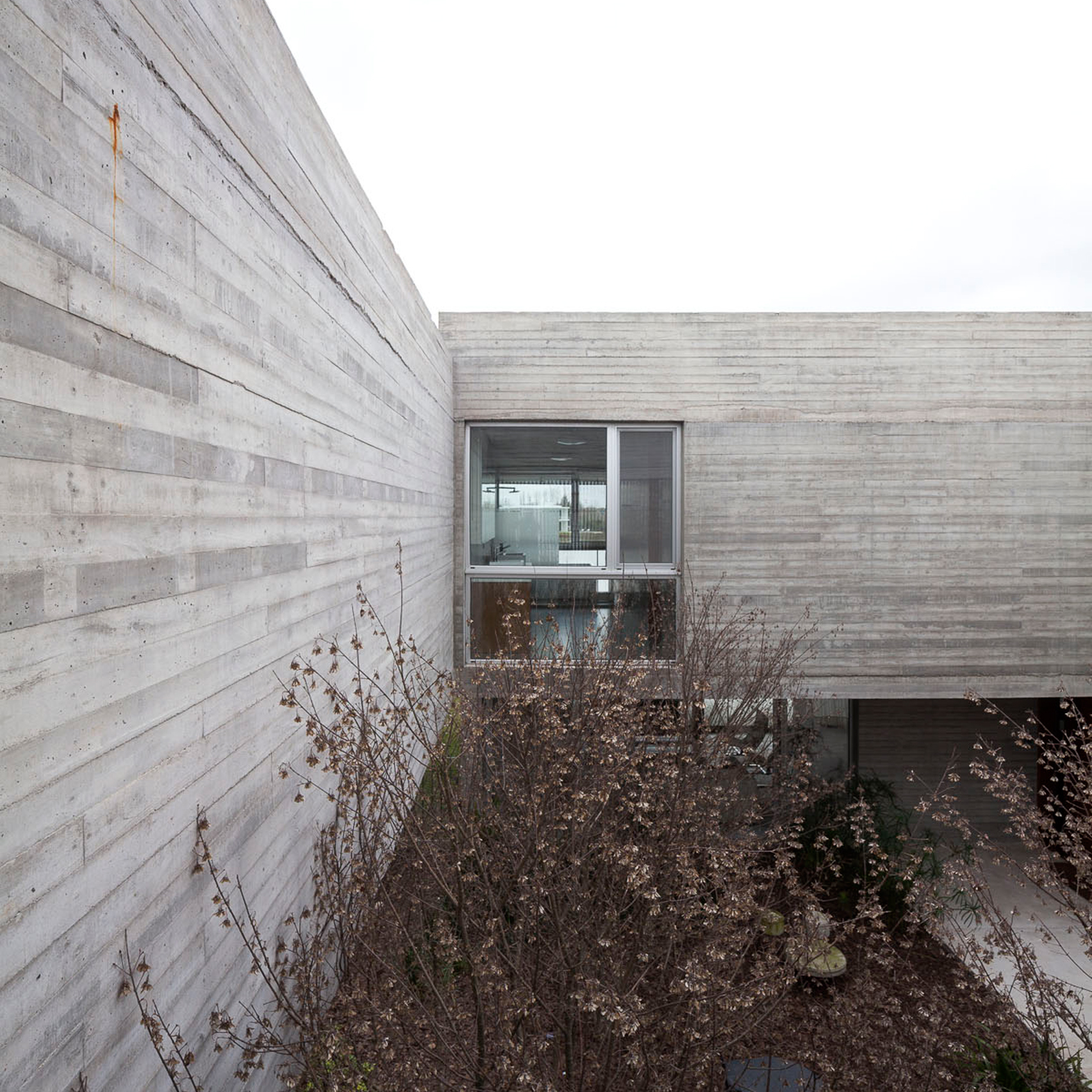
Board-marked concrete walls frame this Buenos Aires residence by Argentinian architect Federico Sartor, but at the back they give way to large windows, offering views of a courtyard and lake (+ slideshow). (more…)
TD House is a private residence designed by Sporaarchitects. It is located in Debrecen, Hungary and was completed in 2014. TD House by Sporaarchitects: “The concept of this house is based on both the traditions of early modernism in Debrecen and the simple, clear and logical construction of rural houses. The composition is open and closed at the same time, as the mass of the building is basically following a..



 Sig Nordal