5 Reasons Why Theodore Roosevelt Is Inspiring

I love to learn from great people and get inspired by their stories. Among them, Theodore Roosevelt (TR) is a favorite of mine. His story never ceases to inspire me.

Here I’d like to give you the reasons why I find TR inspiring. After reading them, I think you will agree with me that he is a great model to learn from.

Without further ado, here are five reasons why TR is inspiring.

1. His achievements are extraordinary.

The list of TR’s achievements is almost unbelievable. He is the youngest ever U.S. president, the winner of Nobel Peace Prize, and a recipient of the Medal of Honor. He also authored more than 30 books despite his busy schedule. He even had time to become America’s first brown belt in judo!

Franklin Roosevelt, his cousin who later became U.S. President, said that TR “was the greatest man I ever knew.”

2. He excelled in all five aspects of life.

There are five aspects of life. While many people excel in just one or two, TR excelled in all five. In fact, I have yet to find another person who excels in all five aspects.

Let’s see how TR did in each:

  • Working: The list of achievements above says it all. There is doubt about it.
  • Learning: He read three books a day while he was in the White House. Many people can’t read three books a month.
  • Physical: As mentioned above, he had a brown belt in judo. He was also a boxer. He thrived in physical activities.
  • Social: He was very good at connecting with people. In fact, he became an example in the popular book How to Win Friends and Influence People.
  • Spiritual: He maintained his integrity throughout his career. He was also a devout Christian: a Bible was found under his pillow upon his death.

3. He thrived in both “extrovert” and “introvert” activities.

Normally, people thrive in just one kind of activities that matches their personalities, either extrovert or introvert. But TR excelled in both kinds of activities.

He excelled in getting along with people, an “extrovert” activity. But he also excelled in writing, an “introvert” activity. Again, it’s difficult to find someone who excels in both.

4. He was a great learner.

TR was a curious person. He read books in different fields. He also had a photographic memory. He often cited passages from books that he hadn’t seen for years.

I think the main reason for this ability was his focus. While he was reading, he couldn’t even hear his name being called. He was totally immersed in the book.

5. He excelled in energy management.

An important factor behind TR’s achievements is his energy. His energy was so abundant that he was called “steam engines in trousers”. This abundance of energy allowed him to do things with focus and enthusiasm.

This is remarkable because he was physically weak as a child. He got sick often. But one day his dad challenged him to make his body, and he did. He began exercising intensely, and over time became the energetic person he was.

***

These are the reasons why I find TR’s life inspiring.

Any thoughts? Comments here.

http://ift.tt/2hEMqjv

7 Small Habits to Help You Handle The Overwhelm of Working and Living in the Digital World

How to Handle the Stress in the Digital World

“If you ask what is the single most important key to longevity, I would have to say it is avoiding worry, stress and tension. And if you didn’t ask me, I’d still have to say it.”
George F. Burns

“Give whatever you are doing and whoever you are with the gift of your attention.”
Jim Rohn

Life today is quite different compared to when I was a kid in the 80’s and early 90’s. Back then I had a TV with just a few channels and later on a Nintendo videogame. That was it.

Today many of us have smartphones that we use to browse the internet, to work and to play games. We spend a many hours in front of computers and a part of our day is often spent online.

There is so much information these days. So many potential distractions and sources that seem to have made people more stressed, overwhelmed and unhappy than they were in the past.

Working and living in this age isn’t always easy.

So this week I’d like to share 7 habits that help me to keep my attention on what truly matters – both at work and in my private life – and at the same time minimize stress and overwhelm.

1. Shut off notifications.

To find focus the first simple thing to do is to shut off notifications in:

  • Your email client.
  • Messaging programs.
  • Social media and gaming apps.

Then get back to what truly matters without those pings hanging over you and distracting you.

2. Keep your smart phone far away for quality time/work.

The simplest way to not be distracted all the time by your smartphone is to put up small obstacles so you don’t have that easy and tempting access.

Here’s, for instance, what I do when I work:

  • I put the phone in silent mode.
  • I put it in another room at the other end of our home.
  • Then I check it a few times a day for calls and text messages.

We often do the same thing during the evenings and weekends to make sure that the time we spend together is quality time and not time spent being distracted.

3. Unplug or use an app to keep your focus on what matters.

When I write a new article or work on a course then I usually do that disconnected from the internet.

If that’s not possible for you then try a program or browser addon like for example StayFocusd or Cold Turkey Pro to temporarily block the sites where you know you tend to procrastinate and waste too much time.

4. Disconnect over the weekend.

Stay away from work and offline over the weekend. Leave your work phone at your job.

If that’s not possible keep things to a minimum:

  • Leave that work phone in silent mode and check it just every 24 hours over the weekend.
  • Do a quick 2 min check of email once a weekend (that’s what I do).
  • Reply only to the calls, texts and emails that are very important. Otherwise, let them wait until Monday.

5. Focus your information inflow.

Ask yourself:

  • What email newsletters in my inbox have I actually read and gotten something good out of in the past 30 days?
  • What podcasts I have listened to that have given me value in the past month?

You can ask yourself the same questions for magazines, blogs and forums and so on. Then take 5-15 minutes to unsubscribe to the ones that just clutter up your inbox, smart phone, bookmark list and shelves.

Time is limited. So is your attention.

So use both of them in a way that enriches your life and that focuses on only the best information sources. This very simple exercise can be surprisingly effective to get rid of mental clutter too and think more clearly again.

6. Stop comparing your life to someone’s high-light reel.

When you start comparing yourself and your life to what old classmates, friends and celebrities share on Instagram or Facebook and you each day see how perfect and wonderful their homes, kids, work and lives are then that can create a lot of stress and erode your self-esteem.

So what can you do if you get stuck in this habit?

  • Remember that what they share is usually just the high-light reel of their lives, the most positive moments. The other stuff that is a part of life happens too, you just don’t see it.
  • Focus on comparing yourself to yourself instead. See how far you have come, what you have learned and what you have overcome.

7. Remember the 5 little words for sanity: One thing at a time.

When you’re feeling overwhelmed by all the tabs open in your browser or missed messages, when you’re distracted by something while trying to have quality time with your loved ones and when the stress is starting to build up remember those 5 little words.

Breathe and let them help you to connect with this moment and with simplifying things. Use them to slow down, to find clarity in what you need to do and to resharpen your focus and attention once again.

http://ift.tt/2hw6Qvx

In Memory of Juan “Brand” Cruz, a Man Who Inspired Me to Be Better

By Leo Babauta

About 10 days ago, my wife Eva’s father Juan “Brand” Salas Cruz passed away, and he left an immense legacy.

He also changed me in ways I am only now beginning to realize.

He was a man of fierce and immense love for his family and anyone whose life he touched — and he touched a lot of lives, for many years. My father-in-law Juan was a man who was there for anyone, whether you were one of his beloved grandchildren, nephews or nieces … or a friend of his at the Guam Legislature … or a fellow rancher who was in need. He was there, always.

He was the guy who was called when someone was in trouble. The guy who made huge amounts of foods for weddings, graduation parties, funerals, birthday celebrations. The man who would fight for his loved ones, would be a second father to nieces and nephews, would do anything at all for his brothers and sisters, who poured out love for his grandchildren.

He changed me, because I saw him live that message of love every day that I knew him. He changed me, because he inspired me to be a better man. And I love him for that.

A Life of Contribution

Juan Salas Cruz was born in 1948 in Santa Rita, Guam, when the village was still newly built in the red-dirt hills of southern Guam. It was shortly after World War II, and Guam was in ruins from war, when the Japanese occupied the island until 1944.

He was born to his parents Juan Camacho and Luisa Salas Cruz, the “Brand” family, and he was one of 14 brothers and sisters. So a huge family, one that is incredibly loyal to each other.

He served in the Navy in the Vietnam War, worked at the Guam Telephone Authority, and then he met his wife, Lourdes Santos, who he loved for 40 years. They had three children together: my wife Eva, along with Amy and Juan Jr. There was nothing he wouldn’t do for these three kids.

Juan worked for many years in the Guam Legislature, as chief of staff and key administrative staffer for several Guam senators. He was the man behind the scenes for many people in the government, the problem solver, the mover of worlds.

He was also the first person in his family to get a college degree, and he had a strong intelligence that he didn’t often show off but that you could see in his eyes and actions.

But he was not an academic: he was a fisherman and a rancher. He loved fishing with a “talaya” (the Chamorro word for fishing net) and would take his nephews and nieces with him to remote beaches to catch fish that he loved to barbecue. He absolutely loved his ranch in Dededo (in northern Guam) and raised pigs that he would roast for people’s special occasions, along with vegetables for his delicious soups. He was often found with red dirt smeared all over his clothes and cowboy boots after a long day at the ranch, and some of his best friends were his ranch neighbors.

How I Knew Him

Some of my favorite memories of him were were when I would help him cook. He had a huge outdoor kitchen with massive pots and pans that he got from Navy surplus, and it seemed like every week there was a big event he was cooking for.

I would help him make red rice (a Guam specialty), or make incredible amounts of fried rice, eggs, bacon, pancakes and more for family breakfasts on New Year. We would barbecue, smoke beef, fry fish, bake hams, roast pigs. And then after all that, we would clean those massive pots with a big spray nozzle and hose down the kitchen.

I remember helping him after a typhoon had devastated the island and we had no power or running water. He would drive his big red 4×4 truck around getting water for family members and friends, helping them fix their houses, cleaning up debris of torn-up houses and trees, getting equipment to whoever needed them.

I remember him with his grandchildren, my kids … and how they were the world to him. He threw big birthday parties for them, took them to the ranch to ride tractors and help feed the pigs, brought them donuts on random mornings just because he was thinking of them, made them their favorite dishes and desserts, was always looking for toys for them, and would kiss them as if it were the last kiss he’d ever get.

I know how much he loved his home island of Guam. There was no other place like it, and he would say, “Guam is good,” with a pride and love in his eyes. He loved the backcountry ranches but also the people in the villages, and he had friends everywhere. Everywhere. He would listen to island music (and also country music) and he talked to me about his pride in the Chamorro people.

His Love Lives On

It’s an understatement to say that loved his brothers and sisters and their kids — including his brothers and sisters on his wife’s side, and their kids, they were no different in his eyes, all family, all deep inside his heart. Love is a tremendous word, but it’s inadequate to express how he felt. He would do anything for them, and often did.

He had nephews who were sons to him, on both sides of the family. He had nieces who were daughters to him. And their kids were his grandchildren. He raised not only his own kids but many others, and they are so broken up about the loss of this father figure in their lives. He went to any length to help them, and taught them so much about life.

He is not dead, because he lives on in their hearts, in their actions, everything they do reflecting some part of him, from how they treat each other and others in the community, to how they made a huge fiesta spread with several dozen dishes last night to honor him.

He lives on in me, my wife, my kids. In his daughter Amy, in Juan Jr. and his wife Jenny, in every relative who loved him and wants to express that love in some way. He lives on in his wife, Lourdes, who now has to go on without her partner. I’m so sorry for your loss, mom. I’m sorry for everyone’s loss, because his cowboy boots can never be filled, nor can the place he holds in our hearts.

All we can do is live by his example, and be better people, out of love for him.

http://ift.tt/2gq1BQE

The Power of Determination

What do you think is an important factor for success? While there are others, I believe that an important factor for success is determination. Paul Graham – the founder of a startup incubator in Silicon Valley – wrote this:

We learned quickly that the most important predictor of success is determination… While it certainly helps to be smart, it’s not the deciding factor. There are plenty of people as smart as Bill Gates who achieve nothing.

In The Dip, Seth Godin wrote that there is a place on the way to success where you suffer setbacks. He called that place “the dip.”  This is the place where determination is needed.  Many people quit there, but winners will go through it. Determination can help you go through the dip and come to the other side.

A good example of this is the story of Elon Musk. He is now well-known for his audacious ventures such as Tesla and SpaceX, but back in the day, he had a humble beginning. He started his first business in an apartment with his brother. It was a startup called Zip2, and the idea was to “provide local businesses with an Internet presence by linking their services to searchers and providing directions.”

But it was in the 1990s and the Internet was still in its infancy. Most small business owners still didn’t know how the Internet could benefit them. As a result, they got zero sales. They couldn’t get a single buyer.

But they kept at it. They didn’t quit. They kept going door-to-door to sell the product despite many rejections. They also kept improving the product. Musk and his team had the determination to go through the dip, and long story short, the company became a success.

What you need in such a situation is a fighter’s mentality. In Musk’s own words, you need to have the mentality of a samurai.

Microsoft is another good example. Again and again, Microsoft started with an inferior product. The product lost in the market. But they kept at it; they kept improving the product. At the end, the product became a success and even dominated its category. That was the case with Windows, Word, Excel, and many other Microsoft’s products. Bill Gates and his team had the determination to keep going.

Determination is key. Whatever it is that you do, make sure that you put determination in the mix. But determination isn’t just not quitting; it also requires you to keep improving yourself. Just keeping at it without improving yourself is not determination but stubbornness.

One more thing: keep your life balanced. Some people have blind determination that sacrifices other parts of their lives, but that’s not the way to get true success. True success is about balance. That’s how you can live a fulfilled and meaningful life.

http://ift.tt/2hsKuK0

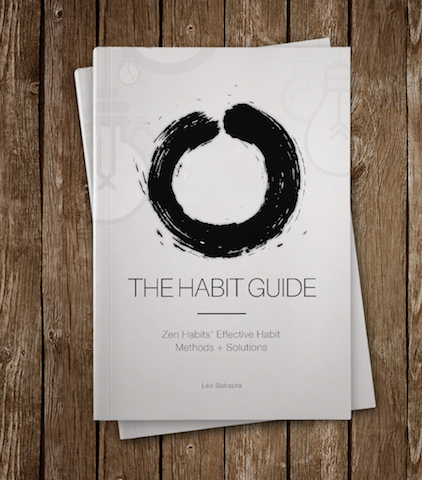
The Habit Guide Ebook: My Most Effective Habit Methods & Solutions

habitguidepic

By Leo Babauta

I’m thrilled to share with you my newest ebook about habits, and perhaps my best yet on the topic: The Habit Guide: Zen Habits’ Effective Habit Methods & Solutions.

I wrote this for the Kickstarter backers of my Habit Zen app (so if you’re a backer, don’t buy this, check your Kickstarter updates for links to the book) … but I also had all of you in mind. I think this is a great guide for anyone who struggles with habits

Some of the essentials from the guide:

  • The basic mechanics of forming a habit
  • The one reason we fail to stick to a habit
  • A dozen+ effective methods for overcoming that obstacle (tested by me and many others)
  • Solutions to the most common habit problems
  • A whole section on forming the most common habits: exercise, eating healthily, meditation, journaling, writing, sleeping well, beating procrastination and more.

Trust me, this book is packed as full as I could pack it with all the best methods for forming habits, ones that I’ve tested on myself and many people I’ve coached in the 11+ years I’ve been forming habits.

This book is aimed at:

  • Beginners who want a guide to forming habits
  • Anyone who has struggled with habits
  • People who are willing to put in the work to form one habit at a time
  • People who want to learn to be flexible, overcome struggle, form mindfulness

If you’re an advanced habit practitioner, you probably won’t need this. I only briefly talk about more advanced topics like quitting a bad habit or forming irregular or emotional/mental habits or other difficult practices. I’m going to put out a course in the Spring called “Habit Mastery” that will focus on these types of topics.

But for everyone else, I think this is a great guide. If you’re ready to change your life, one habit at a time, I highly recommend this ebook.

The Ebook & Two Package Deals

I’ve created a few options with this guide … the first is just to get the ebook, and the other two packages have some short videos I’ve created to go with the ebook.

You can buy just the ebook here (in PDF, Kindle & iBooks formats) for $5.99:

Buy the Ebook

The first package (let’s call it “Habit Gold“, priced at $9.99) also contains three videos to go along with the ebook:

  1. The Meditation Habit: How I’ve set up my meditation habit, what cushion I use, how I sit.
  2. Lentils recipe video: A video of me making the lentils, tofu and greens recipe I am currently eating every day.
  3. The Journal Habit: How I set up my journaling habit and what app I use.

You can buy the Habit Gold package with the 3 video downloads and the ebook in 3 formats here:

Habit Gold Package

The 2nd package (let’s call it “Habit Platinum“, priced at $12.99) contains six videos (the three in Habit Gold plus three more) to go along with the ebook:

  1. The Meditation Habit: How I’ve set up my meditation habit, what cushion I use, how I sit.
  2. Lentils recipe video: A video of me making the lentils, tofu and greens recipe I am currently eating every day.
  3. The Journal Habit: How I set up my journaling habit and what app I use.
  4. Mindful Eating Habit: How I practice mindful eating.
  5. The Writing Habit: My daily writing habit, what apps I use, how I write.
  6. Resistance Meditation: The crucial meditation on resistance described in the book, shown in action.

You can buy the Habit Platinum package with the 6 video downloads and the ebook in 3 formats here:

Habit Platinum Package

Contents

Here’s the table of contents:

Introduction: Why Habits Are Important

Part I: How to Stick to a Habit

  • Chapter 1: Overview of Habit Mechanics
  • Chapter 2: Why People Struggle
  • Chapter 3: Overcoming Resistance & Procrastination
  • Chapter 4: One Habit at a Time
  • Chapter 5: Prioritizing Habits & Balancing Multiple Habits
  • Chapter 6: Start Small, Take Tiny Steps
  • Chapter 7: Finding Time for Habits
  • Chapter 8: Remembering — Set Reminders for the Habit
  • Chapter 9: Deeper Motivation
  • Chapter 10: Fully Commit (& the Inertia of Starting)
  • Chapter 11: Don’t Overdo Your Habit
  • Chapter 12: Accountability & Unmissable Consequences
  • Chapter 13: Facing Resistance with Mindfulness
  • Chapter 14: The Just Get Started Mindset
  • Chapter 15: Rule – Don’t Miss Two Days
  • Chapter 16: Distractions
  • Chapter 17: Overcoming Disruptions Like Illness & Travel
  • Chapter 18: Overcoming a Slump
  • Chapter 19: Create the Right Environment
  • Chapter 20: Practice the Skill of Mindfulness
  • Chapter 21: Journaling & Reflecting
  • Chapter 22: Don’t Rely on Feeling Like It
  • Chapter 23: Don’t Talk Yourself Out of It
  • Chapter 24: Getting Through the Dip
  • Chapter 25: Restarting & Re-motivating
  • Chapter 26: On Consistency
  • Chapter 27: Overcoming Adversity
  • Chapter 28: Changing Your Identity
  • Chapter 29: Dealing with Negative Thinking
  • Chapter 30: Habit Questions & Other Struggles

Part II: Quitting a Habit, Common Habits

  • Chapter 31: Overview of Quitting a Bad Habit
  • Chapter 32: Irregular or Frequent Habits
  • Chapter 33: Eating Habits
  • Chapter 34: Exercise Habits
  • Chapter 35: Discipline, Procrastination, & Motivation Habits
  • Chapter 36: Meditation & Mindfulness Habits
  • Chapter 37: Sleep & Waking Early Habits
  • Chapter 38: Writing or Journaling Daily
  • Chapter 39: Financial Habits
  • Chapter 40: Notes on Other Habits

Book Formats

I’ve written the book in PDF, Kindle (mobi) and iBooks (epub) formats. You can buy them all in one compressed file here for $5.99:

Buy the Ebook

Kindle Store: If you just want to buy the book from the Amazon Kindle store, you can buy it here for $5.99. That will only be the Kindle format, though. I would love it if you gave me a good review and/or rating! (Note: It should be available in all of the global Amazon stores.)

iBooks Store: If you just want to buy the book from the Apple iBooks store, you can buy it here for $4.99. That will only be the iBooks/epub format, though. And again, I would love it if you gave me a good review and/or rating! (Note: It’s available in all of the global iBooks stores.)

Also, the Habit Gold package includes the three ebook formats (PDF, mobi, epub) plus a package of three videos for $9.99 that you can buy here:

Habit Gold Package

And finally, the Habit Platinum package includes the three ebook formats (PDF, mobi, epub) plus a package of six videos for $12.99 that you can buy here:

Habit Platinum Package

Table of Contents & Sample Chapters

If you’d like to see the table of contents, plus the introduction and first two chapters, you can download/open the PDF here:

Table of Contents & Sample Chapters

Questions

You have questions, I have answers.

Q: What do I get when I buy the ebook?

A: If you buy it using the blue “buy the ebook” button above, you’ll get a PDF with links to the PDF, epub (for iBooks) and mobi (for Kindle) files.

If you buy from the Kindle store, you’ll just get the Kindle book.

If you buy from the iBooks store, you’ll just get the epub version.

If you buy the Habit Gold package, you’ll get the three formats plus links to download three companion videos that I’ve recorded.

Finally, you can buy Habit Platinum Package with the 6 video downloads and the ebook in 3 formats.

Q: Is there a print version? What about an audiobook version?

A: No, sorry. This is only being released as an ebook.

Q: I bought the package, but where are the video files?

A: Open the PDF file you downloaded … there are links to download the video files in the PDF.

Q: Did you do the design yourself?

A: No, I wish! The cover was designed by Dave of Spyre, and the interior was designed by Shawn Mihalik.

Q: I’m hugely disappointed and want my money back!

A: I’m sorry to hear that. There’s a 100% money back guarantee on all my books. Just email support@zenhabits.net and we’ll give you a full refund. I don’t want unhappy customers.

http://ift.tt/2gdDS1Z

36 Inspiring Quotes on Letting Go and Moving On

36 Inspiring Quotes on Letting Go and Moving On

Letting go can be one of the hardest things to do in life.

But at the same time it can be one of the most powerful and liberating things too.

So this week I’d like to share 36 of the most thought-provoking and inspiring quotes from the past few thousands of years on letting go, moving on and living your life fully and happily.

I hope you’ll find something helpful here.

  1. “Some of us think holding on makes us strong, but sometimes it is letting go.”
    – Hermann Hesse
  2. “When one door closes, another opens; but we often look so long and so regretfully upon the closed door that we do not see the one which has opened for us.”
    – Alexander Graham Bell
  3. “Creativity requires the courage to let go of certainties.”
    – Erich Fromm
  4. “Breathe. Let go. And remind yourself that this very moment is the only one you know you have for sure.”
    – Oprah Winfrey
  5. “We need to learn to let go as easily as we grasp and we will find our hands full and our minds empty.”
    – Leo F. Buscaglia
  6. “There are things that we never want to let go of, people we never want to leave behind. But keep in mind that letting go isn’t the end of the world, it’s the beginning of a new life.”
    – Unknown
  7. “It is only through labor and painful effort, by grim energy and resolute courage, that we move on to better things.”
    – Theodore Roosevelt
  8. “The greatest loss of time is delay and expectation, which depend upon the future. We let go the present, which we have in our power, and look forward to that which depends upon chance, and so relinquish a certainty for an uncertainty.”
    – Seneca
  9. “Your past does not equal your future.”
    – Anthony Robbins
  10. “To let go is to release the images and emotions, the grudges and fears, the clingings and disappointments of the past that bind our spirit.”
    – Jack Kornfield
  11. “When I let go of what I am, I become what I might be. When I let go of what I have, I receive what I need.”
    – Lao Tzu
  12. “This is love: to fly toward a secret sky, to cause a hundred veils to fall each moment. First to let go of life. Finally, to take a step without feet.”
    – Rumi
  13. “Letting go doesn’t mean that you don’t care about someone anymore. It’s just realizing that the only person you really have control over is yourself.”
    – Deborah Reber
  14. “Nothing in the universe can stop you from letting go and starting over.”
    – Guy Finley
  15. “I demolish my bridges behind me…then there is no choice but to move forward.”
    – Fridtjof Nansen
  16. “Why do people persist in a dissatisfying relationship, unwilling either to work toward solutions or end it and move on? It’s because they know changing will lead to the unknown, and most people believe that the unknown will be much more painful than what they’re already experiencing.”
    – Anthony Robbins
  17. “We must be willing to let go of the life we’ve planned, so as to have the life that is waiting for us.”
    – Joseph Campbell
  18. “Courage is the power to let go of the familiar.”
    – Raymond Lindquist
  19. “Yesterday is not ours to recover, but tomorrow is ours to win or lose.”
    – Lyndon B. Johnson
  20. “It is impossible to live without failing at something, unless you live so cautiously that you might as well not have lived at all, in which case you have failed by default.”
    – J. K. Rowling
  21. “Stop acting as if life is a rehearsal. Live this day as if it were your last. The past is over and gone. The future is not guaranteed.”
    – Wayne Dyer
  22. “The most difficult aspect of moving on is accepting that the other person already did.”
    – Faraaz Kazi
  23. “Laughter gives us distance. It allows us to step back from an event, deal with it and then move on.”
    – Bob Newhart
  24. “Don’t dwell on what went wrong. Instead, focus on what to do next. Spend your energy moving forward together towards an answer.”
    – Denis Waitley
  25. “Holding on is believing that there’s only a past; letting go is knowing that there’s a future.”
    – Daphne Rose Kingma
  26. “Let go of your attachment to being right, and suddenly your mind is more open. You’re able to benefit from the unique viewpoints of others, without being crippled by your own judgment.”
    – Ralph Marston
  27. “When we go back in to the past and rake up all the troubles we’ve had, we end up reeling and staggering through life. Stability and peace of mind come by living in the moment.”
    – Pam W. Vredevelt
  28. “Just remember, when you should grab something, grab it; when you should let go, let go.”
    – Unknown
  29. “You don’t need strength to let go of something. What you really need is understanding.”
    – Guy Finley
  30. “There’s an important difference between giving up and letting go.”
    – Jessica Hatchigan
  31. “You’ve got to make a conscious choice every day to shed the old – whatever ‘the old’ means for you.”
    – Sarah Ban Breathnach
  32. “Leaders spend 5% of their time on the problem and 95% of their time on the solution. Get over it and crush it.”
    – Anthony Robbins
  33. “Anything I cannot transform into something marvelous, I let go.”
    – Anais Nin
  34. “The best skill at cards is knowing when to discard.”
    – Baltasar Gracián
  35. “Let go. Why do you cling to pain? There is nothing you can do about the wrongs of yesterday. It is not yours to judge. Why hold on to the very thing which keeps you from hope and love?”
    – Leo Buscaglia
  36. “You can clutch the past so tightly to your chest that it leaves your arms too full to embrace the present.”
    – Jan Glidewell

What is your favorite quote on letting go? Feel free to share the best one(s) you have found in this article or in your life in the comments section below.

http://ift.tt/2gFxCUd

The 5 Best Productivity Books to Read

I have read many productivity books over the years. These are books that aim to improve your personal productivity. They aim to help you get more done in less time.

Among them, I have some favorites. There are many other books on productivity, of course, but these are the ones that you should read if you want to read just a few of them.

Without further ado, here the five best productivity books to read.

1. The 7 Habits of Highly Effective People (book) (summary)

Years after it was first published in 1989, this book is still on Amazon’s best sellers list. That’s amazing because there are hundreds of thousands of books out there. But there is a good reason for that: this book works.

As the title says, the book covers the habits of highly effective people. Among them, the one that is particularly relevant for personal productivity is the third habit: Put First Things First. It uses a matrix (also known as the Eisenhower matrix) that divides your time into four quadrants: important and urgent, important and not urgent, not important and urgent, and not important and not urgent.

The matrix is a simple but useful tool for managing your time. It helps you see how you have spent your time. It also helps you plan your activities.

2. Getting Things Done (book) (summary)

Getting Things Done is also a book that’s still popular years after it was first published. The subtitle of the book describes the topic well: the art of stress-free productivity.

The book shows you how to be productive without being stressed. That requires you to have a productivity system where you can put everything in so that you don’t need to remember it. That clears your mind and helps you avoid stress.

I have been applying this principle for years. While I don’t follow the book’s method exactly, I have found this and other principles in the book useful.

3. The Now Habit (book) (summary)

Do you want to overcome procrastination? If you do, then this is the book that you need to read. It contains some effective methods to overcome procrastination and help you achieve your goals.

For instance, it shows you how to change your self-talk from negative to positive to overcome resistance. It also shows you how to use the concept of persistent starting to achieve big goals.

4. The Power of Full Engagement (book) (summary)

When it comes to personal productivity, energy management is actually more important than time management. If your energy level is high, you can get a lot of things done in a short amount of time. But if your energy level is low, you could spend a lot of time on something and still get almost nothing done.

The Power of Full Engagement is the best book I have read on energy management. It explains how to manage your energy in four dimensions: body, emotions, mind, and spirit.

5. The 4-Hour Workweek (book) (summary)

This book isn’t strictly a productivity book, but it contains useful tips to increase your productivity. One example is the Parkinson’s law which says that “work expands so as to fill the time available for its completion.” Accordingly, you should set yourself a short deadline in order to be efficient.

Another helpful tip is what’s called “the art of non-finishing.” It says that you shouldn’t feel obliged to finish something if it doesn’t give you enough value for your time. For instance, you don’t have to finish a book if you think you can get more value by reading something else.

****

I have found these books useful, and I believe they can help you form a solid foundation for productivity.

Do you have other productivity books that you’d like to recommend? Feel free to share them in the comments.

http://ift.tt/2gwBtjG

Video: How We Get Hooked, & How to Unlearn Our Patterns

By Leo Babauta

In more ways than we often realize, we get caught up in our stories, and get latched into mental patterns that leave us frustrated, angry, full of resentment … or cause us to procrastinate.

In other words, getting caught up is the cause of lots of our problems.

I recorded a webinar this weekend for my Sea Change members about how we get hooked into our patterns of fear, reaction, resentment, and more … and how to start changing our patterns to something new.

I’d like to share this video with you because I believe it will be helpful for many. If you’re interested in more on this topic, join my Sea Change Program today to take my newly launched video course, the Path of Fearlessness.

I’ve broken this webinar recording into two parts:

  1. Part I: My talk on the patterns of getting hooked, how to interrupt them, and how to form new mental habits.
  2. Part II: I answered questions on practicing at work and elsewhere, forgiving yourself, big past fears resurfacing, and more!

But if you want to watch or listen to the full webinar in one piece, you can download the full video here, or the full audio here.

Part I: Leo’s Talk (with notes)

You can download this video here, or download just the audio. Or watch below.

Here are the notes from my talk (video is below the notes):

  • Fear has so much power over us because it happens when we don’t notice, and we just immediately get caught up in it.
  • We procrastinate, we lash out, we get caught up in anxiety, we hide in our comfortable activities.
  • It’s a mental habit, of running from discomfort and running to comfort or pleasure. It’s hoping for something better, and then fearing we won’t get it.
  • Instead, we can be present with what is right in front of us … opening up to the task, to the situation unfolding, even to our feelings of fear and resentment and frustration.
  • There’s a feeling of getting hooked, and then going into a chain reaction of thoughts … the initial feeling of “I don’t like this” and then building up a case against the other person, against the situation we don’t like, or against ourselves.
  • It’s a physical feeling, this “getting hooked,” and we can learn to notice it. Spend the day today trying to catch yourself getting hooked, and pause. Notice how it feels. Try to become familiar with this, just as you start to get caught up in the chain reaction.
  • When you notice yourself getting hooked … and you learn to pause … you can actually change your patterns.

For me, I’ve noticed patterns of:

  • Procrastinating and wanting to avoid or run from discomfort
  • Anxiety
  • Rushing
  • Resentment
  • Comparing myself to others

In the webinar video, I talk about some of the replacement patterns I’ve been trying to form instead of these patterns.

Part II: Questions and Answers

You can download this video here, or download just the audio. Or watch below.

Questions answered in this video:

  • How to best remind yourself to pause and interrupt the patterns? It happens so automatically and fast. The idea of a practice day is great–but what about at work etc?


  • Besides focusing on the breath and pausing, is it helpful to ask ourselves “How can I best help this feeling in my body?”


  • I get especially hooked when there is some truth in “the story”. Any thoughts on this?


  • I like the idea of going below the story and I’ve done this and it works. Do you also find that sometimes you have to use the story to better understand the harmful patterns/attachments?


  • How do you go about forgiving yourself for automatically getting hooked in the past – for so much of your life?


  • The more I contemplate my fears, the more I seem to uncover. Am I missing something, or is this normal?

  • In the Fearless Sessions, I’ve been focusing on current fears, but after those seem less powerful, old big past fears are surfacing. I thought the old were gone, so does it ever end?
  • I learned that there are many people that are unenlightened and attempt to try to deny my importance. Am I justified to ignore them?


  • When we have the pattern of comparing ourselves and our ways of doing things with ours and when we feel better, sometimes I feel I can help others by telling them my/our way is better. But how can I tell whether my way is really better or I just feel so?


http://ift.tt/2gCjQPJ

Cyber Monday Deal: Get 60% Off My E-books

After the first deal on Black Friday, today I’d like to give you my second (and last) deal: for three days only, you can get my e-books for 60% off.

There are three e-books that you can get. The first one is Motivation Booster, a collection of my best motivational writings, revised and updated. The second one is A Dent in the Universe, a collection of business lessons from Steve Jobs that can help you build your own business. The third one is Wisdom of the Ages, a collection of the best quotes for living successfully.

You can now get Motivation Booster for $3.50 (normal price: $8.99), A Dent in the Universe for $2.70 (normal price: $6.99), and Wisdom of the Ages for $1.90 (normal price: $4.99). Or you can get all three of them for $6.90.

Please go through the links above for more information and get each book individually. Or you can click the link below to get all of them right away.

>> Click here to get all three books <<

I hope you enjoy the books. Have a great week!

http://ift.tt/2fIMQ9G

Black Friday Deal: Get 50% Off Blinkist Forever

Blinkist has a Black Friday deal for you: for one day only, you can get a Blinkist subscription for 50% off forever.

In case you aren’t familiar with it, Blinkist is a service that gives you the key insights of non-fiction books so that you don’t need to read entire books. Instead of spending days on a book, you just need to spend around 15 minutes. As a result, you can learn from a lot more books in the same amount of time. It’s a good way to learn more in less time.

Blinkist has an app available for iOS and Android, so you can read the content on your favorite device. I have been a happy subscriber for more than two years now.

Click here to get the deal. I’m sure you will find the resource useful.

http://ift.tt/2gFVF5Y