
Forest Lodge is a private home located in New Forest, Hampshire, England. It was designed by PAD studio in 2015. Forest Lodge by PAD studio: “Located within a clearing of New Forest Woodland PAD were commissioned to design a bespoke contemporary mobile dwelling. The mobile dwelling conforms to the 1968 Caravan Act and will be capable of being lifted once erected. The air tight, highly insulated dwelling is constructed to..
The Next Great Public Spaces Will Be Indoors. Are Architects Prepared?

Oslo Opera House by Snøhetta. Image © Snøhetta
This article by Kjetil Trædal Thorsen, the cofounder of Snøhetta, was originally published by Metropolis Magazine as “Opinion: The Next Great Public Spaces Will Be Indoors.”
Maybe with the sole exception of railway stations, public space is generally understood as outdoor space. Whether in the United States or in Europe, especially now with heightened concerns around security, there seems to be this determined way of privatizing everything that is indoors, even as we are increasingly aiming to improve access to public space outdoors. But in the layered systems of our cities of the future, we will need to focus on the public spaces that are found inside buildings—and make them accessible.


Section of Giambattista Nolli's 1748 map of Rome. Image <a href='http://www.lib.berkeley.edu/EART/maps/nolli.html'>via UC Berkeley Library</a> (Public Domain)
In 1748, Giambattista Nolli made this wonderful map of Rome where he only had two distinctions—what was private and what was public. Whether it was indoor or outdoor, whether there was a church space or a plaza, it didn’t really matter. It told a different story of the city. There are some examples from today—the roof of our Oslo Opera House is outdoors, for instance, but it’s on the building and publicly accessible. Opening up the Louvre and trying to let people walk through it 24 hours a day—as with the museum’s recent takeover by the artist JR—is another way of not making a distinction between indoor and outdoor public space.

Oslo Opera House by Snøhetta. Image © Snøhetta
These kinds of programming decisions are essential to the way new architecture typologies develop, and architects should definitely have influence on them. In certain situations, accessibility to indoor public space is enough. In other situations, you have to define the program for the particular indoor or outdoor spaces to be adequate. To use the example of the roof of the Opera House in Oslo again, it was basically programmed only for one thing, and that’s to be walked on, for a promenade. But on occasion, it could be reprogrammed to hold an outdoor concert. Or it could be reprogrammed against the original intention by skaters or by a biker who actually drives his motorbike up and down the roof.
Maybe the outdoor can be programmed in such a way that it unlocks the possibility of the public spaces indoors. There’s always a bit of urban planning in designing interiors. There’s always a bit of interior design in an urban space. There’s no question that interior architecture is professionalizing itself as well—interior architects are not seen as decorators of interior space anymore. The same is true of landscape architects. And those are only the traditional design professions.

Markthal Rotterdam by MVRDV. Image © Nico Saieh
Every architect doesn’t need to be trained in every specialized profession, but what is lacking is an overall understanding of how people should collaborate. That’s why we’ve introduced transpositioning as a working method in our office, where you not only sit around tables with a lot of specialists, but you actually swap professions during creative workshops. The only thing that can save the essence of architecture is some kind of collaborative model like this.

Markthal Rotterdam by MVRDV. Image © Daria Scagliola+Stijn Brakkee
By adopting this model, both in education and practice, I think we would be better equipped to fully understand the effects of programming. We are usually generalists enough to understand that a change of use is sometimes demanded and that we shouldn’t try to desperately hold on to certain kinds of programming. But the profession itself should, in my opinion, really contain that kind of knowledge, simply because it’s so tightly connected to the actual design task. How can we change the relationship between buildings and the public unless we’re directly involved in programming ourselves?
Kjetil Trædal Thorsen is a founding partner at Snøhetta. The firm’s recently completed projects include the Ryerson University Student Learning Centre in Toronto and the expansion of the San Francisco Museum of Modern Art.
http://www.archdaily.com/799165/the-next-great-public-spaces-will-be-indoors-are-architects-prepared
Residential Clusters Unveiled for Moscow’s New Silicon Valley

© Agence d’Architecture A. Bechu & Associés
In the beginning of 2010, Russian President Dmitri Medvedev announced the creation of a “Silicon Valley for Russia,” to be located in a southern suburb of Moscow, that would feature research facilities, university laboratories, start-ups, meeting hubs, and housing. After an international competition in 2011, each of the districts within this larger project was awarded to its own architect. After careful planning, Agence d’Architecture A. Bechu & Associés has unveiled its design for District 11 of the project.
Concentrating on ecological housing, this district will contain individual houses dedicated to researchers and their families, under the greater goal of positive social interactions.


© Agence d’Architecture A. Bechu & Associés
Like penguins gathering on ice in a circle to keep each other warm, one hundred villas are grouped in tens, in a vast clearing surrounded by a river to accommodate snowmelt explained the architects in a press release. This organization also allows for the formation of micro-communities around a central square, reminiscent of a village.

© Agence d’Architecture A. Bechu & Associés
Each of the villas will be unique, giving occupants their own identity within the urban ensemble, but will all feature a modular concrete frame, green roof, and use of renewable energy and water recycling.

© Agence d’Architecture A. Bechu & Associés

© Agence d’Architecture A. Bechu & Associés

© Agence d’Architecture A. Bechu & Associés
Public functions and common shared services will be located in a central area, in order to create a social link between residents.
Learn more about the project here.
News via Agence d’Architecture A. Bechu & Associés.
http://www.archdaily.com/799066/residential-clusters-revealed-for-moscows-new-silicon-valley
Job of the day: architects at MVRDV
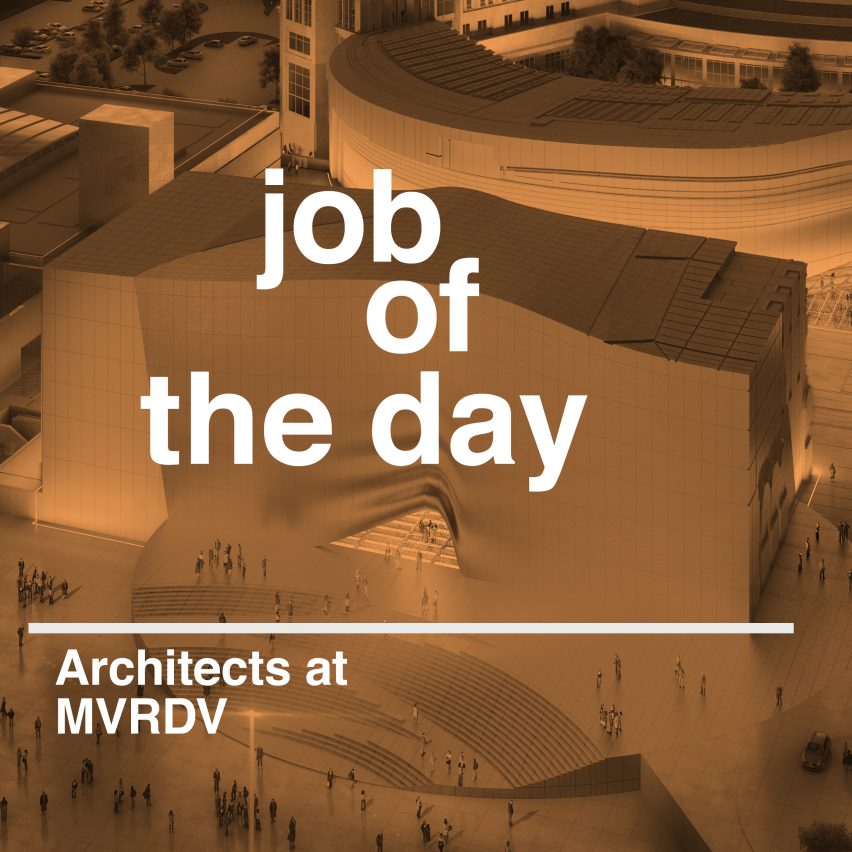
Our job of the day from Dezeen Jobs is for German-speaking architects at MVRDV in Rotterdam, whose design for the Paradise City entertainment complex in South Korea is pictured. Read more stories about MVRDV or browse more architecture and design opportunities on Dezeen Jobs.
http://www.dezeen.com/2016/11/10/top-job-german-speaking-architects-mvrdv-rotterdam/
Precarious Alpine shelter by OFIS offers shelter to Slovenian climbers
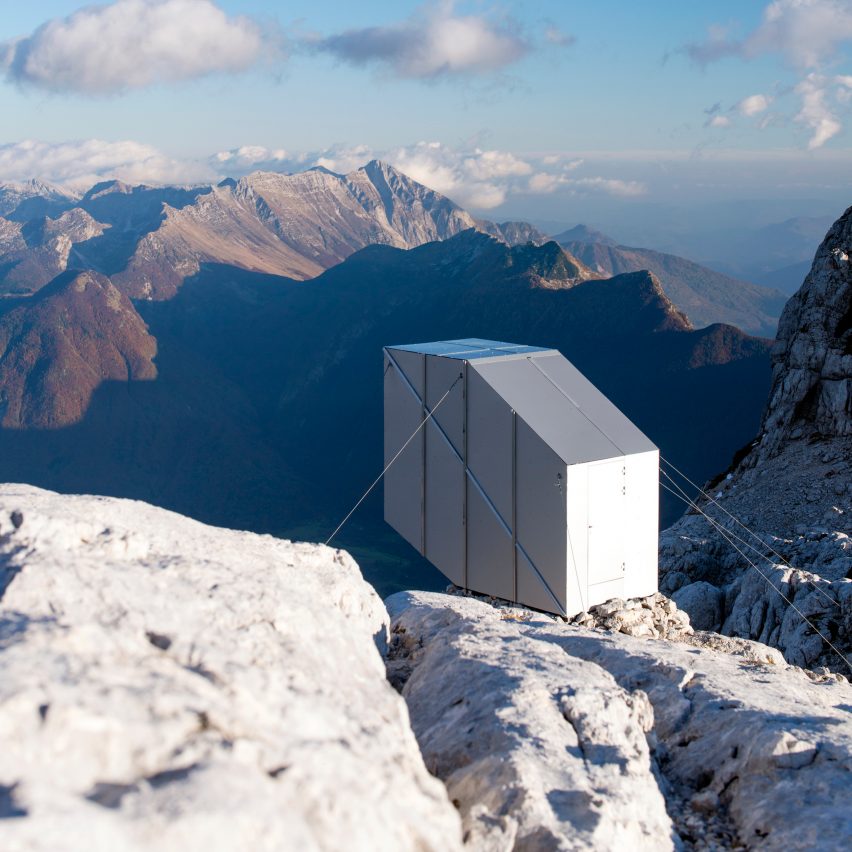
This tiny aluminium-clad cabin by Slovenian studio OFIS Arhitekti cantilevers over the edge of a mountain on the Slovenian-Italian border. Read more
Peter Saville designs laboratory-style glassware for Museum of Science & Industry

British designer Peter Saville has created a range of three glass flasks for Manchester’s Museum of Science & Industry. Read more
Walters & Cohen combines fluted stone and glass at London’s American School
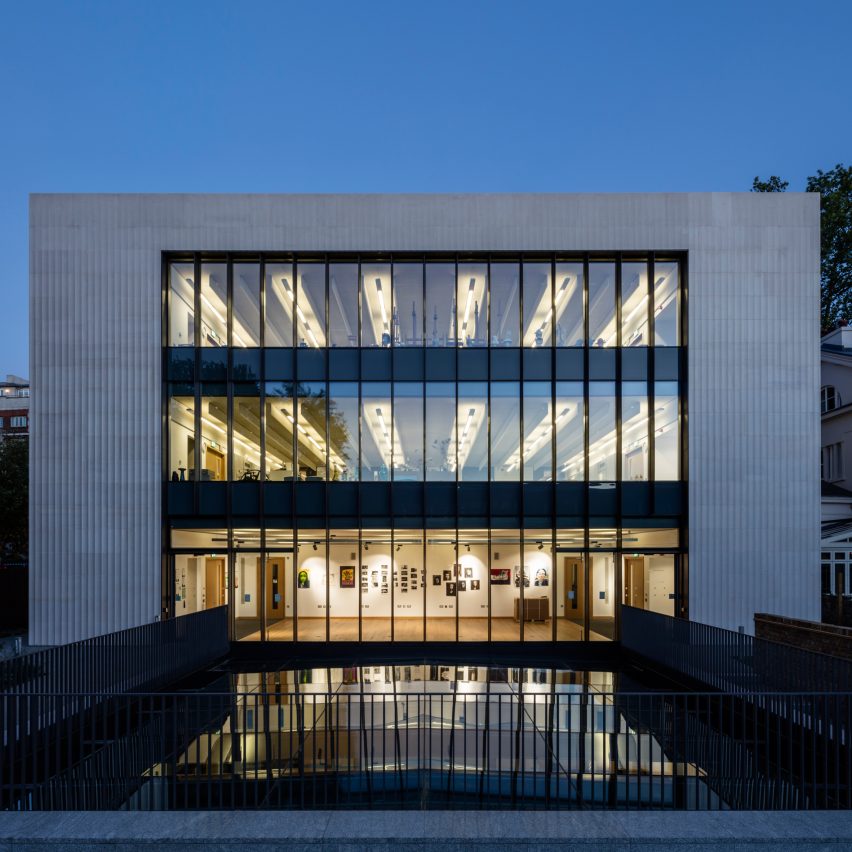
Fluted stone panels form a frame around a huge window in the facade of this building designed by Walters & Cohen Architects for the American School in London. Read more
http://www.dezeen.com/2016/11/10/walters-cohen-fluted-stone-glass-london-american-school-england-uk/
BIG completes pair of twisting towers in Miami’s Coconut Grove
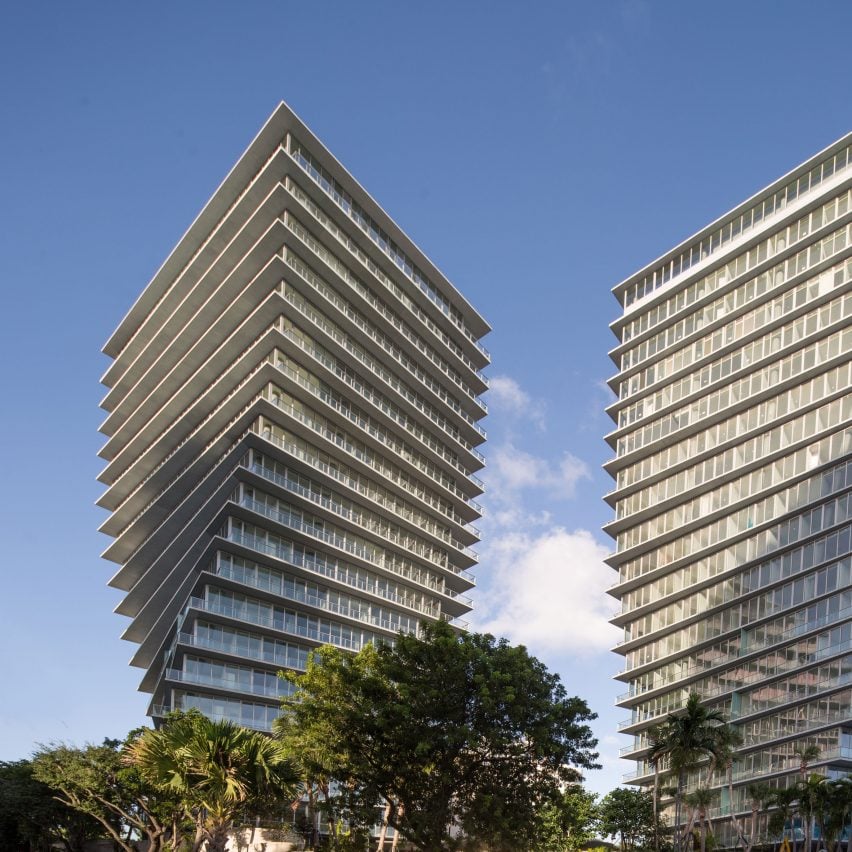
Work has finished on Bjarke Ingels Group‘s first condominium project in the United States, a pair of glass high-rise buildings that overlook Biscayne Bay. Read more
http://www.dezeen.com/2016/11/09/big-completes-grove-at-grand-bay-twisting-towers-miami/
Wehrhahn-Line Düsseldorf / netzwerkarchitekten

Pempelforter Strasse Station: “Surround”. Image © Jörg Hempel


- Architects: netzwerkarchitekten
- Location: Düsseldorf, Germany
- Project Year: 2016
- Photographs: Jörg Hempel, Achim Kukulis
- Kirchplatz Station's Artist: Enne Haehnle
- Graf Adolf Platz Station's Artist: Manuel Franke
- Benrather Strasse Station's Artist: Thomas Stricker
- Heinrich Heine Allee Station's Artist: Ralph Broeg
- Schadowstraße Station's Artist: Ursula Damm
- Pempelforter Strasse Station's Artist: Heike Klussmann

Graf Adolf Platz Station: “Achat”. Image © Achim Kukulis
From the architect. The Wehrhahn Line is the largest and most sophisticated recent urban development project in Düsseldorf, reaching its successful conclusion this weekend after 15 years of construction and planning. One highlight of the route is the design of the new U-Bahn tunnel and the six U-Bahn stations. Architecture and art strikingly come together, characterizing impressions of the spaces. The artists also contributed to the remarkable decisions as equal partners from the beginning of planning and have not permitted any advertising spaces in the new stations.

Pempelforter Strasse Station: “Surround” Model
The project was implemented by the office of netzwerkarchitekten from Darmstadt together with artist Heike Klussmann, who together in 2001 won the EU-wide architecture competition for all six stations against major international competition. Together they developed the overall concept of a U-Bahn tunnel as an “underground continuum,” similar to a giant snake as it slips through the earth, widening at the respective stations before continuing on its path. In contrast to the colored spaces of public space, it features a light relief-like grid structure. The smallest graphic unit of the design is a rhombus generated by the structural joints and constantly varied, resulting in a spatial drawing. The structure of Continuum systematically shrinks or expands resulting in a dynamic spatial effect.

Heinrich Heine Allee Station: “Three Model Spaces” . Image © Jörg Hempel
The stations are connected via openings to the urban space, each maintaining its own identity while acting as a connection to the city above. The central guidelines for the design of the stations were spaciousness, generous sightlines between platform levels and concourse levels, clarity, easy orientation and allowing as much natural light as possible deep into the stations. During the second competition in 2002, artists Ralf Brög, Ursula Damm, Manuel Franke, Enne Haehnle and Thomas Stricker were selected. Together with the architects each developed a specific design for the access areas of a specific station. Additionally, Heike Klussmann undertook the design of Pempelforter Straße.
Kirchplatz Station: “Track X” / Enne Haehnle

Kirchplatz Station: “Track X” . Image © Jörg Hempel


For the station at Kirchplatz, Enne Haehnle wrote poetic texts and then gave them sculptural life. The lines of text leading passengers down into the subway begin at the three entrances, lead down into the station, intersect there and then accompany the passengers to the tracks. A fourth text scrolls across the central skylight. The lines of writing, forged from steel cables that were then covered with a bright color, can each only be read from certain perspectives owing to their 3D qualities. A game between abstraction and legibility thus unfolds, depending on the passengers’ location and angle of vision.
Graf Adolf Platz Station: “Achat” / Manuel Franke

Graf Adolf Platz Station: “Achat”. Image © Jörg Hempel


Manuel Franke has used hundreds of panels of luminous green glass to create an immersive chromatic environment interrupted only by a powerful flow of lines that accompany the passenger from the street, through the concourse and down to the platform. Delicate linear subdivisions alternate with explosive bursts of color. These zestful colors were achieved by way of a specially developed analog process realized by an artistic intervention during manufacturing.
Benrather Strasse Station: “Heaven Above, Heaven Below” / Thomas Stricker

Benrather Strasse Station: “Heaven Above, Heaven Below”. Image © Jörg Hempel


Through a conceptual inversion of the space surrounding the architecture, Thomas Stricker has brought the universe, with its planets and stars, its tranquility and weightlessness into the underground world of the subway station. In cooperation with netzwerkarchitekten, the interior design of a spaceship was developed for the station. A stainless steel embossed matrix covers the walls, interrupted by large panoramic windows in the form of multi-media displays. These screens show 3D video animations of the universe, giving passengers a window looking out onto outer space.
Heinrich Heine Allee Station: “Three Model Spaces” / Ralph Broeg

Heinrich Heine Allee Station: “Three Model Spaces” . Image © Jörg Hempel


Ralf Brög designed the three new entrances to the Heinrich-Heine-Allee station as visual and acoustic venues for the performance of changing sound compositions – as an “Auditorium”, a “Theater” and a “Laboratory”. Each of the three model spaces boasts a high-quality sound system, enabling the most wide-ranging acoustic interventions possible; they can be used in coming years to present works by as broad an array as possible of composers and sound artists. For the opening, contributions by author and director Kevin Rittberger (Theater), composer Stefan Schneider (Laboratory) and musician Kurt Dahlke and artist Jörn Stoya (Auditorium) were to be heard.
The “Laboratory” focuses on the experimental use of tones. Sound sculptures hang in space while opposite the “Interference Atlas” visualizes optical phenomena. In the “Theater” a theater curtain can be discerned on the ceramic surface. Messages and other sound material is audible. Viewers find themselves asking where they stand: Are they a part of the play or are they the audience? The “Auditorium” is equipped with 48 loudspeakers that can be individually controlled. The 3D wall elements enable the spread of sound to be modulated, thereby optimizing the acoustic properties of the room. This equipment facilitates a unique compositional approach and an equally unique listening experience.
Schadowstraße Station: “Turnstile” / Ursula Damm

Schadowstraße Station: “Turnstile”. Image © Jörg Hempel


Ursula Damm has created an interactive installation involving multiple elements. At its center is a large LED screen displaying the real-time movements of passersby on the city surface – transformed through a computer program. The resulting images of small, virtual life forms are create through the constantly changing dynamic energy of the passersby. This concept recurs in the blue glass of the station’s walls. Geometrically interpreted aerial views of Dusseldorf are presented as whole or excerpts.
Pempelforter Strasse Station: “Surround” / Heike Klussmann

Pempelforter Strasse Station: “Surround”. Image © Jörg Hempel


At the Pempelforter Strasse station Heike Klussmann works with the 3D effects of the space’s specific geometries. She measured the station and transposed the measurements onto a 3D model. She took the directions of movement from each entrance, extended them into the station and placed four white bands, each with the same measurements as the entrances, as an inverted sculpture over the floor, walls and ceiling. The directions of the edges of the space were recorded so that they could break and process the geometry of the room. The band structure has an independent existence after breaking with the geometry of the space and as an inverted sculpture cuts across the perimeters of the station’s spaces. The resulting three-dimensional effect of this game with the dimensions of surfaces and spaces is surprising. It seems that the actual boundaries of the subway station have dissolved.
http://www.archdaily.com/799091/wehrhahn-line-dusseldorf-netzwerkarchitekten
Caroline Brodard Remodels a Home in Le Mont-sur-Lausanne, Switzerland

A Place Called Home is a residential project completed by Caroline Brodard – Architecture d’Intérieur. The home is located in Le Mont-sur-Lausanne, Switzerland. A Place Called Home by Caroline Brodard – Architecture d’Intérieur: “The remodeling of this house for a family of four children is about digging up old memories of my own childhood in a similar family environment. The existing house was dark and cold, so we first worked..

