… A really small facing South plot, the result of Judith’s parent’s house segregation…
This brief site description contains the main conditions to explain the project strategy: The size explains the height and number of floors (3) and the minimum occupation possible (40 m2). Parents are the reason to concentrate the free space converting the garden into access and lobby of the house. The orientation explains how the south facade is the main source of light and views; it does so without any limit, using a set of large recycled windows. The overtures are complemented by a polycarbonate greenhouse gallery that performs as heat collector and sun protector. Only the north facade contains other windows to allow good cross ventilation.
The stairs, single-section, transversal and reversible, acts as vertical circulation and distributor of the six resulting spaces, only the bathroom and laundry are specific to it’s function, the rest five assume in ambiguous way the domestic program awarded at the end by customers. The spaces are highly characterized in terms of geometry, material, and comfort but little in terms of function.
A good friend of mine bought an old house some years ago and asked us to develop a concept for its refurbishment. It became the first project of our Hamburg-based architectural studio, asdfg Architekten: the conversion of an old miller’s house into a home for a family with three kids. Due to its history and location, we considered the project a big challenge, but we also saw significant potential for it to become a very unique single family house with a small garden in the center of one of the most popular neighbourhoods in Berlin.
Because of its status as the oldest building of Prenzlauer Berg (built in 1844), the authorities asked us to reconstruct the facade of the heritage-protected building precisely as depicted on a historical drawing from 1844. We wanted to show the history of the old building, but we didn’t want to pretend that the facade would be 170 years old. In an architectural drawing, a line can be interpreted in many different ways: e.g. as a gap in the wall, a section line or a difference in height. The concept we developed was to argue that the lines in the historical drawing could be read as differences in the height of the plaster-rendered facade using ancient techniques and materials. It took us quite some time and many visualisations and physical models to convince the authorities of our approach. As a result of its prior use as a police station and a workshop, followed by many years of vacancy, the house was in a very dilapidated condition, and the interior was divided into many very small rooms. In order to create a generous space, we only kept the outer walls and one massive wall in the middle. The staircase, kitchen, as well as the sleeping galleries for the children are ‘plugged’ into this wall. The main inner-staircase is divided in two parts. The first five steps lead through the big wall on a small platform, where it is possible to experience the full height of the main room. The second part hangs from an open gallery which spans from one wall to the other, creating the parents’ working and sleeping spaces, which are separated by a huge sliding door. For the staircase and the kitchen interior, we reused the wood of the old beams of the former ceilings. The old brick walls were left uncovered and are visible from the inside.
The design process was carried out in close consultation with the client, which resulted in many highly personalized and individually created elements. Not only the cabinets, but almost everything, from the shutters to the washbasins and even the bathtub, was custom made for this project.
Just 15 kilometers far from the center of Hanoi, the suburban district Dong Anh has witnessed pervasive urbanization – one of the major causes for a trend towards a maximum use of volume and quantity of construction areas. Lesser importance has been attached to the quality of used space and surrounding scenery. This has resulted in a large number of “suffocating” buildings as often found in newly planned, stuffy urban areas characterized with land plot subdivision for building row houses in Vietnam.
Diagram
A “properly breathing” solution
Featured in both living and working space, a “properly breathing” house serves as a solution to the quality improvement of used space by creating a natural sense of breathing rhythm in monsoon tropical conditions, which is attributed to the two built-in functions: The Inside and outside. The inside offers many voids while the outside has double-skin facade including the inner layer as all-glass panels; the between as corridor for movement; the outer layer as recycled ceramic bricks (40cmx40cm). Pot plants are also randomly arranged to absorb the humidity and mitigate calorific radiation.
Together with the inner duplex, the layer of ceramic bricks is to purify dust and smoke, suck in fresh air and take heat away through open panels alternated with pot plants on the facade. This filter helps revitalize the architectural space by balancing the breathing of human and nature, and promoting the connection and interaction between the inner and outer scenery, roofs with creepers above and pot plants and vegetables below, sunlight and shade,…
As a breathing space is only considered an existence; therefore, a properly breathing space is required so that it can breathe properly towards a healthy life in both natural and socio-cultural habitat particular to each region. In this sense, the properly breathing house is expected to contribute to highlighting the local architecture in a current global context.
From the architect. The Ji County Geological Museum has taken “the exhibition of the history of tier and fold of rocks” as its theme, using stones of rare shapes which have evolved over billions of years to construct the outline and space of the museum. The museum imitates the special forms of geological structure, forming a spiral plane layout.
Master Plan
The irregular curving eaves and the newly built wall made of the stones from the discarded mountain houses look just like laminating stratum formed after billions of years’ sedimentation.
The architecture looks so natural as if it is grown from the underground layer after layer, showcasing the unique charm which can only be seen after great changes.
From the architect. Learning and training center for hair and beauty students located in the most prestigious area of Gangnam. The 8-story building includes training rooms, auditorium for large seminars and cultural events, and a rooftop penthouse lounge space.
The main training salon is a double height space on the 5th floor that is the showcase for Juno Academy. The highlight of a multi-level academy for hair and beauty, this space can transform into a venue for presentations, seminars and shows. Free-standing designer stations are easily movable allowing flexible layouts. The raw-industrial materials of pre-cast cement blocks and brushed-finish bronze ceiling panels extend outward to the underside of a double-height cantilevered terrace. Images of the moon are projected on this ceiling at night contributing public art to one of the most exclusive retail districts in Gangnam.
Exposed concrete block columns are spaced according to the designer station module emphasizing the verticality of the space and bringing texture and scale to this large volume. The upper level offers views of the training activity below for visitors.
The building sits on a narrow site with the main stair and elevator hall taking up over a third of the floor area. In order to maximize the public space, these fire separate halls are opened to the main function spaces so that there is constant interaction between them. The halls are used as an informal lounge space with the walls showing the history of the academy and expressing the vision and mission of its founder.
Floor Plan
Floor Plan
Floor Plan
The top floor with access to a lush roof garden is based on a library loft concept with sitting, dining and open kitchen areas. The library bookshelves with a mezzanine level filling the entire wall is the centerpiece of the space. Natural walnut wood floors and long dining table, wood slat ceiling, copper mesh between the kitchen and dining, and brushed metal finishes continues the industrial theme but with a much warmer tone, color and lighting. Its become a favorite place for meeting, dining, and informal parties.
To accommodate large conferences and events, the basement level maximized the site area by pushing the walls to the site boundary line and eliminated columns by transferring all the structure to the outside building line. The column-free space with 5m high ceiling has movable walls for flexible space configuration and full-height pivoting glass entry doors to allow the space to flow into the foyer area. With a sunken garden planted with giant bamboo trees, this basement level gets plenty of natural light and ventilation.
The typical training spaces follow the same layout as the main training salon with island movable training stations, and fixed stations along the wall. The color and material concept in wood, metal, and exposed concrete floors continue here with details and lighting to match the scale of the space.
The church for 1,100 people is part of a three phase project for a Catholic parish in Oceanside, with which the firm has worked for over twenty years. Located on a hillside at the intersection of Melrose Road and Cannon Drive, the parish grounds also include a 4,000 square foot community hall, administrative offices, and surrounding garden courts.
The church is built on the highest elevation of the site, with a 60 foot bell tower lending visibility and definition from afar. The solid volumes flanking the bell tower oppose harsh Western sun with staggered walls and clerestories that filter light softly into the interior.
Inside, the design of the sanctuary celebrates the congregation itself as the center of liturgy. Pews made of cherry wood from the Pacific Northwest are arranged in a semicircular layout to encourage interaction and visibility among parishioners. Overhead, cherry ceiling louvers envelope the congregation and choir, providing a sense of warmth and unity.
At the altar, angled walls of cross-cut Chilean travertine and raw concrete deliver diffuse light onto the sanctuary’s focal point—the crucified corpus. The bronze sculpture was created by artist Lynn Kircher; the cross frame by Renzo Zecchetto Architects.
The building takes advantage of natural sea breezes for cooling. An underfloor plenum supplies conditioned air through the perforated supports of the pews.
The eastern elevation is defined by transparency and openness: the narthex is here reimagined as a curtain wall and overhang that welcomes parishoners directly from the courtyard and gardens.
The glazed courtyard doors further increase accessibility and visual connection to the rest of the campus and its outdoor spaces which, thanks to the temperate Southern California climate, provide year-round places for contemplation and repose.
Jean Nouvel visiting the Mohawk Theater, with the scale model of the Empire State Building under construction for the forthcoming Extreme Model Railroad and contemporary Architecture Museum in Heritage Park. Image Courtesy of North Adams Office of the Mayor
Jean Nouvel is engaged in talks to provide master planning concepts for the town of North Adams, Massachusetts, home to the renowned art institution MASS MoCA and a few miles from the Tadao Ando-designed Clark Art Institute. Initial discussions have included preliminary design proposals for three buildings in the city center along Heritage Park and on Main Street.
The new plan would be tasked with contributing to the economic revitalization of the city’s downtown, and would need to respond to the MASS MoCA campus, itself master planned with consult from Frank Gehry, Robert Venturi, David Childs and Simeon Bruner of Bruner/Cott & Associates.
Jean Nouvel taking a tour of MASS MoCA with Director Joseph Thompson. Image Courtesy of North Adams Office of the Mayor
“The concept of a cultural corridor in northwest Massachusetts is unique,” said Nouvel in a statement. “The existing institutions are phenomenal. The combination of elements that exists here is like no other that know of. The landscape, the topography, the colors, and the collision of Main Street, the overpass, and the railroad lends itself to an extraordinary and precise intervention or series of interventions that would preserve the scale of the city, and build on the concentration of cultural resources in the region.”
Left to Right (Jean Nouvel, Nicolai Ouroussoff (former chief Architecture critic of the New York Times) and Richard Alcombright, Mayor of North Adams. Image Courtesy of North Adams Office of the Mayor
From the architect. Wave Housing is situated in Otes, the suburban neighbourhood of Sarajevo, with the river and mountains as its close and distant surroundings. In order to extend the interior space of the apartment towards outside and the views, the wave-like structure is added to the regulated building volume from 2nd floor upwards. In this way, each unit is given a lavish and unique outdoor area/terrace, making it a defining architectural element of the project. While the inner facade of the building is clad in warm wooden ribs, outside is kept simple in white plaster with metal screens providing additional visibility protections to the apartment terraces.
Product Description: Local materials Facade: Composite wooden vertical panels 4x4cm made from local spruce and fir tree. Panels are placed vertically at intervals of 1 cm and skirting laths 4×7 cm with vertical reveal façade openings and the thermal insulation boards of rock wool 12 cm thick laminated with black fibreglass mat. Glass: Triple pane glass units – combination of 4.2.2 + 16 Argon +6 Low E Safety network on the balconies: Galvanized iron profiles painted in white colour with all necessary preparation work. The network consists of squares derived from iron sheet 40×4 mm external size of 114×114 mm with all the peaks associated with cross stitch of iron with a diameter of 8 mm. Hresa stone: local stone quarried from the surrounding hills highly resistant to cold and heat. Used for lining the main staircases and entrance hall.
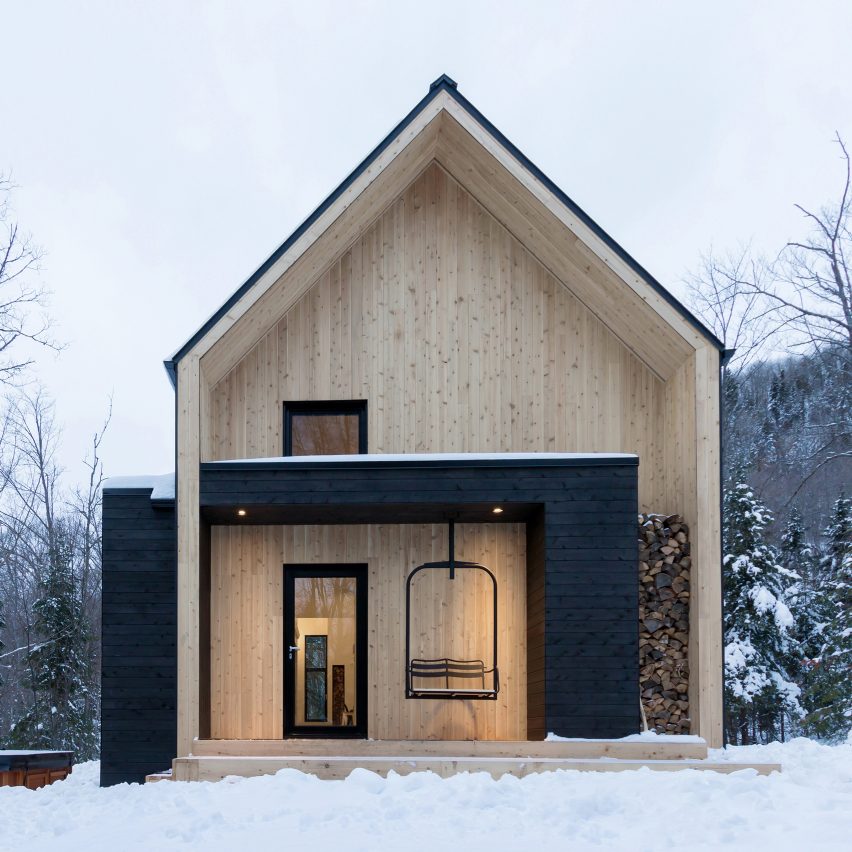
The US election result has driven some Americans to search for a way out across the northern border – so many that the website for Canadian Immigration has been crashing from demand. For those keeping that daydream alive, here are ten cabins in Canada that would be perfect to escape to. Read more


_YOONSUN'S_FOREST_(1).jpg?1476260703 "© Yoon, Joonhwan")


_YOONSUN'S_FOREST_(1).jpg?1476260703 "© Yoon, Joonhwan")