The biggest surprise in this Archilogic model is the spectrum of color. Anyone who has visited the Case Study House 26 in San Rafael, California during the last 40 years would be familiar with the building’s classic all-white steel frame look, but the architect, Beverley David Thorne, had originally picked a very different color scheme: “Dull Gold” for the steel, saffron and other more vivid colors for the interiors. “The choice of exterior colors,” wrote Thorne in Arts & Architecture magazine, “was dictated by the climate and the character of the surrounding landscape.” This Archilogic model recreates the original 1963 conditions, down to the bedroom wall and tile colors.
With the all-white scheme, Case Study House 26 resembles Mies’ Farnsworth House or one of modern architecture’s favorite references, the ocean liner. This is never more prominent than when you step out on the deep deck that floats over the site and offers a sweeping panoramic view of the Marin County hills, virtually denying that the house is built on solid earth.
The Case Study House program was an initiative sponsored by the Arts & Architecture magazine to address the housing shortage after World War II. Its mission was to provide a vision of how families might live in modern homes built with contemporary materials and technologies. With the post-war population and building boom, buildable land in California became scarce and more expensive, resulting in builders looking to hillsides as cheaper alternatives. For Case Study House 26, addressing the steeply sloped site was a self-imposed criteria that qualified the building for inclusion in the series. Ironically, the series resulted in architectural gems that did not shape mass housing, but rather influenced the tastes of discerning fans of high design. Steel frame construction was too expensive, and required too much precision, to be applied to cheap tract housing. Material-intensive details, like solid wood floors, made such houses unaffordable for most American families.
However, steel is an ideal material for construction on a steep slope. The large spans made possible by steel required fewer foundations, and by having the floor levels follow the terrain, the design avoided both expensive excavation or an unattractive “toothpick” look with exposed floor undersides.
“Touching the ground lightly” signaled an early environmentalist position and was a very important aspect for Thorne, who expressed this key intention in the A&A article as “resolving the integration of a space platform to the site without affecting the contours or natural state of the land or the occupants feeling that they are living on a hillside.”
A single drawing showing the section is enough to explain the entire house. It details the overall compositions and most construction details. Using only this section and a basic floor plan, the house could have been built. It is hard to imagine today, but the entire drawing set consisted of only four sheets. Many key decisions were made directly between the architect and contractor during construction, without the use of drawings. On site, the floor plan layout was flipped and prominent corners got windows instead of walls. Fittingly, the architect even got his hands dirty, helping to weld the steel frame himself.
Originally commissioned by the CEO of Bethlehem Steel, the first owners of Case Study House 26 were the Ketcham family, a TWA pilot and flight attendant couple, who raised their family there. The modern design corresponded perfectly to their profession. They equipped the home with cutting edge technology, like an intercom system and Jetson-esque kitchen appliances. Thorne, in addition to a few alterations, made plans to add a lower floor and pool, though they were never realized. With a few exceptions, like the current almost monochrome color scheme and a kitchen remodel, the house is preserved in its original 1963 condition.
The current owners maintain a website with more information, images and literature references on www.csh26.info, or follow them on Instagram.
We encourage you to experience Archilogic’s Virtual Experience in your Browser, create your own designs and share your tours online. To join the Archilogic Platform Sign up here and enjoy the free trial version of the pro subscription.
Archilogic transforms 2D floor plans into interactive, accessible and customizable 3D virtual tours in 24 hours from $69 upwards. Don’t miss Archilogic’s previous models shared on ArchDaily:
Traffic in Denali National Park in Alaska can sometimes look like this – a bear ambling along a winding road surrounded by incredible vistas of mountains and wildflowers. The park’s one ribbon of road runs through low-elevation taiga forest to high alpine tundra and snowy mountains, culminating in North America’s tallest peak – Denali – at 20,310 feet. Photo courtesy of Jacob Frank.
From the architect. This new nine-unit residential building occupies a small but unique site on the waterfront in East Boston. Located between the residential neighborhood of Jeffries Point and an active shipyard, public art gallery and cafe, the design utilizes industrial materials to effect a contemporary interpretation of context while dissolving the boundary between building and city. Planning limitations, including height restrictions imposed by neighbors, parking requirements from the city, and the developer’s desire to provide water views for every unit, presented an opportunity to strategically rework standard residential typologies. The result is tube-like stacked units opportunistically interlocked to effect sectional and proportional shifts within the space of the unit. Living, dining, and cooking areas on the front of the building are compressed and horizontal, leading the eye through a series of layered spaces toward framed views of the water and the Boston skyline beyond. Sleeping spaces in the rear of the building are compact in plan and tall in section, focusing the eye upward.
On its façade, the building mixes an industrial material palette of corrugated steel and cable mesh with warm red cedar siding reminiscent of its triple-decker neighbors. The architects worked closely with a highly skilled team of metal workers to develop a fabrication method for the façade frame and attachment detail for the wire mesh, ultimately combining factory labor and the handmade. Each wire-mesh panel was partially fabricated by the mesh manufacturer in the factory and then painstakingly handwoven into the cables defining the edge of each facet on site.
The unique geometry of the façade, elevation of the building off the ground, and transparency of the lobby perform a tectonic negotiation between the territory of the building and the surrounding neighborhood. The porous boundary of the mesh façade pushes the private space of the unit into the public space of the street, while the parking void and lobby become an extension of the sidewalk. The façade and lobby thus becomes an amenity shared between the building’s residents and the neighborhood: climbing plants both green a predominantly concrete streetscape and provides shade for the residents in the summer, while the lobby acts as a display case for a rotating art exhibition visible from within as well as the street.
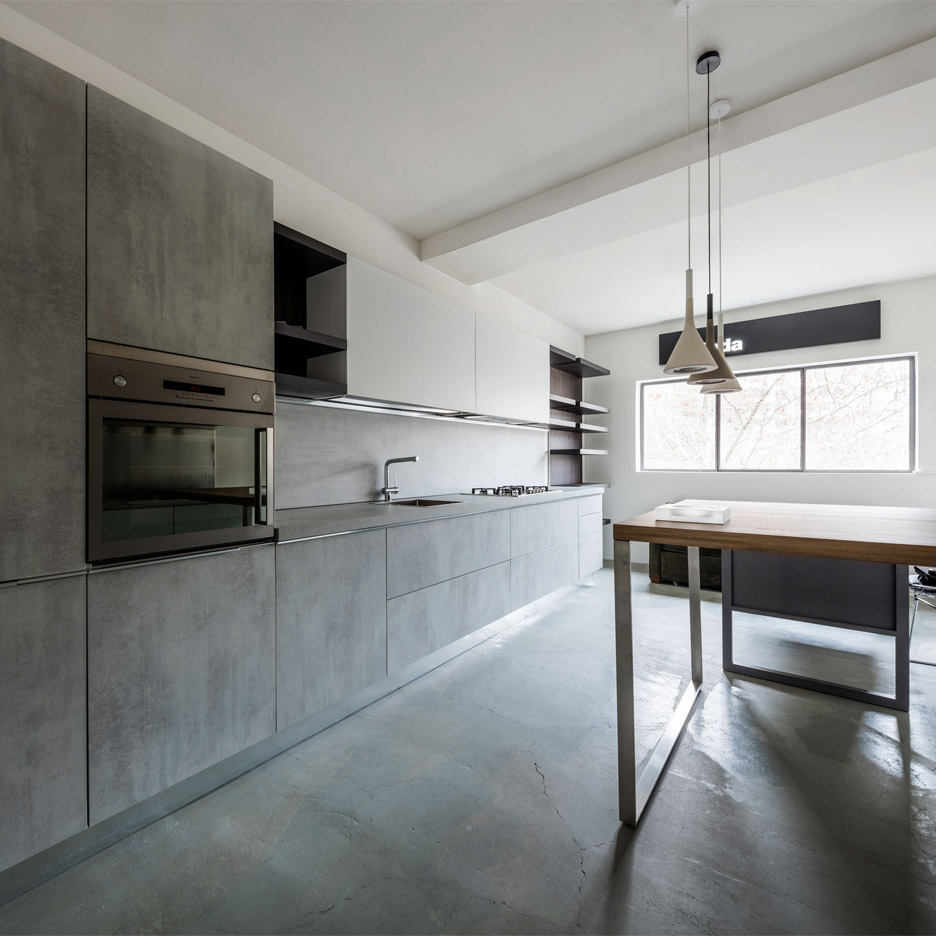
Italian luxury brand Molteni has opened a flagship showroom in Tehran, describing itself as a “pioneer” for design companies moving into the country following the lifting of trade embargoes earlier this year. (more…)


 Sig Nordal