After receiving building permit approval, Twelve Architects has revealed their design for a 42,000 square meter international exhibition center in Yekaterinburg, Russia. The design, which houses a series of conference halls, a media center, gallery, exhibition space, seminar rooms and lounges, has been developed from their initial 2015 competition winning entry. Partnership with a local practice has helped to guide the design of the center, enabling the creation of a major cultural hub within Yekaterinburg.
Included within Twelve Architects’ £400 million masterplan does not only include the new cultural center but a new 300 room hotel and banqueting complex, all linking to existing exhibition halls and public spaces. The congress hall is the epicenter of the design, with a series of engaged, organically shaped volumes stacked and twisted forming the main area of the building. The architects explained in a press release that “the congress hall’s interlocking forms represent people coming together from around the world to meet and share experiences.” The main 4,000 seat auditorium is located at the heart of the building and is designed to facilitate a wide breadth of cultural and professional events.
Courtesy of Twelve Architects
Their 2015 winning design in the competition has undergone revisions to comply with the Russian SNIP building regulations. Many design decisions came from compliance necessities, including the standardization of the facade panels to meet fire codes. For this, the modular system of the steel rain screen alternates between 300mm wide silver and 150mm wide black panels, arranged into 3m panel ‘zones’ offsetting in elevation to accommodate the facade curvature.
The International Exhibition Center is the latest in a series of projects Twelve is working on in Russia, including Rostov On Don International Airport which is currently under construction. The Center is currently being documented, with construction due to begin mid-2017.
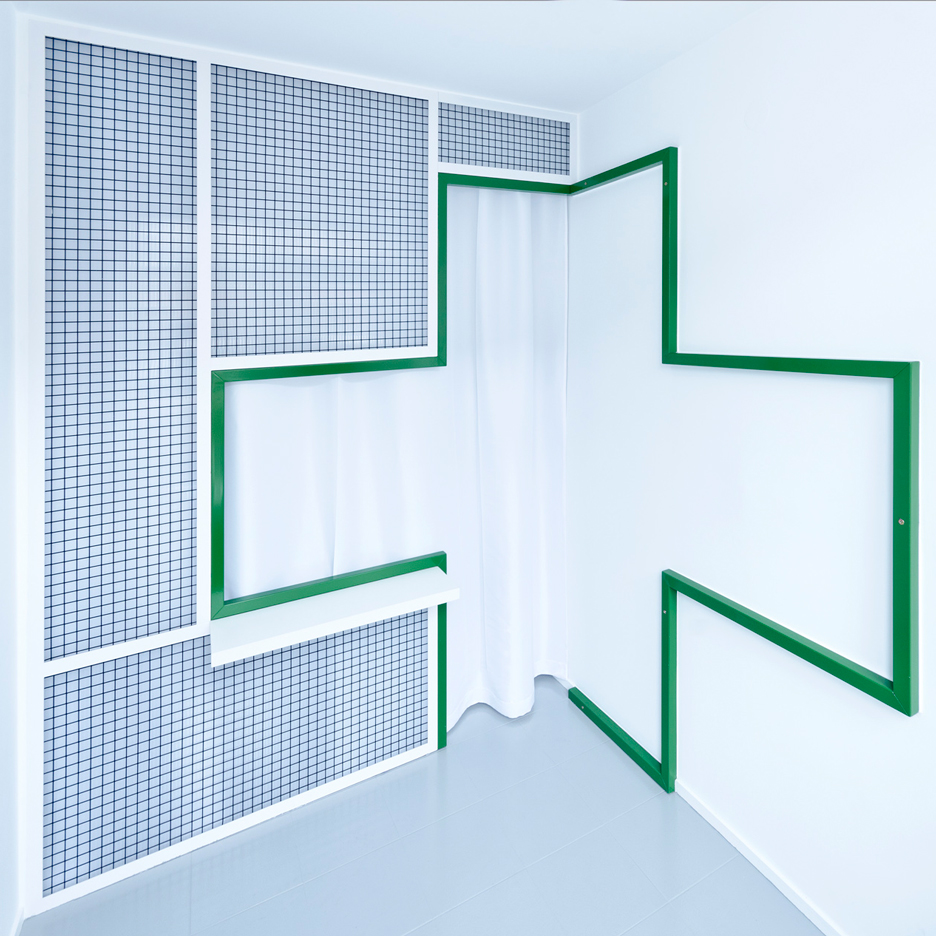
A green cross emblazoned across the centre of this denture repair centre by Polish architect Adam Wiercinski marks a window where customers can collect or drop off their teeth (+ slideshow). (more…)
The XV century farm villa, object of CMT Architetti restoration, is located in Tuscany (ITALY) in the town of Monteriggioni (Siena), just a few steps away from the beautiful “Castello della Chiocciola”. The Villa has been attributed by some scholars to Baldassarre Peruzzi opera, a fomous Sienese painter and architect who worked in that area between the XV and the XVI century.
The leading idea of the project was to use two parallel registers, the almost philological restoration of the original parts and the absolutely contemporary project of new interventions and furnishing. The result is an assembly in which the two parties communicate with expressions that are even very different, but with the constant search for a final common synthesis.
Plan
Section
The original walls were treated with a lime-colored paste and pulled to iron plaster on the example of the ancients XV centuty plasters , the floor slabs too, were treated with lime. The existing floors have been restored and they veiled with natural lime too.
The new environments functional to the new residential program are made as white enamel gloss boxes which never arrive to the ceiling, so that they can hold indidect led light illumination. The new living floor is made of clear ochre resin cement, without any expansion joint. Also the bath floors and coverings are made of the same materials. The night zone floors are all made with a natural oxidized Oak parquet treated with lime.All the furniture of the house, with the exception of some object of recovery, are tailor made products from local artisans, unique and unrepeatable.
The furnishings are made with recovered oak wood with black veins, crude raw plate treated with natural wax and opaque lacquered wood parts. The kitchen top is in black matt marble.
Construction of the museum began in 2011 and now that it is finalized, it will house one of the most important Portuguese art collections, from the Nadir Afonso Foundation, this will most likely place the municipality of Chaves as a highlight of cultural tourism in Portugal.
According to Bernardo Pinto de Almeida, professor and curator of the exhibit inauguration entitled “Nadir Afonso – Keys to a Work of Art,” which features 35 of the 70 years of the painter’s work says, “this is a museum that demonstrates the “greatness” of one of the great artists of the twentieth century.” The great painter of geometric abstraction is presented here as an artist, a philosopher, as well as demonstrates his other works such as his collaborations with Le Corbusier and Oscar Niemeyer.
The museum cost £8.5 million to build, while 85% of it was privately funded. The building is punctuated by geometric references that reference the work of Nadir Afonso. His program includes an auditorium, exhibition halls, library, archive, workshop, café, and shop.
The 2,700 square meters project is set on a site about six times larger. Located on the right bank of the river Tamega, the museum was subjected to flooding, Siza’s solution was to raise it with a series of perpendicular structural blades to protect it.
The building has already been critically acclaimed by Jorge Figueira who told PUBLICO that he considers the project one of the most significant from Siza, putting it at the same level as the Iberê Camargo Foundation building in Porto Alegre. The winner of the Pritzker prize, Eduardo Souto de Moura, thinks that this is one of the best buildings he says, “I do not know if it’s the best, but it is one of the ones I like the most.”
Nadir Afonso Contemporary Art Museum opened its doors to the public last month, a date which coincided with Chaves’s Municipal Day. Visitation is free of charge and it is open between the hours 10:00 and 24:00.
Nadir Afonso, who passed away at 93 in 2013, inspired another exhibition space, the Nadir Afonso Arts Center, by US architect Louise Braverman in collaboration with Paulo Pereira Almeida, which opened in Boticas, near Chaves in 2013 .
Music: animation studio Parallel Teeth has designed an abstract world of disembodied eyeballs and dancing shapes for Ladi6’s Beffy music video (+ movie). (more…)
Photographer Jose Torres took advantage of a cross country move to take pictures in national parks along the way. One of his favorite stops was Badlands National Park in South Dakota where he captured this amazing scene of the unique rock formations glowing in the light of the moon and the Milky Way. What a shot! Photo courtesy of Jose Torres.
From the Cradle of Civilization in ancient Mesopotamia to the modern urban explosion in China, cities are among the most obvious and dramatic evidence of human existence. In a recent paper published in Scientific Data, a team led by Yale University researcher Meredith Reba mapped the emergence of cities between 3,700 BC and 2,000 AD based on when they were first mentioned in historical records.
Taking the data from this study, Max Galka of Metrocosm has produced this fascinating animation showing the history of cities worldwide. “Most datasets available go back only a few years or decades at most. This is the first one I’ve seen that covers 6 millennia,” Galka told CityLab. “I’m a big fan of history, so after reading the study, I thought it would be interesting to visualize the data and see if it offers some perspective.” The steady flow of time may seem a little slow at first, but stick with it through the early BC years and the shifts in urban development start to get intriguing. And—spoiler alert—buckle up as you approach the 20th century.