Casa Esse is a private home designed by LDA.iMdA Associated Architects. It is located in San Miniato, Italy. Casa Esse by LDA.iMdA Associated Architects: “This project concerns the renovation of a part of a reinforced concrete building of the eighties. The project idea is to create a multifunctional space where the bathroom element, which seems to be a little living room, is central to the architectural composition. Organization and practicality..
Stepney Green College / S333 Architecture + Urbanism

© Tim Crocker
- Architects: S333 Architecture + Urbanism
- Location: United Kingdom, London Borough of Tower Hamlets, Greater London, UK
- Area: 4500.0 sqm
- Project Year: 2013
- Photographs: Tim Crocker
© Tim Crocker
From the architect. In the final days of the BSF program and with a vastly reduced budget, this project brings transformational change to the school by delivering two new buildings and outdoor spaces, whilst renovating the existing library and classrooms.
Isometric
A key requirement for the project was to create a new identity for the school; transforming its image into a welcoming, dynamic learning environment and raising the school’s profile within the borough. The new buildings improve the school’s civic presence and inclusiveness with adult evening classes, community groups and a Saturday morning school using the library and other buildings.
© Tim Crocker
The original school site was dominated by an eight-storey tower with the rest of the school arranged in poor quality single storey structures. The new masterplan creates a robust ‘campus’ structure of buildings and different scaled outdoor spaces, integrating the retained and refurbished buildings with the new ones. The current areas of outdoor play are maintained but further expansion of the school facilities through densification can be accommodated.
Ground Floor
One of the ambitions is to improve learning and community provision as well as enhancing the local streetscape. The two new buildings, a new teaching block and a sports hall are at key locations on the school boundary. New entrances and generous glazing of the activity studios and classrooms brings much needed school activity to the surrounding streets, Trafalgar Gardens and the Ocean Estate. This also improves the safety of the surrounding streets by providing passive surveillance and brings new and accessible amenities to local people the first time.
© Tim Crocker
The reception, art and technology building creates a new main entrance that opens up school life to the community whilst reducing the impact of the tower. A triple height communal stair, a new sheltered courtyard and an IT pavilion are part of a diagonal sequence of spaces used to create strong visual connections across the school campus and to emphasise the extent of improvements and the school’s ICT specialism to the wider community.
© Tim Crocker
The sports hall has been designed to be accessible to the local community from Trafalgar Park. It supports the school’s sporting success with Sports England compliant amenities, 4-court gym, activity studio, and multi-gym. In order to maintain the existing areas of outdoor play an additional rooftop multi-use games area has been provided, transforming the sports curriculum.
© Tim Crocker
The broad open stair of the reception, art and technology building is complemented by break-out spaces at each level. The partition walls between classrooms are non-structural, enabling maximum future flexibility and accommodating further variety in learning strategies. The structural solution also includes a rooftop beam that screens the plant room from view while freeing up the lower levels from additional structure in the deep span of the building.
© Tim Crocker
The sensitive setting with adjacent conservation area is complimented by a contemporary architectural approach that mediates between the surrounding context and reduces the negative impact of the existing austere school environment. The buildings communicate with the outdoor space via large openings, capturing views of the adjacent farm, conservation area and vicarage as well as the City of London. Their appearance is also a response to the need to cover large buildings within the very limited budget constraints by bringing a soft, textured surface of light and shadow, and a new consistency to the school campus.
© Tim Crocker
The key challenge for Stepney Green was to maintain the delivery of the school curriculum with the BSF budget cuts and the tight construction sequencing. The cuts meant that there is no extraneous space in the new buildings yet they still meet the educational brief for transformational change. The compact form of the buildings meant that they could be erected whilst existing buildings were still in use.
© Tim Crocker
As a result the project came in on budget and 20 weeks early. Innovation on site included using plywood protection to allow refurbishment to proceed before demolition was complete and using metal shuttering to build the concrete frame without scaffolding which made huge inroads on the tight programme.
How To Find the Power in Your Story

You’re reading How To Find the Power in Your Story, originally posted on Pick the Brain | Motivation and Self Improvement. If you’re enjoying this, please visit our site for more inspirational articles.
Sometimes we feel powerless in our own life. We feel as though nothing we do is working in our favor. Life can feel like that. We have all had those moments, days or even weeks where life felt like – and was – a hard slog. Yet if we look more closely we can find that we still have power in our story, in our life.
We can find power in our story because we are the ones writing our story. It’s the distinction between events and story. The things that happen to us are often out of our control but we are in complete control of the story that we write around those events.
Think back to a time when you and someone else experienced an event that, when you spoke of it later, was remembered differently by each of you. Can you recall how surprised you were that they had a different recollection than yours? Right there, in that difference in recollection, is where story lives.
In order to make sense of the things that happen in our life we create a narrative, a story, around the event. This is what we all do. And that is where the gift of story lives. We get to choose what story we write. We get to choose what a given event means for us. That means we can choose to find the point of power in our difficult experiences.
When I was in my 20’s my best friend died of cancer. It was a devastating experience but within the devastation was the lesson of loving my friends and family deeply and consciously. I learned not to take the gift of them in my life for granted. I learned about courage and grace in the face of imminent death. I learned that I could survive that grief and come out the other side a stronger and more compassionate person. That was the story I chose to write because to do otherwise would be to disrespect the memory of my dear friend and the lovely soul she was.
I could have chosen to write a different story. A story of the unfairness of life that a young, kind, funny, smart and beautiful person was taken so soon. I could have written a story about how unfair it was that my beloved uncle had died of cancer just a few months before my friend’s diagnosis. I could have written a story of bitterness and anger at the loss of two people I loved so deeply.
In this case the choice was easy because it was so clear to me that to embrace bitterness would be the polar opposite of the response my uncle and friend would want me to have. But the choice isn’t always so clear. What about when someone has truly wronged you? What about when someone has intentionally done something that was damaging to you? How do you choose a different story then?
We choose a different story by recognizing that it is our choice. We choose a different story by understanding that we, first and foremost, will be impacted by our choice. Our happiness and our peace of mind are within our control.
Finding the power in our stories requires that we take the story apart and actively look for the lessons we can learn. We have to ask what can be difficult questions: What did I do here that I am happy about? What did I do that I regret and don’t want to do again? What lessons can I learn that will help me in the future?
In my case I learned to not leave things unsaid to those I care about. I learned that I can survive things I didn’t think were survivable. I learned that the power is in how I decide to hold my story, not in the events that create my story.
So when you find yourself struggling with an event that leaves you feeling out of control take a moment, take a breath – or several, and consider what your ideal response to the event would be. You aren’t trying to change the circumstances – if only we could. What you are trying to do is use the power of choice to get the best out of the event that you can.
As you write the story of what happened, be conscious about what pieces of it you wish wish to take going forward. Find the pieces that empower you and build your story on that foundation. Look for the opportunities to expand your capacity to love, to improve communication or to simply learn so that next time you make a better choice. Uncover the elements that will contribute to you being able to grow from what has occurred. Writing your story isn’t about changing the truth, it’s about finding the lessons we can learn and the places within where we are truly strong.
We often have no control over the things that happen to us but we have complete control over our response to events. Choose thoughtfully, create a story that enriches and expands your life. Create a powerful story that supports the highest vision you have for your life.
——–
Omkari Williams writes, speaks, and coaches on story and creativity. You can find her at omkariwilliams.com
You’ve read How To Find the Power in Your Story, originally posted on Pick the Brain | Motivation and Self Improvement. If you’ve enjoyed this, please visit our site for more inspirational articles.
Teawith kettle by Keren Hu is designed for the living room

Graduate shows 2016: Royal College of Art graduate Keren Hu has created a smaller, quieter and faster kettle that’s designed specifically for use outside of the kitchen (+ slideshow). (more…)
Rome, Italy photo via alicia

IDC School of Psychology & Economics / Gottesman-Szelcman Architecture

© Amit Geron
- Architects: Gottesman-Szelcman Architecture
- Location: Herzliya, Israel
- Area: 6000.0 sqm
- Project Year: 2014
- Photographs: Amit Geron
- Design Team: Inbar Idan (project Architect) , Asaf Gottesman (partner), Ami Szmelcman (Partner)
- Project Coordinator: Dani Rahat
- Main Contractor: Build Up
© Amit Geron
Situated on an extremely narrow site with eucalyptus trees along its southern & eastern edge, our design of the Faculties of Psychology & Economics building reflects several key considerations; our commitment to “green” architecture, our desire to create clear and dynamic relationships between architecture and its surrounding and our commitment to effectively and harmoniously incorporate within our buildings carefully defined functions.
© Amit Geron
In the case of this project Professor Uriel Reichman, the President of IDC, delivered an ambitious program that included numerous classrooms that would need to fulfill the specific needs of the Faculty of Psychology, as well as, seminar rooms, computer labs, brain study labs, and rooms dedicated to experimentation, observation and research and effective monitoring.
Section
Our response was to design an elongated building that responds to the specific dimensions and limitations of the site. We introduced a transparent northern façade that would be able to exploit the benefits of the northern light while establishing a visual relationship with the campus. Thus, whether students enter or leave their classes, whether they choose to form discussion groups or study on their own within the common parts of the faculty or beyond, they are simultaneously a part of the building and its surroundings. Rather than conveying institutional mass, our aim was to project the building’s accessibility. We slightly raised the ground floor in order to enhance the “lightness” of the building, by underlining its delicate relationship to the ground and the surrounding eucalyptus trees.
© Amit Geron
In complete contrast to the building’s northern aspect, the southern façade is typified by its solidity and the incorporation of long narrow windows that introduce sunlight into the building with minimal thermal consequences. The pattern of long horizontal openings is extended both to the roof and to the sidewalk; creating a sensation as if the transparent northern façade has been raped in a protective skin.
© Amit Geron
Ohiophoto via joanna

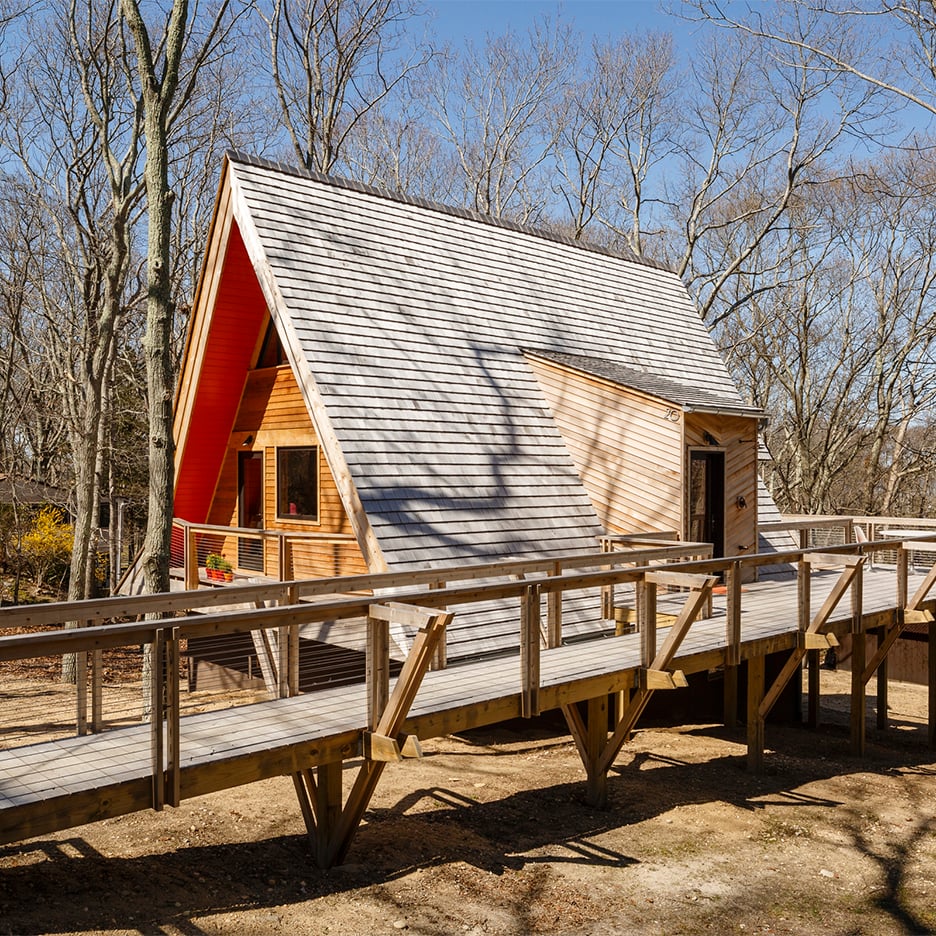
Edgar Papazian transforms pointy wooden cabin in the Hamptons into weekend retreat
Salton Sea, California, US by Phillip Jun

My http://ift.tt/1XZ918K San Jose – California – USA (by Kevin Lau)