Month: July 2016
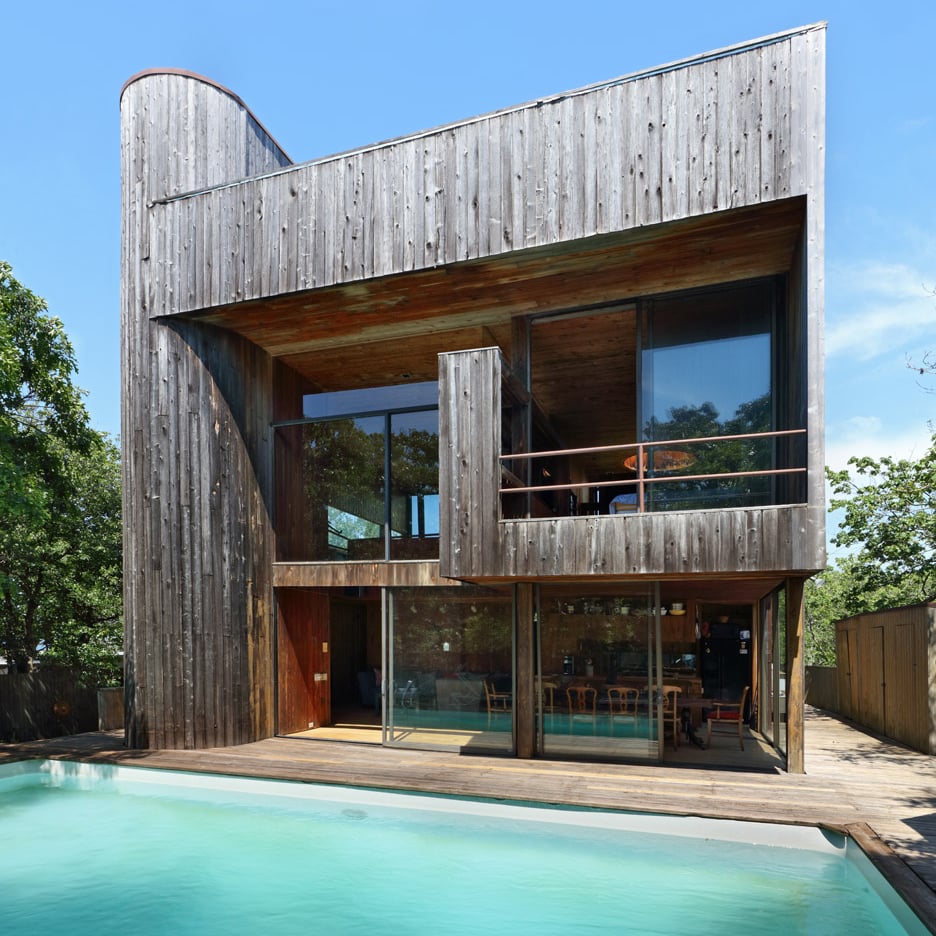
Swimming Pool Allmendli / illiz Architektur

© Hertha Hurnaus
- Architects: Illiz Architektur
- Location: Im Allmendli 5, 8703 Erlenbach, Switzerland
- Architect In Charge: Pöyry Switzerland AG
- Area: 1131.0 sqm
- Project Year: 2016
- Photographs: Hertha Hurnaus, Daniel Enzensberger
- Swimming Pool Design: Aqua Transform Ingenieurbüro
- Hvac Design: Tri Air Consulting AG
- General Management: CAAB GmbH
© Hertha Hurnaus
The disused shelter for rescue forces at the edge of the Erlenbach school campus had disappeared under an overgrown hill and a sports field over the years. From outside, the only identifiable markings were two entries dug into the hillside. It was just waiting on a new lease on life. The lack of swim lessons for the children of the lake community and the site’s proximity to the school made it the perfect location for partial redevelopment into a pool for beginners. A selective tender was created in 2012 to find a suitable general planning team for the building project.
© Hertha Hurnaus
Section
© Hertha Hurnaus
The challenge put forth was to accommodate all areas of the pool in the underground shelter. The team of Pöyry Schweiz AG and illiz architektur was able to win over the client with an alternative approach: Instead of excavating under the former billet to accommodate the enormous volume of the pool, the pool would simply be suspended above the existing cubature of the underground space. This allowed the surface of the water to remain level with the surrounding terrain, thereby offering expansive views over Lake Zurich. Besides the pool’s volume and lift platform, the underground space was also used to house the technology and systems required for the building and pool as well as an entrance hall and adjoining changing rooms. The actual bathing hall was designed as a light-filled pavilion over the new pool and now marks the urban end of the school grounds.
Plan
Dark cubes along the terrain’s edge
Today, two seemingly intertwined dark cubes rest on the edge of the ground, only slightly reminiscent of the site’s original layout. The southeast corner of the military billet was exposed and parts of the outer wall removed. A one-storey glass façade now fills the span between the two flanking walls, providing a view into the hitherto hidden interior of the building. Deep dark green wall tiles radiate outward, bringing to mind the moment of immersion into a shady, clear lake. The diffusely luminous atmosphere continues throughout the entrance hall and into the changing rooms. Only as one emerges to the surface and into the bathing hall via a narrow staircase does the wall design become lighter and brighter – with the surface of the water appearing as sunny shores in silvery green and delicate pink.
© Hertha Hurnaus
Interplay of lightness and solidity
Even as the colourful wall tiles unmistakably transform the structure into a swimming pool, the massive and raw character of the old facility remains largely intact. The concrete slab floor of the basement is covered with a protective coating, while cable guides, conduits and pipes remain visible, with corridors and changing rooms illuminated indirectly. Only through the exposed, prone front hall is the massive concrete structure truly revealed, emerging from a surface recessed deeply into the slope.
© Hertha Hurnaus
Structurally, the lately revealed building and the structure placed upon it have been formally united as a new entity. A massive coffered concrete ceiling spans the entire bathing hall and rests on a dense row of slender concrete columns placed along its edges. The ceiling almost appears to float over the delicate tile designs covering the interior walls. Between the columns, the silver-grey floor folds into benches that encircle the pool, while a filigree glass façade wraps around the raw concrete structure like an effervescent bubble. Steel and concrete supports stand in synchronous sequence, yet remain at a significant distance from each other. As the inside begins to glow at dusk, the contrasting interplay of lightness and solidity is particularly clear. The dark envelope of the building seems to dissolve, thereby revealing the plasticity of the superstructure and its exceptional tectonics.
© Hertha Hurnaus
Bijoy Jain Designs Australia’s Largest Bamboo Structure for 2016 MPavilion

The Naomi Milgrom Foundation has released plans for Studio Mumbai founder Bijoy Jain’s design for the 2016 MPavilion, the Australian counterpart to London‘s wildly successful Serpentine Gallery Pavilion program. Continuing the concepts driving Studio Mumbai’s work, the pavilion will utilize a process Jain describes as ‘Lore,’ an exploration of handmade architecture and simplicity of building craft that centers on the relationship between making and human connectedness.
© Nicholas Watt
The 2016 MPavilion will consist of an 18 meter by 18 meter structure built of bamboo, rope, earth and bluestone sourced from India and Australia. Reaching 12 meters tall, the pavilion will become the largest bamboo structure ever built in Australia, and will be capped with a roof made from karvi panels (similar to a wattle and daub form of construction). The awning and roof panels will then be covered using a traditional Indian technique “whereby a mix of cow dung and earth are tied to the bamboo structure and covered in a waterproof white lime daub,” which will take on the color Australian landscape.
“The idea is not to guide observers but to allow discoveries through visual layers of thinking, making and seeing,” explains Bijoy Jain.
Courtesy of Studio Mumbai
The pavilion borrows from the Indian typology of the ‘tazia,’ an elaborate tower used in traditional Indian ceremonies, to connect the strata of earth, sky and gravity that is shared by all humans. The project’s tazia was constructed in Bharuch, India, by a family who has specialized in building the ornate towers for generations.
“I wanted to create a space that connects the entire culture of the land. The tower or ‘tazia’ is an imaginary building that reaches deep into the stars, so it is otherworldly, and through it you can see the stars, the sky, other dimensions,” says Jain. “I want the MPavilion to be the scaffolding that provides a creative space that suspends visitors between earth, ground and sky.”
© Nicholas Watt
The pavilion will provide shade and space for lectures and public events, and will also feature a coffee bar and market for selling local produce.
“I want the building to be a symbol of the elemental nature of communal structures – a place of engagement, and a space to discover the essentials of the world and of oneself,” he said. “What’s interesting about the site is that the garden’s edges are formed by the streets and roads – in some ways it is a non-place. MPavilion relocates this space and makes it a place of meaning.”
© Nicholas Watt
Naomi Milgrom AO, MPavilion founder said: “Bijoy Jain’s practice is unique in that it focuses on honouring age-old crafts and building-techniques, which resonate strongly in this technologized world. As an architect, Bijoy thinks like an artist. His buildings are realised around a central idea, and are then fleshed out through an extensive process of collaboration, and always, careful consideration of the surrounding environment.”
Jain and his design team have been working for the past six months alongside a team of Australian builders, who Jain flew to Mumbai to involve in his collaborative approach to design and construction. Engineering and construction for the project is led by Studio Mumbai and Kane Construction in India in partnership with the Melbourne and Mumbai offices of Arup Engineering.
© Nicholas Watt
The pavilion is expected to take 8 weeks to build, with a grand opening in October. Once completed, the pavilion will welcome visitors for a series of talks, workshops, performances and installations until February 2017. It will then be moved to a new home in downtown Melbourne where it can become a part of the city’s architectural landscape.
This is the third edition of the MPavilion program. Previous pavilions were designed by British architect Amanda Levete in 2015 and Australian architect Sean Godsell in 2014.
Courtesy of Studio Mumbai
“A Mind that Insisted on Utterance”
We would have every arbitrary barrier thrown down. We would have every path laid open to woman as freely as to man. Were this done, and a slight temporary fermentation allowed to subside, we believe that the Divine would ascend into nature to a height unknown in the history of past ages, and nature, thus instructed, would regulate the spheres not only so as to avoid collision, but to bring forth ravishing harmony . . .
The American activist and journalist Margaret Fuller began to serialize “The Great Lawsuit,” excerpted above, in the July 1843 issue of The Dial, the journal of Transcendentalism she edited. Published in 1845 as Woman in the Nineteenth Century, Fuller’s impassioned argument for gender equality is regarded as a seminal text for American feminism and the cornerstone of her legacy. “I had put a good deal of my true self in it,” she later wrote a friend, “as if, I suppose I went away now, the measure of my footprint would be left on earth.” Five years later, on July 19, 1850, Fuller, her husband, and her infant son drowned when their storm-tossed boat ran aground just off Fire Island, New York.
Fuller’s pioneering and fervent personality put her in the spotlight throughout her life, but her last years, spent in Rome supporting the short-lived Roman Republic, reached an operatic level of passion and poignancy. In her dispatches for the New York Tribune — she was the newspaper’s first female foreign correspondent — Fuller argued the cause of the Italian revolutionists, one of whom she had married.
With the ramparts fallen and her husband at risk for his politics, Fuller had set aside her premonitions of disaster (and warnings from Ralph Waldo Emerson and other Concord friends that her socialist leanings and out-of-wedlock son would provoke public disfavor) and sailed for home.
Emerson sent Thoreau to Fire Island to help look for Fuller’s body and for any personal belongings he might find. In the historical record, Thoreau came back empty-handed; in April Bernard’s novel Miss Fuller, he returns with a letter-journal, addressed to Sophia Peabody Hawthorne. Part biography and part manifesto, Fuller’s letter ranges across her unconventional life and provocative thoughts. As Thoreau’s younger sister Anne (imagined for the novel) peruses the document, she begins her own voyage toward understanding why Fuller’s life was so provocative, and her death almost welcomed:
Everyone was — relieved. Not actually glad that she was dead, perhaps. But surely relieved, relieved of the burden of this impossible woman. Relieved that they no longer would have to read her exhortations to do good, to send money, to think more broadly, to consider the poor and the powerless, to worry over their place in history, to follow her difficult sentences, to wonder if women after all should be allowed to pester them in this way, and to do such things as Miss Fuller did and imagined.
She made everybody angry. Such a terrible talent.
”I neither rejoice nor grieve,” Fuller says in one of her late letters from Rome, “for bad or good I acted out my character.” This insistence on self-realization, says Megan Marshall in her Pulitzer-winning Margaret Fuller: A New American Life, may be the most indelible principle of her message-in-a-bottle to the modern world:
In a time when “self-reliance” was the watchword — one she helped to coin and circulate — Margaret had, by her own account, a “mind that insisted on utterance.” She insisted that her ideas be valued as highly as those of the brilliant men who were her comrades. She refused to be pigeonholed as a woman writer or trivialized as sentimental, and her interests were as far-ranging as the country itself, where, as she wrote in a farewell column for the Tribune when she sailed for Europe, “life rushes wild and free.”
The Barnes & Noble Review http://ift.tt/2aFIXhO
Coussée & Goris and RCR Arquitectes use iron-coloured concrete for Belgian crematorium

A+Awards: the next project in our collaboration with Architizer is a tinted concrete and steel crematorium in Holsbeek, Belgium, which was named as one of the winners in the religious buildings and memorials category at the 2016 A+Awards (+ slideshow). (more…)
Original Sins and Enduring Fractures
By law, a slave was three-fifths of a person. It came to me that what I’d just suggested would seem paramount to proclaiming vegetables equal to animals, animals equal to humans, women equal to men, men equal to angels. I was upending the order of creation . . .
“My goodness, did you learn this from the Presbyterians?” Father asked. “Are they saying slaves should live among us as equals?” The question was sarcastic, meant for my brothers and for the moment itself, yet I answered him.
“No, Father, I’m saying it.”
—from The Invention of Wings, Sue Monk Kidd’s novel about the life of the nineteenth-century abolitionist-activist Sarah Moore Grimké
The Fourteenth Amendment was ratified on July 28, 1868, when three-fourths of the states (twenty-eight of thirty-seven) accepted what would become some of the most important and frequently litigated constitutional measures, among them the citizenship, due process, and equal protection clauses. Ratification represented the triumph of the principles espoused by the abolitionist movement, in which Sarah Grimké and her sister, Angelina, were among the earliest and most ardent campaigners, advocating not only emancipation but equality.
The Grimké sisters came from a Southern slave-holding family, which they defied. In Master of the Mountain: Thomas Jefferson and His Slaves, Henry Wiencek tries to make sense of the man who declared the nation built upon the self-evident truth of equality but, conforming to his heritage and his class, built his Virginia plantations and his wider prosperity upon “the execrable commerce” of slavery. Wiencek notes that while the younger, abolitionist Jefferson wished to take the ancient Roman dictum “Let there be justice, even if the sky falls” as his guiding principle, his personal documents reflect “a turmoil of doubts, loathings, self-recrimination, all vying with the imperative to create a productive plantation”:
The pages of Jefferson’s notebook offer a diorama of the young man’s psyche — the architect and planter struggling against the moralist, seeking a way to absorb this foul, repugnant system into his interior landscape and into the exterior landscape he is shaping.
Jefferson’s first public proposal against slavery was through an emancipation bill he proposed to Virginia’s House of Burgesses (boroughs). The first legislative assembly in the New World, the House of Burgesses is also tied to this week, its first session held on July 30, 1619. While its endorsement of the “one man one vote” principle was compromised — at first enfranchising only free men, then only landowning men, and of course no women — the House of Burgesses reflected a commitment to consensus and to community. Now 450 years onward, says Yuval Levin in The Fractured Republic, the nation must somehow renew that commitment, thereby overcoming the yawning liberal-conservative divide. This cannot be accomplished through a nostalgic recreation of some earlier stage of American greatness but by exploring how the foundational principles “could be applied to our novel, twenty-first-century circumstances — to build upon our dynamism and diversity while combatting the aimlessness, isolation, social breakdown, and stunted opportunities that now stand in the way of too many Americans.”
For Levin, “a politics of subsidiarity” offers a way forward. In principle, “Subsidiarity means that no one gets to have their way exclusively,” that freedom is “a social achievement,” and that the only way to mend the national fracture is “not by denying our differences, but by rising above them when we are called.” In practice, subsidiarity means empowering the “middle layers of society” — the contemporary boroughs, in which reside “the institutions of family, community, local authority, and civic action”:
The middle layers of society, where people see each other face to face, offer a middle ground between radical individualism and extreme centralization. Our political life need not consist of a recurring choice between having the federal government invade and occupy the middle layers of society or having isolated individuals break down the institutions that compose those layers. It can and should be an arena for attempting different ways of empowering those middle institutions to help our society confront its problems.
The Barnes & Noble Review http://ift.tt/2a8USpK
House in Alentejo Coast / Aires Mateus

© Juan Rodriguez
- Architects: Aires Mateus
- Location: Grandola, Alentejo, Portugal
- Authors: Manuel e Francisco Aires Mateus
- Project Leader: Maria Rebelo Pinto
- Collaborators: Vânia Fernandes, Maria Bello, Bernardo Sousa
- Area: 633.0 sqm
- Project Year: 2015
- Photography: Juan Rodriguez
- Engineer: Axial
- Constructor: Mateus Frazão
- Surface Area: 750.80 m²
© Juan Rodriguez
© Juan Rodriguez
From the architect. Among the pines trees, a stone plateau is drawn to a scale that can no longer be understood as a courtyard. The space embraces a wide area of trees.
© Juan Rodriguez
Plan and Sections
© Juan Rodriguez
The house and its services define a recognizable solid border. The interior of this boundary is inhabitable and characterized by light.
© Juan Rodriguez
© Juan Rodriguez
© Juan Rodriguez
The more open side of the house creates a water tank through the connection of geometries. A space that embraces its context is created through this closed extension.
© Juan Rodriguez
mikenudelman: One chart that explains Alphabet, Google’s parent…

Rising nearly 5,000 feet above Yosemite Valley and 8,800 feet…

Rising nearly 5,000 feet above Yosemite Valley and 8,800 feet above sea level, Half Dome is a Yosemite National Park icon and a great challenge to many hikers. At least a 14-mile round trip through wilderness with an elevation gain of over 4,800 feet, this hike is not for the unprepared. Permits are required to reduce crowding – protect natural and cultural resources, and improve safety. But for those who make to the top, the view is indescribable. Photo by National Park Service.
Lions
Picture this: “The red of the grass made all the great prairie the color of wine-stains, or of certain seaweeds when they are washed up. And there was so much motion in it: the whole country seemed, somehow, to be running.” And now this: “A hard rind of shimmering dirt and grass. The wind scours it constantly, scrubbing the sage and sweeping out all the deserted buildings and weathered homes . . . Flat as hell’s basement and empty as the boundless sky above it.” The first image is from Willa Cather’s My Ántonia, published in 1918, the second from Bonnie Nadzam’s new novel, Lions. Both stories are rooted in similar earth — and Nadzam declares herself “particularly indebted” to Cather — yet the landscapes portrayed could not be more different. Whereas Cather’s wind-caressed Nebraska prairie moves ” . . . as if the shaggy grass were a loose sort of hide, and underneath it herds of wild buffalo were galloping, galloping . . . , ” Nadzam’s present-day Colorado plain is a desiccated wasteland. The place name itself was surely “meant to stand in for disappointment,” no lions having existed there. “I can’t remember ever seeing this town anything other than empty, ” an old-timer tells his drinking companions. ” ‘The past was great, they said. The future will be great, they said . . . None of it was true.’ They all grew quiet. Everything was heavy. Their beer glasses. The boots at the ends of their feet.”
Even with the “mute television hanging over the bar” and the nearby interstate roaring past, the residents of Lions might be mistaken for peasants in an ancient fairy tale: immobilized, entranced. “Everyone old, everyone poor, everyone white,” one character observes. Except for pretty Leigh Ransom and handsome Gordon Walker, in love and leaving soon for college. But can they leave? When Walker men have for generations been bound to this land — and pledged to serve one of its ghosts? For Lions is a ghost-ridden place set down on ancient, blood-soaked terrain. Nadzam describes it, however, with such cinematic clarity that each element, whether real or spectral, seems tangible: the brooding stranger at the door, the diner sandwich on the grill.
The mystery begins, of course, with the stranger. “It was just barely twilight. The man stooped and scratched the dog behind the ears and spoke to her, looking out over what he could see of the town . . . the small crush of lights in the distance from the diner and the bar where anyone still surviving had gathered to ride out the coming night.” At the Walker house he is welcomed as though expected, fed, freshly clothed, and given provisions for the road. He visits the bar, spends the night in jail, and the next day finds his dog dead on the highway. “A huge dry storm rotated overhead that evening,” Nadzam writes with biblical gusto, “howling like loose trains and beating the naked plain back to life.” Before long, a human corpse turns up in the town’s water tower, and Gordon Walker has headed northward on a cryptic mission, ” . . . a band of darkness slowly closing over him like a lid.”
As the atmosphere thickens with a few portents too many, Nadzam wisely shifts our attention to restless Leigh Ransom, a lively spark in the gloom and the novel’s most substantial character. Helping out in her mother’s diner and impatient to leave, she studies the occasional fresh customer, ” . . . bitter that others had what looked to her like a better life. Their easy smiles, their confidence.” Then along comes Alan Ranger, a slick Denver businessman, whose arrival perks up both Leigh and the somnolent narrative. “He drove a forest green pickup, his golden arm hanging out the window. He smiled, and she leaned in at the rolled-down window. There was a six-pack of cold brown bottles in the passenger seat.” The diversion is brief — a few beers, a few kisses, the zing of maybe — yet in it Nadzam, at her plain best, conveys both the reckless certainty of youth and its accompanying lurch of dread. (A feeling palpable throughout Nadzam’s first novel, Lamb, whose theme notoriously recalled Nabokov’s Lolita.) Leigh will leave. But escaping your place, she eventually learns, is easier than escaping the past; there is simply too much of the latter on this brooding frontier. Even Nadzam, the creator, has nowhere to go at the novel’s conclusion but back to the land where a centuries-old legend still holds sway over puny mortal desires.
“She’ll drive north, alone,” Nadzam writes of Leigh’s inevitable return, years later, “higher and higher, as she searches for a tall narrow hut. She’ll look for the white circle of a man’s face flashing like a light among the trees. She’ll look for a blue feather of chimney smoke.” In this evocative yet frustrating novel, the reader too is left searching for the meaning of it all.
The Barnes & Noble Review http://ift.tt/2a7RcBq
 Sig Nordal