The villa is fitted to a bucolic rural land in a small village of eastern France.
The radical and uncompromising project takes place in this site to establish a close relationship between indoor spaces and the garden. All internal spaces have an access to the garden.
The concrete volume is composed of solids and voids, the notion of traditional openings is forsaken in favor of completely open and continuous facades.
Section
The terrace and pool are treated with the same material so as to expand the volume to the garden.
With their latest facade construction, Iranian architecture firm Sstudiomm explores the potential that brick can offer by utilizing parametric architecture. Instead of relying on unique construction elements for assembly on-site at a later date, in their new project (called, in full, “Negative Precision. On-Site Fabrication of a ParametricBrick Facade // A DIY for Architects”) the firm considers how a simple mass-produced element like the brick can be assembled in unique ways by taking advantage of digital technology. While firms like Gramazio Kohler have already developed industrial methods of assembling brickwork following parametric designs, Sstudiomm aims for a more lo-fi approach, creating parametric brick walls using little more than the traditional construction methods found in Iran and a dose of ingenuity.
Courtesy of Sstudiomm
Iran has a long tradition of brick construction, as clay and lime mortar are among the most readily available materials in the country. Vernacular buildings, such as housing blocks, are generally made of plain brick walls, while landmark Iranian buildings are either built with traditional brick construction and coated with decorative plaster and tiles, or feature brickwork that forms geometrical patterns. But by using 3D modelling, Sstudiomm offers new alternatives to generate sophisticated brickwork patterns and make the ornamental character of Iranian architecture accessible to a larger part of the population.
Courtesy of Sstudiomm
As Sttudiomm’s facade for an apartment block in Damavand exemplifies, stencils allow the assembly of bricks into a geometric pattern. This construction technique had already been used by Archi-Union Architects when assembling concrete blocks for their AU Office and Exhibition Space, but Sstudiomm also proved that digital technology can open new fields to building industries that still rely on craft and traditional construction methods.
Courtesy of Sstudiomm
Sstudiomm demonstrates that stencils can provide a low-budget solution to the building of parametric walls. They developed the various patterns using a Grasshopper code that rotates the bricks between 9 and 27 degrees depending on their position within the pattern. Beside the laser cutting of stencils, the construction requires little new technology and mostly relies on local resources and crafts.
Courtesy of Sstudiomm
As a result of the hand-made assemblage, the finished parametric wall differs from the initial drawings, but Sstudiomm takes advantage of this lack of precision. Digital fabrication provides an excessive degree of precision, yet to some extent this precision is not necessarily visible to the human eye. On the other hand, whereas digital technology can be a luxury in the building industry, Sstudiomm’s construction method opens parametric design to a larger section of society. The Iranian firm even released open-source pattern and stencil designs on their website, providing architects with the essential tools for a DIY construction technique to build brick parametric walls.
Courtesy of Sstudiomm
Architect: Sstudiomm Client: Z. Jabarpour + R. Naghavi Location: Damavand, Iran Construction: Behesht construction co. + sstudiomm Construction Manager: Sadegh Naghavi@ Behesht co. Photographs: Courtesy of Sstudiomm
Graduate shows 2016: Vilnius Academy of Arts graduate Austeja Platukyte has designed a range of eco-friendly, waterproof packaging that could replace non-biodegradable plastic (+ slideshow). (more…)
The waters of Leigh Lake at Grand Teton National Park in Wyoming reflect the deep green of the surrounding trees. Photographer Dennis Liew enjoyed this perfect moment with his girlfriend. “We canoed to the eastern side to watch the sun light up the mountains. It was a serene moment; the air was calm and not a soul there disturbed the peace.” Photo courtesy of Dennis Liew.
For a ruined Civil War-era warehouse in Brooklyn, there may have been no better organization than an avant-garde theater group to think creatively about its future.
Situated in the shadow of the Brooklyn Bridge in the popular Dumbo neighborhood, the 1860 tobacco warehouse was crumbling and forgotten when St. Ann’s, a 36-year-old theater company that began life in another Brooklyn church, sought to renovate it for its first permanent home. Attaining energy efficiency in historic buildings is not just possible—it can be the most sustainable and aesthetic choice.
St. Ann’s, led by artistic director Susan Feldman, hired a building team that included Marvel Architects; BuroHappold Engineering; and Charcoalblue, a theater, lighting, and acoustics consultancy. The resulting 25,000-square-foot complex, St. Ann’s Warehouse, includes two versatile and changeable performance spaces, lobby and event areas, and a triangular garden (designed by landscape architects Michael Van Valkenburgh Associates).
The historic structure of what became St. Ann’s Warehouse. Image Courtesy of Charcoalblue
The main performance area can accommodate between 300 and 700 audience members, depending on the configuration, which allows for a range of productions that has included an all-female staging of Shakespeare’s Henry IV and a production of A Streetcar Named Desire starring Gillian Anderson (X-Files).
Yet the renovation was a long time coming and by no means assured. In addition to getting all the necessary approvals to refurbish the building, including a sign-off from the New York City Landmarks Preservation Commission, the primary design problem involved creating a flexible, comfortable, and energy-efficient space for performers and audience members. This had to be done without sacrificing the building’s most historic and architecturally significant elements, namely its 24-foot brick perimeter walls and arched windows and door openings, which had warranted the building’s inclusion on the National Register of Historic Places.
“One of the first things we agreed upon was preserving that brick shell,” says Zachary Griffin, a Marvel associate who served as the project architect for St. Ann’s. “We decided that those walls would remain untouched and exposed on the inside of the building as well as the outside. In addition, to really function as a performance center, St. Ann’s needed about seven more feet in height. It was always assumed that we would do something above the existing walls.”
Essentially, the designers created a building within the building—a steel, glass, and plywood structure that preserves the historic walls. The new roof was built upward and set back from the original frame, with a clerestory made of glass bricks. It’s a modern twist on historic building materials. This element put a permanent roof on the structure for the first time in decades; previous roofs had caved in and left the building open to the elements.
“The clerestory was an opportunity to let in natural daylight,” Griffin says of the unusual-but-welcome concept for theater people used to working in dark backstage spaces. “It’s solid glass, so it works very well acoustically, and there’s some R-value associated with it. We have blackout shades for when performances are going on.”
Construction at St. Ann’s Warehouse. Image Courtesy of Charcoalblue and Pavel Antonov
From the outset, the company and the designers wanted a sustainable and energy-efficient space, going for LEED Silver certification with a goal of a 20 percent energy reduction over a comparable building. At the same time, theaters have different heating and cooling needs than, say, offices. Keeping such a large open space comfortable was a challenge.
“As a performance venue, the acoustics and volume are very important,” Griffin says. “We chose to use a fin-tube radiant perimeter heating system in conjunction with a forced-air system to improve efficiency and reduce noise.” Ductwork for the cooling system runs overhead, dropping cool air down from above; the design team kept it exposed, along with a series of catwalks, which honors the historic industrial nature of the space.
Building in climate-change resiliency and protecting against flooding were also important—especially given that the project began just weeks after Hurricane Sandy had devastated many waterfront areas in the Northeast. The team moved certain essential electrical and mechanical equipment to the mezzanine and roof levels to help reduce the impact of potential flooding. Other sustainable elements included an insulated roof, triple-glazed windows, energy-recovery ventilation, and occupancy sensors, which reduced unnecessary energy use and reliance on electrical systems.
To envision the new design, the team used a combination of software, including Autodesk AutoCAD, but that came after quite a bit of hand drawing. “A lot of theater clients are wary of high-tech visualizations; they are craftsmen who create productions step-by-step, often by hand,” says Gavin Green, founding partner of Charcoalblue. “To them, computer renderings look finished—even though they’re far from that. So we don’t emphasize that too much in the early stages. We promote physical models and sketching to engage the client team and encourage them to participate in the design process, but that takes you only to a point. Then we complement that work with three-dimensional modeling to help clients understand how rooms will feel.”
Seating inside St. Ann’s Warehouse. Image Courtesy of Charcoalblue and David Sundberg/Esto
Just as St. Ann’s (the company) has been pushing the boundaries of theater, its building is now pushing the boundaries of historic preservation to include sustainable design, energy efficiency, and resiliency. The design has already won several awards, including recognition from the AIA New York chapter, the Municipal Art Society of New York (which awarded the project Best Adaptive Reuse), and the Urban Land Institute’s New York chapter.
Making the choice between tearing down a building and resurrecting it is a big one, but a historical structure should be able to make the case for itself. “Because it was so powerful in its architectural language, there was a lot of respect for the structure and the complexities in this historic building,” Green says. “Those fantastic brick walls established the character for the rest of the project.”
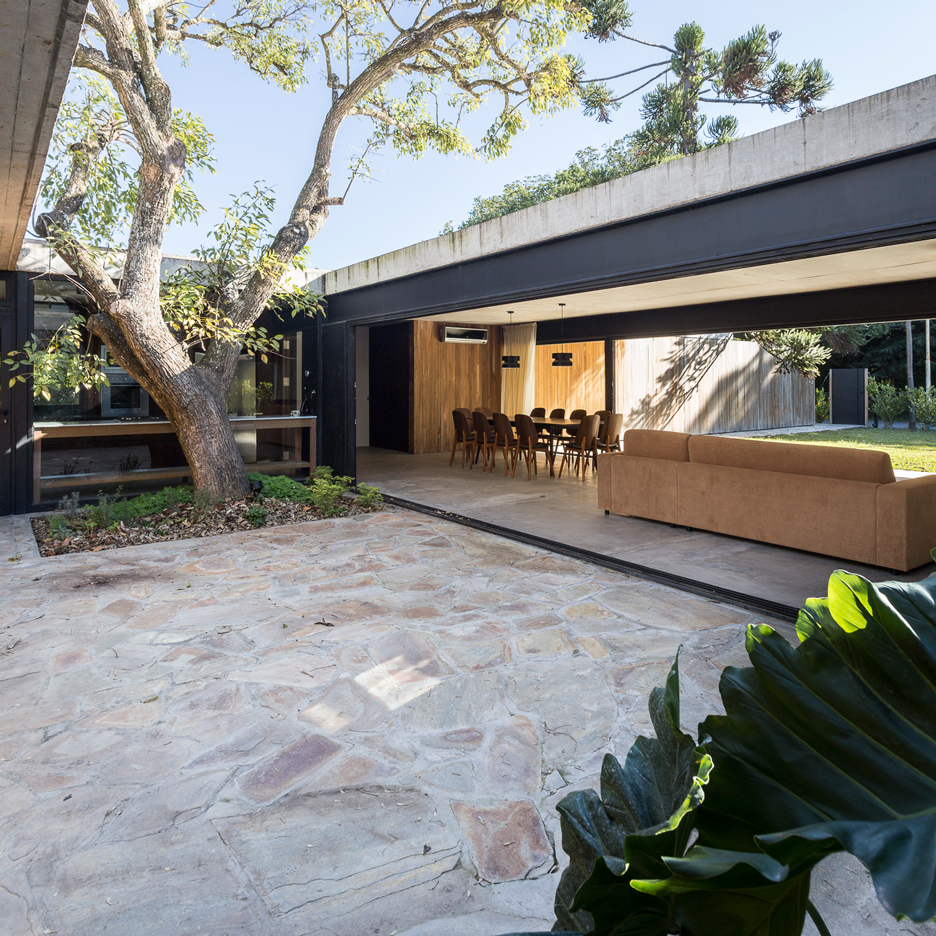
Argentinian architect Marcelo Del Torto has arranged a family home around a group of mature trees in a gated community in Buenos Aires Province (+ slideshow). (more…)
Collaborators: London School for Children with Cerebral Palsy, NOW Gallery, London Festival of Architecture, BD Landscape Architects, City Sq, Creative Aluminiun Solutions
From the architect. An experiential garden den has been created for the London Festival of Architecture 2016 by pH+ Architects on Peninsula Square, Greenwich. Conceived as an inclusive sensory space, The Milkshake Tree is a pop-up inspired by the practice’s work for the London Centre for Children with Cerebral Palsy (LCCCP) in Haringey. The installation stimulates and encourages play through sounds, smells, movements and reflective surfaces.
The Milkshake Tree is part of the philosophy of learning through play, embraced at the LCCCP. Using specific education techniques, which were specifically developed for children with cerebral palsy or other movement disorders, the charity’s aim is to inspire disabled children to develop independence, confidence and self-esteem to achieve their full potential. The pop-up is named after a request from one of the children for a milkshake tree in their new Centre.
Located outside the NOW Gallery, the installation includes a ramped walkway bounded by a screen of timber fins combined with copper xylophones which can be played by the children as they pass by. The walkway wraps around a 12 sq metre gold mirrored cube with leaf-shaped cut outs, an Amelanchier tree and a glass prism in the centre creates a kaleidoscope of colours and light.
According to Wikipedia “In some Indian religions, a chakra (Sanskrit cakra, “wheel”) is thought to be an energy point or node in the subtle body. Chakras are believed to be part of the subtle body, not the physical body.” Their number varies in different scriptural texts, but seven are the most important ones.
They are associated with different physiological functions, but also with the way we react in different situations. Any imbalance in their functioning is affecting us.
Take just now this quick, easy quiz to find which chakra is guiding you!







 Sig Nordal