A local dairy farmer, located close to Leipzig, wanted to enlarge his living space as the family ex-pected further offspring.
Plan
We established the extension as a one- story pavilion. Large openings enable the view into the garden. Depending on the weather the windows can be completely slided aside. Thus the spatial limits are set aside, interior and exterior converge.
The smoothly formed concrete facade of the cube contrasts the existing timber paneled house. The conjunction between existing building and extension was drafted as a „glass joint“ to detach the new building with a light gesture.
Section
Section
On the contrary the interior provides a warm and cozy atmosphere. Therefore walls, floor and ceiling were furnished with an oak facing.
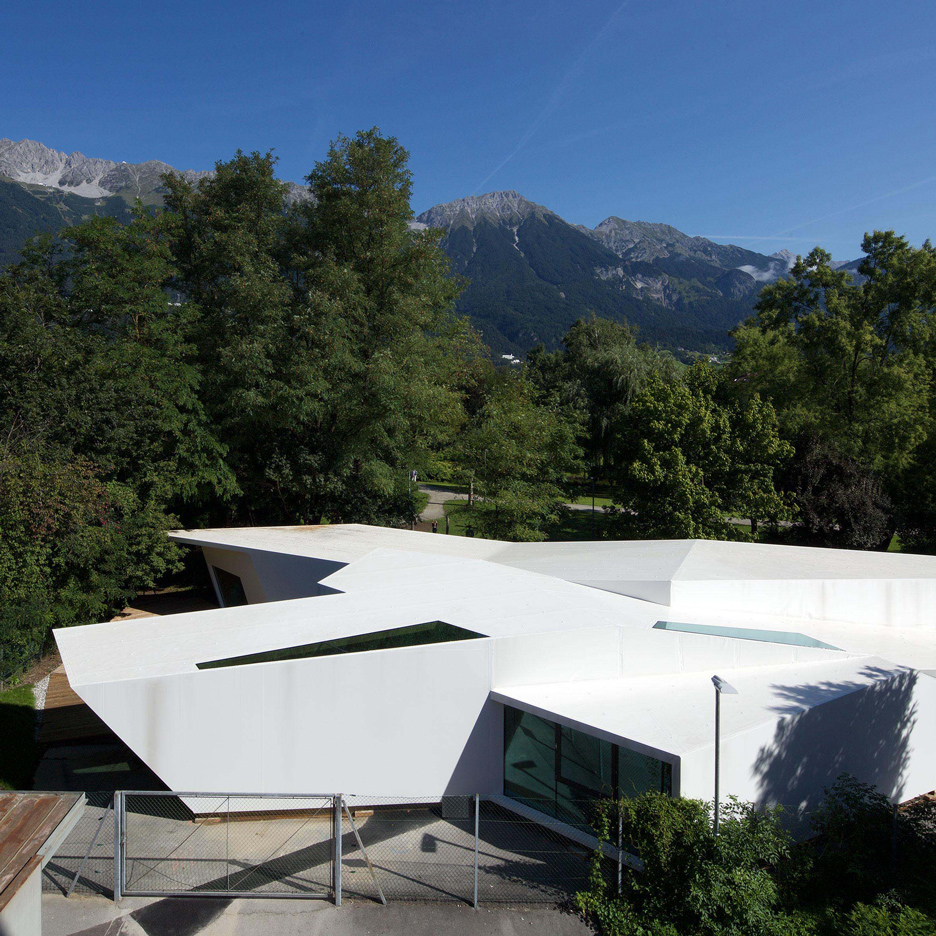
Architecture students from the University of Innsbruck have designed and built an angular timber and glass structure to provide a place for youngsters in the Austrian city to develop creative skills (+ slideshow). (more…)
The team of CIRCOLO-A + LINEARAMA has won first prize in the AAA-Architetti Cercasi 2015 competition with its design, EPICICLO. As a mixed-use building, EPICICLO will feature apartments, alternative residences like student and social housing, common spaces, as well as both public and semi-private outdoor spaces.
The design is shaped after a ring so that it is open to the outside and comfortable on the inside. The design takes into account the relationship between public and private, not only creating a gradient from outside to inside but also varying public and private spaces within the building. Similarly, open and closed spaces are alternated, to create “spots of community life and moments of privacy.”
Courtesy of CIRCOLO-A + LINEARAMA
The project is based on the idea of public space and “introduces the idea of ‘discovery beyond the corner,’ according to which everyone can experience a micro-world populated by children and young people, teachers and students, sportsmen, artists and craftsmen, professionals and retirees” explains the architect.
With no main “front” to the building, the project offers 360-degree views of the external park, as well as access to the internal, more private green space.
Courtesy of CIRCOLO-A + LINEARAMA
EPICICLO additionally centers on the concept of modularity, in order to create a mixed dimension and foster the interaction of residents both indoors and outdoors.
Courtesy of CIRCOLO-A + LINEARAMA
Outside, the project features a natural hilly landscape, as well as a system of wooden walkways, rest areas, and water tanks. These water tanks contribute to the sustainability of the project by collecting rainwater to be reused for irrigation and household appliances, it performs phytoremediation, which reduces pollutants in the water.
Courtesy of CIRCOLO-A + LINEARAMA
Courtesy of CIRCOLO-A + LINEARAMA
Sustainability is further improved through winter gardens in each home, which work as solar greenhouses and naturally regulate climate, reducing the need for air conditioning systems.
Music: after eating some strange eggs, a girl goes through an “inner metamorphosis” controlled by an octopus in Barcelona-based director Alan Masferrer’s music video for Netherlands band Klyne. (more…)
Channel Islands National Park in California encompasses five remarkable islands and the dynamic ocean waters around them. Isolation over thousands of years has created unique animals, plants and archeological resources found nowhere else on Earth. And if that isn’t enough, the sunsets are amazing. Photo by Kurt Schuette (http://ift.tt/18oFfjl).
The damage caused by Hurricane Katrina in 2005 can never be forgotten, but 10 years after the rebuilding of New Orleans started in 2006, a new architecture has emerged with cutting-edge designs being widely celebrated in the media. The Make It Right foundation (founded after the disaster to help with structural recovery) commissioned first-class architects such as Morphosis, Shigeru Ban, and David Adjaye to design safe and sustainable houses for New Orleans’ Lower 9th Ward. But Richard Campanella and Cassidy Rosen worry that this vision is detached from reality.
In their article for Places Journal, the two scholars report that contemporary and modernist houses only account for 5% of the post-Katrina cityscape. After studying a sample of 500 houses with both Google street view and study visits, they observed a revival of historical facades with a specific homage to the iconography of Old New Orleans. However interestingly, the use of historical architectural elements is limited to facades—all materials, technology, interiors, and infrastructure reflect 21st-century codes and domestic needs.
This interest for the architecture of the past is quite new, argue Campanella and Rosen. New Orleans citizens are known for their progressive thinking in architecture, especially during the post-war years, when Curtis and Davis Architects, Charles Colbert and Edward Durell Stone constructed locally. In Campanella and Rosen’s opinion, “the retro revival is mostly a response to the recent past—to difficult decades of contraction and decline,” that began prior to Katrina, but were intensified after the disaster.
Read the entire article, “14 to 1: Post-Katrina Architecture by the Numbers,” here.
The design looks to work with the existing urban grain of the Town of Roscommon in order to create a coherent vision for the public realm.
The principle institutions of Roscommon Town, -Church and Court- historically somewhat dislocated from the town centre, are located in pocket of land that sits to the west of Market Square.
Diagram
It is this quarter, once a precinct of the C19th criminal justice system with its court building and walled enclosure of the County Goal, that the new civic offices are located.
The Gaol was demolished in the Mid 20th Century, apart from some boundary walls, while the Courthouse was extended in the 1960’s with an unsympathetic concrete annex to provide accommodation for the county council. It was onto this context that the new civic offices was to be overlaid.
The project consists of some 6600m2 of office accommodation, laboratories, canteen and Council Chamber for the Council within a single building together with a series of discrete interventions within the greater context of the town so as to form a coherent urban proposal.
The building proper is composed of interlocking volumes constructed amid the traces of the C19th Gaol to create a variety of external spaces – a series of woodland gardens, a forecourt and a covered ‘walk’ sheltered by the cantilevered structure of the offices above.
A linear concourse provides the principle public space and primary horizontal circulation for the project linking the office ‘fingers’ with the Council Chamber suite.
Section
Section
From this space, visitors can enjoy views into adjacent wild gardens while transacting their business. A series of dramatic light shafts cut through the concrete structure and lined with fritted glass provide further daylight and glimpses to the offices above.
The council chamber, an independent suite with its own entrance located at the head of the scheme, is designed as a grand public room for council functions and civic gatherings. A corner window affords panoramic views of the county with its rolling landscape beyond – an appropriate backdrop for civic exchange.
As part of a coherent urban proposal, the project proposes the re-instatement of the original form of the Richard Morrison-designed C19th Courthouse, by removing a 1960’s annex and restoring the southwestern façade which now addresses the new civic offices.
Plan
Plan
Plan
The creation of a new town car park as part of the greater project afforded us the opportunity to create a new pedestrian route through backlands so as to link the town centre to the new civic offices. Stone boundary walls were restored, pebble paving with granite sets were laid down to delineate a route, and a concrete pavilion constructed to create a gateway from the car park to the civic precinct of Court and Civic Offices.
Robust fair-faced concrete walls wrap and fold to support upper floors of white render complimented by Carrara marble which in turn provides an honorific expression to the building. Window ‘boxes’ of oak and LVL form linear strips with deep reveals that modulate daylight to offices.
This palate extends to the interior where floors are of polished concrete and white marble, walls are of fair-faced concrete and fritted glass and joinery is of White Maple.
The project uses simple technologies and strategies to achieve an A3 energy rating and a BREEAM Excellent certification.
Shallow plan depth combined with natural ventilation, exposed concrete structure and the careful control of insolation assist in creating a well-lit, well-tempered working environment.
Fleet Architects has paired slatted timber screens with wooden parquet flooring in this transformation of a “concrete shell” in east London into a craft beer house (+ slideshow). (more…)
Everyone of us has his/her dark side. Some people more than the others. This dark side can sometimes help us succeed in life, but, please, be aware we are not talking about the real psychopaths, just the normal, plain Jane.
Aren’t you curious to see how dark are you inside? Are you moderately evil? Very dark? Or you don’t have any symptoms of evil?
Take just now this quick, fun test to find out how dark is your personality!





 Sig Nordal