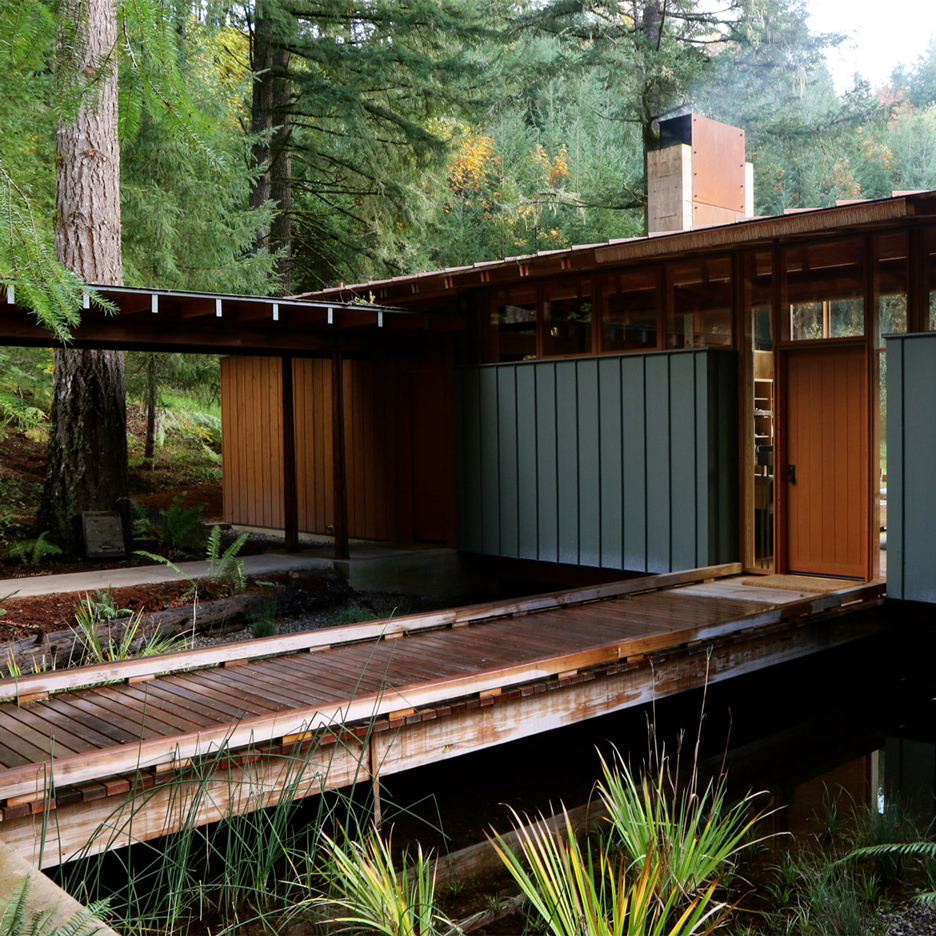
This week’s roundup of American houses from each of the 50 states brings us to Oregon, where a house built atop a pond and a home and studio nestled in a defunct warehouse are among our favourites (+ slideshow). (more…)
This week’s roundup of American houses from each of the 50 states brings us to Oregon, where a house built atop a pond and a home and studio nestled in a defunct warehouse are among our favourites (+ slideshow). (more…)

House 4.16.3 is located in the city of Erechim, in the countryside of Rio Grande do Sul state, around 400 km from the state capital, Porto Alegre. The region has a subtropical climate, with warm, humid summers and chilly, rainy winters, which poses yet another challenge to the architect, in terms of habitability. Built on a terrain with a slope of twenty meters and several native plant species, the project sought to minimally alter the topography, proposing a building that lies on one of its highest parts and, from there on, develops sometimes accommodating itself on the natural profile and sometimes hovering over it.
The program was divided into two volumes: the first is 42 meters long and 8 meters wide, positioned parallel to the contour lines, holds services and the house’s intimate area. The second is one floor below and accommodates the social sector, connecting directly to the patio and the pool area. The two blocks form a “T”, just as the Prairie Houses of Frank Lloyd Wright and articulate through vertical circulation. Where the imaginary axes meet there is a double height ceiling that unites the volumes and allows the intimate area of the house to spatially take over the social area.
There are two accesses, one of daily use of the residents, which is through the garage and allows the house to be used as if it were one-story despite of the rugged topography, since the basic program is completely at the same level. The other access is at the lower level, through the living room with double height ceiling, and through it there is access to a promenade architecturale, which starts on the promenade, passes under the structural balance of 4.5 meters and develops through the pillars below the main volume.
On the slab of the lower volume there is a garden terrace, which can be accessed from the intimate living room, and next to the barbecue lounge there is another terrace, where the pool is located. From both the user is positioned at the same level of the treetops and this artificial floor takes the view as if the landscape were habitable.
The work is materialized through common construction techniques of the region: the structure is in reinforced concrete and the walls are ceramic brick masonry coated with cement and sand mortar plaster. The labor used was local and in addition to the utmost respect for the natural terrain profile, the house has a rain water reuse systems; heating through solar energy; natural ventilation and lighting in every room; reduction of energy losses through double exterior walls with air chambers and also high performance double glazed window frames. Individual actions that together make a difference for the environment.
This residence was requested by a couple who were already friends before being clients, who also had children whom we watched grow. The design act took, more than ever, the

MVRDV has announced plans for Paradise City, a 9,800 square meter entertainment plaza near Incheon Airport in Seoul, South Korea. Designer in partnership with Gansam Architects, the complex will consist of two monolithic forms housing retail and a nightclub, and new public spaces. The connecting element of the project is a giant golden spot at the public square, which the architects hope will become a beacon visible to tourists as they fly into the city.
Paradise City’s two sibling buildings, the Sandbox (the retail complex) and Nightclub, are introverted and completely contextual, echoing the language of surrounding buildings on their cast concrete facades. The relentlessly opaque skin of the Sandbox is brightened by pops of bright gold color seen through its entrances, created by tucking the facade in on itself. On the Nightclub building, a giant golden spotlight is draped over the building, connecting levels of the public square and providing the club entrance “a blast of light before the contrasting dark interior.”
“The project takes two simple volumes, which create a new urban space. These masses then take an imprint of the facades around the site, stretching over the two buildings. Thus adapting themselves to the given environment, accepting these conditions as a sine qua non,” explains MVRDV co-founder Winy Maas. “The buildings are opened by lifting them like a curtain, unravelling their interior. Then, to top it off is the golden spot, marking the entrance like a sunbeam, making its presence known even from the air and the landing planes at Incheon airport.”
The Sandbox, containing 3,600 square meters of retail space, curves to meet a neighboring casino, giving direct access to visitors. The 6,200 square meter Nightclub building houses not only a nightclub, but also a water club and top floor sky-garden. Interiors will feature glass flooring and visually appealing materials, providing the “spectacle that entertainment architecture calls for.” The urban platform between the two buildings is raised, allowing service spaces and a car park to be placed below the surface.
Paradise City is part of designs for a larger tourist district, master planned by Gansam Architects. The 33 hectare masterplan has already begun construction with construction on MVRDV’s Paradise City anticipated to begin in September 2016, to be completed by 2018.

A skylight is not just a view to the world above you, but a window to the world beneath. In this photo, taken last month on the Puʻu ʻŌʻō crater at Kīlauea in Hawaii, a volcanic skylight reveals a river of molten rock, drifting just below the charred surface. It’s a powerful reminder of the forces at work below us. Photo by U.S. Geological Survey.

This article was originally published on Lance Hosey’s Huffington Post blog as “A Darker Shade of Green.”
Last week, Architectural Record reported that Architecture for Humanity (AFH), the nonprofit founded in 1999 to address humanitarian crises through building, is being sued for mismanagement of funds. On June 10th, a court-appointed trustee filed a complaint alleging that the co-founders, Cameron Sinclair and Kate Stohr, and the ten-person board of directors acted with gross negligence by shirking their fiduciary duties from 2012 through 2014. The specific charges relate to misusing charitable donations earmarked for specific purposes. This is the latest in a string controversies, beginning with the co-founders departing in 2013 and the organization declaring bankruptcy last year.
As I wrote a decade ago, in a review of AFH’s book, Design Like You Give A Damn, the organization’s purpose and strategy always seemed misguided:
In focusing more on design than on the conditions that create a need for it, sometimes AFH overstates the role of building. The book’s jacket claims, ‘The greatest humanitarian challenge we face today is that of providing shelter.’ The United Nations disagrees. Its Millennium Development Goals (MDGs), eight targets for the global community…, list the first priority of all of humanity to ‘eliminate extreme poverty.’ For the sixth of the world’s population that is starving, access to food, medication, and especially clean water are the most urgent needs. Shelter, which isn’t even mentioned in the MDGs, is a comparative luxury. After all, if buildings are a basic human necessity, how did we survive before the last five or ten thousand years?
Even the most egalitarian impulses of designers, it seems, are tainted by an over-inflated sense of our worth.
Many of the field’s most high-profile architects are notorious for their “monumental egos,” and their private behavior can be despicable. Early in my career, I worked for one of the world’s most famous architects, and he routinely raged at his employees. Yet, the cliché of the black-cape-wearing architect isn’t limited just to name-brand designers. In fact, entitlement and self-aggrandizement run rampant among architects. To some degree, this is to be expected in any field that prides itself on creativity and innovation. “Ego-fueled fisticuffs“ long have defined Silicon Valley rivalries, for instance. The classic chicken-and-egg question: Does ego spur innovation, or does success inflate egos? Either way, the arrogance of architects no longer surprises me.
What does continue to surprise and sadden me is when I encounter such arrogance among the leaders of the design industry’s more altruistic movements. Years ago, I individually interviewed dozens of the recognized pioneers of sustainable design, the movement to improve the environmental and social impact of buildings. At the time, I did not know most of them, yet many volunteered shockingly petty stories about each other. As recently as last year, one of the field’s most influential proponents bullied a young writer I know after she publicly (and fairly) criticized one of his projects. At such moments, I’m embarrassed to be an architect.
In my experience, great leaders combine vision, conviction, communication, humility, and empathy. Design leaders often demonstrate the first three and all too frequently lack the other two. This is difficult enough to stomach with most architects, but it’s unacceptable for those who claim to be promoting the public good. How can we respect the leader of a social movement who shows little respect for people?
The clash of personal ego and public interest holds us all back. Advocates for change in the design industry can go only so far without also changing how designers behave. Architects can set a new standard, and those of us working toward improving the impact of design have an urgent responsibility to do so.

House LNT is a residential project designed by P8 Architecten in 2012. It is located in Lint, Belgium. Photos courtesy of P8 Architecten

How to fix common sleep problems with science
You’ll never have a poor night of sleep again if you follow these science-backed facts.

Tinhouse by Rural Design, is located on the northwestern tip of the Isle of Skye, on a steeply sloping site overlooking The Minch, the body of water separating the Inner and Outer Hebrides.
Tinhouse is an essay in landscape, economy, construction and imagination which shares the same design ethic as its neighbouring sister the Wooden House. Where, however, the Wooden House celebrates timber detailing the Tinhouse celebrates corrugated metal sheeting, commonly used on the agricultural buildings of the rural landscape. It does so in a thoroughly contemporary way by using mill nished corrugated aluminium as the external cladding for both roof and walls. Internally its timber boarding, concrete oor and plywood cabinetry add to the handmade palette giving the house a character that is simultaneously modern and rustic.
The simple form recalls both the archetypal child’s image of a house and the rural sheds that sit as ghosts in the landscape alongside the ubiquitous white rendered crofthouses. Tinhouse is similarly scaled to the smaller sheds and contains one bedroom along with the living space, kitchen, and bathroom.
The external metal skin predominates as a protective layer against the often ferocious storms with minimal openings cut out for the view. The long, horizontal slot cut in to the north elevation creates a point from which to view the landscape and seascape in good weather and bad, from the inside, a perfect hide.
The house has been designed and self-built by the husband and wife founders of Rural Design, Gill Smith and Alan Dickson, and the materials were mostly chosen to allow for an ease of build by one person. In this way, the handmade Tinhouse celebrates the self-build tradition commonly found in a rural context. Where greater numbers were required, for example to raise the gable wall panels or install the steel beams, this became a celebration and a social event.
The use of materials adopts simplicity where complexity normally prevails, and this approach informed the aesthetic of the interior. The recycled, timber pocket doors have simple cut-outs instead of “ironmongery”, wooden dowels are used as door handles or coat pegs, and left-over cement board frames the shower opening.
An imaginative use of colour also informed the aesthetic of the house where little moments are celebrated with highlights inspired by colours found naturally outside: the yellow or pink of the wild owers, the green of the grass, the blue of the sky and the sea and the orange of the sunsets.
Similarly, the furniture informs the aesthetic and celebrates the handmade spirit of the house. This includes a concrete topped dining table on Douglas Fir sawhorses, beds and seats built in using leftover structural timber, a prototype “Mobius” coffee table which sits at the centre of the social space and offcuts of Douglas Fir as bedside tables.
The external landscaping uses timber and hand poured concrete surfaces which together with rough, large section timber walls create sheltered spaces and routes from which to enjoy the view beyond.
The completed building marks the end of a ve year design and build process and the beginning of a new era for the house, that of a holiday house bringing enjoyment to many, and a new era for its authors who take inspiration and many creative ideas from the Tinhouse on to the next project.
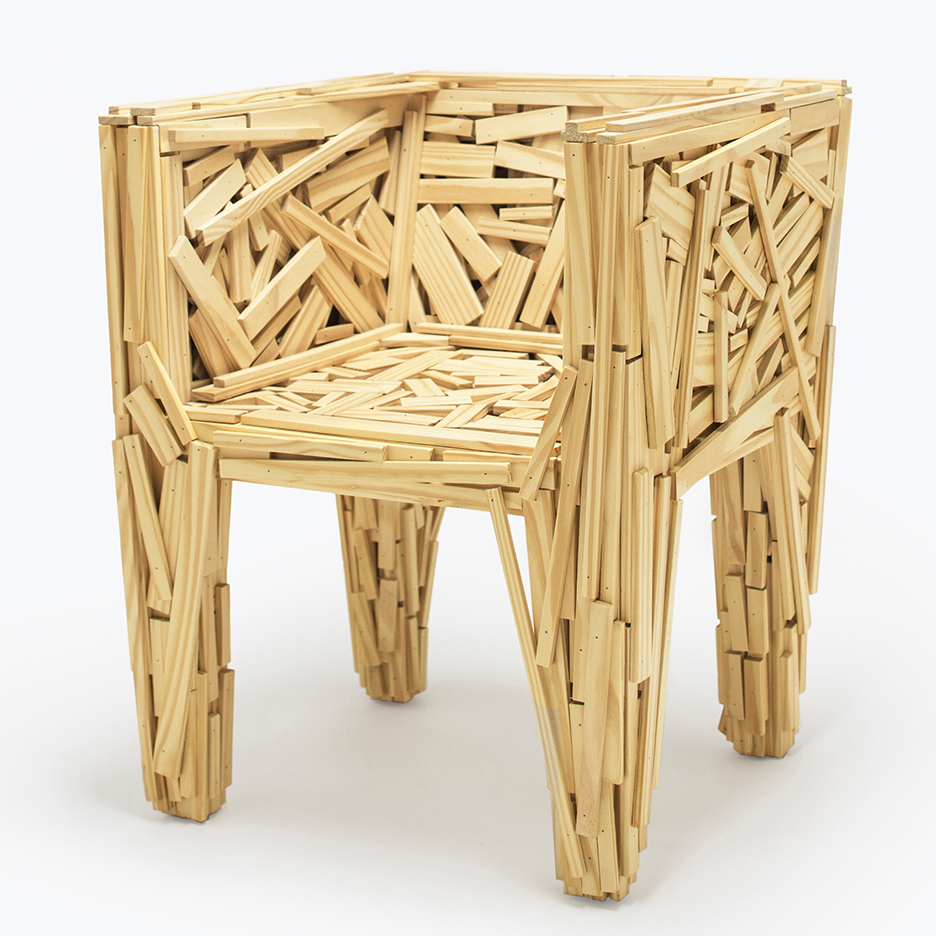
Most Loved: Brazilian designer Humberto Campana explains why the Favela Chair is one the designs he is most proud of in the next movie from our exclusive video series. (more…)
 Sig Nordal