From the architect. The house is located in an urbanization in the town of Pilar, province of Buenos Aires. The environment is characterized by a long-standing, profuse vegetation.
Diagram
On a 20m x 40m. plot, the implantation seeks to minimize the footprint of the house to achieve a greater absorbent surface soil, and direct natural illumination of all north-facing areas of the house.
On the ground floor the window system favors the expansion of the living room and the kitchen into the gallery. The access, toilet, sauna hydro-massage and the service area safeguard this huge ground floor from the street.
Details
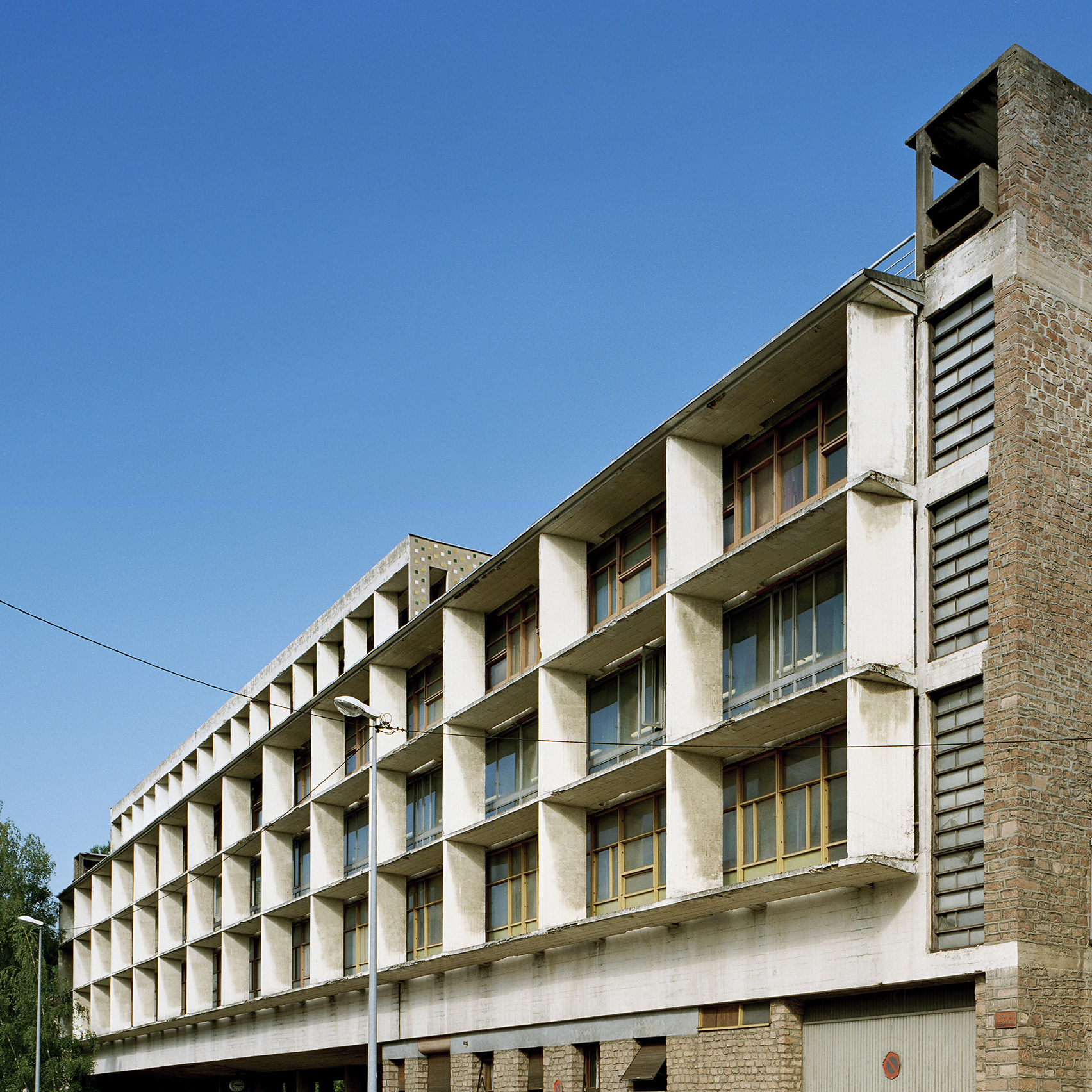
The stereotomic plinth made of reinforced concret confers solidity. Furthermore, the tectonic finish of the house with a steel frame system along with a metalic cover, complet the expressive-comstructive system of the house.
“We define stereotomic architecture as that one in which gravity is discountinuosly transferred, in a continuous structural system where the constructive continuity is completed. It´s a massive architecture, petreous, heavy. That one that sits on the soil as emerging from there. It´s the architecture that follow the light, that one that pierce the walls so the light could enter. It´s the architecture of the podium, the plinth. That one of the stylobate. It´s, summarizing, the cave architecture.” Campo Baeza.
“We define tectonic architecture as that one in which gravity is discountinuosly transferred, in a structural system with knots where the construction is syncopated. It´s a boney architecture, woody, light. That one that settle on the soil as raising on tiptoe. It´s the architecture that safeguard from light, that look after their hollow to control the light coming inside. It´s the shell architecture. The one of the abacus. It´s, summarizing, the architecture of the cottage.” Campo Baeza.
The program for the 2016 edition of the World Architecture Festival (WAF) has been announced. Being held from November 16-18 at the Arena Berlin, Germany, the festival will feature 3 days and 4 nights of events including conferences, lectures and seminars, architect-led city tours and networking opportunities, as well as live critiques of the 411 projects shortlisted for the 2016 WAF Awards. An all-star list of speakers will include leading architectural figures such as Patrik Schumacher, Ole Scheeren and Peter Cook.
This theme of this year’s festival is “Housing For Everyone.” Inspired by a variety of influences, markedly the condition of displaced communities of political and disaster refugees, lectures will focus on “the growing understanding of how demographics and global urbanization are forcing change; and the imperatives to create shelter at one end of the spectrum, and sufficiency for occupation and investment at the other.”
Keynote speakers will end each night with an hour long lecture or discussion. On Wednesday, filmmaker Hubertus Siegert will talk to Louisa Hutton, Principal of Sauerbruch Hutton, about his acclaimed 2001 film “Berlin Babylon” and the continued reconstruction of Berlin from the fall of the Berlin Wall to the present day. Thursday, Zaha Hadid Architects director Patrik Schumacher will examine the typology of housing as architecture, looking beyond the current discourse typically focused on politics, migration, urbanization and numbers. Wrapping up proceedings on Friday will be Sir Christopher Frayling, historian, critic, broadcaster, and Chancellor of the University of the Arts, Bournemouth, discussing film, architecture and the city of Berlin.
In addition to the Arena Berlin events, the WAF will offer architect-led tours of the city by Niche Berlin, a city guide company that focuses on introducing visitors to contemporary and hard-to-find architectural gems, including access to normally restricted destinations. The tours will present both important and under-appreciated building projects, as well as their history and context within the city and the history of architecture as a whole.
Attendees will also be welcome to attend the live project critiques, WAF’s Gala Dinner and late-night drinks. Additionally, the Festival Hall will provide the opportunity to meet with suppliers and manufacturers, and will feature installations and product showcases.
Design: Empresa de Desarrollo Urbano EDU – Medellin Taller de diseño EDU
Enterprise Work Team: CEO: Cesar Augusto Hernandez Correa, Margarita Maria Ángel Bernal (2012-2015)
Design Director: John Octavio Ortiz Lopera
Collaborator Architects: Victor Hugo Garcia Restrepo, Gustavo Andres Ramirez Mejia, Ana Carolina Restrepo acosta, Juan pablo Ramos Gaviria, Catalina Ochoa Rodriguez, Jorge Ramirez, Julián Camilo Yepes, Julián Esteban Gómez Carvajal
Technical Designs Consultant: Empresa CONCAVAS Ingenieria.
Technical Design Controler : Empresa EIP.
Enviromental And Lansdcape Consultants: Mauricio Jaramillo Vasquez + ARBOREA
From the architect. Articulated Units Life, UVA, are urban interventions in neighborhoods, intended for the public meeting, the promotion of sport, recreation, culture and community participation, under the concepts of:
Joint Programmes, Projects and City:
-Facilities that promote balance in services for the neighborhood and the city
-These spaces are articulated to a high offer of programs for sports, culture and recreation.
-Recycling of Existing and Unused Urban Spaces
-Revive restricted urban spaces in effective public space understanding that in Medellin we have few spaces for new infrastructure, areas such as soccer fields are an opportunity for the development of new projects multipurposes
-Light for Recovery Regarding Urban
-Resignifying the neighborhood landmarks as representative cityscape
-Facilities that become referents 24 hours, lighting of quality in sports venues, contribute to build safe environments
-Spaces to Enjoy with the Five Senses
-Architectures that interact with the public, which generate experiences, to walk through various programs and the interaction with water in public spaces.
The UVA (life articulated unit) Sol de Oriente, is the transformation of an old neighborhood soccer field built in sand located in the top of the slopes of Medellin, used intensively by all its inhabitants in different sports and community events. It is a strategic icon in the historical memory of people, protective equipment against urban sprawling and a strategic project of the Comuna 8 of Medellin. This project was conceived from a collective construction by the ideas of citizens and embodied in imaginary workshops with a lingering interest to preserve the soccer field and its original measures, along with the opportunity to incorporate a range of various services to the community without leave aside their sporting traditions.
Diagram
In an urban level, this equipment located on the edge of the city is part of a comprehensive transformation of habitat framed in the Metropolitan Green Belt project, corresponding to his fringe of consolidation was thought as part of strategies to curb the rapid growth of the urbanization toward the high side.
In the Cerro Pan de Azúcar of Medellin was formulated this urban-rural master plan, a sector that for many years has been affected by violence and social debt of the state, but in the last eight years a high public investment has been made by the government that has allowed it to offer quality in all development programs to close this gap of inequality, thus achieving that quality public facilities become a platform for social transformation, in this case sport, culture and recreation merge and create a multipurpose equipment, giving a new meaning to the community imaginary and the stories that were lived there.
“We learned to listen to our main clients, the citizens”
From participation and community ideas a urban transformation was generated “to elevate” the existing soccer field and fold it to create a seats system which serves too as a large square, a privileged public space opened 24 hours to people. Once elevated, an architectural program of services is inserted instead of; it goes from one to five new sports scenarios for citizen meeting, sports, fitness, dance hall, auditorium, commercial spaces, community rooms and playroom among others inserted in its place.
“An open architecture, where the act of approaching is friendly to citizens, pleasant transition spaces between the street and the depths of the building connected to the neighborhood daily.”
This building is a volume in concrete specifically crossed in the middle by a neighborhood street that connects the existing health care center and surrounding houses. A series of vertical sunbreakers are part of bioclimatic strategy for solar protection and building identity itself through color in their facades, crowned by a soccer field in synthetic turf of high quality for a popular neighborhood of Medellin, which replaces the polluting dust of the previous court, to become the new icon and referent. We have made of public architecture, a reference that dignify the poorest areas of the city.
Section
It is a soccer field- terrace, a mixture of two fundamental spaces in the way we live our hillsides, the soccer fields are sacred scenarios in the neighborhoods of Medellin, the terrace as the neighborhood house’s is that intimate space for future growth of our homes has become in the setting for many activities in daily life, for our mountain condition are privileged city balconies.
“Architecture without limits; public transformations erase barriers reject “locked” spaces and favor open
Wolverines are well known, but rarely seen animals. Famously fearless and incredibly tough, wolverines can travel over almost any terrain and will take on prey many times their size. Because they thrive in remote areas, it’s difficult to get good photos of these amazing animals. Luckily, on a recent boating trip on the Noatak River at Gates of the Arctic National Park in Alaska, National Park Service staff were able to get some pictures of this curious wolverine. Photo by S. Behrns, National Park Service.
Yuri Grigoryan founded Project Meganom in 1999 in Moscow with his partners Alexandra Pavlova, Iliya Kuleshov, and Pavel Ivanchikov. Together, the group all graduated from Moscow’s Architectural Institute, MArchI in 1991, the year of the Soviet Union’s collapse, and then practiced at the studio of Moscow architect Alexander Larin. Today Project Meganom is headed by Grigoryan, Iliya Kuleshov, Artem Staborovsky, and Elena Uglovskaya, and keeps in close contact with the theoretical side of architecture: Grigoryan teaches at his alma mater and until recently he was the Director of Education at Strelka Institute, founded in 2009 under the creative leadership of Rem Koolhaas, while in 2008 the practice was involved in the Venice Architecture Biennale with their San Stae project for curator Yuri Avvakumov’s “BornHouse” exhibition. All of this gives Grigoryan an interesting overview of Russia’s unique architectural context. In this interview from his “City of Ideas” column, Vladimir Belogolovsky speaks with Grigoryan about the issues facing Russian architecture and how Project Meganom has responded to those challenges.
Vladimir Belogolovsky:You travel often and participate in student critiques in the West and in Russia. Do you notice any particular difference in approaches?
Yuri Grigoryan: First, the West is not homogeneous. For example, in the late 1980s, during what was then a very rare trip to the USA I had a chance to visit some of the leading studios and schools. I remember how during our visit to the IIT in Chicago the students would sit and methodically place four pieces of paper, forming laconic spaces precisely following Mies van der Rohe’s principles. That was very strange and I did not see any influences coming from outside of that particular school of thought. I could say the same about Russia. At the height of the Constructivist movement, the teachings of our great educators Nikolai Ladovsky and his students Ivan Lamtsov and Mikhail Turkus at Vkhutemas lead to the situation where the figure of a teacher lost its meaning; it was replaced with methodology that was to be obeyed as if it were a sort of religion.
Until today, if you place your pieces of paper in opposition to the precise principles prescribed by the great pioneers of Constructivism who are long gone, you can forget about getting a good grade. In other words, if a student is attempting to construct an interesting dynamic composition in his own way, he is stopped and forced to use the so-called “approved” solutions. I am against that. On the contrary, I try to encourage all kinds of initiatives. I say to the students, “Burn it, experiment!”
To say “no” to students in their first year is wrong. But they are told, “This is not according to the canon.” In other words, originally, the Constructivists overturned all possible canons and precedents, after which their own discoveries were then made into a stale canon that defines a particular territory for prescribed creativity. So often students at MArchI who have fresh ideas are crippled in their first two years. There is little time spent on discourse and self-searching, and more attention is given to learning practical skills.
I teach students from third to sixth year and often I end up unteaching them. They often ask, “Can I do this or that?” I always respond, “Before asking such questions say, ‘Yes, I can’ and ask me the next question.” In other words, you can do anything. Do what you want. You can and need to do absolutely anything. This simple idea puts many students into shock because before they were always told, “No” and were shown the “right” way.
VB:You once pointed out that Russia, just like other national architecture schools, needs to define its identity. But Russia already has its strong Constructivist roots and a number of leading western architects, such as Hadid, Libeskind, Tschumi, Koolhaas, Holl, and others, even get their inspiration precisely from this architecture. Why then does this theme not seem to be the primary source of inspiration for contemporary Russian architects?
YG: Again, you have to look at this movement and understand what was its fate. There was a time of incredible freedom and exchange of ideas among the leading masters in the West and Russia. Gropius, Le Corbusier, and Wright understood that Russia was brimming with interesting ideas and that such Constructivists as Moisei Ginzburg and the Vesnin brothers were creating the type of architecture that was causing a stir all over the world. But as I said, even before Stalin reorganized architecture in the early 1930s, the dogmatic methodology of teaching at the Vkhutemas lead to the evaporation of the spirit of freedom of the initial years. The Constructivist projects were turned into icons.
In the West, there is a very different attitude toward Constructivism. It is much looser. For example, I heard that when Alvin Boyarsky, the head of the AA in London, was following Zaha Hadid’s experiments with Arabic calligraphy, he suggested to her to unite it with Russian Constructivism. That’s when her new forms started to appear. They were rooted in Constructivism, but they also merged into something uniquely her own. Her architecture grew out of her passion to invent a new language, in which she succeeded as very few did in the 20th century. Just like Le Corbusier, she invented her own architectural language. You can say she changed the planet. She transformed nature. After we saw her projects, they changed our understanding of freedom that one can acquire. Architecture is often just a matter of emulation – you can do this or that. But suddenly, here came someone whose creative process was absolutely free and boundless. And I don’t feel freer because now I can copy what she did, but because I understand that anything is possible.
VB:And why wouldn’t Russian students and architects feel free to experiment with the Constructivist legacy today? Wouldn’t you agree that they should have a special affinity toward this architecture?
YG: We still don’t have such teachers who could direct students in this direction. Don’t forget what kind of country we lived in until very recently. There was just one kind of ideology, one kind of truth. There were only certain things that you could do.
Still, if you glance at the work of our leading architects today you can see that the ideas they are exploring are rooted either in functional works by Moisei Ginzburg or more romantic projects by Ladovsky and Leonidov. You can’t deny the relation of contemporary Russian architecture to Constructivism. Yet, this does not take place on a massive scale and we don’t talk about this as a particular movement as much as this is discussed in the West.
Theater Mercury, Moscow, 2006. Image Courtesy of Project Meganom
VB:Where do you derive your inspiration?
YG: In anything and everything, really – from city to nature and specific projects by various architects whose work I follow. I am also inspired by the work of artists. The Weather Project [2003], or the Sun, by Olafur Eliasson at the Tate Modern in London influenced me tremendously. I’m not sure how but since seeing that installation I am a different person. It was the moment when the world, the entire cosmos, people’s behavior suddenly transformed. I was absolutely happy. It changed my life. Another artist who had an effect on the entire Russian culture is Alexander Brodsky.
Moscow River Competition, 2014 (under construction). Image Courtesy of Project Meganom
VB:How?
YG: Very simple. Those of us who consider ourselves modernist architects see architecture as a particular medium that can help us to make order in everything around us, to transform our reality into the world of organized geometry. And when we walk into an ordinary world oversaturated with advertisements and leaning fences everywhere it is natural for us to want to bring everything into order. But how? The chaos surrounding us is constantly growing. It is so irritating because you understand that even if you solve this problem of chaos in one particular apartment or even a whole building you can’t do anything about what happens everywhere else. Brodsky showed to us that everything that in our opinion looks like a mess is in fact life, a vital life. And it is quite beautiful. He simply included everything that’s around us into the archive of what art is. He turned around our glasses. Since that we understand that beauty is the chaos of our life. Now we look at everything around not with the eyes of architects but with the eyes of ordinary people.
Masterplan of former ZIL automobile factory redevelopment, Moscow (ongoing). Image Courtesy of Project Meganom
VB:And how did this revelation change your architecture?
YG: It is not as ambitious and with much less pathos. Our gestures are confined to specific situations. They are relevant. We decided not to fight chaos. For this reason, we are constantly searching for new forms specific to each place. We try not to come with predetermined solutions. Our studio is an educational project. We educate ourselves based on the life around us and on the work process. We are not after a particular style. We are constantly in the process of forming our style.
VB:How would you define your mission in architecture? What are your goals in addition to those set by your clients?
YG: In finding the right type of building, in changing the actual archetype or inventing an entirely new type. This process of finding the right type is the most interesting part to me. Today building types constantly pulsate, mutate, and lead to new hybrid types. The goal is to find the most straightforward solution.
VB:Once you remarked that building a project is not the purpose. So what is the purpose then?
YG: Any realization is the intermediate phase. Architecture is not simply utilitarian or functional. Many buildings go through reincarnations and change their purpose many times. Architecture is interesting because forms or so-called shells can be filled with various functions over time. This is the goal of an architect – to create a kind of form that would correspond to different functions.
Masterplan and renovation of The Pushkin State Museum of Fine Arts (ongoing). Image Courtesy of Project Meganom
VB:Do you ever create forms that may hint at a particular function?
YG: I don’t think this is possible because in reality a building has a purpose, not just a function. Functionalism in itself is not productive despite the fact that any building has certain degree of utilitarianism. Only such projects as pavilions, tombstones or monuments can truly be the highest manifestations of architecture in the sense that they are not utilitarian. Other buildings have to be utilitarian, but that does not mean that thinking about their functions leads to the best possible form. Take such examples as Brunelleschi’s Dome, St. Basil’s Cathedral in Moscow or the National Parliament of Bangladesh by Louis Kahn. None of those buildings’ forms express their interior spaces. In these examples, forms are completely independent of their functions. Any form is artistic. All buildings are made up. They illustrate either one thing or another.
VB:And what then is the purpose of architecture?
YG: The thing about architecture is that an architect can imagine any building in his or her own way, in his or her own language of gestures and techniques. The meaning and purpose of architecture is in inventing a form, but not just a new form. Such a form should instead be local and specific.
VB:In addition to defining forms specific to each project, you explore such themes as a building’s skin and how it admits light within.
YG: This fascination started with one tiny shed structure in Nikola-Lenivets, a town near Moscow that over the last quarter of a century has become a real laboratory for artistic and architectural expressions for many leading Russian architects. This shed is the laconic form of a typical village log hut. All sides of the shed were perforated with apertures – 600 apertures per square meter. During the day, it was full of light bursting in, and at night, bright light was coming from within. It was this project that instigated our exploration of a building’s skin and how it could be penetrated by light. Now it is our concern in every project. The shed has become our manifesto.
The main thing in our architecture is a story that we are presenting with the help of a particular form. The point is to create a form that is able to tell its own story. Our architecture is literary. We can tell a story about every one of our buildings and why it has one particular form and not another. A form carries a story that is possible to read. That’s why every time the form is different. In other words, each of our buildings has its story and its goal.
VB:You said that architecture is always in a state of a crisis, and that it is a never-ending process.
YG: It is like a city. Any city in its development is going through a crisis and it is precisely a crisis that creates fruitful development. Any solution leads to a new search and it is impossible to find an ideal solution to a question which will only come up in the future. Our world is constantly changing and there will always be new challenges. That’s why we always have to aim at being ahead, ahead of others and ourselves. We can’t use yesterday’s solutions and that’s why we are always in crisis. Architecture can’t be created only for the sake of realizing a building. This is not interesting. Architecture must respond to new challenges of the ever-changing times.
Masterplan and renovation of The Pushkin State Museum of Fine Arts (ongoing). Image Courtesy of Project Meganom
Belogolovsky’s column, City of Ideas introduces ArchDaily’s readers to his latest and ongoing conversations with the most innovative architects from around the world. These intimate discussions are a part of the curator’s upcoming exhibition with the same title which premiered at the University of Sydney in June 2016. The City of Ideas exhibition will travel to venues around the world to explore ever-evolving content and design.
Olympic athletes inspire and awe us. They are the greatest athletes in the world. And every four years they get together to put their lives’ work on display for all of us to see at the Olympic Games.
And even if sometimes we feel like couch potatoes who can’t walk down the block without breathing heavy, there is much we can learn from these amazing athletes that we can apply to becoming top performers in our careers.
Below are 5 scientifically proven Olympic training secrets you can use to become twice as productive as your competition.
1. Work Deliberately
Olympic athletes don’t get to where they are without practicing. A lot.
The kind of practice Olympians engage in is what famed researcher Anders Ericsson calls “deliberate practice.” Deliberate practice is focused work done without distraction and it’s right on the edge of one’s abilities. It’s mentally challenging and requires clear goals and objectives rather than just “going through the motions.”
Picture a gymnast practicing a new move – and falling on her butt over and over again – before finally getting the hang of it after hours and hours of struggle and effort. That’s deliberate practice.
If you want to perform your best at work, you need to adopt this same deliberate practice mindset. This means you must focus on your most important tasks without distraction.
In addition, you need to identify the actual skills needed to excel at your work and make efforts to constantly stretch your current skill levels. If you focus on getting just a little bit better every single day, you’ll make amazing progress.
Constant feedback is a requirement if you want to truly excel in your profession. All Olympic athletes work with expert coaches and mentors who provide them with feedback and guidance on their training. You’ll get the most out of your time spent doing your deliberate focused work if you’re also getting feedback along the way.
The inability to use feedback correctly is one of the main reasons why many people who seem to be working “hard” never get the amazing results they’re after. It does you no good to work hard if you’re working hard on the wrong things.
The best form of feedback is to work with an established expert in your chosen field who can provide you with coaching and guidance. Ideally, this is someone who has a proven track record of successfully taking people up the same mountain you want to climb.
These days you can find experts to help you in almost any area you want to improve at. Sites like wyzant.com have thousands of experts that can help you with anything from gardening to aerospace engineering.
Now, if for some reason you can’t find or afford an expert or coach to work with, I suggest you reach out to a friend or co-worker whose opinion you trust for help. Practically everyone loves giving feedback so finding someone to help you with this should not be too difficult.
It takes a superhuman amount of motivation to become an Olympic athlete. Getting up at the crack of dawn every day, training hard for years and years and years, and making numerous other life sacrifices is not easy. How do they do it?
Great athletes reach a point where they enjoy practicing and working hard for reasons beyond the actual, immediate results. In his book the Talent Code, author Daniel Coyle calls this type of motivation “ignition.” Ignition is what allowed swimmer Michael Phelps, arguably the greatest Olympian ever, to make it to the pool to train 365 days a year without fail for a period of over five years.
There are two key elements of ignition.
a strong vision of what the athlete wants to be and;
an internal belief that it’s possible to attain this vision
If you want to be a top performer in your field, you’ll need be supremely motivated as well. Spend some time thinking about what your vision for the future is as it relates to your career and look for evidence that this vision is attainable.
The easiest form of evidence is to find others who have accomplished what you want to accomplish and use them for inspiration. If they can do it, so can you.
4. Meditate
At last count, there have been over 1400 clinical studies demonstrating the benefits of meditation from everything from stress relief, to improving the immune system, to improving the brain’s ability to focus. So it should be no surprise that in the field of high stakes athletics, where a hundredth of a second can mean the difference between glory and vanishing into oblivion, many athletes believe it’s just as important to spend time in the “mental gym” meditating as the physical one.
Meditation will also help us mere mortals get a leg up on the competition by reducing stress, increasing our will power, and increasing our ability to concentrate. The biggest reason why most people say they can’t meditate is because they “don’t have the time.”
The truth is, if you want to perform at peak levels at work, you don’t have time NOT to meditate. Twenty minutes a day is the ideal amount of time for most people. But if you’re just getting started, do whatever you can. Start with 5 minutes a day or even one minute and build from there.
5. Recover
Olympic athletes actually spend much more time recovering from their training than actually training. For example, Olympic marathoner Ryan Hall not only made sure he slept for at least 8 hours a night, he also scheduled 90 minute naps (which he described as “business meetings”) every afternoon.
Leading sleep researchers agree that we need 7 to 9 hours of sleep per night to perform at peak levels. This is true for Olympians as well as everyday people like you and me. If your engine is going at 100 miles an hour all day, it’s eventually going to burn out if you don’t let your foot off the gas on occasion.
In addition to getting enough sleep, you’ll also want to optimize your recreation time. Among the worst ways to spend your non-work recreation hours are surfing the Internet, playing on social media, and watching television. These things drain our will power and actually make it much more difficult for us to focus while on the job.
Instead, use your recreation time for things that will re-energize you. Go for a hike, spend time with loved ones, read a book or take up a new hobby. These things will not only make you happier, they’ll help you leave your work competition in the dust as well.
(function(d) {
var params =
{
id: “cb4f919c-04fa-460c-b2ff-2c7f9ecf4472”,
d: “ZHVtYmxpdHRsZW1hbi5jb20=”,
wid: “165294”,
cb: (new Date()).getTime()
};
var qs=[];
for(var key in params) qs.push(key+’=’+encodeURIComponent(params[key]));
var s = d.createElement(‘script’);s.type=’text/javascript’;s.async=true;
var p = ‘https:’ == document.location.protocol ? ‘https’ : ‘http’;
s.src = p + “://api.content.ad/Scripts/widget2.aspx?” + qs.join(‘&’);
d.getElementById(“contentad165294”).appendChild(s);
})(document);







 Sig Nordal