ColiRoma OneHundredTwentyEight / Arqmov Workshop


© Rafael Gamo

© Rafael Gamo


© Rafael Gamo


© Rafael Gamo


© Rafael Gamo


© Rafael Gamo

  • Architects: ARQMOV WORKSHOP
  • Location: México, Colima 128, Roma Nte., 06700 Ciudad de México, D.F., Mexico
  • Architects In Charge: ARQMOV WORKSHOP
  • Area: 2300.0 m2
  • Project Year: 2016
  • Photographs: Rafael Gamo
  • Collaborators: Eduardo Micha, Fabio Correa, Gabriel Merino, Oscar Osorio, Patricia Pérez, Christian Rodriguez, Miguel Angel Chiney, Armando Hernández, Mario Moreno, Maricruz Pérez, Daniel Reyes, Eduardo Acosta
  • Builder: ARQMOVPLANNER
  • Structural Engineering: ing. Max Tenembaum
  • Ilumination: ARQMOV WORKSHOP
  • Renders: ARQMOV WORKSHOP

© Rafael Gamo

© Rafael Gamo

From the architect. ColiRoma OneHundredTwentyEight is part of the urban fabric of the Colonia Roma Norte in Mexico City. The district’s features and use of public space offers a unique perspective on progressive neighborhood living within the city, and as such, reflects contemporary society, where life and living happens not only in our private spaces but also in our nearby public spaces. 


© Rafael Gamo

© Rafael Gamo

Activities, like those of the Condesa-Roma Cultural Corridor, generate vibrant personal relationships with neighbors that allow for living together in the public space. This is how the concept of livable space and lifestyle has a direct impact on this residential project.


Diagram

Diagram

The building is configured using conceptual elements of public-private space. First of all, the building and its urban setting lead to spatial permeability between the two through an “urban pit stop”. This is a flexible space of public-private interrelationships, located a half-level below the sidewalk, that can become a gallery, forum or place for interacting during the Cultural Corridor, etc. It can also be a common area for building residents, turning into an exclusive space for gatherings if required, allowing for flexibility in use and reaffirming the impact of neighborhood living on the area. 


© Rafael Gamo

© Rafael Gamo

Additionally, a public bench is built around an existing tree outside the main façade, where bicycles can be parked or where pets and people can sit and mingle freely.


Section AA

Section AA

Section BB

Section BB

On the other hand, from a residential perspective, the building consists of 8 apartments, 2 town houses, 2 penthouses, a roof garden and 2 subterranean parking levels. The apartments have a linear spatial configuration, generating a sequence of interior cubes of light and natural ventilation across their inner walls. This affords street views and views toward the inside and back cubes, which produce spatial transitions along the linear path of the apartment, exposing light, shade and indoor and outdoor environments.


© Rafael Gamo

© Rafael Gamo

There is an apartment on the first level configured as a studio-loft. Another of the apartments on the fourth level plays with the open space by preserving the living room-dining room as an open terrace of double height, and the top of an existing tree relates spatially as an element of nature. The townhouses and penthouses have two levels, two overlook the street and two overlook the rear light and ventilation cubes, maintaining the spatial transition and revealing the indoor and outdoor environments. The roof garden has 6 private areas and a spa in the common area, encouraging and facilitating interaction among neighbors.


© Rafael Gamo

© Rafael Gamo

The balconies and the spatial configuration of the apartments are visible from the main façade. In the center are the 2-storey blocks. The studio-loft appears as a pewter cube with urban phrases, which calls attention to the vehicle and pedestrian access. At the top, a 2-storey cube with pewter details highlights the apartment with the open terrace. The existing tree and the public bench also interrelate well. Everything is a communication of components and elements, permeability of spaces, interaction of public and private use.


Parking Plan

Parking Plan

The overall finishes are exposed: the structure is based on metal columns that are painted black, with exposed intermediate floors made of corrugated metal; the flat slab support system uses reinforced concrete which holds an exposed concrete ceiling; the general interior installations are exposed, except for the service areas, the window frames are black aluminum with clear glass. The main façade has pewter details and sliding panels of perforated laminate.


© Rafael Gamo
© Rafael Gamo

http://ift.tt/2bvV7tE

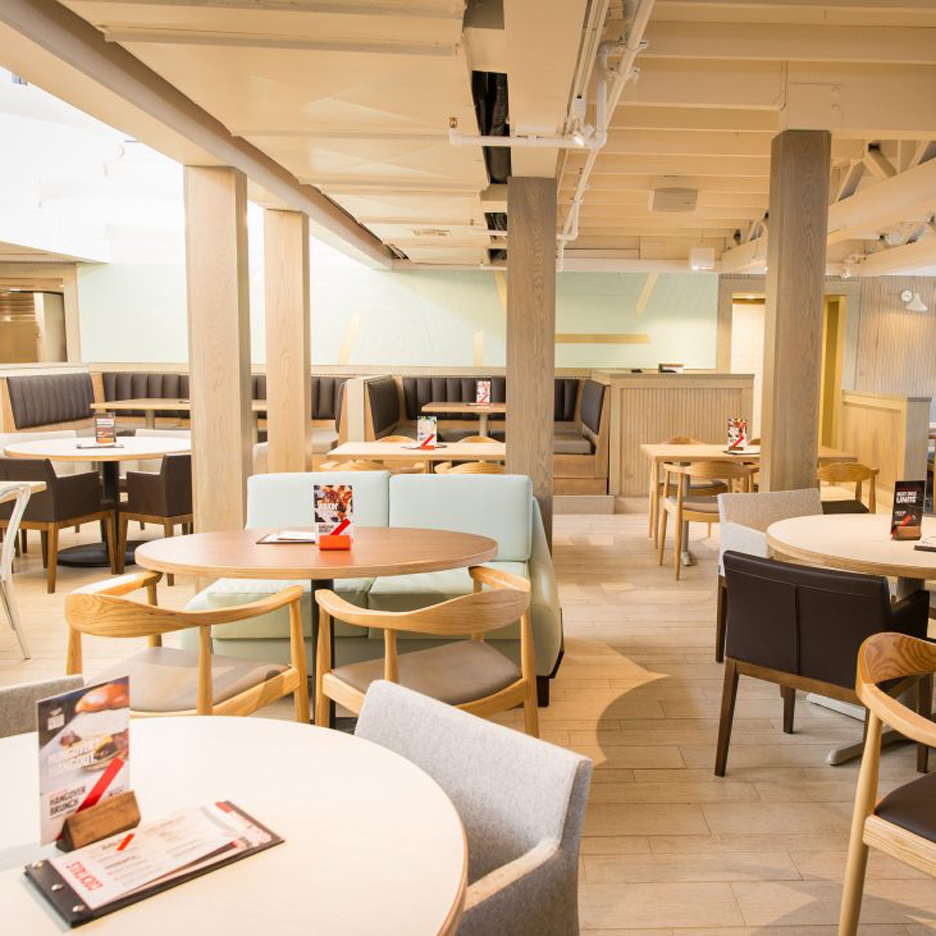
TGI Fridays unveils new look at Corpus Christi concept restaurant


Restaurant chain TGI Fridays has ditched its dark wood and red-striped interiors in favour of a muted Scandinavian-style aesthetic at a branch in Corpus Christi, Texas, following similar revamps by McDonalds and Burger King (+ slideshow). (more…)

http://ift.tt/2b44jnX

Kofa National Wildlife Refuge is the second largest wilderness…

Kofa National Wildlife Refuge is the second largest wilderness area in #Arizona. A campaign by the Arizona Boy Scouts helped establish the refuge in 1939 to protect desert bighorn sheep and other wildlife. The refuge’s name – Kofa – comes from an acronym for one of the area’s most notable mines, the King of Arizona gold mine. Photo of mountains, palo verde & brittlebush by Brian Powell (http://ift.tt/18oFfjl).

Architecture Activism


The international practice GRAFT is known for its experimental and interdisciplinary designs as well as for its strong social commitment. The publication documents projects characteristic of this social responsibility portraying architecture as an active tool for driving the development of places worth living in. One key project is the Solar Kiosk, a high-output, which is already used by many communities in Sub-Saharan Africa.

– Foreword by Cameron Sinclair
– Introduction by Lats Krückeberg, Wolfram Putz, Thomas Willemeit

Relief and Affordable Housing

Make It Right / Rebuilding the Lower 9th Ward in New Orleans, USA, 2006-
– Affordable Housing Namibia / Attack Ownership Barriers, 2014-
– Heimat2 / Dignified Solutions for Refugees in Europe, Berlin, Germany, 2016-
– Eckwerk Holzmarkt / Affordable Urban Living & Working, Berlin, GErmany, 2014-

Energy Autonomy
– Solarkiosk / Reducing Energy Povertry, Botswana, Ethiopia, Germany, Ghana, Kenya, Rwanda, Tansania, USA, Vietnam, 2009-
– Holistic Living / Mobility Plus House, Berlin, Germany, 2013-2015

Healing Architecture
– Two Icu Rooms in Berlin / Linking Design and Healthcare in a Research Project, Berlin, Germany 2011-2013

Cultural Campaigning
– Platoon Kunsthalle / Temporary Buildings and their Impact on the Built Environment, Seoul, South Korea / Berlin, Germany, 2009, 2012
– Art Cloud & Unity Flag / Leading Campaign for Change, Berlin, Germany, 2006, and diverse places, 2006

– GRAFTIES Members of staff
– About GRAFT
– Illustration Credits

  • Isbn: 9783035610239
  • Title: Architecture Activism
  • Author: Cameron Sinclair
  • Publisher: Birkhauser
  • Project Year: 2016
  • Binding: paperback
  • Language: English

Architecture Activism

http://ift.tt/2bhUVzA

Studying the “Manual of Section”: Architecture’s Most Intriguing Drawing


Phillips Exeter Academy Library by Louis I. Kahn (1972). Published in Manual of Section by Paul Lewis, Marc Tsurumaki, and David J. Lewis published by Princeton Architectural Press (2016). Image © LTL Architects

Phillips Exeter Academy Library by Louis I. Kahn (1972). Published in Manual of Section by Paul Lewis, Marc Tsurumaki, and David J. Lewis published by Princeton Architectural Press (2016). Image © LTL Architects

For Paul Lewis, Marc Tsurumaki and David J. Lewis, the section “is often understood as a reductive drawing type, produced at the end of the design process to depict structural and material conditions in service of the construction contract.” A definition that will be familiar to most of those who have studied or worked in architecture at some point. We often think primarily of the plan, for it allows us to embrace the programmatic expectations of a project and provide a summary of the various functions required. In the modern age, digital modelling software programs offer ever more possibilities when it comes to creating complex three dimensional objects, making the section even more of an afterthought.

With their Manual of Section, the three founding partners of LTL architects engage with section as an essential tool of architectural design, and let’s admit it, this reading might change your mind on the topic. For the co-authors, “thinking and designing through section requires the building of a discourse about section, recognizing it as a site of intervention.” Perhaps, indeed, we need to understand the capabilities of section drawings both to use them more efficiently and to enjoy doing so.


Bagsværd Church by Jørn Utzon (1976). Published in Manual of Section by Paul Lewis, Marc Tsurumaki, and David J. Lewis published by Princeton Architectural Press (2016). Image © LTL Architects


Notre Dame du Haut by Le Corbusier (1954). Published in Manual of Section by Paul Lewis, Marc Tsurumaki, and David J. Lewis published by Princeton Architectural Press (2016). Image © LTL Architects


United States Pavilion at Expo '67 by Buckminster Fuller and Shoji Sadao (1967). Published in Manual of Section by Paul Lewis, Marc Tsurumaki, and David J. Lewis published by Princeton Architectural Press (2016). Image © LTL Architects


The Solomon R. Guggenheim Museum by Frank Lloyd Wright (1959). Published in Manual of Section by Paul Lewis, Marc Tsurumaki, and David J. Lewis published by Princeton Architectural Press (2016). Image © LTL Architects


São Paulo Museum of Art by Lina Bo Bardi (1968). Published in Manual of Section by Paul Lewis, Marc Tsurumaki, and David J. Lewis published by Princeton Architectural Press (2016). Image © LTL Architects

São Paulo Museum of Art by Lina Bo Bardi (1968). Published in Manual of Section by Paul Lewis, Marc Tsurumaki, and David J. Lewis published by Princeton Architectural Press (2016). Image © LTL Architects

The book starts by highlighting the uniqueness of section as a representational tool. Section allows us to understand a project’s materials, structure, and tectonic logic. The vertical cut, combined with the representation of people, helps to identify scale and proportion. It simultaneously reveals a project’s neighboring urban context (the outside), its envelope and internal structure (the cut), and interior ornamental or material visual qualities (the inside). The authors also remind readers that sections and detailed sections help to solve thermal, technical and structural issues.


Ford Foundation Headquarters by Kevin Roche John Dinkeloo Associates (1968). Published in Manual of Section by Paul Lewis, Marc Tsurumaki, and David J. Lewis published by Princeton Architectural Press (2016). Image © LTL Architects

Ford Foundation Headquarters by Kevin Roche John Dinkeloo Associates (1968). Published in Manual of Section by Paul Lewis, Marc Tsurumaki, and David J. Lewis published by Princeton Architectural Press (2016). Image © LTL Architects

But the most fascinating suggestion of the text is the authors’ categorization of sections into 7 types that allow readers to engage critically with the section as a design tool. These types are “intentionally reductive” to facilitate their recognition and dissociation. “Extrusion,” “Stack,” “Shape,” “Shear,” “Hole,” “Incline,” and “Nest” each highlight a different design strategy that is exemplified by enlarged sections from well-known built projects of the 20th and 21st century. Hybrid cases are also described, showing how to combine various section types within one building. The authors manage to balance clear and informative projects with more intricate and creative ones, thus offering a good overview of section design strategy.


Yale Art and Architecture Building by Paul Rudolph (1963). Published in Manual of Section by Paul Lewis, Marc Tsurumaki, and David J. Lewis published by Princeton Architectural Press (2016). Image © LTL Architects

Yale Art and Architecture Building by Paul Rudolph (1963). Published in Manual of Section by Paul Lewis, Marc Tsurumaki, and David J. Lewis published by Princeton Architectural Press (2016). Image © LTL Architects

Interestingly, readers can assess the quality of each design in relation to vertical cuts only. The authors have avoided using plans, elevations and renders, and the use of photographs is kept to a minimum. All 63 projects are represented in one-point-perspective section, with the same standardized view and graphic representation to allow for a strictly architectural (as opposed to representational) understanding. This in turn brings complex structural systems into focus, along with sophisticated spatial hierarchies and interplays between the interior and the exterior.


Notre Dame du Haut by Le Corbusier (1954). Published in Manual of Section by Paul Lewis, Marc Tsurumaki, and David J. Lewis published by Princeton Architectural Press (2016). Image © LTL Architects

Notre Dame du Haut by Le Corbusier (1954). Published in Manual of Section by Paul Lewis, Marc Tsurumaki, and David J. Lewis published by Princeton Architectural Press (2016). Image © LTL Architects

The varied selection of projects is also worth noting. The book shows modernist masterpieces, such as Louis Kahn’s Salk Institute for Biological Studies, Le Corbusier’s Notre Dame du Haut, Alvar Aalto’s Seinajoki Library, Jorn Utzon’s Bagsvaerd Church and Paul Rudolf’s Yale Art and Architecture Building, while contemporary architects featured include Toyo Ito & Associates, Sou Fujimoto Architects, OMA, Peter Zumthor, Herzog & de Meuron, MVRDV, Steven Holls Architects, Diller Scofidio + Renfro, Weiss/ManfrediBIG… the list goes on. The authors also give attention to historically significant buildings like Henri Sauvage’s social housing project 13 rue des Amiraux and Starrett & Van Vleck’s Downtown Athletic Club (later celebrated in Rem Koolhaas’ canonical text Delirious New York).


The Solomon R. Guggenheim Museum by Frank Lloyd Wright (1959). Published in Manual of Section by Paul Lewis, Marc Tsurumaki, and David J. Lewis published by Princeton Architectural Press (2016). Image © LTL Architects

The Solomon R. Guggenheim Museum by Frank Lloyd Wright (1959). Published in Manual of Section by Paul Lewis, Marc Tsurumaki, and David J. Lewis published by Princeton Architectural Press (2016). Image © LTL Architects

To represent these sections, the authors used an incredible amount of documentation ranging from historical photographs and detail drawings to primary documentation from contemporary architecture firms. Each section also comes with a full description, and if you’re attentive to details, you’ll even find consistency in the furniture items; don’t miss the Thonet chairs and Charlotte Perriand’s design in Le Corbusier’s work.


Taichung Metropolitan Opera House by Toyo Ito & Associates (2016). Published in Manual of Section by Paul Lewis, Marc Tsurumaki, and David J. Lewis published by Princeton Architectural Press (2016). Image © LTL Architects

Taichung Metropolitan Opera House by Toyo Ito & Associates (2016). Published in Manual of Section by Paul Lewis, Marc Tsurumaki, and David J. Lewis published by Princeton Architectural Press (2016). Image © LTL Architects

Finally, Manual of Section also includes a short and cohesive “History of Section” that brings perspective to the historical development and recent use of sections. The text notably sheds light on the emergence of section in the early fifteenth century, explaining how sections first appeared as an “analytical device” to depict Roman ruins. Only later did the section progressively become a “generative instrument” for architectural practice, in the works of PalladioEtienne-Louis Boullée and Eugène Viollet-le-Duc among others.


United States Pavilion at Expo '67 by Buckminster Fuller and Shoji Sadao (1967). Published in Manual of Section by Paul Lewis, Marc Tsurumaki, and David J. Lewis published by Princeton Architectural Press (2016). Image © LTL Architects

United States Pavilion at Expo '67 by Buckminster Fuller and Shoji Sadao (1967). Published in Manual of Section by Paul Lewis, Marc Tsurumaki, and David J. Lewis published by Princeton Architectural Press (2016). Image © LTL Architects

As history shows, section has always been considered as a representational method first, and its input on architectural discourse is still largely undermined. Manual of Section successfully attempts to reintroduce sections within theoretical discourses; a new reference book for architects.

Manual of Section by Paul Lewis, Marc Tsurumaki, and David J. Lewis published by Princeton Architectural Press (2016) is released on August 23rd.


Manual of Section by Paul Lewis, Marc Tsurumaki, and David J. Lewis published by Princeton Architectural Press (2016). Image Courtesy of Princeton Architectural Press

Manual of Section by Paul Lewis, Marc Tsurumaki, and David J. Lewis published by Princeton Architectural Press (2016). Image Courtesy of Princeton Architectural Press

http://ift.tt/2bAI5eC

http://ift.tt/2b3uEoQ

433 Broadway / RKTB Architects, P.C.


© ESTO

© ESTO


© ESTO


© ESTO


© ESTO


© ESTO

  • Architects: RKTB Architects, P.C.
  • Location: 433 Broadway, New York, NY 10013, United States
  • Area: 45000.0 ft2
  • Project Year: 2015
  • Photographs: ESTO
  • Mechanical Engineer: Abraham Joselow, P.C., P.E.

  • Structural Engineer: Wexler & Associates Structural Engineers

© ESTO

© ESTO

433 Broadway is a new, six-story office building in Manhattan’s SoHo Cast Iron Landmark District on the corner of Howard Street and Broadway. Vacant for many years, the site was originally occupied by a branch of the now defunct Franklin National Bank that was housed in a small pavilion in the corner and surrounded by a large, park-like space.


© ESTO

© ESTO

The architects have taken advantage of the corner site by placing the building’s entrance on Howard Street, thereby freeing the entire lower Broadway façade for retail space. Exterior facades offer large floor-to-ceiling windows that take advantage of SoHo’s skyline. Using modern materials, the facade interprets the rhythms and proportions established by surrounding landmark buildings while providing efficient, high tech, commercial and office space within its 37,000+ square feet.


© ESTO

© ESTO

Section 1

Section 1

© ESTO

© ESTO

Each of the five floors of the building contain individual work spaces that are divided by glass partitions. Shared functions include bathrooms, kitchens, and meeting rooms. Above the sixth floor the exterior walls set back from the property line allowing for a single-story penthouse not visible from the street. There is an outdoor terrace and a rooftop area, and the entire building is equipped with state-of-the-art communications systems. It is the home of Cubico.co, an office community featuring shared creative space.


© ESTO

© ESTO

Working closely with the Landmarks Preservation Commission, RKTB received the approval of the Community Board and the Municipal Arts Society for its design.


© ESTO

© ESTO

http://ift.tt/2bpRHLL

Dezeen has reached 750,000 Instagram followers!

dezeen-750000-instagram-followers-illustration-guillaume-kurkdjian-dezeen-sq

French illustrator and animator Guillaume Kurkdjian made this image to celebrate Dezeen reaching 750,000 followers on Instagram. Follow us here for a stunning curation of architecture, design and interiors images.

http://ift.tt/2bKTRau

Can Your Favorite Colors Reveal Where You Are From?

Our favorite colors can tell a lot about us! If we are optimists or pessimists, if we are male or female, even can hint at our age. But can the colors tell from where we are?

I believe it’s possible, the colors can tell even that. How come? you might ask. It’s simple, the culture we have grown up in prefers some colors over the others.

see all the coloursTake now this quick, fun quiz and find out if your favorite colors can reveal where are you from!

Can Your Favorite Colors Reveal Where You Are From?
//cdn.playbuzz.com/widget/feed.js

Leave a comment below to tell us what you’ve got!

The post Can Your Favorite Colors Reveal Where You Are From? appeared first on Change your thoughts.

http://ift.tt/2b1thda

Winners of Timber in the City: Urban Habitats Student Competition Announced


Courtesy of University of Washington: Buddy Burkhalter, Mingjun Yin, Connor Irick, Richard Mohler and Elizabeth Golden

Courtesy of University of Washington: Buddy Burkhalter, Mingjun Yin, Connor Irick, Richard Mohler and Elizabeth Golden

The Association of Collegiate Schools of Architecture (ACSA) has announced the winners of the Timber in the City: Urban Habitats Competition, a student competition exploring wood as an innovative building material. Out of more than 850 architectural student entries, three winners have been selected, along with two honorable mentions, with prizes totaling $40,000.

The competition focused on a site in the Lower East Side of Manhattan, and asked for designs for inhabitation, repose, recreation, and local small-scale commercial exchange, all while embracing the possibilities of wood and a variety of wood technologies.

Today, timber is being used in new, innovative ways to help address the economic and environmental challenges of the build environment,” said Cees de Jager, executive director of BSLC. “This competition brought to life the way the design community is recognizing the benefits of wood–from reduced economic and environmental impact to enhanced aesthetic value and structural performance–to design buildings and communities of the future.

The winners of the Timber in the City: Urban Habitats Competition are:

First Place: Stack Exchange / Students: Buddy Burkhalter, Mingjun Yin, and Connor Irick, University of Washington, Faculty Sponsors: Richard Mohler and Elizabeth Golden, University of Washington


Courtesy of University of Washington: Buddy Burkhalter, Mingjun Yin, Connor Irick, Richard Mohler and Elizabeth Golden

Courtesy of University of Washington: Buddy Burkhalter, Mingjun Yin, Connor Irick, Richard Mohler and Elizabeth Golden

Courtesy of University of Washington: Buddy Burkhalter, Mingjun Yin, Connor Irick, Richard Mohler and Elizabeth Golden

Courtesy of University of Washington: Buddy Burkhalter, Mingjun Yin, Connor Irick, Richard Mohler and Elizabeth Golden

Courtesy of University of Washington: Buddy Burkhalter, Mingjun Yin, Connor Irick, Richard Mohler and Elizabeth Golden

Courtesy of University of Washington: Buddy Burkhalter, Mingjun Yin, Connor Irick, Richard Mohler and Elizabeth Golden

Courtesy of University of Washington: Buddy Burkhalter, Mingjun Yin, Connor Irick, Richard Mohler and Elizabeth Golden

Courtesy of University of Washington: Buddy Burkhalter, Mingjun Yin, Connor Irick, Richard Mohler and Elizabeth Golden

Second Place: Hybrid Domains / Students: Greg Stacy, Benjamin Wright, Alex Kendle, and Michael Meer, University of Oregon, Faculty Sponsor: Judith Sheine and Mark Donofrio, University of Oregon, and Mikhail Gershfeld, California State Polytechnic University, Pomona


Courtesy of University of Oregon: Greg Stacy, Benjamin Wright, Alex Kendle, Michael Meer, Judith Sheine, Mikhail Gershfeld, Mark Donofrio

Courtesy of University of Oregon: Greg Stacy, Benjamin Wright, Alex Kendle, Michael Meer, Judith Sheine, Mikhail Gershfeld, Mark Donofrio

Courtesy of University of Oregon: Greg Stacy, Benjamin Wright, Alex Kendle, Michael Meer, Judith Sheine, Mikhail Gershfeld, Mark Donofrio

Courtesy of University of Oregon: Greg Stacy, Benjamin Wright, Alex Kendle, Michael Meer, Judith Sheine, Mikhail Gershfeld, Mark Donofrio

Courtesy of University of Oregon: Greg Stacy, Benjamin Wright, Alex Kendle, Michael Meer, Judith Sheine, Mikhail Gershfeld, Mark Donofrio

Courtesy of University of Oregon: Greg Stacy, Benjamin Wright, Alex Kendle, Michael Meer, Judith Sheine, Mikhail Gershfeld, Mark Donofrio

Courtesy of University of Oregon: Greg Stacy, Benjamin Wright, Alex Kendle, Michael Meer, Judith Sheine, Mikhail Gershfeld, Mark Donofrio

Courtesy of University of Oregon: Greg Stacy, Benjamin Wright, Alex Kendle, Michael Meer, Judith Sheine, Mikhail Gershfeld, Mark Donofrio

Third Place: Grid + Grain / Students: Everardo Lopez, Lauren McWhorter, and Jesce Walz, University of Washington, Faculty Sponsors: Richard Mohler and Elizabeth Golden, University of Washington


Courtesy of University of Washington: Everardo Lopez, Lauren McWhorter, Jesce Walz, Richard Mohler and Elizabeth Golden

Courtesy of University of Washington: Everardo Lopez, Lauren McWhorter, Jesce Walz, Richard Mohler and Elizabeth Golden

Courtesy of University of Washington: Everardo Lopez, Lauren McWhorter, Jesce Walz, Richard Mohler and Elizabeth Golden

Courtesy of University of Washington: Everardo Lopez, Lauren McWhorter, Jesce Walz, Richard Mohler and Elizabeth Golden

Courtesy of University of Washington: Everardo Lopez, Lauren McWhorter, Jesce Walz, Richard Mohler and Elizabeth Golden

Courtesy of University of Washington: Everardo Lopez, Lauren McWhorter, Jesce Walz, Richard Mohler and Elizabeth Golden

Courtesy of University of Washington: Everardo Lopez, Lauren McWhorter, Jesce Walz, Richard Mohler and Elizabeth Golden

Courtesy of University of Washington: Everardo Lopez, Lauren McWhorter, Jesce Walz, Richard Mohler and Elizabeth Golden

Honorable Mention: Within a Timber Glade / Students: Ross Silverman, Kelly Hayes, James Ko, and Caitlin Powell, Philadelphia University, Faculty Sponsors: Lisa Phillips, Li Hao, and Edgar Stach, Philadelphia University


Courtesy of Philadelphia University: Ross Silverman, Kelly Hayes, James Ko, Caitlin Powell, Lisa Phillips, Li Hao and Edgar Stach

Courtesy of Philadelphia University: Ross Silverman, Kelly Hayes, James Ko, Caitlin Powell, Lisa Phillips, Li Hao and Edgar Stach

Courtesy of Philadelphia University: Ross Silverman, Kelly Hayes, James Ko, Caitlin Powell, Lisa Phillips, Li Hao and Edgar Stach

Courtesy of Philadelphia University: Ross Silverman, Kelly Hayes, James Ko, Caitlin Powell, Lisa Phillips, Li Hao and Edgar Stach

Honorable Mention: The Delancey Cut / Students: Zachary Jorgensen, Elizabeth Kelley, and Charles Landefeld, University of WashingtonFaculty Sponsors: Richard Mohler and Elizabeth Golden, University of Washington


Courtesy of University of Washington: Zachary Jorgensen, Elizabeth Kelley, Charles Landefeld, Richard Mohler and Elizabeth Golden

Courtesy of University of Washington: Zachary Jorgensen, Elizabeth Kelley, Charles Landefeld, Richard Mohler and Elizabeth Golden

Courtesy of University of Washington: Zachary Jorgensen, Elizabeth Kelley, Charles Landefeld, Richard Mohler and Elizabeth Golden

Courtesy of University of Washington: Zachary Jorgensen, Elizabeth Kelley, Charles Landefeld, Richard Mohler and Elizabeth Golden

Learn more about the projects here.

The winning projects will be on display at the 2016 Greenbuild Conference in Los Angeles in October, the 2017 ACSA Annual Meeting in Detroit in March and the American Institute of Architects 2017 Convention in Orland in April.

News via the Association of Collegiate Schools of Architecture (ACSA).

http://ift.tt/2boVEkW

Race relations in 2016: much to deplore but plenty to applaud

No one should be complacent about racism but the story is rarely as straightforward as some commentators routinely assert

In my city neighbourhood this summer a man on the run from police custody hit a black woman in the face. Understandably, she reported it as a racial attack. Except it probably wasn’t. The runaway also hit a boy when his mother opened the door and tried to spray another woman’s hair red at a bus stop. He had mental health problems.

Not much harm done in this instance. But it’s one reason why I don’t often write about race relations in modern Britain, though I first did so 50 years ago when many aspects of them were pretty grim.

Continue reading…

Politics blog | The Guardian http://ift.tt/2bpM0gP