A Dalston based creative workshop has been completed for Sweetdram, a new distillery collective, in collaboration with young architecture practice SODA.
Sweetdram’s first ‘permanent’ home is in a former printworks in Dalston and has been designed to be as flexible as possible – everything within the studio can be easily dismantled, moved and adapted to the needs of the company.
Plan
SODA’s approach has been to use a limited, modern materials palette to inform a ‘kit of parts’ to design practical, minimal interiors, which reinforce Sweetdram’s contemporary take on liquers for modern tastes.
Cork is used for worktops and a bespoke storage wall that doubles as a partition of the space, separating the main workshop area from the office. SODA have specified tailored copper detailing as the backdrop to a feature display of bottles and liquids and as a reference to the copper still.
The project brings together the endeavours of several young and entrepreneurial studios. In addition to SODA and Sweetdram, Walthamstow-based cabinet maker David Vivian has helped create additional bespoke elements for the interior. SODA have also referenced graphic motifs taken from Sweetdram’s new brand identity, developed in conjunction with Spring Studios Creative Director Andreas Neophytou, which also informed the industrial bottle design by Felix de Pass for Sweetdram’s first release, Escubac.
Co-director of SODA, Russell Potter said: ‘There are some projects that are too good to turn down. When Andrew and Dan approached us about a technical workshop and events space we were interested. When they said they were happy for us to take the design of their branding and graphics and run with it to create a physical version, we were really excited. When you add bespoke liquers into the mix too! What’s not to love?”
Co-founder of Sweetdram, Andrew MacLeod Smith said: “The approach SODA took made us feel like we were in constant collaboration, which enabled them to get underneath the brand’s skin. As a result, they have managed to create a workshop that not only balances function and aesthetic but also acts as an extension of Sweetdram and a showcase for what we do. More than being just a nice place to work, the space becomes a highly unique, dynamic marketing tool, and for a small brand in a competitive industry, that’s invaluable.”
In this video, Ben Uyeda of HomeMade Modern demonstrates how to build a sleek, contemporary spiral staircase using just a standard schedule steel post, plywood and a CNC router (along with a healthy amount of wood and construction glue). To build the staircase, Uyeda uses the CNC to cut out 12 shapes of incremental size from a plywood sheet, which he then stacks and fits around the post to secure into place.
HomeMade Modern has also made the CAD files available for free, so handy woodworking types can attempt the construction themselves.
Uyeda estimates that each full step requires approximately 1.25 4 foot by 8 foot sheets of ¾ inch plywood, which cost him about $40 a sheet. Add in the cost of the steel ($450) and screws and glue ($200), and the finished material cost rang in at a price significantly lower than the prefabricated metal spiral staircases available on the market. But with a construction time of about 2 hours per stair, the material savings does not come without a rigorous amount of labor.
HomeMade Modern is also beginning a partnership with AutoDesk to utilize their brand new BUILD Space (BUilding, Innovation, Learning and Design), a state-of-the-art coworking and shop facility dedicated to exploring the potential of digital fabrication technologies. Located in South Boston, Massachusetts, the 34,000 square foot space contains workshops for metal fabrication, CNC & manual machining, woodworking, water jet cutting, large format routing, laser cutting, composites, glass, robotics and 3D printing.
Find full CAD files and instructions for a wide variety of DIY projects on HomeMade Modern’s homepage, here.
Under the sunshine of an Alaska summer, glacial runoff flows over rocks and swells streams and rivers across the state. The waters allow salmon to make their annual spawning runs, which in turn feed the bears and eagles of Kenai National Wildlife Refuge. This pristine wilderness is a nature lover’s paradise. Photo by Zachary Spira-Bauer (http://ift.tt/18oFfjl).
The house is placed in Challabamba’s sector to a few minutes of the downtown of Cuenca; the area for this project thinks to a few meters of the Rio Tomebamba, the same one that he presents green spaces accompanied of vegetation of fall, average and high density, giving a natural environment of importance to be taken this way.
For before exposed as point of architectural item in the offer for the production of the design and planning of the house, one sought to provide the major entail of the interior space with the exterior natural space.
Floor Plan
Floor Plan
To obtain the result to this item, in the offer of his front towards the area of the river one proposed the use of big vain glazed (floor – ceiling) with the minor possible carpentry, obtaining a transparency from the house towards this natural space creating the visual interesting one; with the use also of vain these also he took advantage of the natural lighting to the interior inhabitable spaces, reducing this way the use of artificial lighting.
This building was planned for a family composed by 4 persons, the parents and his two children, this one has an area of construction of 349 m2 in two plants, having in his ground floor what consists of social common areas as room, dining room, kitchen, study and an area of exterior cover is (deck), and while in the high plant one finds the area deprived of the family since it are the bedrooms and zone of being or of television.
Section
In his formal part the house is composed by simple linear elements that with the use of materials in each of them as the stone, the natural wood, the white cloths and the big vitrales bring together a game of volumes and textures that they harmonize with the place and give sobriety to the building.
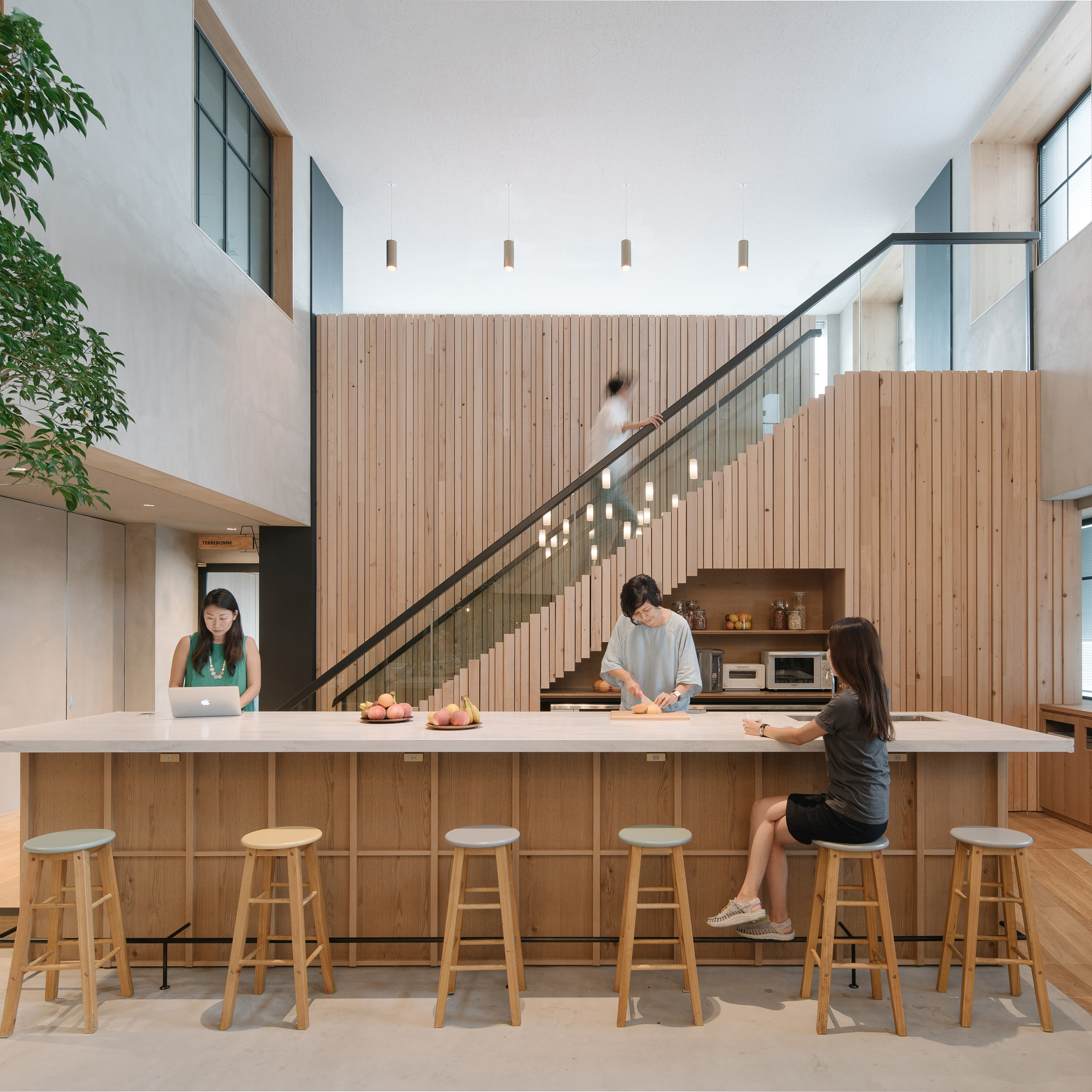
Home rentals website Airbnb has created a multipurpose office space based on traditional Japanese interiors and neighbourhoods for its Tokyo employees (+ slideshow). (more…)
In You’ll Grow Out of It, comedian Jessi Klein describes a trip to the Chanel counter at Barneys to purchase a blush brush. The brusque salesman, giving her the once-over, asks, “Can I speak freely?” Klein writes, “I hated him but I also felt like he was about to tell me the most important thing any human has ever said to another.” Speaking freely, the salesman declares, “Right now, your priority needs to be your undereye area.” This feedback leads Klein to a fierce rant on priorities — “forget paying your rent and maintaining your relationships. Put off charity work and don’t worry about voting in the general election” — but it also leads her to spend $150 on “a thingy of Chanel eye cream about the circumference of a bottle cap.”
Many of the autobiographical essays in You’ll Grow Out of It give hilarious voice to the ridiculousness of the pressures of femininity — and to how vulnerable many women nonetheless are to those pressures. The funny riffs often suddenly give way to sincere emotion, as when Klein, the head writer and executive producer of Inside Amy Schumer (she has also written for Transparent and Saturday Night Live), addresses her experience with infertility. The book also features plenty of sharp feminist critique. In a piece on why she hates baths, Klein’s jokes about 1970s Calgon commercials and Oprah’s love of bathing build to a clever, Virginia Woolf−inspired analysis, with the author concluding that “getting in the bath is a kind of surrender to the idea that we can’t really make it on land.” I spoke with Jessi Klein about her book and comedy writing via email. —Barbara Spindel
The Barnes & Noble Review: Some of the essays, in addition to being very funny, are unexpectedly moving. Did writing a book allow you to express yourself in a different way than writing for television or doing stand-up?
Jessi Klein: Definitely. One of the things I enjoyed most about writing a book was the freedom to go off on tangents that aren’t necessarily hilarious but represent the kinds of things I think about. I’m a comedy writer and I love watching and creating comedy, but I also like having and expressing other feelings such as anxiety and hunger.
BNR: Writing for television is a collaborative process; writing a book is not. How do you compare the experiences?
JK: Well, being in a writers’ room is usually a pretty raucous, fun environment. Writing a book is more of a lonely slog. That is why I drank white wine through so much of it.
BNR: Many of the essays are about the absurdity of the expectations placed on women. Do you think of your comedy as political?
JK: I think of my comedy as personal, but the personal is political. I think that’s true, right? Yeah. It’s true.
BNR: You had a baby during the writing of the book. Are you interested in writing about motherhood, which, like femaleness in general, comes with its own absurd expectations?
JK: I read a lot of baby books when I was pregnant, and NOTHING prepared me for how bananas the entire experience is. There should be a 1,000-page book whose sole topic is how to deal with the trauma of even just looking at your breast pump for the first time. I’m happy to give it a shot at some point.
BNR: In the essay “How I Became a Comedian,” you reject the idea that you were brave for doing stand-up. But I’d describe some of these essays as fearless because, well, you’re revealing embarrassing things about yourself in a book with your name on it. Do you feel brave now?
JK: Well, I don’t feel brave, but I also don’t feel embarrassed by anything I revealed in the book. Acknowledging that you look at porn isn’t embarrassing. Voting for Donald Trump is embarrassing.
BNR: Did you have any models in mind while writing? What are some of your favorite books by comedians?
Did you know that companies have a new way to increase productivity?
The working day used to be very different. A typical one used to be heaving ourselves out of bed after pressing snooze for the fifteenth time, eyes swollen shut with exhaustion, rushing to Starbucks to grab a coffee and chocolate pastry before reaching the office to tackle the mountain of emails which have accumulated between midnight (when we finally put our phone down) and 8am.
And this was the least stressful part of our day. Scoffing lunch at our desks, or worse, forgetting to have lunch, juggling 3 different meetings with phone calls, emails and general everyday tasks, all the while inhaling enough coffee to bring a small animal back from the dead.
Being permanently high on caffeine and frantically replying to all your emails over the course of a 24-hour working day used to be the road to productivity and career success. Raised eyebrows were directed at anyone who actually left work on time and even our commute was an opportunity to dive head-first into our ever-growing to do lists.
However, large tech companies are now beginning to see the unpleasant effects of the ‘work-hard-do-nothing-else’ company culture that was so prevalent. They’ve realised that yes, we may get a lot done, but the high-stress environment affects employees both physically and mentally. More sick days, less employment satisfaction and strained relationships with colleagues were just a few of the side effects that coincide with such a high-pressure atmosphere.
Now, a new method of increasing productivity is emerging — office meditations. It’s based on the notion that a happy employee is a productive employee and, I speak from experience when I say that surviving on caffeine and 4pm Snickers bars is no road to happiness.
Tech giant Google began recognizing the benefits of meditation for employees back in 2011 after a Zen monk visited their Silicon Valley headquarters. The internal course, named Search Inside Yourself, was designed to help employees manage stress and emotions. Greater happiness equals greater productivity which leads to company growth and yes, increased profit.
Google also introduced ‘mindful lunches’ where the only noise during the meal is that of a prayer bell, a far cry from swallowing our Pret chicken wrap whole whilst frantically stabbing at our keyboards with one hand.
As usual, Google are onto it. More than 1000 employees have completed their Search Inside Yourself training, Meditation and mindfulness have officially replaced caffeine. They have become the new fuel, with quiet contemplation the key to a successful day.
Other tech giants have getting in on the action. Steve Jobs reportedly allowed employees 30 minutes breaks in the official meditation room and he also provided on-site yoga. Many believe Jobs’ love for meditation actually helped him become so successful.
HBO has also implemented free yoga classes and meditation sessions into their working days. Device free rooms are opening in offices and in France some companies are banning employees from checking or sending emails during the weekend and evenings.
But not everyone has jumped on the meditation bandwagon and, as with any new ‘trend’, there are sceptics. Some believe integrating Buddhist values into our high-pressure, high-speed lifestyles is counterproductive. As Buddhism is traditionally about renouncing material possessions and feeling content with what you have, it seems backward to use it’s techniques in a workplace where employees have targets to meet and must constantly strive to achieve more.
Dan Nixon of the Bank of England recently argued that widespread mindfulness meditations could actually effect a growing economy thanks to the ‘less is more’ values that it promotes. It teaches contentment, the opposite to the common view that ‘economics is all about consumption’. Perhaps if everyone becomes content with what they have, businesses will cease to grow at the rate they have been.
Yet taking time to focus on the present or setting aside a moment to relax during our working day doesn’t equate to Buddhism. Whilst the effect employee meditation may have on company growth counters the anti-material Buddhist teachings, the effects of mindfulness meditations on general well-being cannot be denied. Besides, anything is better than that 3pm coffee crash.
(function(d) {
var params =
{
id: “cb4f919c-04fa-460c-b2ff-2c7f9ecf4472”,
d: “ZHVtYmxpdHRsZW1hbi5jb20=”,
wid: “165294”,
cb: (new Date()).getTime()
};
var qs=[];
for(var key in params) qs.push(key+’=’+encodeURIComponent(params[key]));
var s = d.createElement(‘script’);s.type=’text/javascript’;s.async=true;
var p = ‘https:’ == document.location.protocol ? ‘https’ : ‘http’;
s.src = p + “://api.content.ad/Scripts/widget2.aspx?” + qs.join(‘&’);
d.getElementById(“contentad165294”).appendChild(s);
})(document);
In response to a conservative and sometimes fragmented building industry, some architects believe that improving and automating the construction process calls for a two-front war: first, using experimental materials and components, and second, assembling them in experimental ways. Extra-innovative examples include self-directed insect-like robots that huddle together to form the shape of a building and materials that snap into place in response to temperature or kinetic energy.
The automation battle has already been fought (and won) in other industries. With whirring gears and hissing pneumatics, rows and rows of Ford-ist mechanical robot arms make cars, aircraft, and submarines in a cascade of soldering sparks. So why shouldn’t robotic construction become commonplace for buildings, too?
MSC robots. Image Courtesy of Coop Himmelb(l)au
That’s the common-sense suggestion of one of architecture’s most daring and imaginative dreamers, Wolf D. Prix, founder of the Austrian firm Coop Himmelb(l)au. Working with China-based curtain-wall technology company MSC to create custom robotic fabricators, he’s proposing a simple system of robotic arms that place and fasten panelized façades with off-the-shelf technology. “The only thing different is the programming,” Prix says.
Prix was introduced to the world in the landmark MoMA 1988 Deconstructivist Architecture exhibition alongside contemporaries Frank Gehry, Rem Koolhaas, and Zaha Hadid, and his work since then has remained perhaps the most consistent—full of colliding forms, twisting steel, and otherworldly spaces. His was part of the last architectural aesthetic born in a predigital era of tracing paper, ink, and freehand illustration, which has been accelerated by the advances in computer design. Today, Prix feels its ultimate built expression will come at the behest of computerized automation, as well.
This fabrication method is an attempt by Prix to circumvent some criticism of willful and experimental architecture with better efficiency—to level the playing field of cost and resources between nonstandard spaces and the long-assumed rectilinear model.
“People are always saying these complex shapes are impossible to build, or it’s very expensive and takes a long time,” Prix says. “For years, we’ve tried to find a fabrication method that lowers the cost and is constructed in a very quick way.”
Exterior of the Museum of Contemporary Art and Planning Exhibition in Shenzhen, China. Image Courtesy of Coop Himmelb(l)au
Coop Himmelb(l)au planned to use robotic fabrication in this way at the Museum of Contemporary Art and Planning Exhibition (MOCAPE) in Shenzhen, China. This pilot project, led by Prix, would use robots to assemble the interior façade of its central circulation volume—a multistory silvery drop of molten metal Prix calls “The Cloud.” (Its formal allusions du jour include Brancusi sculptures and Mars’ oblong moon, Phobos.)
This volume knits together the building’s two resident institutions: a contemporary art museum and an exhibition hall used to display the city’s urban planning and architectural evolution—a topic especially relevant in Shenzhen, which grew from the size of a large fishing village of 300,000 in 1980 to one of the world’s largest cities today. Its hovering presence creates a focal point amid Prix’s swirling crosshatched steel supports.
The building is set to be completed by December 2016, but its clients (the Shenzhen Municipal Culture Bureau and Municipal Planning Bureau) canceled the robotic-fabrication plan for The Cloud, opting instead to install the custom-designed metal panels conventionally. Prix says he’s not exactly sure why this happened, but he has a theory. “I think the Chinese thought we were getting money from MSC because we proposed them so heavily, and they canceled it,” he says.
MSC robot doing a fine grinding of the welding seam. MSC robots (inset). Image Courtesy of Coop Himmelb(l)au
But there’s still hope for Prix and MSC’s robots. He’ll begin the construction of a hotel tower in Vienna next summer using the same technique.
This is how the robots work: First, a mechanical press forms the panels. They’re trucked to the build site, and articulated robot arms that have been lifted onto mechanized crane platforms then place, weld, buff, and shine them. The same robot performs each of these functions, just with different attachments. It’s configured as a panel system now, but all components are off the shelf and recognizable from any heavy manufacturing assembly line. Prix estimates work that would normally take six months can happen in six weeks, and an 80-person job might require only eight people.
Prix sees this method of construction as a way to “set people free” from the tyranny of the omnipresent rectangle, offering greater experiential wonders for people like himself and the design-savvy public. But it also might set builders free from their livelihood, as did the automation that shook the automotive labor force, when it finally forces its way into the building industry.
Prix says the building industry is mostly a “slow and stubborn” place, and every wooden balloon-framed house (technology invented during the Andrew Jackson administration) that pops up on expanding suburban frontiers is a testament to this traditional recalcitrance. It’s a resistance to change supported by conservative and historicist consumer tastes—a stance not tolerated in other industries, as it would doom them to disruption and obsolescence. “If the car industry acted like the building industry,” Prix says, “we would ride on horses still.”
Interior of the Museum of Contemporary Art and Planning Exhibition in Shenzhen, China. Image Courtesy of Coop Himmelb(l)au
Among his contemporaries, Prix has always been the most bright-eyed and optimistic about the liberating power of pure form. “Architecture gives people the possibility to react in a more fantastic way and not like they’re suppressed in rectangular, nondynamic prisons,” he says.
“Nondynamic” means the assumed square, or “stupid box architecture” as Prix calls it. And this robot-led fabrication technique is a way for Prix to combat the questions that arise every time he issues a press release about a new building: Can we afford form for form’s sake? Why this swoop of cantilevered steel when a few more straight lines would keep out the rain just as well?
As for the rising generation of architects and designers plotting out more experimental methods of robotic self-assembly, Prix says what they’re doing isn’t yet a practical means to an end.
“The small-assembly things are kind of a hobby,” he says. “We need bigger buildings, as well.” These projects might be good for a park pavilion, but larger structures will require the sturdy, soldered connections inherent in more traditional building methods.
Given Prix’s past history as a provocateur himself, these are the words of an architect who’s past his midcareer post, is more intrigued by practical application than theoretical rumination, and is willing to embrace the conservative end of a raw and speculative field to mark this transition.






 Sig Nordal