Month: August 2016
What Were Your #FirstSevenJobs?

#firstsevenjobs
photography sales
pot washer
bartender
urban planner
professor
author
architect— Vishaan Chakrabarti (@VishaanNYC) August 10, 2016
//platform.twitter.com/widgets.js
Last week, the latest craze to hit the Twittersphere was #FirstSevenJobs. An interesting mix of nostalgia and self-congratulatory posturing, the hashtag had seemingly everybody on the social media site sharing how they took their first seven steps to where they are now. For architects though, whose path to their ideal job is often long and torturous, the hashtag may have offered a little solace: with notable and successful architects, educators and critics sharing how they took their first tentative steps into the profession, those still working towards their goals can be reassured that, no matter where they are now, success could be on the horizon.
With that in mind, we wanted to extend the hashtag to our users: what were your first seven jobs, and what did you learn while doing them? What was your experience like in getting to where you are now? And do the jobs that many architects have in their early years reveal anything about the architecture profession?
janitor
fast food
Art T.A.
US AirForce (Contracts Officer)
Arch Gallery Assistant
Arch Design/Research
Now (#6 + teaching)#firstsevenjobs— Quilian Riano (@quilian) August 7, 2016
//platform.twitter.com/widgets.js
The best responses will be featured in a forthcoming article. Please share your experience in the comments below – even if you can’t claim to be as upwardly mobile as The Architectural Review‘s former Editor-in-Chief:
#firstsevenjobs urine sample collector; pork pie factory worker; train cleaner; semi-architect; architect; hack; grand dame.
— Catherine Slessor (@cath_slessor) August 7, 2016
//platform.twitter.com/widgets.js
New York City – New York – USA (by Jonathan Gross)

New York City – New York – USA (by Jonathan Gross)
Landskipping
On my worktable are two photographs; one of the Dargle River on Ireland’s east coast, where I grew up, the other of nearby Killiney Beach, where my mother spent her youth. Both scenes are empty of people but filled with ghosts. When I look at them, I can feel the riverbank spongy under my sandals and hear the shush of waves collapsing on shingle, churning the pebbles. Every detail is imprinted for life because this is my native place. Anna Pavord knows the feeling. The Welsh-born writer had a similarly quiet start and she begins her new book, Landskipping: Painters, Ploughmen and Places, with a bucolic memory: gathering winberries with her mother on gentle slopes. “At the top of all three of the hills, the land flattened out and wide grass paths, kept open by the endless nibbling of sheep, led forward to the smooth cone of the mountain . . . Not sublime. Not even as beautiful as other places I discovered later in life. But resilient. And deeply familiar.” Pavord’s North Wales is not “a landscape to be given a capital L” like Snowdonia or the Lake District, and her wonderful book — as deceptively modest as the hillside just described — reveals why that is; how ideals of beauty were imposed on nature, most assiduously in the eighteenth century and most ecstatically in the Romantic era.
Landskipping, a title taken from the seventeenth-century word landskip, which derived from the Dutch landschap, covers a lot of ground historically and geographically. Journeying from prehistoric Stonehenge to the present, Pavord alights in the Scottish Highlands, the Lake District, Norfolk, Northumberland, Wales, and Dorset. As she vividly describes each region, she also introduces us to eighteenth-century travel writers like the nitpicking William Gilpin and nineteenth-century agricultural reformers such as the fulminating William Cobbett. She calls on painters and poets: Constable, Turner, Wordsworth, John Clare. Yet Pavord never seems hurried or, worse, plodding. An ideal travel companion, she dispenses her erudition deftly and engagingly, varying her pace and point of view with such agility that the land she surveys and the history she contemplates become equally tangible. Trudging across marshland, for example, she observes that “Until about 7000 BC, Norfolk was joined to mainland Europe by a North Sea landscape of forests, swamp and brackish pools . . . you could make out the shape of roots and whole trees, lying where they had fallen, pickled now to a crumbly softness.” She passes cottages built of ” . . . melting blocks of chalk . . . ” and retreats to a pub decorated with ” . . . the carefully stage-managed remnants of a civilization now vanished: walls hung with reed cutters, rick knives, spokeshaves.” Then out again into the rain. Would a visit to the harbor town of Wells be fun? “It might be, but not on the wet Sunday afternoon I was there, when only amusement arcades leered out of the greyness.”
There are echoes of Robert Louis Stevenson in the book’s companionably irreverent tone and of Laurie Lee in its lyricism, but Pavord’s own voice, direct and witty, is strongest of all. Lamenting the blurring speed of modern travel, for example, she writes, “I always salute Stonehenge when I pass it. Yet I feel bad storming down the A303 with Eric Clapton pounding on the car’s tape deck and a half-eaten Mars bar in my hand. It seems disrespectful to flash by like this.” Then she allows us a glimpse of the site as Turner painted it in the nineteenth century, “the enigmatic stones standing in silhouette on the horizon beyond.” Pavord loves this varied land — her childhood Wales, her Dorset fields — but with clear-eyed passion. “It is a fallacy that our landscape is an entirely natural phenomenon,” she explains in her chapter on agriculture, “the views that we croon over and write about, with too many adjectives, have very often been shaped by farmers.” No wonder she has a soft spot for agriculturalist William Cobbett, whose zealotry is one of this book’s delights. “To travel in stage coaches is to be hurried along by force, in a box, with an air-hole in it,” he huffed as he traveled on horseback in the 1820s, visiting farmers, extoling the swede, hating the potato, and skewering big landowners. (“The great, the big bull frog grasps all,” Cobbett wrote in 1823. “In this beautiful island every inch of land is appropriated by the rich.”) And the new suburbs? Pavord writes that “Sunninghill made him so apoplectic you wonder he could stay in the saddle: ‘a spot,’ he raged, ‘all made into grounds and gardens by tax eaters.’ ” (Imagine Cobbett’s delight when Pavord later remarks, “As an environment, a golf course is a fascist state.”) Equally charming are crotchety tourists like John Byng, who visited Tintern in 1781and wrote that he “entr’d the abbey accompanied by a boy who knew nothing, and by a very old man who had forgotten everything; but I kept him with me, as his venerable grey beard, and locks, added dignity to my thoughts.”
The history of tourism, of landscape painting, of revolutions in taste; the fact that Constable, when painting on rough sheets, “put wings” on any specks in the paper and made them “fly away as birds”; the thrilling description of a Lake District waterfall when “the whole leisurely bulk of the river is penned between jutting cliffs of rock on either side, wet with spray, green with moss:” Pavord folds all of this and more into a graceful, airy narrative that ends where it began, on a Welsh mountainside and with a final gesture. “I cast my mother’s ashes into the wind,” she concludes, “and waited silently as they whirled out over the glittering valley.”
Image: John Constable, Yarmouth Pier (1822) via Wikiart
The Barnes & Noble Review http://ift.tt/2byvg8Q
England’s Premier League gets a minimal rebrand by DesignStudio

Atrium Townhome & Garden / RobitailleCurtis

© RobitailleCurtis
- Architects: RobitailleCurtis
- Location: Montreal, QC, Canada
- Design Architect: Andrew Curtis AIA, MRAIC, LEED BD+C
- Designer: Marie-Eve Lamarre Brodsky
- Project Year: 2016
- Photographs: RobitailleCurtis
- Landscape Architecture: RobitailleCurtis
- Design Landscape Architect: Sophie Robitaille, CSLA, AAPQ, ASLA Landscape Architect: Teressa Peill, CSLA, AAPQ
- Structural Engineering: Lateral
- Structural Engineers: Thibaut Lefort, Eng. & Alicia Gallagher, Eng. General Contractor – Avantage Plus
- Custom Millwork: Kastella
© RobitailleCurtis
From the architect. This townhome has a 32’ atrium with a skylight running the full width of the house. Our design embraces this feature and heightens the experience of its dynamic interior volume. A fireplace is integrated as a central focal point. Atop the mantle is a grand bookcase that provides storage and visual interest as it draws one’s eyes upward through the atrium.
Section
At the main living level, the kitchen has been relocated from the front of the home to the rear where it now enjoys more open space and daylight in its position adjacent a window wall with views to a newly designed garden. A carefully detailed millwork ‘cube’ is a primary organizing element of the ground floor plan. It is a nicely proportioned object that orients movement through the space as it separates the living room from the atrium and kitchen. The ‘cube’ contains two concealed glass pocket doors that enable the living room to be closed off. It also conceals a coat closet at the main entry of the home and hides a discreet powder room.
© RobitailleCurtis
At the ground floor level and up through the atrium and main stair, vertical grain Douglas fir slats provide screened views through the home and eliminate the necessity for guardrails. Douglas fir, concrete floors, and white lacquered millwork combine to create a crisp, clean, and warm material palette.
© RobitailleCurtis
At the third floor level, a net ‘floor’ has been installed at the top of the atrium allowing the void space to become a dramatic play surface adjacent to the kid’s bedrooms. The use of a net in this location precludes the need for guardrails and opens the floor plan to unimpeded views to and from the third floor. Riggers from Cirque du Soleil provided and installed the trapeze net.
Plan
Plan
Plan
In the garden a covered seating area adjacent to the kitchen serves to blur the boundary between the interior living spaces and the exterior. Carefully placed hornbeams create an aerial hedge offering privacy from adjacent buildings while focusing attention towards the rear of the garden. At the garden’s terminus, views are borrowed from a mature grove of hemlocks and spruce trees, enhancing the sense of lushness in this small city garden. Additionally, a small, shallow, fountain built into a concrete bench serves as a focal point.
© RobitailleCurtis
The Latest LEGO® Architecture Set: The U.S. Capitol Building

Courtesy of LEGO®
LEGO® has unveiled the newest kit in their Architecture series: The U.S. Capitol Building in Washington, D.C. Originally designed by architect William Thornton in 1793, the building has gone through several iterations, including the addition of its iconic white, cast-iron, neoclassical dome in 1866. The 1,032 piece LEGO® set portrays the building in its current form, with its “striking white, columned façade with its famous steps and lawns.” The kit also features a removable dome, which, when lifted off, reveals “a detailed interior depicting the famous National Statuary Hall, complete with columns, statues and tiled floor.”
Courtesy of LEGO®
The Capitol Building set measures just over 17 inches long and 6 inches high; and for those looking to build their own LEGO version of the Washington Mall, the set matches the scale of the LEGO® Architecture Lincoln Memorial kit. The new set will retail for $99.99 and will be available for purchase on September 1, 2016.
Courtesy of LEGO®
Courtesy of LEGO®
Courtesy of LEGO®
Courtesy of LEGO®
News via LEGO.
Roof of Rhode Island holiday home by Bernheimer Architecture features pyramid-like skylights
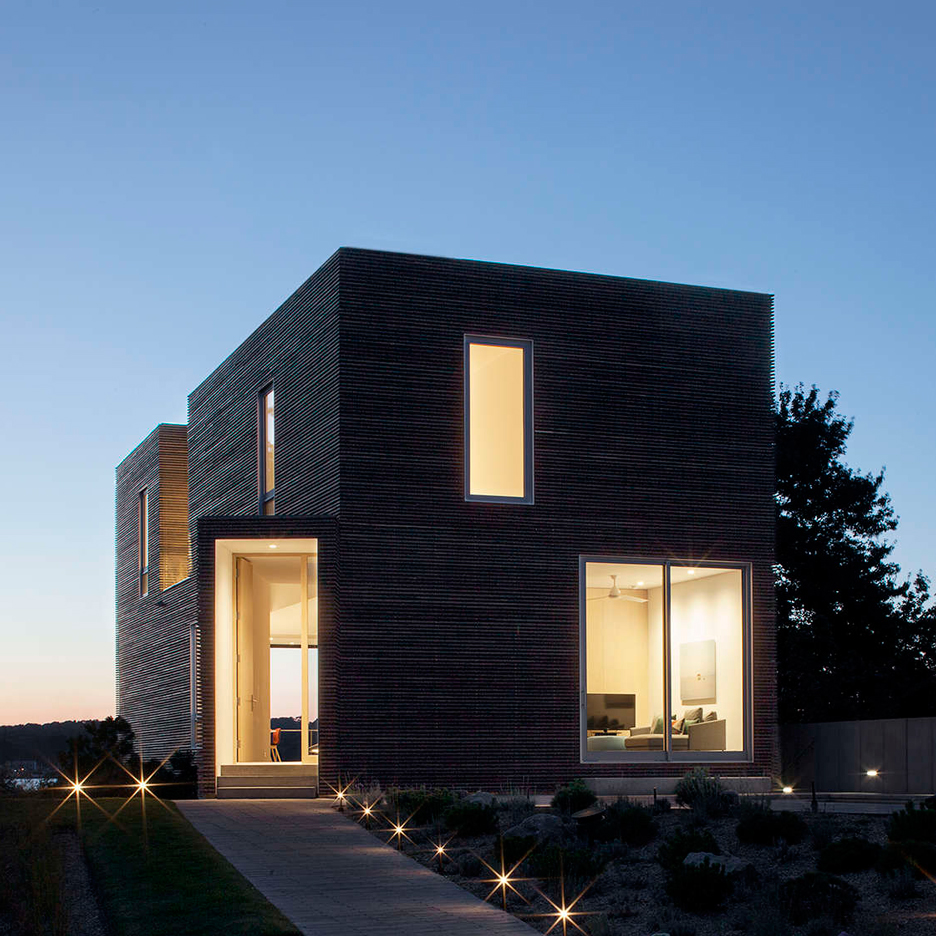
A+Awards: the next project in our series on winners from this year’s A+Awards organised by US site Architizer is a holiday home for a Brooklyn-based family on Rhode Island, with a charred-timber facade (+ slideshow). (more…)
The Bisti/De-Na-Zin Wilderness is a rolling landscape of…

The Bisti/De-Na-Zin Wilderness is a rolling landscape of badlands in New Mexico, which offers some of the most unusual scenery found in the Southwest. Time, water and wind have etched a fantasy world of strange rock formations made of layered sandstone, shale, mudstone, coal and silt. The weathering of the sandstone forms hoodoos – carved rock in the form of pinnacles, spires, cap rocks and other unusual forms like these “cracked eggs” recently captured by photographer Matt Beckmann under a purple sunset. Photo courtesy of Matt Beckmann.
How to Ensure that Your Online Architecture Portfolio is On Point

Why should I even have an online portfolio?
A portion of working in architecture includes having to market yourself and your skills. “One minute networking” is a skill that many architects learn in order to be successful in the creative field, but having the gift of gab requires you to put your money where your mouth is. If you have an online portfolio which is accessible with just an internet internet connection and a digital device capable of viewing it, your work is always conveniently available during your networking conversations. It’s also helpful for sharing your work in online conversations: while a pdf of your print portfolio can really only be sent by email, practically every messaging app or direct messaging service built into social networks will allow you to send a link, allowing you to take advantage of an opportunity even when you weren’t expecting one to arise. Finally, if you make it right your website can even do some of the advertising and networking for you.
The most important thing to remember is that like your resume or print portfolio, an online portfolio is a tool to help you advance your career, so it must be useful towards your goals. Therefore instead of asking yourself why you should have an online portfolio, you should ask yourself what those goals are, and how your online portfolio can be optimized to help you achieve them.
Now that we’ve gotten that question out of the way, here are 8 other questions to ask yourself:
2. Should I just upload a PDF of my print portfolio?
Yes and no. Uploading your PDF portfolio to a zine hosting site such as ISSUU is an easy-click way to get an accessible sample of your work online. It’s convenient for job applications when you can just include a URL rather than an attachment, or when you can include a QR code in your business card that links directly to ISSUU. But this method isn’t for everyone.
Besides simplicity, the main advantage of uploading a PDF is that it allows you to demonstrate your graphic presentation skills in traditional print media, which is great if that’s a skill you particularly want to highlight. But on the other hand, an online PDF is rarely the most convenient or effective way to see something online—just because your graphics looked great on a large format printout does not necessarily mean that it would convey the same quality as a jpeg on a 15 inch screen.. In addition, just as you may need different types of print portfolio for different purposes, having the same projects in both print and on your online portfolio could be redundant. Perhaps uploading a PDF of a two-page portfolio on your website is a happy medium. Do whichever you think your employers would prefer in your *dream* job.
<a href='http://ift.tt/2bu9Qsb;
3. I don’t have much time to learn how to code or to customize visuals—can I still have an online portfolio?
As mentioned previously, you could simply upload a PDF of your portfolio on ISSUU. An alternative to this is to create an account with Behance. The platform is hosted by Adobe and your free account displays a collection of all your work. There aren’t any customization features, which on the one hand makes the setup straightforward and easy, but on the other means that your work must stand on its own, without any added “wow factor.” However, the value of uploading individual images for online viewing rather than spreads and layouts should not be overlooked, and Behance therefore offers a more digitally-native way to display your work than ISSUU. The site also offers a fairly comprehensive social networking component—almost like a Linkedin for creatives. You never know, this could be the source of your next job opportunity.
<a href='http://ift.tt/2bbjImZ;
4. How should I create my website?
If you are quite adamant about having more control over the presentation of your work then this question is for you. There are ultimately more than a hundred ways to create a website but among the more popular these days are three platforms: WordPress, Squarespace, and Format.
Squarespace and Format: Both of these sites are quite similar in terms of pricing scheme and the friendliness of the user interface. There are easy-to-use templates that give you a polished looking website in mere minutes. As for comparisons, Squarespace targets their service beyond portfolios while Format focuses solely on portfolios. Squarespace also has a simple logo making service which might be useful. The choice really comes down to which templates you prefer, as they are exclusive to each site.
WordPress: It’s important to be aware of the difference between wordpress.com and wordpress.org. The former is a hosting service which gives limited customization options, but on the plus side is free and relatively easy to use. The latter platform is quite possibly the most reliable website creation service that is readily available to the public, however it does require you to host your own site, with all the technical understanding that requires. However, the system is incredibly popular, with even large companies using the platform including CNN and The New York Times. In general, as an open-source platform WordPress.org also gives you more freedom and control than Squarespace and Format thanks to its thousands of user-generated plugins you can install.
<a href='http://ift.tt/2bbjD2H;
5. How many projects should I feature on my website?
The answer to this question goes back to what you ultimately want to achieve with your portfolio. With print portfolios, they always say that you should only feature your best work—not only does it demonstrate critical abilities but it also keeps the page count to a reasonable number. For websites, you are allowed to have as much data as you want, so it depends solely on your desired outcome. If you want to be known for just one innovation or type of building, or you want people to only see the best you have to offer, only upload the corresponding projects. If you want a comprehensive archive, you should obviously upload all of your work—but you should probably also think carefully about the next question.
6. How do I organize the contents of my website?
If you choose to have a comprehensive archive of your work, it’s important to have logical organization system which makes it easy to quickly access whatever type of work your future employers are looking for. Many larger firms, such as Diller Scofidio + Renfro display their projects chronologically, but they have categorized their projects to different typologies. You may want to follow a similar technique. It’s best to look for inspiration towards the larger architecture firms like Foster + Partners or OMA because they have such a volume of projects that they need to have a good organizing system.
<a href='http://ift.tt/2bbjqws;
7. What is SEO and how will it help me?
SEO stands for Search Engine Optimization. It can be an incredibly complex consideration—after all, an entire industry has been built off of it—but in simple terms it boils down to a good mixture of links, content, and keywords on your website which increases the likelihood of search engines like Google to recommend your website on searches. There are many ways you can increase your website’s SEO ranking and here are a few ways to start, but perhaps the most important to remember is to include your name or the business name you with to go by in prominent places such as the url, the page titles and the headers in your page text. This may sound astonishingly obvious, but it’s actually surprisingly easy to forget, as we’ll discuss in the following question.
8. How can I make my portfolio standout?
The quick answer to this question is: Not with image based graphics! It’s very tempting to create beautiful image-based headers for online websites but the downside to this approach is that search engines cannot process image-based data which means that your website is not as SEO friendly as you would like. If you make the decision to have a beautiful, customized website, it’s worth your tie to make sure it is done properly, as trying to “hack” your way to a beautiful website often does more harm than good.
Spending extra time on formulating a unique color palette, and investing in a tasteful customized font is an efficient and cost-effective way to stand out from the pack. But the most important thing to remember is that your portfolio will be compared with many others in a crowded online space, so you need to make use of your creativity to highlight your best aspects; whether that means putting faith in your design abilities with a design which highlights the work itself or by creating something a bit more unconventional is up to you.
9. How often should I be updating?
There are few things more off-putting to a potential contact than an online portfolio that seems abandoned. The rule of thumb is that you should probably update your online portfolio at least once every 6 months, provided that you have a new project to add. Alternatively, you could opt to make regular updates on a monthly or weekly basis much like what Bob Borson has done with Life of an Architect. Creating articles that are useful to other architects/designers is a great way to market yourself and your practice and shows that you’re an engaged thinker, not to mention the fact that helpful articles with relevant titles are SEO friendly.
 Sig Nordal