Interior designer Maayan Zusman and architect Amir Navon have transformed a rundown apartment in Israel into an airy space punctuated by delicate black frames and furnishings (+ slideshow). (more…)
Summer in the PNW? Yes, please! And there’s no better place to explore than North Cascades National Park in Washington. The park is part of more than 2 million acres of wilderness, including nearby Mount Baker Wilderness (pictured here). Enjoy the solitude, peace and challenge that hiking in this beautiful park and surrounding wildernesses offer. Remember to walk lightly in all wilderness areas, so that many generations more may discover this place too. Photo courtesy of Dene Miles.
In The Archipreneur Concept, architect Tobias Maescher explores new business models that architect-entrepreneurs are using to build game-changing, novel enterprises that are enriching the field of architecture. The fundamentals of how to break away from the convention of trading time for profit, create additional income streams to help sustain your practice when times are tough, and build your own projects are explored through real-world examples and actionable techniques. The book is a comprehensive guide to new business models for architects interested in practicing their craft in an entrepreneurial way, with each business model complemented with case studies of exciting new firms and individuals that run their businesses with scalability and efficiency in mind.
You will discover how to avoid common traps in passive income models, and how to take advantage of productizing architectural services through automation, building products, developing your own projects through co-housing initiatives, taking the lead in design builds, contributing to projects on tactical urbanism, and marketing your firm effectively.
The following is an excerpt from the chapter “Archipreneurship as a Solution.”
Courtesy of Archipreneur
Archipreneurship as a Solution
In reaction to the increasingly volatile job market, some architects have started to look to other industries for cues on how to compete. One of the most prominent changes to architectural practice has been the widespread adoption of business models from other industries.
Architects are clueing up to the fact that a successful business is as much down to the design of their business model as it is the design of their buildings. Savvy professionals are going beyond the traditional confines of the vocation and implementing:
Market research
Funding plans
Financial forecasts
among others into their plans before they even think about launching their product or service. But traditional business models are simply more comforting for architects, and changes are not easy to implement.
In our talks with archipreneurs from all over the world, we have identified three major obstacles to building successful architectural practices:
Trading Hours for Dollars
Unless we’re really lucky, we don’t get to choose our clients, at least not when we’re just starting out. And unfortunately for us, the industry is still rife with clients who see architectural services as a cost, rather than seeing it as it is: a value. As a result, architects are often paid for their work by the hour. What’s the problem with that?
The information technology, publishing and retail sectors have all shown that hourly rates for entrepreneurs are at best outdated, if not totally inefficient, ways of doing business. If you only do work that charges by the hour, your income stops the moment you stop working. In order to break away from hourly rates, the onus is on architects to scale their businesses.
We’ve said that architects tend to lack business & management development skills. If you’re interested in entrepreneurship (and if you’re reading this, we assume you are!) this can be a fatal oversight. Archipreneurs need more than experience in architecture and design: they need to understand how to design a business model.
A failure to understand the financial and the business sides of architecture is what keeps otherwise great architects from starting up great businesses. As architects, we know how to design, draw, write, interpret specifications and monitor construction processes. But it doesn’t necessarily follow that all architects will know how to manage a practice.
To run a firm, architects must learn:
How to find loans and other financial support
How to enter into leases
How to manage cash flows
How to work with employees
How to source contractors and consultants
In addition, archipreneurs must start out by ensuring their businesses can turn a profit. That means setting aside more covetable roles to do with design and spending most of their time tending to management and administration. Sneer at management and administration at your own peril!
How can you develop business acumen without spending thousands on university management courses?
Underestimating Marketing
Architects are used to the traditional methods of getting clients and establishing networks. This false security makes small firms reluctant to invest in market research and marketing. But that completely underestimates the impact market tools can have on a business. We’ve already said that traditional roles are breaking down thanks to the globalization of the workplace – the same can be said for how businesses engage with their clients.
Where it once wasn’t necessary, or was only considered a nice luxury, it is now imperative for archipreneurs to have a solid and frequently updated web presence. Though many architecture firms do realize that they should have an online presence, most continue to struggle with how to use online marketing in a consistent and beneficial way.
To be thought of as authorities – or leaders – in the market, archipreneurs should engage with colleagues, peers and clients online by way of:
Informative websites
Portfolios
Seminars/webinars/courses
Social media accounts
Testimonials
Blog posts
or a combination of the above.
Building a presence online need not be scary, or even difficult. In fact, the simplest and most cost-effective way to establish a strong brand and develop customer/client loyalty is to do so online. The success in differentiating yourself from the competition is in knowing how to use platforms and social media; how to build email lists and define your target market; and how to cultivate relationships and define your brand.
To become archipreneurs, architects need to redefine their offer by taking on board the new business structures available and the opportunities that technology has opened up for them. In order to become successful, set aside any negative preconceptions you may have about management and embrace the business behind designing buildings and creating products and services in the AEC industry.
Don’t be discouraged by an initial lack of knowledge in how to overcome the above three obstacles. Many of today’s most successful archipreneurs hadn’t a clue about running a business when they first started out. They made mistakes and experienced setbacks. But rather than give up, they looked to their peers for help.
The following chapter will look at how to overcome the three obstacles given above by detailing how the AEC industry’s most out-of-the-box thinkers run their businesses and stay at the top of their profession.
Situated between two major urban thoroughfares, the Berrini Avenue and the Bandeirantes Avenue, the Berrini One Building occupies a priveleged site position with an unobstructed view of the River Pinheiros hub.
The building’s design makes good use of the staggering and markings of its articulations, defining planes that highlight these layers. The facade overlooking the street features a smooth curve taking advantage of that side of the building with the most favorable sunlight, the east-west axis. Some terraces on the east and west facades provide shading and accentuate the building’s verticality. The broader sidewalks, with large green areas running alongside them, offer a friendly space that helps soften the impact caused by the heavy traffic of the nearby avenues.
Claw-like forks and spoons with extra bowls are among a collection of nonsensical cutlery commissioned by Amsterdam design studio Steinbeisser (+ slideshow). (more…)
Memory is an important part of what makes us human, but is also the most elusive and misunderstood part of us. We relay on her even if in so many cases it fails us. It is said that when we recall a certain event it is not the actually event that comes to our mind but the last time we have remembered it.
Let’s put our memory to the text and see how good it is! Some iconic masterpieces will help us.
Take just now this quick, fun quiz and find out if you can pass the color memory test!
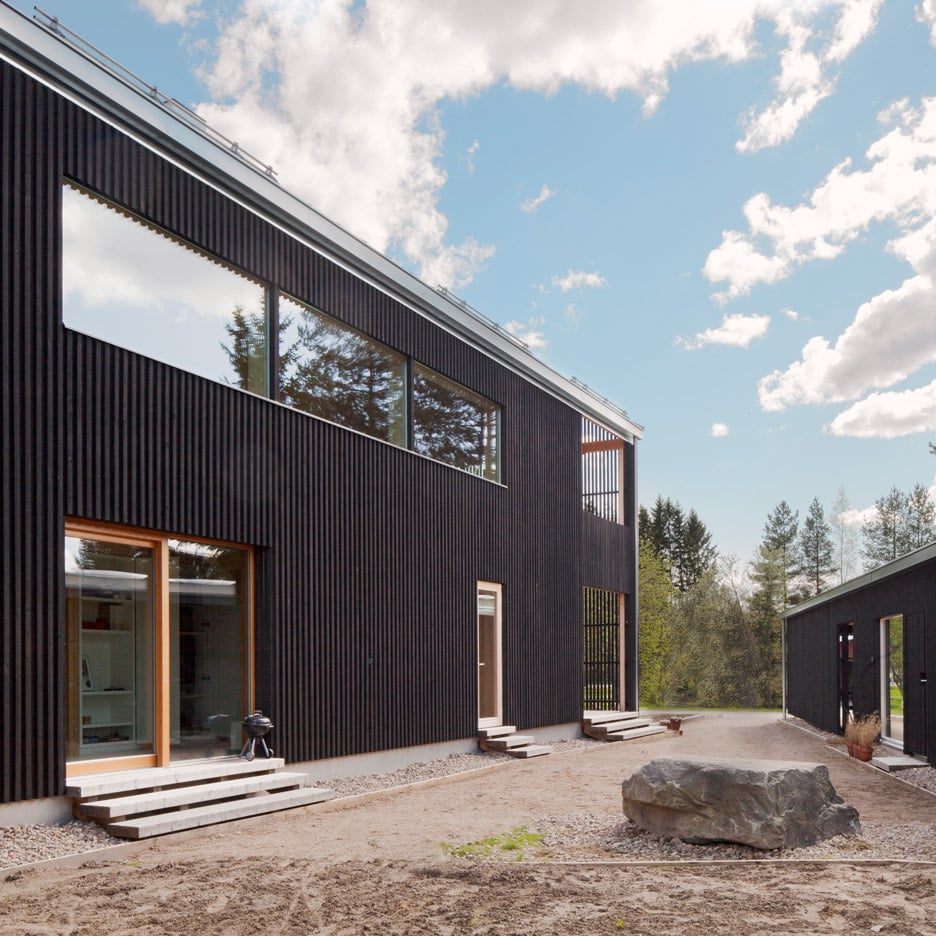
Architect Teemu Hirvilammi has completed a wooden house for his own family in the Finnish city of Lahti, featuring dark external walls and a contrasting interior of pale spruce wood (+ slideshow). (more…)
Inner City Warehouse is a project completed by Allen Jack+Cottier. It is located in Sydney, Australia. Inner City Warehouse by Allen Jack+Cottier: “Innovative and cutting-edge, AJ+C’s Mancave design demonstrates how modelling and fabrication technologies are used to create a sophisticated bespoke retreat. The space Part of the Surry Hills Warehouse, an AJ+C-designed home renovation project, Mancave is a sculptural carbon-fibre pod positioned on the warehouse’s upper floor. Featuring a semi-gloss..







 Sig Nordal