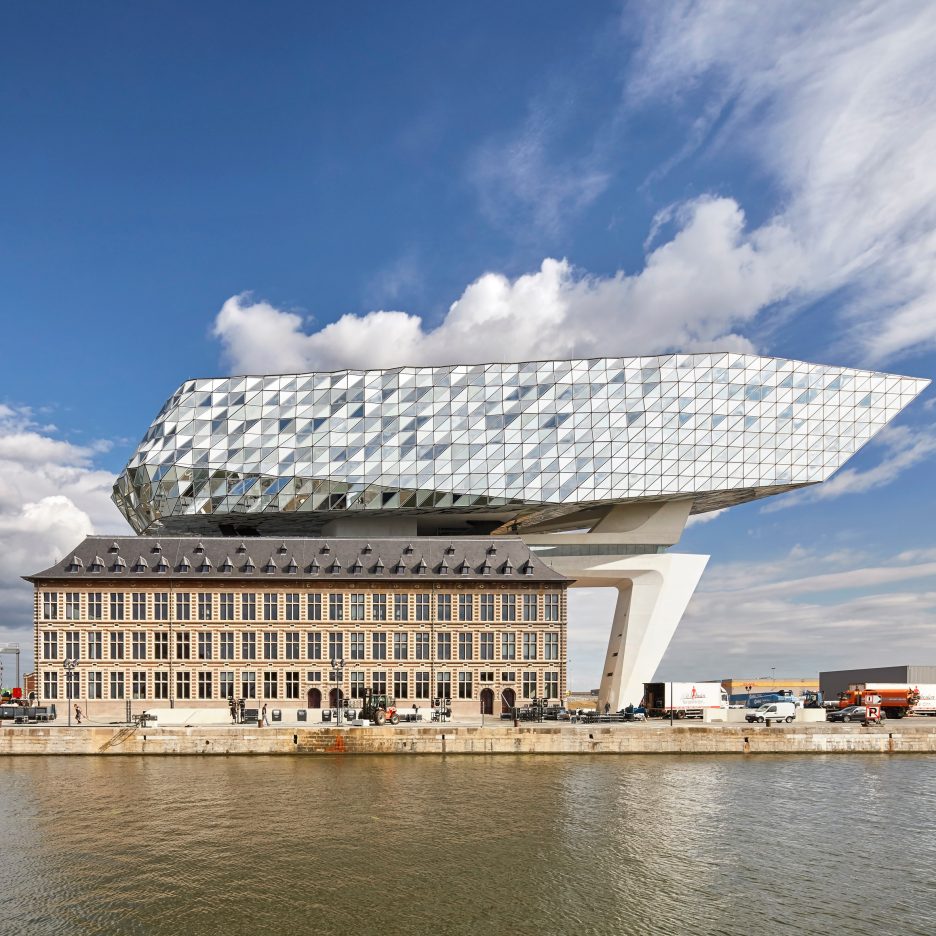
Comments update: Zaha Hadid Architects’ new headquarters for Antwerp’s Port Authority is the controversial talking point this week, with readers both decrying and praising the building’s visual impact on its surroundings. (more…)
Comments update: Zaha Hadid Architects’ new headquarters for Antwerp’s Port Authority is the controversial talking point this week, with readers both decrying and praising the building’s visual impact on its surroundings. (more…)

From the architect. Strengthening and Reinforcing the City
The overall masterplan for Porta Volta holds an important strategic potential for creating a positive impact on the surrounding area, due to its important urban dimension. As part of the redefinition of the area Porta Volta, Fondazione Giangiacomo Feltrinelli intends to relocate its seat to the northern centre of Milan, considered as an ideal environment for the foundation’s multiple activities. Together with the building of Fondazione, the project includes the development of two further buildings, mainly dedicated to offices, and a generous green area as extensions of the existing boulevards.
A Site Steeped in History
The historical analysis of the site drove the evolution of the design proposal. The urban organisation of Porta Volta traces back to the course of the Mura Spagnole, the ancient 16th century city walls which were the last of a series of fortifications which since Roman times have defined the city’s growing boundaries. After the opening of the bastion in the late 19th century, Via Alessandro Volta laid the basis for the city’s extension outside the ancient walls, connecting as a new, prominent urban axis the historical centre with Cimitero Monumentale. Today, the emptiness of the site is a testament to the walls and, at the same time, reminds one of the destructions this area has suffered during the Second World War.
A Gate as Point of Reference within the City
Together with a series of preserved gates, the two Caselli Daziari di Porta Volta offer an important reference point within the Milanese city plan. The allocation of Edificio Feltrinelli and the Fondazione along Viale Pasubio and the allocation of Edificio Comune along Viale Montello opposite the axis Via Alessandro Volta underline this historical gate, taking up the Milanese tradition of twin buildings as in Piazza Duomo, Piemonte or Duca D’Aosta.
Besides the preservation of the Mura Spagnole’s archaeological remains, the concentration of building mass endeavours to create a generous public green area as extensions of the existing boulevards. On the street level, the new edifices will house cafes, restaurants, and shops, offering an area for interaction and recreation to the citizens.
A House for the Fondazione Giangiacomo Feltrinelli
A narrow gap separates the Fondazione from the adjacent building, reflecting two autonomous constructions which are simultaneously part of an overall whole. The ground floor of the Fondazione accommodates the main entrance, cafeteria and book store, followed by the double height multi-functional space on the first floor, and an office area on both the third and fourth floors. The reading room on top of the Fondazione offers researchers and interested public the opportunity to study documents from the historical collection stored in the secure underground archive.
A Milanese Project: Scale, Structure and Repetition
The new buildings are inspired by the simplicity and generous scale of historic Milanese architecture as Ospedale Maggiore, Rotonda della Besana, Lazaretto and Castello Forzesco. They are also inspired by the long, linear Cascina buildings of traditional rural architecture in Lombardy, which already were an important reference in Aldo Rossi’s work, for instance his residential building in Gallaratese.
This is why we propose an elongated and narrow architecture which in a vaguely figurative way introduces a roof which melts into the facades. The structure expresses the geometrical conditions of the site in a rotation of its members and balances between transparency and spatial definition. Façade, structure and space form an integrated whole.
The redefinition of Porta Volta will intrinsically be a Milanese Project, taking up themes of Milanese urbanism and architecture, which through the course of history have led to a series of emblematic buildings for which the City of Milan is renowned.

It’s a challenge every B2B business owner has faced at one point or another: those customers who pay invoices at a snail’s pace, causing your business financial hiccups of all types and sizes. At best these delays are simply aggravating or force you to move a little extra money around. In the worst case, though, serious cash flow disruptions can translate into missed payments to your own vendors, jeopardizing your business relationships and even the credit score you’ve worked so hard for.
Luckily, there are business financing options—like accounts receivable factoring—that can help smooth out your cash flow while your customers catch up. Accounts receivable factoring—also called invoice factoring—can be a great solution for small business owners who have incoming revenue on their balance sheet, but need to bridge the gap to getting timely payments.
How It Works
Essentially, accounts receivable factoring means you’re selling your outstanding invoices. An accounts receivable factoring company will buy your receivables by advancing you 50 – 90% of the amount of your total invoice, with the remaining 10% -50% held in reserve. When your customer pays in full, the company will pay you back the amount of the reserve, minus their fees.
Typically lenders will charge a 3% processing fee on the invoice amount, plus a 1% “factor fee” for each week the invoice remains outstanding. Some factoring companies will even assume your debt and manage collections on your behalf for an additional fee.
Accounts receivable factoring is a great option for the small business owner or occasional slow paying customers who need a cash injection to cover operational expenses.
Determining Your Eligibility and Rates
When a factoring company considers how much to advance or loan your company, they take several things into account. In most cases, the larger the invoice amount, the more value it represents and the better the deal you’ll be able to make. Since older invoices are harder to collect on, they are also less likely to qualify for accounts receivables factoring, or may come with a higher factor rate. Because of this, you’re best off reaching out to the factoring company as soon as possible after the account becomes delinquent.
Business owners can expect around 85% of their invoice value from factoring companies, with 15% of the invoice to be held in reserve.
Upsides
Accounts receivable factoring offers your business fast access to cash, even when customers are slow to pay. Although every situation is different, you can often get funds for outstanding invoices in as little as one business day.
Since your invoices themselves serve as the collateral on the loan, no extra collateral is required for accounts receivables factoring. And unlike traditional small business loans, lenders typically don’t require a pile of documentation and information about your business before you can be approved. They simply want to know that taking on your accounts receivables is smart business, so they are only concerned with your outstanding invoices. That makes accounts receivables factoring an attractive option if you have poor credit or have struggled to qualify for other small business loan types.
While not every factoring company does this, some will take on your debt and collect accounts receivables for you. This can be a major advantage if you are in a busy season or if you don’t have the in-house resources to manage collections.
Downsides
Although accounts receivable factoring has lots of upsides, there are also some disadvantages to consider.
When compared with other more traditional small business loan options, accounts receivable factoring is one of the more expensive ways to finance your business. Fast cash is often expensive cash, and this option is no exception.
Although accounts receivable factoring is uncomplicated, it does require you to relinquish some of your hard-earned profits, since you won’t receive the full amount your customer owes you.
For example, if your client’s outstanding invoice is $10,000, you’d be giving up at least $400 in order to collect. Even so, if you’re willing to part with that to access the other $9,600, then accounts receivable factoring may be the right choice for you.
When Accounts Receivable Factoring is the Best Choice For You
Customers who pay invoices at a leisurely pace impact your cost of doing business. Before doing business with a factoring company, you’ll want to make sure that cost is worth it to you and your bottom line.
Like any small business loan, there is no one formula that guarantees which loan is best for your business. That said, some businesses may benefit more than others in using accounts receivable factoring.
Accounts receivable factoring may be for you if your company:
While any company with a B2B model can utilize accounts receivable factoring, if you are a trucking, manufacturing, distribution, staffing, or a commercial landscaping company, you may find this loan structure particularly in alignment with your business needs.
Accounts receivable factoring can be a good way to bridge the cash flow gap with slow-paying customers. As always, best practice is to ensure that this financing solution will not only ease your short-term cash flow crunch, but also make long-term financials sense for your business.
The post The Step-by-Step Guide to Accounts Receivable Factoring appeared first on AllBusiness.com
The post The Step-by-Step Guide to Accounts Receivable Factoring appeared first on AllBusiness.com. Click for more information about Meredith Wood.

Endless views stretching to the sea await adventurers in Maine’s Acadia National Park, which has more than 150 miles of trails to explore. To guide hikers and protect fragile plants and soils, trail builder Waldron Bates created small, artfully arranged rock piles, or cairns. Bates cairns have shown hikers the way for more than a century – by walking at Acadia, you’re following in the footsteps of history. Photo courtesy of James Kaiser.
Endless views stretching to the sea await adventurers in Maine’s Acadia National Park, which has more than 150 miles of trails to explore. To guide hikers and protect fragile plants and soils, trail builder Waldron Bates created small, artfully arranged rock piles, or cairns. Bates cairns have shown hikers the way for more than a century – by walking at Acadia, you’re following in the footsteps of history. Photo courtesy of James Kaiser.

Sharon Baurley, head of the Royal College of Art‘s Design Products programme, is leaving after just three years to take up a post at a “prestigious European institution”. (more…)

(adsbygoogle = window.adsbygoogle || []).push({});
Watches can be an extension of our personalities. They can represent our choices, sentiments and values. However, with time and neglect, they can easily wear off and lose their value.
This makes it important that you know the basics of watch maintenance. Here are some of the essential things you need to know in keeping your watches in top shape.
For clarity, let us set some terms in horology straight.
(adsbygoogle = window.adsbygoogle || []).push({});
A watch bracelet is a metal watch band, usually made from a series of metal links. A strap, on the other hand, can be made of leather, rubber or cloth.
A watch band, meanwhile, is a term that describes both.
Watch bracelets are more preferred since they are durable. It can last a lifetime with proper watch maintenance. They require regular cleaning to maintain their presentable and polished look.
The most common metal used for watch bracelets is stainless steel. To clean this type of metal , simply rinse it in warm water and dry with a towel.
You can use a soft toothbrush to get in between the links and for the hinges. Always dismount the case from the watch bracelet when cleaning.
When dealing with scratches, any good metal cleaning agent, such as steel or Aluminium polish can do the trick. Be careful with the amount you dispense, since you only need a small drop for your watch.
(adsbygoogle = window.adsbygoogle || []).push({});
Take a fine quality cloth and use it to gently buff out any scratches and to produce a nice, polished finished. Watch bracelet replacement is rare and you only need it when there’s severe damage to your bracelet.
Watch straps are a slightly trickier matter. They are more stylish but they come with durability issues.
Leather is the most popular material for a watch strap due to its aesthetic appeal. Sadly, leather is difficult to maintain because of its sensitivity to water.
If you do clean a leather watch strap with water, make sure that it is fully dry before you wear it again as your body heat can make it start to rot. As a consequence, you need to replace your leather watch straps as soon as they show excessive wear and tear.
When it comes to replacement, any good watchmaker will be able to assist you when looking for a new watch strap that can fit the style of your watch as well as the size of your wrist.
(adsbygoogle = window.adsbygoogle || []).push({});
First off, let us set something straight: when dealing with the inside of a watch casing, you should always take your watch to a watchmaker. Watch repair is a skilled and delicate endeavor and should not be taken lightly.
It’s possible for you to ruin the entire inner workings of a watch if you meddle with it without the right skills and knowledge. So, for peace of mind, take your beloved watch to a professional whether it’s for cleaning or repair.
If you are extremely busy, there are online watch repair services you can try. These services are very convenient since they are safe, secure and priced just as what traditional street watchmakers charge.
For daily maintenance, you can bring with you a piece of micro cloth. This type of fabric is great in getting rid of dust, fingerprints and stains. It works great in eyeglasses which means it’s safe and effective to use on your watch, too.
(adsbygoogle = window.adsbygoogle || []).push({});
To prevent damage, you should be cautious when working with water. Unless you are sure that your watch’s casing is waterproof, do not attempt to clean it with water.
Moisture inside a watch can rust it out. If this has already happened, take it to a watchmaker right now for a full watch repair. The longer you let the moisture inside your watch, the more damage it can cause.
The main points of watch cleaning to take away are as follows:
• Metal bracelets are durable and easy to clean watch bands.
• Watch straps can be washed, but should be replaced when showing signs of damage.
• Carry a microfiber cloth to clean oil and dirt off of your watch case.
• Never tinker with the inner workings of a watch; take it to a watchmaker for a full watch repair.
Follows these guidelines and your watch should always look presentable in between professional repairs and servicing.
(adsbygoogle = window.adsbygoogle || []).push({});
(function(d) {
var params =
{
id: “cb4f919c-04fa-460c-b2ff-2c7f9ecf4472”,
d: “ZHVtYmxpdHRsZW1hbi5jb20=”,
wid: “165294”,
cb: (new Date()).getTime()
};
var qs=[];
for(var key in params) qs.push(key+’=’+encodeURIComponent(params[key]));
var s = d.createElement(‘script’);s.type=’text/javascript’;s.async=true;
var p = ‘https:’ == document.location.protocol ? ‘https’ : ‘http’;
s.src = p + “://api.content.ad/Scripts/widget2.aspx?” + qs.join(‘&’);
d.getElementById(“contentad165294”).appendChild(s);
})(document);
(adsbygoogle = window.adsbygoogle || []).push({});
The post How to Maintain Your Watch Between Services appeared first on Dumb Little Man.

The Nolli Map made history when it was created in 1748, largely because of its focus on public spaces. With it, Giambattista Nolli highlighted the fact that public places don’t exclusively exist in the forms of streets and parks, but also in enclosed spaces. Yet the importance of our communal areas is constantly being undermined. Our public areas exist to promote inclusion and equal opportunities, but despite that they are being forgotten and abandoned, debilitating their ability to bind communities together.
Given that the main goal of Studio Gang’s newly released, free, downloadable booklet, Reimagining The Civic Commons has been to “help communities everywhere activate their civic commons,” then, it is unsurprising that the booklet includes graphic maps reminiscent of Nolli’s visual aim. The booklet, which arose from work funded by the Kresge Foundation and Knight Foundation, focuses on the advancement of 7 types of “existing assets”: libraries, parks, recreation centers, police stations, schools, streets and transit. Since the start of Studio Gang’s research, a larger, $40 million initiative has begun—funded by the JPB Foundation, The Knight Foundation, The Kresge Foundation and The Rockefeller Foundation along with a multitude of local donors—with plans taking shape in Philadelphia, Chicago, Detroit, Memphis and Akron. The graphic guide is designed to offer adaptable, cost-effective and flexible approaches to these spaces, so that it can be implemented over time and in a variety of different communities. Read on for our summary of the report’s 7 strategies for improvement.
Libraries house a vast amount of public resources and information, with over 120,000 libraries across the US hosting over 90 million visits per year. The physical interiors of many library buildings however, feel closed off and isolated due to their traditional function of storage and as places for individual study. As this method of information exchange gradually becomes less relevant in the new digital era, libraries have begun to adapt the services they provide, and Studio Gang believes that the buildings need to follow suit.
Opening up the façade to create a generous, accessible entrance, as well as installing large windows to visually connect the interiors with surrounding streets, will work to draw in passers-by. Once inside, Studio Gang suggests meeting areas, fabrication tools and technology rooms to support digital development in the workforce. In order to expand the library’s function as a place of gathering, an extension of the building in the form of a covered outdoor space is also proposed, serving as a new neighborhood destination for events.
10% of the urban area of the United States is covered in parks, totaling almost 2 million acres in total. Greenery in cities is known to improve people’s happiness, health and productivity, as well as providing “ecosystem services,” such as relieving strain from storm water systems. In order to increase their reach, Studio Gang encourages more diverse topographies to serve as gathering points, but also manage storm water. Bold and vibrant art, furniture and greenery can help to attract people into the parks, as well as visually emphasizing their presence.
Despite the intended use of recreation centers as year-round social, health and education hotspots, current centers offer far less than what was originally planned. The “Civic Commons” booklet proposes the supplementation of centers with other wellness opportunities, such as on-site medical care, nutrition workshops and stress-relieving activities to attract a broader market.
Once again, the opening of facades, as well as the removal of interior walls, will open up single-purpose rooms into larger, more adaptable spaces. By connecting indoor and outdoor areas more light and air will flow into the buildings, as well as removing barriers to participation. This will hopefully also attract external service providers that can make use of the suggested leasable spaces. Finally, there is the possibility of activating entrances to mobile services such as health and food trucks.
Studio Gang feels that police stations have become isolated from communities, often separated from the surrounding urban environment and surrounded by parking lots. This isolation minimizes productive exchanges between police, residents and city officials, instead increasing the dissonance between policemen and the community they serve. To counteract this, stations can begin by offering free Wi-Fi and ATM services to attract people inside. Implementing art and furniture at the entrance can also create a “porch”-like atmosphere for locals to enjoy. Including a roof-top canopy space may invite more shared activities such as dining and gardening, and opening retails spaces that benefit both policemen and local residents can establish lively community surroundings.
With nearly 50 million students being educated in about 97,000 elementary and secondary schools in the US, schools hold an enormous responsibility for the education, health and welfare of young people, as well as the future of the population. Unfortunately US students have fallen behind their international counterparts in mathematics and sciences, and a third of the children are overweight or obese. Implementing “laboratories” for experiential learning through the utilization of all surfaces, especially in outdoor areas, can enhance the learning environment, improve health, reduce stress and add natural beauty.
The four proposals for achieving this are: converting rooftops to greenhouses and “garden classrooms”, implementing green spaces that reach out into the surrounding neighborhood, growing agriculture on adjacent vacant land that can be used for phenological science, and incorporating student-grown vegetables in the cafeteria.
Streets are used by all people, everyday. They are “the fabric that connects a city,” but how can they be transformed from thoroughfares to places? By developing a dynamic roof canopy pedestrians will be protected, improving the walkability of streets and the public health of a community. Additionally, developing storefronts and supporting local events will provide a form of entertainment for pedestrians, as well as encouraging local spending to stimulate economic growth. Planting trees can solve increasing urban heat, and designing the surface of the streets can optimize the maintenance of storm water, as well as increasing options for transit.
Over 35 million people in the United States use public transportation every weekday, which saves them an average of $10,000 per year and increases property values by 42% when located near a high-frequency transportation service. However, public transportation nodes are often inconsistently located; they include gaps in certain routes and separate neighborhoods, causing socioeconomic divides. Studio Gang envisions future transit stops as “civic anchors,” that are communities in themselves, by expanding existing routes to create “transit hubs” where different circuits meet. In addition to this they propose adding new stops on transit lines, as well as infrastructure to supplement those new connections.
Reimagining The Civic Commons is available for download here. If you want to find out even more, you can visit Studio Gang’s website.

This house sits in a corner of a large lot in the center of Bridgehampton, New York. Reminiscent of an old farmhouse with it’s simple shape and repetitive openings, also shares it’s DNA and it’s open space plan with that of a New York loft.
The house, which was designed and built in 8 months, provides numerous connections to it’s surroundings – gardens, outdoor shower, pool & BBQ pit, while the larger double height end windows maximize the relationship with distance spaces beyond.
The open plan is an exercise in fluidity and weightlessness, which contrast the heavily insulated – stucco exterior walls that ground it.

 Sig Nordal