Denise Scott Brown On the Past, Present and Future of VSBA’s Groundbreaking Theories


Franklin Court, Philadelphia (1976). Image © Mark Cohn

Franklin Court, Philadelphia (1976). Image © Mark Cohn

Through their books, theories and design projects, there’s no doubt that Denise Scott Brown and Robert Venturi dramatically altered the course of architecture at the end of the Modernist period. In this interview conducted at the Harvard Graduate School of Design in 2013, Shalmali Wagle and Alen Žunić talk with Scott Brown about the origins of the groundbreaking theories that underpinned the work of Venturi Scott Brown and Associates, what she is working on now, and her hopes for the future of the profession.

When you decided to practice architecture, was there a second option? What could have been your alternate career?

Because my mother had studied architecture, I wanted as a child, to be an architect, and as she drew a great deal for us, I spent much of my preschool life drawing and painting. In grade school I loved my teachers and wanted to do what they did. And in middle school I wanted to write, study languages, travel, and perhaps be a librarian—a career I saw as appropriate to my interests and open to women. But on entering architecture school, I saw only men there (5:60 was the ratio everywhere, until almost 1980). But the architects I knew were women, so I had thought it was a female’s profession. “What are all these men doing in the studio?” I asked myself. When I was 40 I looked back and realized I had had all the roles I hoped to have but within the framework of architecture.


Denise Scott Brown in Las Vegas, 1966. Image © Robert Venturi

Denise Scott Brown in Las Vegas, 1966. Image © Robert Venturi

What are you working on at the moment, what preoccupies you the most?

I talk to students and others and write articles and books. Though no longer designing buildings I did design my photography show in Venice. But it I am mainly reconsidering our ideas of the 1960s and before and showing how they matured. In the 1960s Bob and I urged that the brave tenets of the early moderns be upheld but updated for our time—that form followed forces before function, and that our definition of function needed greater sophistication. Thereafter we spent a career in designing, proposing and analyzing, and our work shows answers we found to some questions. Differences between our writing before and now are the result of our careers as architects.

People at your age usually choose to retire. What is your alternative to practicing architecture these days?

Some people who retire take cruises but we’re not the type. But in our practice we had an equivalent luxury, a small research arm to support our teaching and project-related research. It was expensive but it brought us fun and made our architecture better. So in retirement I have taken our “cruise” by bringing our mini-university, home with me. Bob, when contemplating retirement, recalled the philosopher, George Santayana, who retired to a convent,where nuns took care of him. Every night he had dinner with the Mother Superior, who must have been a lively woman, or he would not have wanted to. Bob for his part watches “The Golden Girls,” an old TV show about four lively elderly women. I say, he dines with four Mothers Superior, rather than one. We go on Sundays to our local coffee shop and we welcome friends and our son when they visit. This suits us and we enjoy these calmer seas after the rough waves of architectural practice. But I am busy—I’m trying, I think, to leave architecture well set and forging ahead, for a new generation of enthusiasts who are on our wavelength.

Why do you say that?

For the most part, our generation could not understand why we were breaking ranks. They felt we were unpatriotic to architecture, in looking at popular culture and tastes—Las Vegas and things like that. Even my AA friend John Winter, a talented architect said “Denise is my oldest friend, but the things she likes are crap.” I felt like saying, “John, you cant afford to see so much of the rest of the world as crap. That’s just not going to work.” And certainly not from now on. That is my problem with my generation. Your generation is different. When I say that Learning from Las Vegas is in part a social tract, they don’t say what my generation would have said, “you’re kidding.” They say “we know that” or, in the American way, “no kidding.”


Best Products Showroom, Langhorne, Pennsylvania (1978). Image © Tom Bernard

Best Products Showroom, Langhorne, Pennsylvania (1978). Image © Tom Bernard

Has anything changed in global architecture after 2000? The beginning of the 20th century gave us modernism? What has the beginning of the 21st century given us and where is its greatest potentials?

Modernism has to be updated. The modernist idea that function can break open your aesthetics and help you find new ones applicable to your time is wonderful. But last year’s modernism cannot apply. It must be updated. Aalto and others updated it. So, to a certain extent did the New Humanists from Sweden. Then, the Smithsons. And we were yet another. Now it’s time for one more. With updates, modernism is a relevant doctrine for what we face now. But not Neo-modernism. It’s neither Modernist nor Post-modernist. It’s PoMo with Modern decorations. It does not believe in function as I define it and it’s bad for the city because it disdains the idea of context. Context for architects they say is a white page. Well, good luck. First, white pages scare architects. Second, it means designing without help from the generative power of the site and the city. I am happy indeed to see this generation reconsider what we did and wrote in the 1960s but, since then, we too have had to deal as architects with the challenges and opportunities of global change and the computer. This reconsideration is too wide a topic to cover here, but one aspect that I still handle today has to do with the growing and computer-related role of photography in all the processes of architecture. When I started photographing, I wanted record shots of buildings we saw while traveling and of our own work. As a student I added photography to illustrate ideas about architecture and design and objects of architectural relevance. As teachers, Bob and I used photography and photo essays to explain ideas and make points. And when computers came Photoshop and related programs vastly augmented our photographic tools. Over the length of our career photography has evolved from a tool to a discipline of architecture.

Should the focus of an architectural practice be more globally or locally oriented? Which new phenomena in architecture you find interesting for today’s context that the architectural studios are not using enough?

There are always going to be Locals and Globals or Cosmopolitans, as sociologists called them. They used these terms to consider how power (particularly political power) can derive from connections outward and inward. People like us have to travel to work, because few cities commission more than a couple of the kinds of buildings they would select us for, and for most of these they choose architects from outside. So to survive we must find employment in other localities and countries. But this brought wonderful work opportunities, fun, and adventure.


Mielparque Nikko Kirifuri Resort, Nikko National Park (1997). Image © Kawasumi Architectural Photograph Office

Mielparque Nikko Kirifuri Resort, Nikko National Park (1997). Image © Kawasumi Architectural Photograph Office

How important is the theme of the city, public space and landscape to architects? What does urbanism represent in today’s practice? Urban planning or urban design—what similarities and differences do you see between these domains? Many schools separate the education of architects, urban planners and zoning planners—is that a good thing?

That is a nice big narrow question. Yes, architects highly value the idea of public space but, whatever you call it, a place doesn’t become public until people find reasons to use it. And although architects design spaces they call public, people may not use them. Have you wondered why? And why do people flock to places like Las Vegas, no matter what we architects think of them? Our small amphitheater in the Quad at Penn can seat an audience for ceremonial functions, but most of the time it is just curved seating, where people sun themselves, study, eat lunch and meet friends. They do this because it’s in the right place and offers what users are looking for. In designing it we used principles and forms of analysis derived from urban land-use and transportation planning, and we take these inside buildings as well. For instance, in a lab building the bench grids that subdivide space are almost like the grids of a city. But because coffee is not allowed near expensive machines, researchers require coffee-lounges directly outside them. We think of lab corridors as streets that run through the building. Vertical circulation provides cross streets, and lobbies where the two meet are market squares. Locating coffee lounges on these squares allows people from different floors or far ends of the same floor to meet serendipitously. Provide an Informal space off the grid, with arm chairs, a good view, coffee, and blackboards—and the chance is there for a meeting of minds. Then where will the next Nobel prize be generated, at the bench or in the coffee lounge? Serendipitous meeting can be encouraged at various levels from coffee lounge to campus center, as long as pedestrian circulation volumes are appropriate and the needed facilities can be provided. But architects do not learn how to do it.

Concerning the second half of your question: urban design and urban physical planning are not large scale architecture, and urban nonphysical planning is far more than the study of zoning. Their curricula overlap with those of architecture but each has its own extensions into wider territory, and some of these can be used to very good effect in architecture.


Sainsbury Wing at the National Gallery, London (1991). Image © Timothy Soar

Sainsbury Wing at the National Gallery, London (1991). Image © Timothy Soar

How do you see the link between architecture and humanities, i.e. the “theoretical” professions—art historians, philosophers, sociologists, writers, and others who often write about architecture? How can their analysis method contribute to the contemporary practice?

I have concentrated more on linking with the social sciences than the humanities. But a comparison of their methodologies could be instructive to architects, especially regarding their views on analysis, especially quantitative analysis, and more broadly how each define rigor. Then there are the differences between the professional, learning-by-doing education architecture equites and the academic, learning-to-teach most of the others call for. And architects must get what they need from other disciplines,as architects, not try to become them.

Architectural history is a special case. It is so close that it can have many roles. Giedion’s was bringing to the attention of Modernists, things from history that would interest them. It was a focused role, illuminating for architects but in a way, false, and not the only role history should have for us.

Bob had another in his theories course, He loved history but, as a designer, tried to learn from it, not imitate it—to be his own kind of modern architect. This was useful for architecture students who had had scholarly architecture history courses with Scully and the other greats from different schools. I think we need all those approaches.

What we don’t need is historians who look at what we do and accuse us of doing things 180 degrees opposite from what we have actually done. Or they invent reasons for what we did, and those reasons become for them a premise for competing with other historians to describe “Venturi.”

At a conference I listened to one describing our reasons for publishing the second edition of LLV—for as long as I could, till finally I intervened: “You invented these reasons. We did it simply to make the book cheaper so students could buy it.” At that time a new edition would have sold at $75 a copy. Then I asked “Why, when we are still alive, did you not ask us?” He replied “You must admit, my version is much more interesting than yours.”

Who would you say is the most important/promising architect of the 20th century and why?

We are! I think we have had more to say than others. People tell us that Learning from Las Vegas turned around architectural research. Others have said that Franklin Court changed architects’ outlook on preservation. And, Complexity and Contradiction was said to have turned around the culture of architecture and how we look at historical reference, and freed architects from having only the Bauhaus as a reference.


Episcopal Academy Chapel, Newtown Square (2008). Image © Matt Wargo

Episcopal Academy Chapel, Newtown Square (2008). Image © Matt Wargo

What is your opinion on the current status of architectural periodicals? What should they focus on in the present day? It seems like they often set a trend, and architects sometimes blindly follow them.

Louis Kahn felt that architects learned superficial lessons on design from journals. “Did you get the latest issue?” He would ask sarcastically. “Read only the ads to see what’s available,” Corbu urged. I understand their concern but feel too that Bob and I have been given a fair hearing by journals, perhaps because we came later into the developing saga of photo journalism. And today online journals continue the story, finding their way through rich welters of options.

Who had most influence on your work, your understanding of architecture and your visual taste?

It’s hard to name only one. Gropius as a child, named “Farben,” meaning multicolored as his favorite color. Bob might name Donald Drew Egbert as his chief mentor, and Hagia Sophia as his all-time favorite building, and Villa Savoye in modern times, I agree on both. The work of Alvar Aalto is surely important for us and the Italian and English Mannerists. An ethnomusicologist friend taught me my best lessons on describing nonverbal arts like music and architecture in words. Social planners and social scientists in planning school, those passionate tormentors of architects, were my favorite mentors. I learned important lessons from Africa—particularly on how folk art adapts to urban culture. And of course there’s Las Vegas! So many lessons from so many sources.

http://ift.tt/2cZlIP2

Holy Ghost Chapel / Ricci Architetti Studio


© Carlos Berrios

© Carlos Berrios


© Carlos Berrios


© Carlos Berrios


© Carlos Berrios


© Carlos Berrios

  • Collaborators: Xavier Largaespada, S.Obregon, Marvin Bojorge, Patricia Benavidez, Ramón Huertas, Marcos Delgadillo.
  • Model: María Dolores Fonseca

© Carlos Berrios

© Carlos Berrios

Spiritual refuge for visitors, perpetual adoration and includes traditional religious ceremonial activities.

The materialization entails 2 moments:

-Cosmic idea

-Physical construction


© Carlos Berrios

© Carlos Berrios

Genesis 1.2. : “The Spirit of God descending like a dove swept over the face of the waters”.The characteristics of the pigeon are: gentle, tender, graceful, innocent, soft, peaceful, pure, patient, easily grieved or scared and faithful.


© Carlos Berrios

© Carlos Berrios

The White dove of the Holy Spirit, simple, contemporary, of pure volumes, in harmony by formal contrast to the towers of the existing hospital, joint from the central courtyard; with fluent Access from the main lobby, new lobby, cafeteria, Pediatrics and parking lot, Golden users (wheelchair, among others), can move freely by all internal and external spaces.


© Carlos Berrios

© Carlos Berrios

The floorplan layout corresponds to 10 m x 10 m symmetrical square. Each of its vertexes is oriented towards a cardinal point. It is preceded by an elongated foyer that serves as a connection between the exterior and the interior which guarantees privacy. This foyer is of low height averaging 2.30 m, which makes an asceding funnel effect whenever you access  the main threshold into the interior of the chapel.


Plan

Plan

An interesting phenomenon is the natural  lighting, inside the incidences constantly vary according to the time of day, this is achieved through skylights and due to the curved covering. The thin Windows absorb light forming a sense of spiritual twilight.


© Carlos Berrios

© Carlos Berrios

The exterior of the Chapel is sober of a  cold white color, the vegetation was designed with flowers of the same color; and species as plumeria pudica and alba, flowers characteristic of the tropical climate including – Sacuanjoche – the national flower of Nicaragua. All these details create an effect of peace and tranquility.


Section

Section

In the inside, materials and elements of warm color welcome the visitors. Accents in details of wood desings in furniture and floordecors. The colors ochre, red wine, purple and white each correspond to symbols related to the Holy Spirit.


© Carlos Berrios

© Carlos Berrios

In the carpentry works of the ceiling, the interwoven wood planks provide continuity to the curved  covering. They represent branches of olive trees from which  handcraft balsa wood pigeons dangle. 


Section

Section

The slender structure with capacity for 84 people, was built from Cemex reinforced concrete, of 4000 PSI, + grade 60 steele. With a maximum height of 14.50 m, settled by a large white cross on its Summit.


© Carlos Berrios

© Carlos Berrios

The majority of the work has been carried out with Nicaraguan materials, accessories and labor.

Criteria of design that were applied: rhythm, contrast, asymmetry, equilibrium and an aggregate of national identity.


© Carlos Berrios

© Carlos Berrios

http://ift.tt/2d8pPLZ

23 Excuses To Stop You Succeeding

I had a dream once.

I wanted to retire at the age of forty. Well, that time has come and gone without much fanfare or any sign of retirement.

So what happened?

Lots of things. Some within my control, others not (and there’s the first clue as to what can stop you). Although, for the things that weren’t within my control, perhaps my reaction to them was and was found wanting.

excusesThen again…

The more I read about cognitive biases, the less inclined I am to believe in the idea that we can have absolute awareness and control over our decisions and actions. In which case, relax. We’re not 100% responsible for what happens to us in our lives and how we react.

The one thing I do know is that I failed to plan a route to retirement. And without any plan, or a winning lottery ticket, there was never a hope in hell of retiring at forty. But don’t mistake a lack of planning for a lack of progress.

I have achieved many other things.

I’ve travelled a lot, living in several different countries. I’ve met lots of different people, some of whom were very interesting, others less so and one or two who should be avoided at all costs. I have a Masters. I’ve written a novel. I’ve also worked for some good companies and one or two not-so-good ones in a variety of roles. I have two lovely kids and an understanding (most of the time) wife.

All in all, I’m quite happy with my lot. Inevitably, as I see how my friends and family have progressed in their lives, I also look back and wonder why I didn’t achieve my goal or why I progressed in a different way. Not with sadness, but with curiosity. Not having a plan is obviously part of the reason, but what else was involved?

Maybe retiring at forty was just a dream and not a goal. Maybe I liked the idea of retiring more than the effort involved with making it a reality.

I’ve read quite a bit about psychology and successful people over the years, and it’s helped me think about how and why I may have made the decisions I did.

And one of the things that sticks out is the power of stories.

The story we tell ourselves about the world and our place in it, is the most powerful story of all. The objective truth of that story is almost irrelevant, what matters more is the consequence of that story. How it affects our decisions and actions is what makes the most impact on us.
Tell yourself you were just unlucky not to get that great job in New York and you can easily dust yourself off and try again. It wasn’t me! It was just bad luck.

But tell yourself you didn’t get a second date with that beautiful woman because you asked too many questions, or weren’t wearing the right shoes, and you might hesitate to ask another woman out.

And that’s when it hit me.

Maybe all this time I’ve been telling myself the wrong stories, tall tales that conveniently explain away my lack of early retirement.
In other words, what excuses – however reasonable they may sound – have I been telling myself that explain why I am, where I am?

It didn’t take me long to come up with a list. I’m not saying these are the actual reasons I personally didn’t succeed at retiring at forty.  I’m saying this list might be the kind of excuses I told myself.

I’ve tried to be constructive. So after the excuse, I’ve also given a way to address it, because if there’s one thing I am determined to do it is to learn from my past and my mistakes (and overcome the obstacles in the WOOP process).

Let me know if any sound familiar.

1. I’m too old.

What’s age got to do with it? Do you see Mick Jagger drawing a pension?

2. I don’t have time.

Nonsense. We all have 24 hours in a day, every day. That is fixed and unchangeable unless you own a flux capacitor fitted with a DeLorean. Either reprioritise the task, reduce the scope of what needs to be done, increase the resource you have available to get it done, or defer the delivery date. All of those are possible, but not all are acceptable.

3. I have no idea where to begin.

Who does? Start small and keep chipping away at it. Focus on what is critical to do, not what “should” be done or what is quick and easy to do – because being busy is not the same as being productive.

4. I have no money.

Ask someone else to lend it to you. Yes, they’ll want something in return but that’s the price of their investment.

5. I don’t have the right knowledge.

Google it or ask an expert. But beware of collecting too much information or relying on one source; it will skew your perspective and weigh your thinking down because you won’t be able to analyse all the data. What do you need to know in order to answer the question?

6. I’m not qualified.

Is a qualification strictly necessary? If it is, train yourself or find a qualified person to help you.

7. I have no will power.

Imagine how you’ll feel in ten years’ time if you don’t do it now. Start small and do things at regular intervals to build up a powerful habit of progress. Give yourself relevant rewards for your effort as well as your results.

8. My heart’s not in it / I have no motivation.

Not knowing why you’re doing something is the quickest way to lose interest and rob yourself of motivation. So be brutally honest with yourself: why do you want to achieve your goal, what would it mean to you? Knowing the purpose behind what you want to do gives it a meaning which can drive you to achieve it.

9. I have nothing to lose.

Make a public promise, or a promise to someone whose opinion and attention you value. Let them down at your peril. Or sell everything you own and invest the lot in your vision because burning your bridges – aka your escape route – will focus your attention on positive action for sure.

10. I have no permission.

Is it a legal or moral requirement to have someone else’s permission? If not, then you’re denying yourself an opportunity for no good reason.

11. I have no hope of success.

You don’t need to believe in miracles, but you do need to believe that you can achieve something if you keep taking small steps towards your goal.

12. I have no self-belief.

There is always a reason not to do something and a lack of self-belief is as good a reason as any. But if you truly have no self-belief, find someone who does and sell them your idea or pay them to do the work for you.

13. The odds are against me.

You only have to believe that it is possible to achieve your goal, not that it is probable or certain. Remember: the odds are exactly that, odds. They’re not a guarantee of anything, even when they’re in your favour.

14. I have no ability.

Skill yourself up or pay someone else who does have the ability to do it for you or be your mentor.

15. I’m not in the mood.

Look at pictures of cute babies, kittens and puppies. Or watch something funny. Failing that, get some sleep, eat well and go for a run to get your heart pumping lots of lovely oxygen to your brain because that’s what it needs to make better decisions.

16. I have no limitations.

Believing you can do any and everything is calling yourself Superman. You’re not. You’re human. Your time, energy and resources are finite and can only be applied to a finite number of tasks at any given time. What do you want to do first? Start with that.

17. I don’t have the right tools.

As they say in New York: “When the only tool you’ve got is a hammer, every problem looks like a nail.” Put it down and pick up another.

18. I’m not seeing any progress.

Are you working on the right problem? Reframe the question and you may suddenly find you don’t have a problem at all, or you have a different one to the one you first thought. Alternatively, how are you measuring your progress? Rome wasn’t built in a day and overnight success is the worst kind of bullshit to believe in.

19. I have no vision.

Where exactly is it you want to get to? What does that place look, feel, taste, sound and smell like? What would it mean to you to get there? Be that vivid in your thinking about it and it will seem more tangible and more within reach than just a dream.

20. I’m not being realistic.

Biologically speaking, your brain cannot tell the difference between objective and subjective reality – both types of reality are just a bunch of electro-chemical signals – and your brain doesn’t know if something is or isn’t actually real, fake or achievable or pie in the sky. You tell your brain what “is” and it believes or disbelieves you accordingly.

21. I have no plan.

You know what they say about that: fail to plan, plan to fail. Write one, keep revising it and put it into action. Step by step. One day at a time.

22. I haven’t got the right connections.

You’ve heard of the six degrees of separation right? So tweet Kevin Bacon and ask him if he can put you in touch with the right person.

23. I’m not willing to pay the price.

No pain, no gain. Get on board or wait for another train.

If you think of any more, let me know.

The post 23 Excuses To Stop You Succeeding appeared first on Change your thoughts.

http://ift.tt/2dmz7Sy

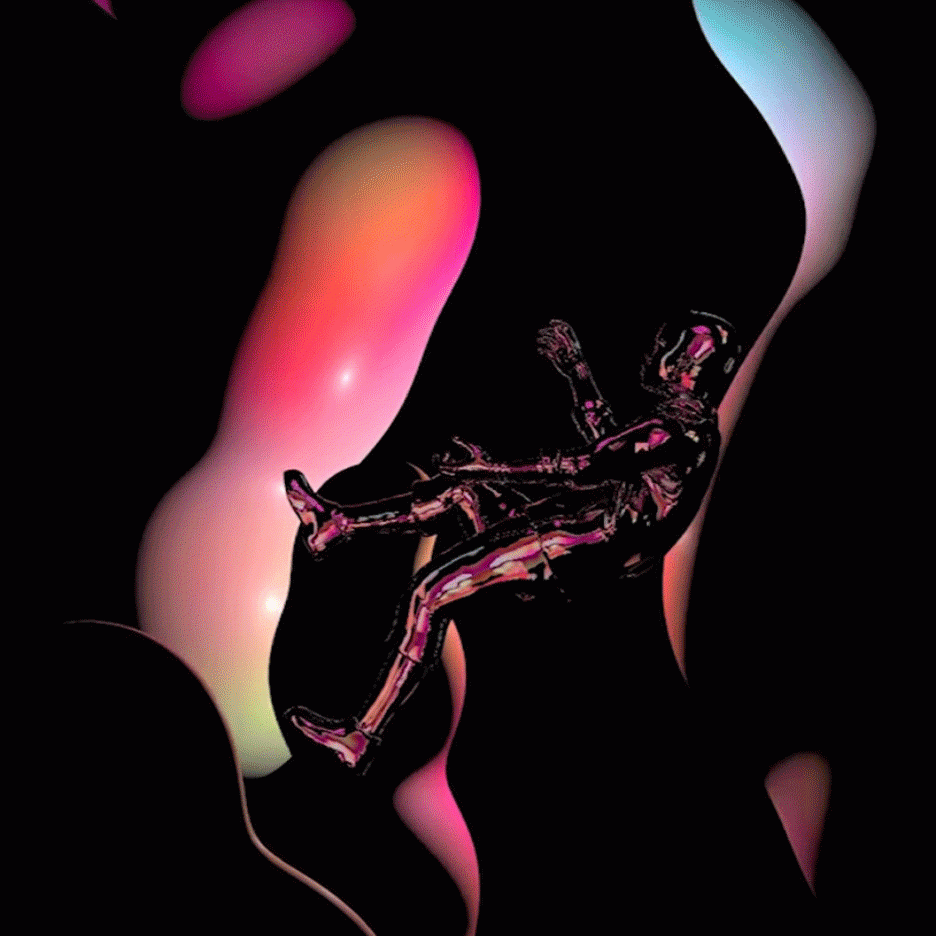
Quentin Deronzier documents growing up for Jerry Folk music video


For Jerry Folk’s Kids music video, French visual artist Quentin Deronzier used Cinema 4D to create hypnotic visuals that document the transition from childhood to adulthood (+ movie). (more…)

http://ift.tt/2e2573b

Selected: Moody forest walk. by Bokehm0n

Processed with VSCO with e6 preset

http://ift.tt/2dBc1th

Fall has arrived at Glacier National Park, and it’s stunning….

Fall has arrived at Glacier National Park, and it’s stunning. Crushing clouds and rain greeted Nate Luebbe at Glacier, but as he crested Logan Pass he was treated to one of the most spectacular alpenglow sunsets we’ve seen. “The sun shot golden fingers between jagged peaks and illuminated the clouds from below, and I couldn’t help but admire the timing. Montana was welcoming me home.” Photo courtesy of Nate Luebbe.

Pia Bauernberger makes custom coats to suit how individual designers work


Vienna Design Week 2016: Austrian designer Pia Bauernberger has designed a series of work coats with features tailored to the idiosyncrasies of specific designers and artists (+ slideshow). (more…)

http://ift.tt/2dazL7H

What Colour Is Your Energy?

The levels of energy are different for different people. Some are very energetic, while others are calm and collected. Let’s not forget the wide range in between those two.

But let’s think in term of colors. Not the color you like, but the one that describe best you spirit.

colorTake just now this quick and easy quiz and find out what color is your energy!

What Colour Is Your Energy?

//cdn.playbuzz.com/widget/feed.js

Leave a comment below to tell us what you’ve got!

The post What Colour Is Your Energy? appeared first on Change your thoughts.

http://ift.tt/2d1WM9C

Yosemite National Park – California – USA (by Giorgio Galeotti) 

Yosemite National Park – California – USA (by Giorgio Galeotti

💙 ::. Coloring Sea .:: on 500px by Ahmad Zulharmin…

💙 ::. Coloring Sea .:: on 500px by Ahmad Zulharmin Fariza,… http://ift.tt/24X7jJj

http://ift.tt/2ecHRP1