@signordal Amazing day in Washington State

via Instagram http://ift.tt/2dTv4BX

@signordal In another world

via Instagram http://ift.tt/2dTvwAa

Eight Amazing Books to Help Write Your Best Life

You’re reading Eight Amazing Books to Help Write Your Best Life, originally posted on Pick the Brain | Motivation and Self Improvement. If you’re enjoying this, please visit our site for more inspirational articles.

top 8 self development books

top 8 self development books

Looking for a Wastebasket to Empty Out Your Head?

Tired of those same thoughts over and over again? Tired of how FULL your head feels?

Sure, it would be great if you could take off your head, scrape it like the inside of a pumpkin, and start fresh, carving out a new face in the process.

But you can’t.

Yep, those thoughts don’t seem fertile, they seem like weeds in your head’s struggling garden.

Good News: Weeds Can Be Great Fertilizer!

Here’s the trick. If you let those weeds overgrow your garden, that garden won’t nourish you.

If you pay attention to those weeds, you can not only fertilize your garden, you can actually harvest those repetitive, initially troublesome thoughts.

How? Keep a diary, write those thoughts down.

And nothing helps you keep an effective diary than great books that help you change negative thoughts to positive ones.

Here are eight of the best ones that have saved my mental and emotional life again and again. They’re like guides who carry torches in the scary darkness of your head so you can turn on the lights, keep them on, and transform your inner house.

Joan Borysenko, Minding the Body, Mending the Mind. This book combines physiological insights concerning the “relaxation response” with perspective on the components of your personality, especially the ego and its role.

Mark Epstein, Going to Pieces Without Falling Apart: A Buddhist Perspective on Wholeness. This book is an outstanding bridge to the healing insights of Buddhism, brought home to the reader through terrific composites.

John Kabat-Zinn, Wherever You Go, There You Are. In a series of short pieces, the author provides the healthiest way to position your mind to avoid, withstand, and manage the stress of everyday life.

Viktor E. Frankl, Man’s Search for Meaning. This inspiring testament by a survivor of a death camp is a shows the resilience of the human spirit in the face of unspeakable horror.

Alice Miller, The Drama of the Gifted Child: The Search for the True Self. Miller’s account of the effects of poor parenting and the insights around the child’s coping mechanisms, sadness, and healing is a terrific addition to any self-help library.

David E. Burns, Feeling Good: The New Mood Therapy: This book brings the art of the internal “Talk Back” to new heights.

Tara Bennett-Goldman, Emotional Alchemy: How the Mind Can Heal the Heart. Goleman’s work on the unhealthy “schema” that emotionally damaged individuals put together is a valuable contribution to the field.

Eckart Tolle: The Power of Now: A Guide to Spiritual Enlightenment. Toll’s work’s insistence on acceptance of the immediate present provides a useful perspective.

These Books Provide Medicine, but You’re Still the Doctor.

If you read these books, and while these are the most meaningful to me, certainly you can find other outstanding ones, that’s just the start. Read books like this, then do the following:

• Accept the Fact that You CAN Take Charge of Your Thoughts
• Become an Observer Rather than a Critic of Your Thoughts
• NOTE the Thoughts That Recur the Most
• Open a Dialogue with YOURSELF

A diary is a tool that helps you do all these things. Each of these books provides a multitude of insights that you can put to use right away as you write down what you see, what you feel, what thoughts you have, and what connections your heart, your mind, your spirit, and the various voices inside you can make.

Each of your internal voices represents a narrative, a story inside you about yourself and your place as human being as well as human doing.

If you observe rather than criticize your thoughts, no matter what they are, you transform useless weeds into something of information, self-awareness, nourishment, and future fertilization.

The Mind Is Your Garden-Tend It Well!

So, next time you want to simply throw your head away, because it’s negative, so negative that you feel you just can’t find something good to hold on to, STOP.

Sit down, take a deep breath, and simply WATCH YOUR MIND and what’s in it.

That’s the beginning.

The, get some of these books, note what you’re thinking, and write the story of your life, every day.

Don’t rip up the weeds, use them to make the garden of your inner world something that will feed you all the days of your life.

Lars Nielsen is a free-lance copywriter whose unique and image-rich selling voice combines the narrative power of his poetry, playwriting, fiction, radio, liturgy, and comedy. Go to http://ift.tt/2aI2xgg and see how Ultimate Influence Copywriting can reframe the narrative of your business, speeches, ideas, and your life for success.

You’ve read Eight Amazing Books to Help Write Your Best Life, originally posted on Pick the Brain | Motivation and Self Improvement. If you’ve enjoyed this, please visit our site for more inspirational articles.

http://ift.tt/2cV7kHy

Louverwall / AND


© Kyungsub Shin

© Kyungsub Shin


© Kyungsub Shin


© Kyungsub Shin


© Kyungsub Shin


© Kyungsub Shin

  • Architects: AND
  • Location: Paju-si, Gyeonggi-do, South Korea
  • Architect In Charge: Euiyeob Jeong, Taekyoung Lee
  • Area: 188.0 sqm
  • Project Year: 2016
  • Photographs: Kyungsub Shin

© Kyungsub Shin

© Kyungsub Shin

Site + Desire

Louverwall is for a couple with five cats. The husband is a music enthusiast who manages the cafe where he enjoys music, coffee, and beautiful space. He wants the café space to be vertical, transparent, and dynamic. They need a small residence on the 2nd and 3rd floors consisted of a bedroom, a living room and a small kitchen. The site is located in the newly developed mixed-use building district in Paju. The plot is surrounded by other buildings on its three sides; it is only open toward due west. Thus, the main challenge of the project is to come up with the west façade that is energy efficient and transparent.


Floor Plan

Floor Plan

Mass + Light

The goal is to have soft daylight in the café space, as it is facing due west. We have decided to limit the direct light of the west and bring in the light from the south. As the south side is blocked by another building, we can only have clerestory. The clerestory of the south side continues to the west creating the curtainwall facade. Inside the envelope, the two massive curved walls are formed to bring in natural daylight deep into the ground floor year round. The light that changes every minute touches the interior surfaces. Every movement of the clouds, the sun, as well as the changes of season is recorded on the walls.


© Kyungsub Shin

© Kyungsub Shin

Louver + Curtainwall

The curtainwall façade is combined with the louvers for the building performance. The louvers are designed to block the summer sun, and to bring in the heat of the winter sun. The aluminum louvers cover the entire curtainwall, creating a sense of solidity. The louver design is done using PLDS (Parametric Louver Design System) which is an algorithm that finds the best performing louver form for the given surface. It finds the optimized set of formal parameters for the given glazed surface; angle of rotation, spacing, projection length, and inclination. The optimized louvers do not just block direct sunlight. It calculates how much summer sun is blocked and how much winter sun can pass through. Therefore, the curtain wall does not create extra heating and cooling load to the building, but offers glazed façade with soft daylight. The structure, curtain wall, and louvers have all worked out together as one’s change affects the others. The final design came out as a synergetic process between the creativity of the designers and the analysis of the system.


© Kyungsub Shin

© Kyungsub Shin

Section

Section

© Kyungsub Shin

© Kyungsub Shin

*PLDS (Parametric Louver Design System) is an algorithm that runs in Rhinoceros 3D as a grasshopper file. A team of Seoul National University’s researchers led by professor Choi, Jaepil has developed the algorithm funded by the Ministry of Land, Transport, and Maritime Affairs of the Korean government.


© Kyungsub Shin

© Kyungsub Shin

Section

Section

© Kyungsub Shin

© Kyungsub Shin

Performance + Experience

The light pours in between the two curved walls, emphasizing the verticality of the space. As one walks up the stairs to reach the rest space, one can experience the utmost play of light and shadow, and the verticality. The shadow of louvers create rhythmical pattern on the curved surfaces; the pattern continuously changes as the light changes. This visual play of light and shadow becomes even more dynamic as it meets the rhythm of music. The music floats in the space, and the play of light continues.


© Kyungsub Shin

© Kyungsub Shin

http://ift.tt/2dz0oT2

Wind House / OPENSPACE Design


Courtesy of OPENSPACE Design

Courtesy of OPENSPACE Design


Courtesy of OPENSPACE Design


Courtesy of OPENSPACE Design


Courtesy of OPENSPACE Design


Courtesy of OPENSPACE Design

  • Architects: OPENSPACE Design
  • Location: Soi Mu Ban Noble Neo City, Khwaeng Si Kan, Khet Don Mueang, Krung Thep Maha Nakhon 10210, Thailand
  • Lead Architects: Chakrawan Smatasoraboosya, Monthon Sanguanpog, Songpon Jirayasin
  • Area: 675.0 sqm
  • Project Year: 2013
  • Photographs: Courtesy of OPENSPACE Design

Courtesy of OPENSPACE Design

Courtesy of OPENSPACE Design

“Wind House” was created as “Resort Space” which was the owner’s preference style regarding the site conditions. As it was located on the edge of the housing estate project’s boundary, it gained the view of big natural green area beside and certainly, the atmosphere of tranquility.


Courtesy of OPENSPACE Design

Courtesy of OPENSPACE Design

The house planning started from the idea – “How to live comfortably with nature?”. Therefore,the building orientation and the space of the house should allow the wind to flow through and allow natural light to shine in without too much heat. At the same time, the users inside could be able to see nice garden view outside as well.


Courtesy of OPENSPACE Design

Courtesy of OPENSPACE Design

Section

Section

Courtesy of OPENSPACE Design

Courtesy of OPENSPACE Design

The house was designed in C-Shape providing big courtyard on the right side, close to big green area beside, where every function from 3 sides could really share this pleasant courtyard together. The building itself could provide privacy to the users as neighbors would not be able to look into the center of the house. The technique to draw the wind flowing through the house perfectly was to provide some big voids of the building mass aligned to the courtyard which were also used as circulation core, stair and relaxation corner. Moreover, even some details such as doors, fences, sunlight screen patterns, etc. were meticulously designed to utilize the wind more efficiently for ventilation purpose.


Courtesy of OPENSPACE Design

Courtesy of OPENSPACE Design

One of the most significant design strategies was to create “Seamless Boundary” between building and nature, indoor and outdoor. All of the common area as well as circulation were treated as “Semi-Outdoor” space, under the roof but without walls, connecting to the courtyard harmoniously. In addition, some enclosed functions were still optional to get fresh air sometimes by sliding full-height partitions to the sides. These would enable the house space to look wider, more airy and definitely, to welcome the delightful wind to be “Wind House”.


Courtesy of OPENSPACE Design

Courtesy of OPENSPACE Design

http://ift.tt/2cUEUxw

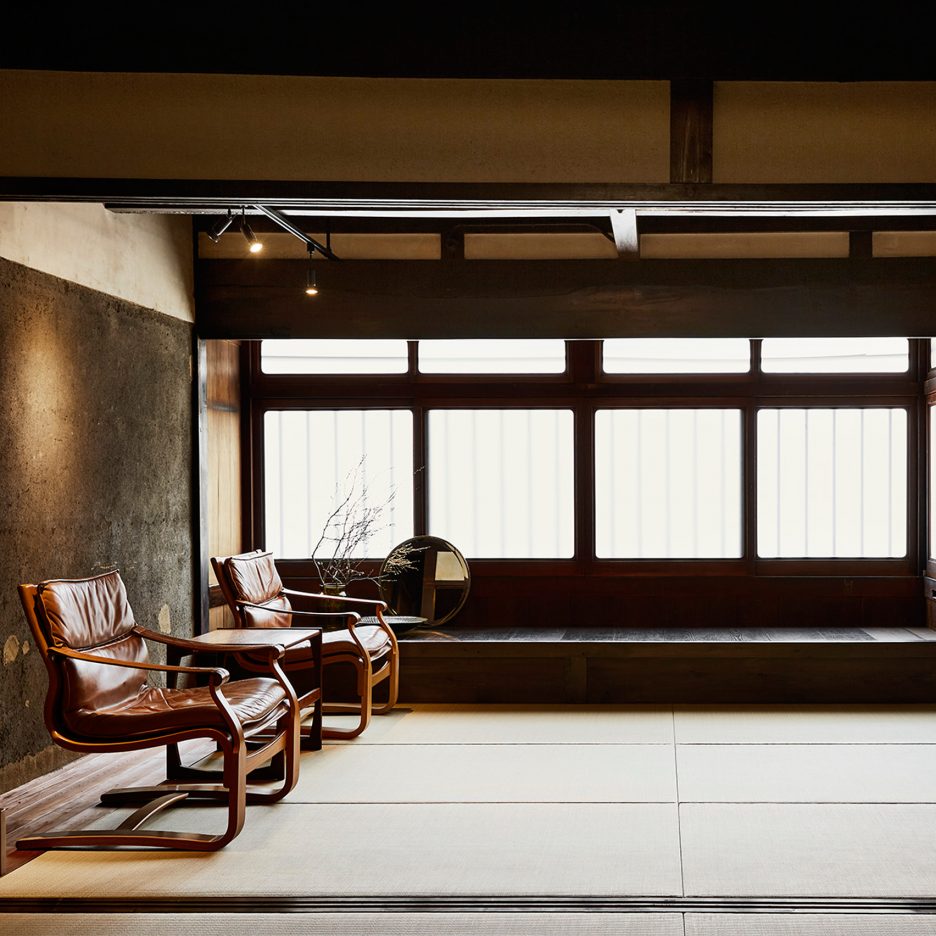
Guesthouse opens inside revamped century-old machiya house in Kyoto


This 120-year-old Kyoto townhouse was once used as a seed plantation, but has been carefully restored to create a guesthouse that celebrates Japanese interior design traditions (+ slideshow). (more…)

http://ift.tt/2dFPWv6

Coconut House / D·LIM architects


© Young-chae Park

© Young-chae Park


© Young-chae Park


© Young-chae Park


© Young-chae Park


© Young-chae Park

  • Architects: D·Lim Architects
  • Location: South Korea
  • Architect In Charge: Yeonghwan Lim, Sunhyun Kim
  • Design Team: Jeong-ho Choi, Wanki Kim, Hongnyeol-Kim
  • Area: 208.91 sqm
  • Project Year: 2015
  • Photographs: Young-chae Park
  • Exterior Finishing: THK30 Stone, Exposed Pine boards concrete, THK24 low-e pair glass
  • Structural Engineering: Eun Structural Engineering
  • Mechanical Engineering: Hitec Engineering Co.,Ltd
  • Electrical Engineering: Hitec Engineering Co.,Ltd
  • Site Area: 265.10 sqm
  • Building Area: 132.24 sqm

© Young-chae Park

© Young-chae Park

The house is called a coconut house due to its solid grey stone exterior, while its interior is white and sweet. It is for a family consisting of a couple and two children.


© Young-chae Park

© Young-chae Park

Plan 1

Plan 1

© Young-chae Park

© Young-chae Park

Privacy from neighbouring properties was a key concern for the clients. The contrast between the exterior and interior materials and colors was chosen to heighten the safety of the house in a dense residential district. The building is packed into a plot between existing neighboring properties. Its plan was created to provide a variety of spaces across the two floors, and also to ensure the main spaces are oriented towards the sun’s path. 


Section

Section

Section

Section

At street level, a concrete-finished wall and grey stones shield the lower story from view. It also incorporates a black swinging door and entrance that opens onto a grey stone courtyard. A large volume of glazing towards this courtyard is used throughout the house to ensure the interior receives plenty of natural light, despite its cramped site. The master bedroom, situated in the more private front end of the second floor, contains a library, a walk-in closet, an en-suite bathroom, and a door to a terrace garden.


© Young-chae Park

© Young-chae Park

http://ift.tt/2dyEAXv

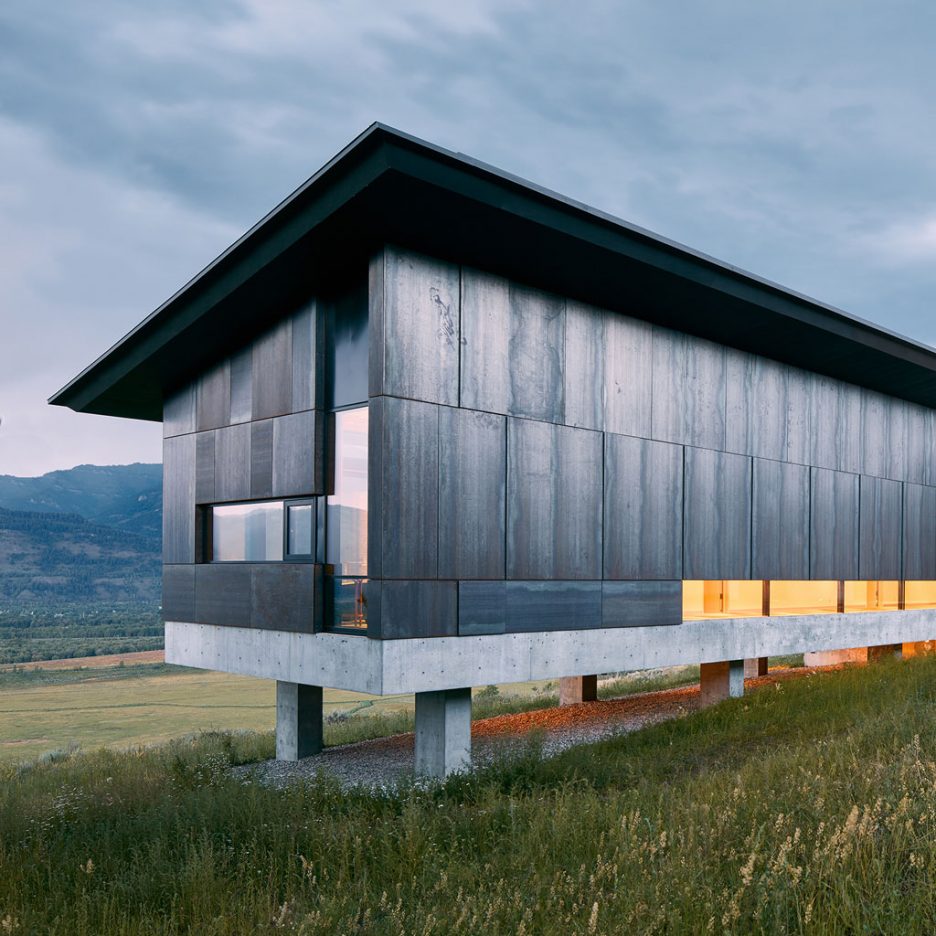
Abramson Teiger builds steel-clad residence in a Wyoming meadow


US studio Abramson Teiger has created a rural Wyoming home that consists of low-lying volumes made of glass, concrete and weathering steel (+ slideshow). (more…)

http://ift.tt/2dLSRnA