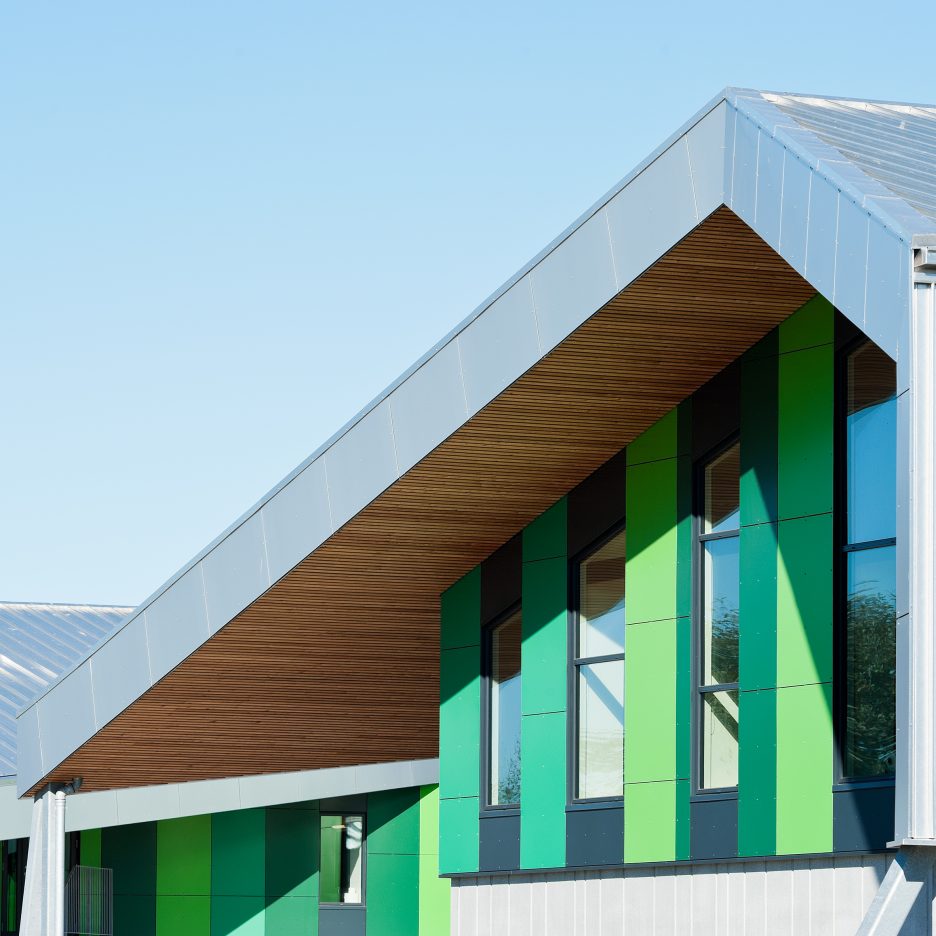
Vibrant green stripes and angular roofs add character to the exterior of this school that architecture firm CEBRA has completed in Aabybro, Denmark (+ slideshow). (more…)
From the architect. The Walter & Leonore Annenberg Center for Information Science and Technology (IST) is a 46,000 sf research facility designed as home to participants of the IST Initiative, a program of interdisciplinary research that addresses the growth and impact of information science as it relates to all science and engineering practices. Participants in this initiative migrate from all parts of the campus, representing all Colleges of Science and Engineering at Caltech.
The aim of the facility is to foster collaboration, research and teaching intrinsic to this new academic discipline. The building was planned as an immediately accessible plaza of group teaching, learning and working spaces on the ground level supporting a two story research center.
Schematic Model
Glass walls make the ground level an active, connected environment. The upper two levels contain faculty and graduate student offices and studios, designed for the project teamwork which is at the core of the University’s educational and research activities.
Flexible studios open onto a two story atrium that acts as a “town square”, furnished for casual gathering, events and study. Upper levels are also interconnected by a two story “resident lounge” that functions as an updated faculty club with dramatic views of the mountains and campus walkway. FFP incorporated green materials and fixtures such as those made from certified wood & recycled content, low VOC paints and carpet, waterless urinals, and a white roof system.
A great focus was placed on the individual comfort of the professors that will have offices in the IST Center. In addition, operable windows have been included in these spaces to maximize thermal comfort and personal control.
Site Plan
This LEED Gold project was awarded “Best in Show” honors from the Los Angeles Chapter of the USGBC at their 2011 Sustainable Innovation Awards.
Images by: Virgile Simon Bertrand, Owencn_95, Courtesy of Zaha Hadid Architects, Thomas Mayer, Khoo Guo Jie
As Zaha Hadid’s successor and current leader of the firm, Schumacher relays a host of opinions, including those on parametricism, which he deems the “architectural style of capitalism.” The term describes the avant-garde practice that uses digital animation to create equations for designs. Patrik Schumacher, who coined this term in 2008, believes this style extracts doubt from the design process, relying instead on the infallibility of science.
I discovered that my own drive and passion for architecture and for the progress of our discipline — together with the enthusiasm and commitment of our staff — can propel us forward without loss of momentum, says architect Patrik Schumacher in The Guardian’s My Blueprint for the Future.
Now parametricism is expanding into products and clothes. “The Extraordinary Process,” a new exhibition at the London gallery Maison Mais Non, centers on innovative technologies in fashion design. Schumacher has personally created two dinner jackets for himself that use “zippers, and leather in particular zones, and lightness and perforations in zones where you might perspire more.” Check out these designs and more on Schumacher’s thoughts here.
When creating this hand-painted music video for Oakland musician Makeunder, Carine Khalife looked to the works of figurative painter Francis Bacon (+ movie). (more…)
Happy birthday, Yosemite National Park! On October 1, 1890, Yosemite became a national park, and 126 years later, it’s still wowing visitors with its waterfalls, towering granite monoliths, deep valleys and ancient giant sequoias. While Yosemite might be our 3rd national park, it was first protected in 1864 with the Yosemite Land Grant – sparking the idea of national parks. Photo courtesy of Tiffany Nguyen.
Cars have reshaped cities across the world, largely at the cost of everyone outside of a private vehicle. In recent years the “grid city” of Barcelona has been suffering from clogged roads and choked air quality, with urban traffic contributing to the 3500 premature deaths caused by air pollution each year. Beginning in the district of Eixample, proposals laid out in the 2014 Urban Mobility Plan aims to diffuse traffic congestion and reduce air pollution in the city. In a recent film Vox have picked up on one of a number of potential schemes: the Superblock concept (known as superilles in Catalan). According to Salvador Rueda, the Director of the Urban Ecology Agency of Barcelona who developed the plan, these are “grid[s] of nine blocks [in which] the main mobility happens on the roads around the outside, […] and the roads within are for local transit only.”
Ildefons Cerdà i Sunyer's 1859 urban plan for Barcelona. Image via Wikimedia Commons under public domain (original source: Museu d'Historia de la Ciutat, Barcelona)
As shown in the video, a Superblock closes off traffic within a square of nine city blocks, with main traffic only allowed around the perimeter. A “one-way system inside the Superblock makes it impossible to cut through to the other side of the Superblock,” Rueda has explained in an interview with Curbed. “That gives neighbors access to their garages and parking spaces but keeps the Superblock clear of through traffic.” Rueda estimates that Barcelona can implement this initial phase across the city for less than €20 million. The second phase, which is designed to reinvent the reclaimed space, will ban curbside parking (moving vehicles to off-street parking complexes) and reduce the speed limit to 10 kilometers per hour (6 miles per hour) in a bid to encourage new forms of urban appropriation. The result is a much more pedestrian-friendly neighborhood, encouraging pedestrian and bike traffic, markets, and other on-street activity.
via screenshot from Vox video
The video also gives a glimpse of Barcelona’s future improvements by discussing the example of Vitoria-Gasteiz, a city northwest of Barcelona. Since implementing the Superblock in 2008, pedestrian surface area increased from 45% to 74%. Pollution also decreased, with nitrogen oxide emissions reduced by 42% and particle pollution by 38%. Finally, noise levels also dropped, from 66.5 decibels to 61 decibels – cutting sound amplitude almost in half.
The first Superblocks will be tested across 5 neighborhoods in Barcelona, with a further 120 locations identified as potentially suitable. For more, the full video and accompanying article from Vox can be found here.
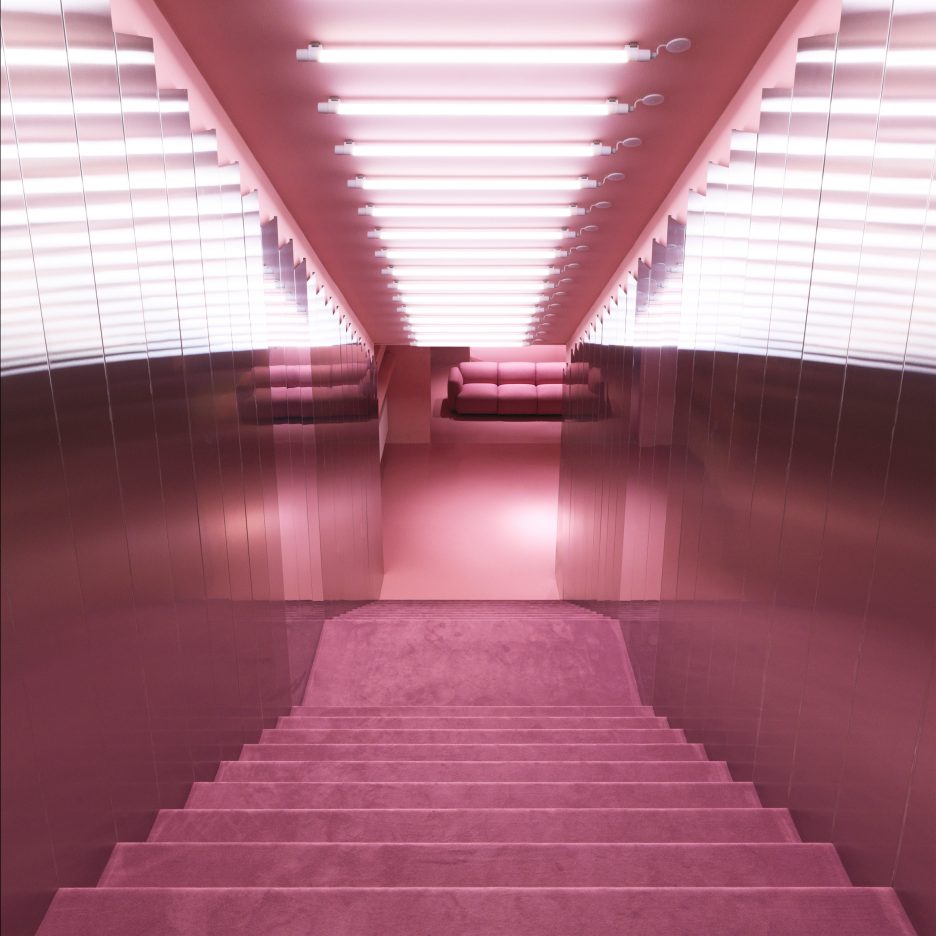
Normann Copenhagen has reopened its flagship furniture and homeware store in the Danish capital, where a steel corridor, mirrored walls and a space coloured entirely in pink have all been added (+ slideshow). (more…)
From the architect. Winner of the architecture competition in 2012, Studio Gardoni Architectures discreetly fit this major facility into the small town of Chamonix and more particularly into the valley’s grandiose landscape. Rising from the slope, the building is covered up by the ground of the clearing, and is destined to disappear when the nature once again reclaims its rightful place.
The architectural concept strives for invisibility: more precisely, it aims to render invisible the impact of a fire station as we typically see or imagine one, a building bustling with activity, with a particularly prominent roadway network. At an emergency services center, every second counts, requiring a design that emphasizes precision and detail. This new building not only meets these criteria scrupulously, but has also been cleverly designed to enable the vehicle bay to be placed underground.
In order to minimize impact and allow space for the natural environment to once again thrive, key elements had to be both built underground and made more compact. The shape is akin to an assembly of elements of programs that intertwine opportunistically to simultaneously create proximity (functionality and ergonomics) and minimize the structure’s footprint. This principle results in a building with two facades that are partially or entirely underground, and two broad facades that contain all of the functions. This is epitomized through the opaque, mysterious structure of the gymnasium, an emblematic figure at the bow of the complex.
Inherent to the nature of this site is the passing of time. These spaces are materialized in a process of disappearance, of time unfolding. Here, time is not destructive but transformative.
First of all, nature covers the roof, and will reclaim its rightful place, both around and on the structure. The gabion foundations are composed of rocks from the site, a selection of pebbles excavated from the surrounding glacial moraine.
Finally, the copper, found in the scaled façade and the standing seams, begins its slow mutation once it has been installed, and will turn from gold to brown, as seen in a number of structures found in the valley. This material reflects the surrounding peaks, transforms the site and is transfigured every hour of the day by the changing sunlight and the clouds.