
Happy New Year! Just like this gorgeous sunrise at Canyonlands National
Park in Utah, we hope your new year is filled with beauty and adventure.
Photo by Greg Sager (http://ift.tt/18oFfjl).
Happy New Year! Just like this gorgeous sunrise at Canyonlands National
Park in Utah, we hope your new year is filled with beauty and adventure.
Photo by Greg Sager (http://ift.tt/18oFfjl).

Buiksloterham (BSH) is part of a former industrial area located on the Northern bank of the IJ-river in Amsterdam and is now being developed into a metropolitan, sustainable working and living area that houses more than 4.000 homes. Project Docklands was the winning entry for plot 12 of a competition on sustainability in Buiksloterham in 2010, in which the municipality has selected our team on the best energy and sustainability concept.
The L-shaped complex consists of a slender tower containing nine storeys with a total of thirty-two apartments and a two-storey base, with thirteen business units and parking on the ground floor and twelve compact studios on the first floor. On top of the parking garage a collective roof garden is located together with the entrances of the studios.
The roof of the tower is provided with a communal roof terrace with thornless honeylocust trees (Gleditsia triacanthos Inermis), a symbolic reference to the 13th century Torre Guinigi Lucca. All apartments also feature a large private outdoor space through a loggia or terrace.
The project is built with specially produced industrial red-brown bricks, to refer to the former rough character of this former industrial area. The bricks are traditionally processed on site in a modular bond. The brickwork module size of three stacked bricks has determined the size of the whole building in three dimensions and manifests itself as an all-enveloping skin of the volume. The ‘grid’ of the elevations are provided with titanium coloured aluminium window frames with outward-opening windows. The loggia’s of the tower have large sliding windows and removable glass panels on the outside, which makes the balconies usable as an additional outdoor room during both winter and summer.
Docklands makes use of an energetic building concept, with innovative ways of climate control. The air-conditioning is collectively controlled wherein the supply air is drawn in through ground tubes, through which the ventilation air is preheated in the winter and cooled in the summer. In addition, the building has its own geothermal heat sources and heat pumps. Thus the complex is not connected to the city’s heating network, but is self-sufficient through a building-related collective thermal storage system. The roof of the lower part is largely equipped with solar and photovoltaic panels.
Product Description. The project is built with specially produced industrial red-brown bricks. The bricks are traditionally processed on site in a modular bond. The brickwork module size of three stacked bricks has determined the size of the whole building in three dimensions and manifests itself as an all-enveloping skin of the volume. The ‘grid’ of the elevations are provided with aluminium window frames with outward-opening windows.

PIARENA has won the Archchel-2020 competition to create a Congress Hall for BRICS and SCO events in central Chelyabinsk, Russia along the Miass River. Separated into two parts by the river, the site will additionally host business meetings, public events, and exhibitions.
In order to emphasize the curve of the river, the new congress hall building will be a solid volume spanning across the river, rectangular in footprint, but curved in a sail shape above.
Rising up to 61 and 150 meters, the building is hoped to become a new urban landmark, as well as a pedestrian crossing over the river.
A common atrium will connect various portions of the building, including a 3150-person concert hall, hotel, office complex, exhibition hall, and media center.
Each functional zone of the building features its own entrance area and vertical transport, “in order to improve flux distribution, loading, and emergency evacuation.”
Outside the building, a parametric grid pattern of parallelograms will govern the placement of green areas, water surfaces, plantings, cladding, and street furniture.
News via: PIARENA.

💙 Red on 500px by Julie’s Photography , Kent, England ☀ NIKON… http://ift.tt/2aAlgcm

Fence House is a private residence designed by mode:lina architekci. It is located in Borówiec, Poland and was completed in 2016. Fence House by mode:lina architekci: “In Borówiec near Poznań, once again a house designed by mode:lina™ studio was built. Form of this house: two blocks with a sloping roof and an asymmetric garage cube, is a contemporary interpretation of the traditional style. It is complemented with simple, raw materials:..
The post A Home in Borówiec, Poland, Designed by mode:lina architekci appeared first on HomeDSGN.

“Re-Constructivist Architecture,” an exhibition now on show at the Ierimonti Gallery in New York, features the work of thirteen emerging architecture firms alongside the work of Coop Himmelb(l)au, Peter Eisenman and Bernard Tschumi. The title of the exhibition is a play on words, referring to the De-Constructivist exhibition of 1988 at the Museum of Modern Art that destabilized a certain kind of relationship with design theory.
This reconstruction is primarily of language. The architects draw from archives—mental, digital or printed on paper—distant from the typical parametric and highly schematic rationales that characterized the last thirty years of design in architecture. Within the theoretical system that drives architectural composition, these archives inevitably become homages, references, and quotes.
Even if it is diverse, this referential landscape maintains very distinctive traits. Renovated links to a series of iconic and communicative architectures, often narrated with a concise and simple lexicon, emerge from this landscape. The architectures are created with radical and sometimes ironic premises that set a distance from narcissistic blobs. In contrast, a strong passion for theoretical investigation becomes fundamental again.
The group of architects from the thirteen firms, all born in the eighties, share not only common suggestive visions but also the challenges of growing in a scenario where the role of the architect is constantly evolving and redefining itself. Some of them are strongly connected with their cities, whereas others have a broader network. Some of them are highly active on social media and the web, whereas others are making a new use of printed media.
It is not a coincidence that the exhibition is a spinoff of a series of lectures called “Generazione: a call from Rome.” From September 2016 to June 2017 the group of architects presented (and will present) their work at the Casa dell’Architettura, in Rome. Each of the offices, along with sharing their professional experience, were asked to elaborate a project for a House in the Roman Countryside; a design exercise meant as a typological investigation, or, more generally, as a meditation on the autonomy of the discipline of architecture.
This type of exercise originated in the eighties as a theoretical speculation in which the architectural project could be considered independent, as a revolutionary act itself without the need for association with political doctrines.
This group of architects could be seen as paradigmatic, but is not exhaustive. In this developmental stage, the Movement is still defining its boundaries. However, we could start to identify its main features. We could recognize the work of recent trailblazers or even the fathers that inhabit the Pantheon of this Movement, but this is not our goal. The distinctive aspect that distinguishes the works presented here from some parallel currents is an interest in a typological point of view, freed from ideology: the objective of the research is architectural language itself—a counter-trend that tries to recover a debate lost years ago.
RE-CONSTRUCTIVIST ARCHITECTURE is an exhibition curated by Jacopo Costanzo and Giovanni Cozzani with Giulia Leone, promoted by the scientific technical committee of Casa dell’Architettura with Consulta Giovani Architetti Roma. The 13 designers on display are AM3, fala atelier, False Mirror Office, Fosbury Architecture, Adam Nathaniel Furman, jbmn, MAIO, PARA Project, Parasite 2.0, Point Supreme, Something Fantastic, UNULAUNU, and Warehouse of Architecture and Research, alongside Coop Himmelb(l)au, Peter Eisenman and Bernard Tschumi. The exhibition is on view at Ierimonti Gallery in New York until February 10, 2017. Find out more via the link below:
Re-Constructivist Architecture//cdn.embedly.com/widgets/platform.js

From the architect. Built at the beginning of the XX century, Casa San Polo is an antique rural house located at the heart of the beautiful countryside of San Polo di Piave, close to Treviso.
The original structure was made up of three floors. The lowest two floors were habitable, whereas the attic was used as a granary. This way of using the space is a typical feature of rural dwellings of that time, characterized by a steep central staircase and a symmetric development of the rooms.
The house, abandoned for several years, totally lacked the roofing: all the wooden parts of the floors were completely damaged and also the masonry walls were compromised.
The design respects the original character of the structure, and the space is symmetrically developed around the main central block, composed by the staircase and the bathrooms.
The house features a big window looking southwards to enjoy the visual beauty of the countryside, and a wooden porch has been built in front of this opening as an addition to the original structure.
A garage and storage place has been added outside the main building.
Product Description. The initial state of abandoned of the house has involved the reconstruction of the all wooden floors, and has maintained the original brick structure. Even the downstairs floors were redone using a smooth concrete, modern material. The concrete was also used to build the new external volume for the garage.
White is predominant in the exterior plaster and even in the interior paintings. The spaces are minimal, as the design of all the furniture for which chose the wood brushed spruce and white laminate.


Happy new year from the Dezeen team and best wishes for 2017! This image of fireworks is one of our favourites from the Christmas cards we received over the holidays, featuring a shot by photographer John Lewis Marshall.
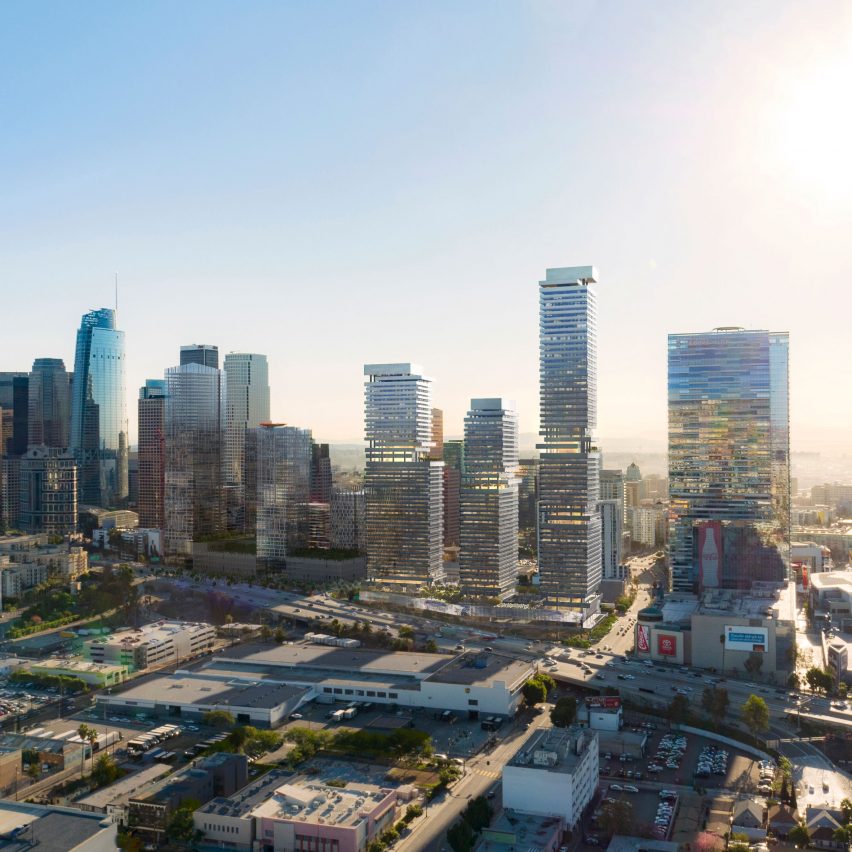
Architecture firm Skidmore Owings and Merrill has designed three residential skyscrapers that will add to the growing Los Angeles skyline. Read more
 Sig Nordal