4 Step Guide to Letting Go of the Past

By Leo Babauta

We’re constantly struggling with the past, in so many ways:

  • Mistakes we’ve made that we regret or that make us feel bad about ourselves
  • Anger about something someone did to us
  • Frustration about how things have progressed up until now
  • A wish that things turned out differently
  • Stories about what happened that make us sad, depressed, angry, hurt
  • An argument that we had that keeps spinning around in our heads
  • Something someone just did (a minute ago) that we’re still stuck on

What if we could just let go of things have have happened, and be present with the unfolding moment instead?

What if we could let the past remain in the past, and unburden ourselves?

What is we could see that our holding onto the past is actually hurting us right now … and look at letting go as a loving act of not hurting ourselves anymore?

It can be done, though it isn’t always easy. Here’s the practice I recommend, in four steps.

Step 1: See the Story That’s Hurting You

In the present moment, you have some kind of pain or difficulty: anger, frustration, disappointment, regret, sadness, hurt.

Notice this difficulty, and see that it’s all caused by whatever story you have in your head about what happened (either recently or in the more distant past). You might insist that the difficulty or pain is caused by what happened (not by the story in your head), but what happened isn’t happening right now. It’s gone. The pain is still happening right now, and it’s caused by whatever story you have about the situation.

Note that “story” doesn’t mean “false story.” It also doesn’t mean “true story.” The word “story” in this context doesn’t imply good or bad, false or true, or any other kind of judgment. It’s simply a process that’s happening inside your head:

  • You’re remembering what happened.
  • You have a perspective about what happened, a judgment, a way of seeing it that has you as the injured party.
  • This causes an emotion in you.

So just notice what story you have, without judgment of the story or of yourself. It’s natural to have a story, but just see that it’s there. And see that it’s causing you difficulty, frustration or pain.

Step 2: Stay with the Physical Feeling

Next, you want to turn from the story in your head … to the feeling that’s in your body. This is the physical feeling: it could be tightness in your chest, a hollowness, a shooting pain, an energy that radiates in all directions from your solar plexus, an ache in your heart, or many more variations.

The practice is to turn and face this physical feeling, dropping your attention out of the story your head and into your body.

Stay and face this feeling with courage — we usually try to avoid the feeling.

Stay and explore it with curiosity: what does it feel like? Where is it located? Does it change?

If this becomes unbearable, do it in small doses, in a way that feels manageable for you. It can get intense if the feelings have been intense.

But for most feelings, we see that it is not the end of the world, that we can bear it. In fact, it’s just a bit of unpleasantness, not all-consuming or anything to panic about.

Stay with it and be gentle, friendly, welcoming. Embrace the feeling like you would a good friend. You’re becoming comfortable with discomfort, and it is the path of bravery.

Step 3: Breathe Out, Letting Go

Breathe in your difficulty, and breathe out compassion.

It’s a Tibetan Buddhist practice called Tonglen: breathe in whatever difficult feeling you’re feeling, and breathe out the feeling of relief from that difficulty.

You breathe in not only your own pain, but the pain of others.

For example:

  • If you’re feeling frustration, breathe in all the frustration of the world … then breathe out peace.
  • If you’re feeling sadness, breathe in all the sadness of the world … then breathe out happiness.
  • If you’re feeling regret, breathe in all the regret of the world … then breathe out joy and gratitude.

Do this for a minute or so, imagining all the frustration of those around you coming in with each breath, and then a feeling of peace radiating out to all of those who are frustrated as you breathe out.

You can practice this every day, and it is amazing. Instead of running from your difficult feeling, you’re embracing it, letting yourself absorb it. And you’re doing it for others as well, which gets us out of a self-centered mode and into an other-focused mode.

As you do this, you’re starting to let go of your pain or difficulty.

Step 4: Turn with Gratitude Toward the Present

As you feel that you’ve let go, instead of getting caught up in your story again, turn and see what’s right here, right now.

What do you see?

Can you appreciate all or some of it? Can you be grateful for something in front of you right now?

Why is this step important? Because when we’re stuck on something that happened in the past, we’re not paying attention to right now. We’re not appreciating the moment in front of us. We can’t — our minds are filled up with the past.

So when we start to let go of the past, we have emptied our cups and allowed them to be filled up with the present.

We should then turn to the present and find gratitude for what’s here, instead of worrying about what isn’t.

As we do that, we’ve transformed our struggle into a moment of joy.

My Upcoming Course: Dealing with Struggles

I wanted to let you guys know about an upcoming video course that I’m launching next week — it’s called Dealing with Struggles, and I’m very excited about it!

This course is aimed at anyone who has struggles:

  • Anxiety about life or social situations
  • Frustrations with themselves or other people
  • Difficulty with procrastination
  • Trouble forming new habits or quitting old habits
  • A feeling of unhappiness with ourselves
  • Struggles with finances, clutter, productivity, health issues
  • Stress about work, life, relationships

As it turns out, we all have struggles.

This video course will aim to get to the root of our struggles, and learn how to apply mindfulness practices to work with them.

It’s a four-week course, with two video lessons and two mindfulness practices a week … and it will start in April. More next week!

http://ift.tt/2nAE7Iq

Something Intricate and Fierce


I, who seemed to myself full of things to say, who had all of Shillington to say, Shillington and Pennsylvania and the whole mass of middling, hidden, troubled America to say . . . some terrible pressure of American disappointment, that would take a lifetime to sort out, particularize, and extol with the proper dark beauty.

John Updike, in his memoir Self-Consciousness

Rabbit at Rest is one of the very few modern novels in English…that one can set beside the work of Dickens, Thackeray, George Eliot, Joyce and not feel the draft.

reviewer Jonathan Raban

John Updike was born eighty-five years ago this week (March 18, 1932) in Reading, Pennsylvania — model for the city of Brewer, capital of Updike’s fictional universe and battle zone for his theme:

My subject is the American Protestant small-town middle class. I like middles. It is in middles that extremes clash, where ambiguity restlessly rules. Something quite intricate and fierce occurs in homes, and it seems to me without doubt worthwhile to examine what it is.

Updike made that comment in a 1966 Life magazine interview, the author just a few years into his half-century, sixty-book career. The most celebrated of his two dozen novels feature Harry “Rabbit” Angstrom, the Brewer High School basketball star who, as his city and region decline, finds prosperity as a car dealer. Published at ten-year intervals from 1960 to 1990, the four-book series tolls a bell for the Middle America that Rabbit, in an often frantic zigzag path, both pursues and flees.

At the opening of Rabbit Is Rich, third book in the series, Harry stands gazing out of the showroom window of his Toyota dealership, convinced that “the great American ride is ending.” At the end of the fourth book, Rabbit at Rest — like the third book, winner of the Pulitzer Prize — Harry consents to dress up as Uncle Sam for a hometown parade; as he mingles with the crowd at his old high school, the “glory days” past competes with the uncertain future:

He expects to come across his old girlfriend, Mary Ann, as she had been then, in saddle shoes and white socks and a short pleated cheerleader’s skirt, her calves straight and smooth and round-muscled . . . springing into joyful recognition at the sight of him. Instead, strange people with puzzled Eighties faces keep asking directions, because he is dressed as Uncle Sam and should know. He has to keep telling them he doesn’t know anything.

Rabbit’s prolonged decline ends in Florida, “death’s favorite state.” Updike’s own death in 2009 was sudden, coming just a few months after his annual checkup revealed stage 4 lung cancer. After hanging on as long as possible in his Massachusetts home, he was moved to a local hospice — described by Adam Begley in his biography Updike as “a mildly pretentious, tastefully landscaped example of suburban-sprawl architecture, a place he would have skewered in exact and loving detail” in the Rabbit books.

Updike’s death is one of six discussed in Katie Roiphe’s The Violet Hour: Great Writers at the End. Roiphe describes Updike’s “Creeper,” one of a number of poems he worked on over his last weeks (collected in Endpoint: And Other Poems), as perhaps the most graceful expression of a peaceful death that I can think of”:

With what stoic delicacy does 
Virginia creeper let go:
the
feeblest tug brings down
a sheaf of leaves kite-high,
 as if to
say, To live is good but not to live — to be pulled down with
scarce a ripping sound,still flourishing, still stretching
toward the sun — is good also, all
photosynthesis abandoned, 
quite quits. Next spring 
the
hairy rootlets left unpulled 
snake out a leafy afterlife
 up
that same smooth-barked oak.

Whatever Updike’s own politics — biographer Begley notes that Updike on his deathbed rejoiced at President Obama’s inauguration — some commentators say that Updike lives on as spokesman for embattled Middle Americans, whose current angst and anger he saw coming: “Revisiting Updike’s Rabbit novels is a rendezvous with prescience, for no collection of postwar fiction could help us better understand how working-class populism — in the form of Donald Trump — prevailed on Election Day 2016″ (Charles McElwee, The American Conservative magazine).


The Barnes & Noble Review http://ift.tt/2nOfnvN

Hocking Hills State Park – Ohio – USA (by Tabitha Kaylee Hawk) 

Hocking Hills State Park – Ohio – USA (by Tabitha Kaylee Hawk

mikenudelman:The Model 3 will be Tesla’s biggest test yet.

Dietrich | Untertrifaller Architekten Design a Contemporary Home in Bregenz, Austria

This beautiful house covering an area of 210 m2 distributed in three levels and located in Bregenz, Austria, was designed in 2016 by Dietrich | Untertrifaller Architekten. It is located on a green hill with wonderful views over the surrounding countryside and Lake Constance. The exterior in wood and concrete seems to merge with its surroundings, an immense green area of tall trees that borders the house. Upon entering, a..

More…

💙 Red Rose on 500px by Alan A Gilmore, Baltimore,…

💙 Red Rose on 500px by Alan A Gilmore, Baltimore, USA☀  Canon… http://ift.tt/2dhbF87

http://ift.tt/2mQzmun

💙 Colores de Urederra on 500px by Pruden Barquin,…

💙 Colores de Urederra on 500px by Pruden Barquin, Bilbao,… http://ift.tt/2e0BWu0

http://ift.tt/2makWbG

💙 NOCHE DE HERMANOS on 500px by Jorge Alonso, Durango,……

💙 NOCHE DE HERMANOS on 500px by Jorge Alonso, Durango,… http://ift.tt/2dyYArZ

http://ift.tt/2mQRZyB

Is everyone wearing green today? Nature’s light show displays a…

Is everyone wearing green today? Nature’s light show displays a fantastic emerald ripple above Denali National Park in Alaska, a great place to see the Northern Lights. Says photographer Carl Johnson, “Having great aurora borealis images to show for a night out in the cold cannot truly capture the thrill of just being out there and witnessing this amazing phenomenon.” Photo courtesy of Carl Johnson. #StPatricksDay

A Map Of Mythical Creatures And Where To Find Them

Have you always dreamed of seeing a yeti? Maybe you’d love to have a beer with ol’ Bigfoot? Or sight a Sasquatch? Have a natter with Nessie?

If mythical beasts from folklore are totally your thing, why not ditch that planned all-inclusive holiday to Greece and head off to a fantastic creature-spotting adventure instead?

We’ve sourced five of the best mythical creatures and assembled a handy guide to these wonderful beasts. With our monster map, you’ll finally know where they live, what they do, and where they are from.

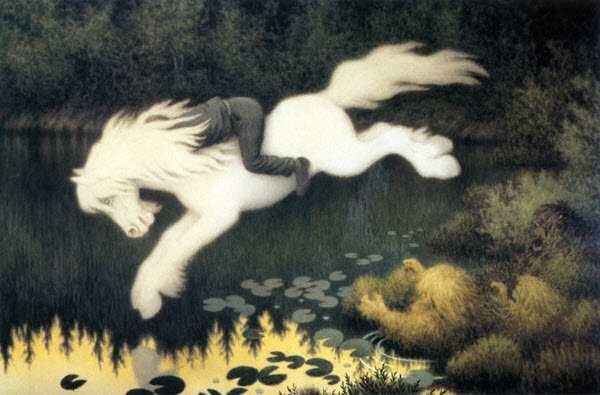
The Kelpie

the kelpie

Go to: Rural Scotland

This mythical creature is one of the most well-known in Scottish folklore. The first recorded usage of ‘kelpie’ goes back to 1759. Thought to haunt the waterways of Scotland, the kelpie is a shape-shifter that usually appears as a horse.

Nearly all rivers, streams and lochs in Scotland have some kind of kelpie story behind them. It’s thought that the kelpies’ ability to shape-shift (they can also appear as beautiful young women, children, and other forms) comes from its bridle.

So, if you’re strong enough to get hold of it, you could well find yourself in the rare position of having the upper hand over one of the most monstrous creatures from all folklore.

Black Shuck

black shuck

Go to: Norfolk, Suffolk, Cambridgeshire and Essex, UK

Black Shuck was the inspiration for Arthur Conan Doyle’s The Hound of the Baskervilles, but the black spectral dog which hides in bushes goes further back than that. It terrorized parts of East Anglia in the 16th century as it stalked coastlines, graveyards, hidey-holes, and hedgerows.

Despite looking like it could cause serious harm, Black Shuck was not necessarily a violent creature. Rather, it was a harbinger, usually of bad luck.

The Loch Ness Monster

loch ness monster
Via 100photos.time.com

Go to: Loch Ness, Inverness, Scotland

Nessie is perhaps the most infamous of all mythical creatures, so it should be right at the top of your must-see list. Travel firm Expedia, who have put together a fantastic online map showing you places around the world where mythical creatures are said to live, explains that early sightings of the Loch Ness Monster compared the aquatic creature to a dragon.

The Nessie phenomenon started back in 1933 when the local paper Inverness Courier reported a sighting of the beast. The rest is history as Nessie cemented itself as a sensation. Expedia’s resource recommends going on a cruise to the ruins of Urquhart Castle, with live sonar on board, to maximize your chances of finding the creature.

Yacumama

yacumama
Via booksie.com

Go to: Manaus, Brazil

The Yacumama is a giant anaconda-like snake that has been frightening Brazilians for many years. This immensely strong serpent, capable of sucking up everything around it, has the power to cause mudslides and general chaos.

The mythical creature resource shows that explorers were reporting seeing the snake as far back as 1906. A report from Percy H. Fawcett reads: “We stepped ashore and approached the reptile with caution. It was out of action, but shivers ran up and down the body like puffs of wind on a mountain tarn. As far as it was possible to measure, a length of 45 feet lay out of the water, and 17 feet in it, making a total length of 62 feet.”

Bigfoot

bigfoot
Via geek.com

Go to: The forests of North America

Another big beast of popular folklore, Bigfoot, or Sasquatch as it’s also known, is thought to stand at least 9 feet tall and with dark fur and skin. The gorilla-like creature is thought to be a vegetarian, so it’s unlikely he’d see you as his dinner.

Where to start with a colossus like Bigfoot?

He’s practically the king of all the mythological beasts out there. The Bigfoot legend relates back to stories of ‘wild men’ that were prevalent in indigenous communities of the Pacific Northwest. The number of apparent sightings and close encounters concerning Sasquatch are legion, but he’s never been proven to exist. Most think Bigfoot is a hoax, albeit an elaborately crafted one.

So, if you’re planning an intrepid holiday to catch sight of your favorite mythical beast, we hope this monster map comes in handy. If you need to make a quick getaway, it’s great if you can take a car with you.

The post A Map Of Mythical Creatures And Where To Find Them appeared first on Dumb Little Man.

http://ift.tt/2nzynyW