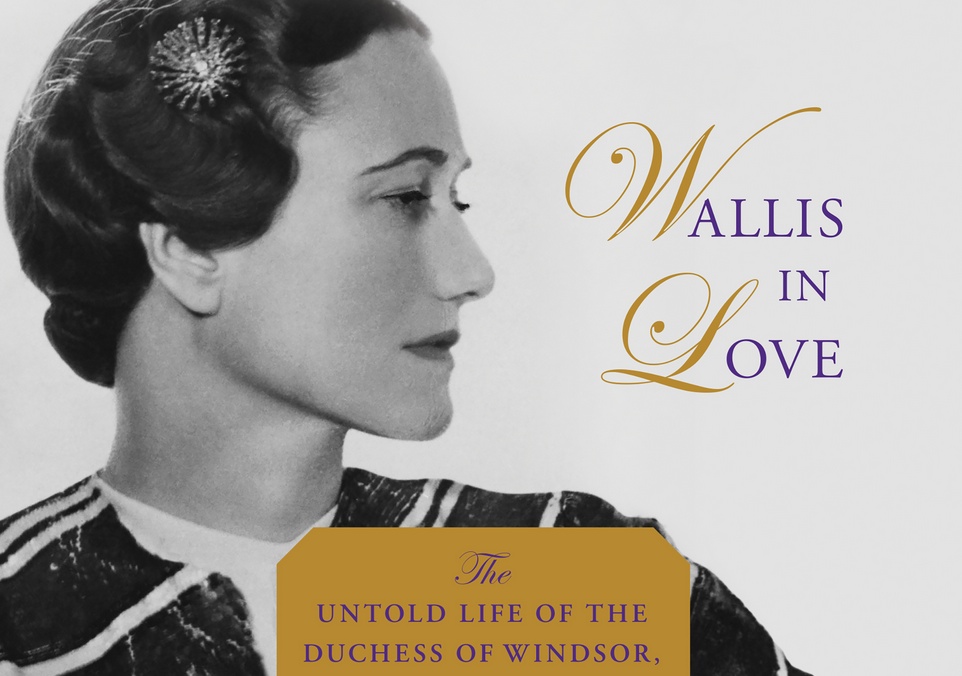
Wallis in Love

If you’re feeling sardonic, a frame of mind that veteran crowned-heads chronicler Andrew Morton’s Wallis in Love does a lot to encourage, it’s tempting to see Wallis Simpson as 1930s Britain’s tabloid equivalent of Lee Harvey Oswald. At a literal level, the comparison doesn’t hold water, since no British monarch has died by violence since Charles I’s beheading in 1649. But until the Baltimore-raised divorcée who ended her days as the duchess of Windsor came along, no British monarch had voluntarily quit the throne either.

As fans of The Crown already know, all Wallis had to do to end the brief reign of Edward VIII was to get him besotted with her. Because ardor wasn’t her thing, she never reciprocated, leaving her stuck for the rest of her life miming the charade of a “great romance” with a man she often privately treated with contempt. Yet her public performance was so convincing that you can’t help wondering how she might have fared if she’d turned actress for real. She might be remembered today as a great one, not the termagant most Britons never forgave for existing.

((EAN1}}Putting Prince Charles’s, Princess Diana’s, and Camilla Parker-Bowles’s later soap-opera hijinks in the shade, Edward’s decision to abdicate in 1936 for the sake of “the woman I love” was both a genuine national trauma and the climax of Britain’s worst constitutional crisis of the twentieth century. To her credit, Wallis realized the idea was cuckoo and tried to derail it, but that wasn’t widely known at the time. During the abdication drama, public hostility to her was intense enough that she even incited her own would-be Jack Ruby: an Australian who wrote letters threatening to find her in France — where she’d fled to wait out the hullaballoo — and “put a bullet in her.” For that matter, Australia itself threatened to leave the British Empire if Edward had the gall to try making her queen.

Then and later, rumors flew that she was a paid Nazi agent, or had seduced the king with the arcane sexual tricks she’d learned in a Chinese brothel, or was a hermaphrodite. (Why not all three?) Anticipating their American counterparts after That Day in Dallas, the Brits were seemingly ready to believe almost any explanation for their young, popular ruler’s abrupt vamoose — preferably, one that didn’t involve accepting that he’d fallen head-over-heels for a pushy Yank whose attractions were confined to a pair of piercing blue eyes and a minor talent for spiteful wit.

Coming closer to the mark, maybe, were the insiders who guessed that Edward had seized on marrying Wallis as a terrific excuse to get out of a job he hated. Aside from that scenario, Morton can’t explain what goaded him either, but Wallis in Love isn’t the kind of book you read for its psychological insights. You read it because the duke and duchess of Windsor were two of the weirdest gargoyles of their era and because their story is such a dotty combination of historical consequence and unspeakably charmless triviality.

Morton marches his readers briskly through Bessie Wallis Warfield’s shabby-genteel Baltimore upbringing. Its details read like a rejected draft of an Edith Wharton novel: The House of Mirth‘s gloom crossed with The Custom of the Country‘s satire, say. After her father died of tuberculosis during her infancy, she and her mother, Alice, were often dependent on relatives for their upkeep — and, no less important, their social status, such as it was. Wallis went to posh schools, but her clothes were often hand-sewn by Alice.

By late adolescence, her verve was attracting any number of would-be beaux. But you hardly get the impression that she was susceptible to romance for romance’s sake. From the start, attracting male attention was, quite relentlessly, her career: the only means available to her to move up in the world. By contrast, her sometime Baltimore neighbor, Gertrude Stein — whose novel Ida, about “publicity saints,” was partly based on Wallis — at least tried her hand at becoming a doctor, although Stein gets dragged into Wallis in Love, mostly because Morton likes hinting at lesbianism as his protagonist’s never-acknowledged Rosetta Stone.

Her first marriage, to naval aviator Earl Spencer, hit the skids quickly, thanks to his drinking and her apparent allergy to sex. (She later told a confidant that she’d never slept with either of her first two husbands, leaving us wondering whether that was also true of her third.) An affair with an Argentine diplomat in Washington, D.C., was her first “grand passion,” and also her entrée to international political elites. Once that ended, an attempted reconciliation with Spencer took Wallis on a long jaunt to China, where he was then stationed. Hence the bogus story about her Oriental-brothel sexual education, which was quite possibly inspired — though Morton doesn’t say so — by lurid 1930s movies like Josef von Sternberg’s Shanghai Express rather than anything Wallis actually did.

In reality, the lasting value of her “Lotus Year” was her introduction to American expat Herman Rogers, who stayed loyal to her for decades and functioned as her “de facto husband” in crises. Wallis called him “the only man I’ve ever loved,” and it typifies her astounding self-centeredness that she chose to tell this to Rogers’s second wife shortly after their wedding in 1950. In fact, his new bride had pushed for a speedy ceremony after his first wife’s death, fearing that Wallis — by then the duchess of Windsor — would toss the poor old duke aside like stale fish guts once her Herman was suddenly available.

After her return from China, she was back on the prowl, eventually divorcing Spencer to marry businessman Ernest Simpson: “to all intents and purposes,” Morton writes, “Herman Rogers Lite.” An Anglomane so inveterate that he’d given up U.S. citizenship to become a naturalized British subject, Simpson was Wallis’s ticket to London — a place she instantly loathed. “I’m sick of seeing old things,” she was soon complaining. “I want to see something young.”

In his mid-thirties by then, the prince of Wales just barely qualified. But Wallis soon got intrigued with his press coverage and promptly began scheming to insinuate herself into his social circle. Exactly what she was hoping would happen isn’t clear, but she presumably didn’t anticipate what did. Happy to dally with a series of mistresses, the heir to the throne had never indicated any interest in marriage, no doubt to the anxiety of His Majesty’s Government as the succession loomed. There may be no better proof of the adage to be careful what you wish for.

Carried on with her complaisant husband’s help, Wallis’s pursuit was well enough known to her family that she wrote “Mission accomplished” to an aunt once they finally met. But then he got smitten, phoning her constantly and sending her puppyish love letters. On her end, his thirty-eight-year-old paramour was enjoying herself: “I might as well finish up any youth that is left to me with a flourish,” she wrote, implying that a permanent union was the farthest thing from her mind. Once she realized he was serious about forging one, she tried to warn him off — predicting, quite accurately, “I am sure you and I would only create disaster together.”

Even so, the situation might have been resolved much more tranquilly if Edward had surrendered his right to the throne for Wallis’s sake before George V’s death turned him into Edward VIII. Making matters worse, the new king insisted on marrying her before his scheduled formal coronation the following spring. Morton’s fresh angle on the ensuing crisis is to tell the story exclusively from Wallis’s point of view. Stranded in France, barred from seeing Edward until her divorce from Simpson was final, she was unable to sway him in their frustrating long-distance phone conversations. When he called to tell her the die was cast, her reply was succinct and, once again, accurate: “You God-damned fool.”

Wed at long last in June 1937, the newly minted duke and duchess of Windsor didn’t need much time before their behavior made Edward VIII’s former subjects catch on that they might be better off without him. The couple’s ill-considered visit to Nazi Germany in 1937, including tea with Adolf Hitler and too many “Sieg Heil” salutes, was a blunder from which they never recovered, and the duke seems to have remained a more or less unrepentant Nazi sympathizer even after the war began. The Nazis themselves certainly thought so, plotting to kidnap him from his Riviera exile for propaganda purposes once Germany invaded France in 1940. Instead, Winston Churchill packed the pair off to Bermuda for the duration after appointing the duke its governor, largely to keep him — or them — safely offstage.

It was the last even semi-serious post the former king ever held. Afterward came decades of vacuous society life in Paris, Cannes, New York, and elsewhere until his death in 1972, followed by Wallis’s own a dozen years later. While the duke never quite came to despise her, she certainly came to despise him, sending him home early from nightclubs with an ungracious “Buzz off, mosquito.” Notoriety was all they had, and not much else bound them together except bitterness at the way they’d been treated.

Considering what she’d come up from, Wallis’s unmitigated self-pity was remarkable. At her worst, she was capable of saying that she couldn’t feel sorry for the British people’s sufferings during World War II after what they’d done to her. One ongoing source of resentment was the royal family’s refusal to let her call herself “Her Royal Highness,” although the duke was allowed the male equivalent. Beyond that, says Morton, their later lives were consumed by only “two issues: their image and their bank balance.” Despite the author’s occasional (and glib) speculations that Edward enjoyed playing the submissive to Wallis’s metaphorical — well, let’s hope — dominatrix, whatever submerged emotional or psychosexual complexities figured into the marriage stayed largely hidden by the two peculiar wax dolls that several generations of magazine readers grew wearily familiar with over the years.

In our time, both The Crown and The King’s Speech have turned the couple into fascinating reptiles, always good for a laugh whenever they intrude on the royal dullards. Morton knows better than to attempt the fool’s errand of trying to make Wallis sympathetic or even pleasant. Yet it seems charitable to think of her as thwarted. In a less gynophobic age, her brains, drive, and cunning could have been put to better use than seducing an idiot with an impressive title. She probably spoke her truest epitaph when a photographer asked her to smile during the abdication brouhaha: “Why smile?”

The post Wallis in Love appeared first on The Barnes & Noble Review.

The Barnes & Noble Review http://ift.tt/2EH2fph

Your Life, Your Rules – Why Happiness Shouldn’t Feel Like Hard Work

You’re reading Your Life, Your Rules – Why Happiness Shouldn’t Feel Like Hard Work, originally posted on Pick the Brain | Motivation and Self Improvement. If you’re enjoying this, please visit our site for more inspirational articles.

Fool Me Once, Shame On You

The biggest lie I was told growing up was that I had to work extremely hard to be happy and get what I want. That I needed to make sacrifices such as sleeping less to do more and minimizing my leisure time, sometimes doing things I didn’t want to do and ultimately following the rules I was given regardless of how I felt about them… because that’s just life, right? The dream had been disguised as a job that paid well with great benefits, that would ensure stability and security (even if I didn’t like it).

Do I Have a Say In This?

But whatever happened to how I feel? Did anyone ask me what I thought about this whole ordeal? Absolutely not. We are molded to think this is the only way but it’s not.

Reality Bites

What really made me challenge this mindset was seeing myself and those around me driving ourselves to the ground, working 50, 60, 70 hours a week. Dealing with ego’s in toxic environments that contradict our own being. Forcing it all for a paycheck that will “set us free” in the end. The illusion here is that there is an end. A happy ending at that. The truth is, if you are not happy now what makes you think that happiness is around the corner?

I’m not saying this is everyone’s case but I’ve lived it and I still know people living through it. This is very real. So real that some people think it is normal.

My Life, My Rules

But what is normal anyway? What really matters is how you feel and how you choose to live. Here’s what I’ve learned through reflecting over the past ten years of my life and the three rules I now choose to live by.

1. I need my sleep.
2. Don’t mess with my leisure time.
3. It has to feel good, it has to feel right.

And this is why…

1. Sleep Is Essential To Your Health and Well Being

Lack of sleep is strongly associated with depression and mental illness. It impacts our attention span and cognitive abilities which slows us down. On the flip side, getting a good nights sleep (7-9 hours) can help boost your energy levels, concentration and awareness. It is as essential as exercising and eating right. The point here is you can be more efficient and productive in 6 hours with proper rest, nutrition and exercise than 12 hours of hacking away restlessly at the same task. Think about it. Getting just as much done in half the time while most likely enjoying the process because you just feel better.

2. Leisure Time Is Necessary To Reset

Having a past time allows a positive flow of energy into our lives through recreational activities. Entertaining our interests when we are not working helps keep our work/life balance and mental stability. I believe we all need variety in our lives and an outlet to express ourselves through art or recreation. This is another key to happiness that many people skip out on because they just don’t have enough “time”. Nobody has time. We make time. Everything we ever do is because we made time for it. Remember that.

3. If It Doesn’t Feel Right, Don’t Do It

Doing things that don’t feel good is torture. It changes your mood and it effects those around you. There is so much resistance going against this current that it can have a domino effect in your life if you do it enough. Not to say there won’t be things in life that you have to do that you don’t want to do, but keep it to a minimum. And if you don’t like doing them, get someone else to do it. Or just don’t put yourself in situations like that again. Learn. The point is – you’re not feeling that way for no reason, something inside of you is telling you that something’s not right. Listen to that feeling. Do what feels right, do what feels good. Slowly but surely, you’ll get there one decision at a time.

The idea here is to follow your own rules. We all have our own values and way of living. Stay true to those, because that’s what makes you who you are. Once you begin to bend those rules and allow other to reshape them you lose the spirit of who you really are. No matter what job or business you are in – keep this at your core.

Coming Full Circle

These are the things I choose not to compromise, and these are my standards… my rules. You might resonate with some of them, you might not. You might have your own set of standards and that’s the point. Play by your own playbook and live on your own terms, not anyone else’s.

It is now easier to see how following the “societal norm” can lead to an unfavorable place. In the moment it’s hard to see the impact it’s having on you. However, over time you can look back and see it clearly. Don’t wait until it’s too late. If nothing changes, nothing changes. The power is in your hands, there’s always a choice, and the choice is yours. What rules will you live by?


Raised in New York where I spent most of my life. At the age of 33 I dropped everything, got in my car and drove to Austin, Texas where I now live. I have a passion for design, photography, writing and basically anything that inspires me to unleash my creativity. I am an entrepreneur with a design & marketing business, Little House Big Idea (lhbidea.com). My life philosophy revolves around being a good human, staying true to myself, being grateful and satisfied with what is, yet still being eager for more.

You’ve read Your Life, Your Rules – Why Happiness Shouldn’t Feel Like Hard Work, originally posted on Pick the Brain | Motivation and Self Improvement. If you’ve enjoyed this, please visit our site for more inspirational articles.

>

It is astonishing how much damage one can do if he’s followed by enough obeying idiots.

An arrogant rich and a humble poor both need help! The former needs help to be human; the latter needs help to live humanely! – Mehmet Murat ildan

All of the US presidents, ranked from tallest to shortest in one…

If guns make a society safer why is America that has 300 million guns not the safest place on earth?

The Truth About What Makes A Great Leader

Leaders are essential to any group or organization. They are the people that guide, control, and manage others so that they can be more productive and efficient in meeting their goals.

However, not all leaders are great ones. Some of them are just wearing the title and don’t live up to their position.

If you’re curious to know what makes a great leader, here are some points to highlight their traits.

“Good leaders tell you what to do while great leaders make you realize what needs to be done”.

great leader

Good leaders have ideas that can only alter what’s within their area while great leaders have ideas that can change the way things are done around the globe. The scale of their ideas is what sets apart greatness from merely being good.

Game-changers and out-of-the-box thinkers are great leaders because they have the power of changing the way people think. They can call their fellow people to action and steer them towards change. An organization that has great leaders with the right mindset will be able to continue growing and evolving.

A magnetic personality is what makes a great leader. Their passion and drive are visible in everything they do. Their shoulders aren’t slouched and there is a zeal that drives them to inspire the people close to them.

“Good leaders say. Great leaders show.”

great leader observation

Great leaders make people observe them. They know that people learn and adapt their behaviors through observation. So, they set examples of effective work culture, communication, and work ethics to influence everyone around them.

Great leaders believe in actions and in inspiring others. They believe that every person has an innate quality of greatness within them and they strive to bring that out.

A good leader will not improve you as a person as much as a great leader will. He can only tell you what should be done in your workplace but he rarely follows his own words.

Good leaders can make you feel good but great leaders can make you feel great about yourself. You will literally see yourself evolving into a better professional when you are under the guidance of a great leader.

“Good leaders cover their weaknesses while great ones work on them”

A good leader will try and cover his weaknesses with tons of excuses. He will make excuses so that he can avoid doing a job he’s weak at. This trait gets communicated to everyone, building a negative vibe.

A great leader, on the other hand, will realize his weaknesses and will try hard to overcome them, even if that involves learning from his subordinates. Great leaders, after all, have no ego when it comes to learning.

Their only goal is to make his employees and the organization better. Everything else is secondary to them.

Great leaders work so hard on their weaknesses to turn them around into their strengths.

See Also: The Importance Of Emotional Intelligence For A Leader

Good leaders aren’t motivators! They can show you the direction but they won’t fuel you up for the journey.

Great leaders will fill you with the thrill of embarking upon something new and will see to it that you stay motivated throughout.

Good leaders become bosses but great leaders become friends. A good leader will only remain your boss and will stay within his professional boundaries. A great leader befriends everyone in his team and doubles as a mentor to everyone.

The post The Truth About What Makes A Great Leader appeared first on Dumb Little Man.

http://ift.tt/2FeDPAp

Are you a bookworm? This is the awesome Shakespeare and Company bookstore located in Paris, France. You’ll get lost here…

Are you a bookworm This is the awesome Shakespeare and Company bookstore located in Paris, France. You'll get lost here...

How often have you said “no” and meant yes? How often have you said “no” only to regret it later? Rejection is in your head. @signordal

earth-1971580_960_720

How to Create a Web Page: 5 Questions to Guide Beginners

Building your own website isn’t that hard. With a lot of tools available online and a quick search on the internet, you’ll be able to set up a website for your business in no time.

Unfortunately, those aren’t the only things you’ll need to build a website successfully. As a beginner, you also need to master the basics.

Here are the most common questions beginners have regarding building websites.

Is it necessary to have the technical knowledge to create a personal web page?

This depends on the level of functionality that you want to give the page. The most complicated way would be to learn HTML and CSS, which are the foundation of any website on the Internet.

However, that is not the only way you can build a website.

Even without technical knowledge, you can create a good web page. If you are able to use Word or PowerPoint, you can use a web page creator.

How much do I need to set up my own website?

The cost of creating a website is not very high. In fact, it can be free if you do not want it to have premium functions.

You can start with $5 per month without advertising and with your own domain.

If what you are looking for is an advanced platform, you can take a look at some website builders. With them, you can do almost everything.

Now, if you want to set up your website with the help of a professional, take a look at Freelancer or Fiverr. You will get an idea of the market prices for your project. Check your budget before hiring someone.

fiverr
Via Techju

I have always been told that you can’t create professional web pages with web creators. Is that true?

With the first generation of Web creators, the design and functionality options are very limited. With the arrival of web 2.0 creation systems, this aspect has changed drastically.

There is a wide variety of web creators today and you can get one depending on your needs. You can have a blog on the page and even create a very professional online store with a system like Jimdo.

A web creator in the current Web 2.0 can make your life easier. It will give you the freedom to select the design and functionality that you want to have on the page.

Remember that each web page creator has its own style. Make sure to take a look at their template galleries.

Should I plan my website before I start working with the software tools?

That will depend on you. However, in general, a small planning is always a good thing.

Here are three tips you can follow:

  • Use a pen and paper to write everything you want the page to have. Brainstorming is a perfect way to organize thoughts.
  • Take a look at other interesting websites, both from a design and content point of view. Take notes of what you like about those pages and what you do not like.
  • Once you have a draft version of the page, ask trusted people to give their opinion about it. This can provide very valuable insights.

What elements do good websites have in common?

good website elements

Your logo and choice of images are keys to achieving a professional-looking page.

This makes it important that you understand the available image formats, like .gif, .jpg, and .png. You also need to have a program you can use to edit and change the size of your images.

Another tip is to use contact forms instead of email addresses on your website. Luckily, any quality web page creator can allow you to add a form with a simple click.

See Also: What Makes A Great Website? 10 Helpful Tips For Every Aspiring Entrepreneur

The post How to Create a Web Page: 5 Questions to Guide Beginners appeared first on Dumb Little Man.

http://ift.tt/2FfrMmt