How to Design School Restrooms for Increased Comfort, Safety and Gender-Inclusivity


Northwood Elementary School in the Mercer Island School District. Image © Benjamin Benschneider

Northwood Elementary School in the Mercer Island School District. Image © Benjamin Benschneider

This article was originally published by Metropolis Magazine as “Why Architects Must Rethink Restroom Design in Schools.”

“Gang style” bathrooms, in which rows of stalls are installed opposite rows of wash basins and designated only for males or for females, have been de rigueur in educational facilities for the last hundred years. They involve predictable plumbing, mechanical exhaust, and fixture costs. Short doors and divider walls allow for the passive monitoring of behavior.

Relinquishing this traditional bathroom model is daunting, since individual toilet rooms can significantly increase costs through additional plumbing, ductwork, ventilation, partitions, doors and hardware. These designs many times require additional space, trigger further ADA compliance, and invalidate some USGBC LEED points. Moreover, school districts typically have limited budgets, established facilities, and deep-rooted social practices.

Which is why the initiative shown by Grant High School in the Portland Public School District has been so extraordinary. In 2013, the school had 10 students who openly identified as transgender. To help combat the real possibility that they would drop out due to a perceived lack of safety, administrators designated four student bathrooms and two staff bathrooms—each individual rooms with a toilet, sink and mirror—as gender-inclusive. The bathrooms were immediately popular with all students at Grant HS, transgender or not, who enjoyed the privacy afforded by these enclosed facilities.

With a major renovation of the 1920s-era school on the horizon, the District realized that providing equitable toilet facilities for all 1700 students would be essential.

Architecture firm Mahlum’s design solution for Grant HS centered around replacing all existing “gang-style” bathrooms with individual toilet rooms with full doors opening to a shared space for wash basins and drinking fountains. Urinals will not be installed. Two entrance and exit points eliminate the feeling of going into a “dead-end” room, increasing safety and security. Signed with a simple pictorial representation of a toilet, not the ubiquitous “his” (pants), “hers” (skirt), or “their” (both), the toilet room is open for use by all. When the renovation is complete in 2019, Grant HS will become the first in the District—and one of the few in the nation—to house one hundred percent inclusive bathrooms.


Mahlum’s design solution for Grant High School in the Portland Public School District. Image courtesy of <a href='http://ift.tt/2eBfGtE;

Mahlum’s design solution for Grant High School in the Portland Public School District. Image courtesy of <a href='http://ift.tt/2eBfGtE;

For the new Northwood Elementary School in the Mercer Island School District, the same architectural team also abandoned gang style bathrooms, instead placing individual toilet rooms in many places on each floor. This solution boosts program flexibility and reduces time lost to toilet transitions. Since the District intends to keep the bathrooms unlocked and available to all students, the solution maximizes restroom equity, which is especially helpful for young students just learning to navigate social customs and keen to fit in with their peers.

Higher education institutions may more easily implement equitable bathroom designs because users are older, more diverse, and tend toward open-mindedness. For a new residence hall currently under construction at University of Oregon, Mahlum held student listening sessions, which revealed a strong desire for gender-inclusive living units with private bathrooms, as well as visibly inclusive public restrooms at the ground level and in common areas. However, residence facilities are still typically grouped by gender per floor or per community, and although suite-style bathrooms serving smaller clusters of students potentially mitigate gender-segregated restrooms, they can cost more. Like school districts, college and university administrators fear that enhanced design solutions will escalate costs, consume space, and drive up room rates.


Inclusive restroom design at the University of Oregon. Image courtesy of <a href='http://ift.tt/2eBfGtE;

Inclusive restroom design at the University of Oregon. Image courtesy of <a href='http://ift.tt/2eBfGtE;

The desire to create more equitable restroom design can also be stymied by building codes that have not yet caught up to changing opinions. Local jurisdictions have limited legal authority to enact code changes, so they usually have no other recourse but to uphold strict compliance. As society calls for more equitable bathroom design, the design and construction industry must demand large-scale code changes to allow “alternate paths” that comply with the intent of code and, moreover, serve the public good.

While the transgender movement may be currently illuminating the issue, toilet privacy affects a much broader group, including families with young children, adult caregivers, and people that are mobility-challenged or have health issues. Enhancing equity through privacy is a basic human right that primary, secondary and higher education institutions can uphold through thoughtful design solutions. By rethinking bathroom design in retrofits or new facilities, what was once an afterthought for architects can become a way to not just promote self-esteem, health and well-being, but improve safety and security.

As architects struggle with understanding what communities need and how to meet and overcome antiquated code regulations, we must quickly find a design vocabulary, inclusive of iconography and code guidelines, to reflect best practices. And most of all, we must place equity and human dignity at the center of these conversations.

JoAnn Hindmarsh Wilcox AIA LEED AP, Associate Principal is the Design Lead for the education studio at Mahlum. JoAnn crafts nationally recognized buildings that prioritize student learning and support student life, rooted in a multi-platform, collaborative engagement process.

Kurt Haapala AIA LEED AP, Partner, is an industry leader in the planning and design of student life and housing facilities, and has helped build Mahlum’s higher education housing studio into a nationally recognized practice.

http://ift.tt/2fcg6D0

Urban Angles Designs a Contemporary Home in Windsor, Australia

GTM Cenografia Uses Shipping Containers in Rio Olympic Pop-up Store for Nike

At the Rio 2016 Olympics, Studio GTM Cenografia developed a temporary installation for Nike. The space, inspired by containers and industrial sheds, occupies a total area of 600 square meters and was built in a metallic structure and wrapped in galvanized trapezoidal tiles. The cube used in the project is an installation from Brazilian artist and designer Muti Randolph, one of the pioneers of digital illustration in Brazil.

Our friends from ArchDaily Brasil talked with the architect Daltro Mendonça (GTM Cenografia) to find out more details on material choices and the execution of the project.


Courtesy of Nike

Courtesy of Nike

What were the main materials you used in the project?

Daltro Mendonça (DM): Metal beams, galvanized trapezoidal tiles, corrugated metal sheets, interior floors and surrounding structures out of wood, concrete pottery and vinyl plates.


Courtesy of Nike

Courtesy of Nike

What were your main sources of inspiration when choosing the materials used in the project?

DM: The customer’s desire to have a more industrial, clean feel, to make people think of the world of ports and shipping containers, we went for using a lot of metal, as a structure, in the finish or even furniture.


Courtesy of Nike

Courtesy of Nike

How did decisions related to materials influence the concept of the project?

DM: The details and finishings that we used because of the choice of material, ended up contributing to the desired design. For example, the choice to also use galvanized trapezoidal tiles in the interior of the space.


Courtesy of Nike

Courtesy of Nike

What advantages did the materials you used offer the construction of the project?

DM: Since we were looking at a project that was going to take almost 3 months to plan and work out all the details, 20 days to manufacture and another 15 days to put all together, the prefabrication and modulation that these materials offered were essential to be able to execute and complete the work within the initially determined time frame.


Courtesy of Nike

Courtesy of Nike

Did any of the project’s challenges involve the choice of these materials?

DM: No, just the opposite. They helped to achieve the necessary speed for this type of work.

Did you ever consider any other possible materials for the project?

DM: No, from the conception stage on, we had already decided on metal for the structures and the closures, which in addition to modulation and assembly, helped define the proposed aesthetic.


Courtesy of Nike

Courtesy of Nike

How did you research the right suppliers and builders for the materials used in the Nike project?

DM: We didn’t need to. Since they were simple, daily use materials, a research phase wasn’t necessary. We only needed structure samples and closures to define the finishings.

http://ift.tt/2gbCamu

Hotel Flottant / Seine Design


© Sergio Grazia

© Sergio Grazia


© Sergio Grazia


© Sergio Grazia


© Sergio Grazia


© Sergio Grazia

  • Prime Contractor (Architecture, Engineering And Interior Design): Seine Design
  • Developer: Christophe Gallineau (Citysurfing)
  • Main Investor: Novaxia
  • Exploitation: Elegancia Hotel
  • Interior Design Of 2 Suites And Lounge: Maurizio Galante and Tal Lancman (Interware)
  • Lightning Design: Franck Franjou 


© Sergio Grazia

© Sergio Grazia

From the architect. Volume and Integration. A piece of Paris on the Seine. The integration of OFF Paris Seine in its environment comes first by the very Parisian expression it proposes. The hotel merges with the city via its right and left banks and the twin hulls of the hotel itself, the river Seine that splits the city, its zinc roofs, and the multiplicity of its services. In many ways OFF Paris is like a floating fragment of the city itself.


© Sergio Grazia

© Sergio Grazia

Section

Section

An uncluttered and elegant design. OFF Paris Seine presents a simple and uncluttered architecture based on twin hulls strongly connected together, on which two levels of modules are superimposed. The floating facility adopts a discrete line since it respects the regulatory height of 6 m from the water line in order to preserve views on the river. Elegant zinc roofs open facades outward while a central glass roof lets natural light enter at the heart of the building.


© Sergio Grazia

© Sergio Grazia

Transparency. Despite its imposing size (75m x 18m), the OFF fits perfectly into its environment. If public areas’ facades celebrate volumes’ transparency and minimize screen effect, those dedicated to the hotel’s present a silver-woody coating that naturally mingle with the urban riverbanks background. The shutters, treated in discontinuity, give the facades some relief and vibration.


Model

Model

To preserve the Austerlitz Viaduct. The more we move towards the Austerlitz Viaduct (historical monument), the more spaces become public and transparent. The aft of the building is composed of a terrace built just above the water line, forming a balcony onto the river, and two marina pontoons allow smaller boats to moor alongside. From the swimming pool, the pool’s water line merges with the river, giving an unprecedented view on the Seine and surroundings.


© Sergio Grazia

© Sergio Grazia

Interior Design. Spatial treatment. On board, all spaces are directly and clearly identifiable by clients. The fluidity of circulation corroborates this dimension. Four gangways enable to organize entries, exits – for customers and suppliers – and give access to different floors and locations in the facility.


Section

Section

River experience. Crossed by the river as Paris is crossed by the Seine, the water is the building’s backbone. Everything has been thought to make the river experience as authentic as possible: the flexibility of the hulls’ articulation to maintain the natural rocking movement, the generous perspectives on the Seine it delivers, the hotel’s projection to 10 m from the riverbanks thanks to gangways, the first floor level designed just above the water line, the port’s integration at the aft. In the evening, the permanent relationship between the facility and the water is magnified by the lighting design work of Franck Franjou.


© Sergio Grazia

© Sergio Grazia

Style & Materials. The style is globally sober, far away from fads, giving to the building a certain timelessness. We choose noble and sustainable materials to do so: mostly wood, copper, leather, glass and zinc. The colors are mainly copper and hot.


Bedroom Plan

Bedroom Plan

© Sergio Grazia

© Sergio Grazia

http://ift.tt/2ftuYjA

Carola Vannini Architecture Designs an Elegant and Spacious Apartment in Rome, Italy

J Apartment by Carola Vannini Architecture (4)

J Apartment is a private home located in Rome, Italy. Completed in 2016, it was designed by Carola Vannini Architecture. J Apartment by Carola Vannini Architecture: “The essence of the space has been completely transformed by the project of this 120 square meters (1,292 square feet) apartment which was previously charcterized by narrow and dark rooms. The lighting design emphasises the main architectural elements, while giving depth and continuity to..

More…

After Belonging Agency On the Emergence of New Patterns of Living

In this film, presented in collaboration with +KOTE, the After Belonging Agency—Carlos Minguez Carrasco, Ignacio Galán, Alejandra Navarrese Llopis, Lluís Alexandre Casanovas Blanco, and Marina Otero Verzier—narrate a walkthrough of In Residence, one of the two core exhibitions at this year’s Oslo Architecture TriennaleAfter Belonging – A Triennale In Residence, On Residence, and the Ways We Stay in Transit.

After Belonging represents the sixth incarnation of the Triennale and the first in which a single curatorial thread has woven all of the festival’s activities together, including an international conferenceIn Residence incorporates a series of Intervention Strategies – platforms with the aim of “rehearsing research strategies” in order to provide new ways for architects to engage with “contemporary changing realities.” Here, according to the curators, “international architects and professionals concerned with the built environment have been invited to engage in local collaborations in Oslo, the Nordic region, and around the globe, to intervene in the transformation of residence.”


"In Residence" Exhibition (National Museum – Architecture, Oslo). Image Courtesy of Oslo Architecture Triennale

"In Residence" Exhibition (National Museum – Architecture, Oslo). Image Courtesy of Oslo Architecture Triennale

In a recent episode of Monocle 24’s Section D Hanna Dencik Petersson, Director of the Oslo Architecture Triennale, alongside members of the curatorial team—Alejandra Navarrete Llopis and Ignacio González Galán—discussed the wider implications of their theme. ArchDaily’s James Taylor-Foster weighed in on the Triennale’s significance. You can listen to the episode, here.

Monocle 24 Reports From the 2016 Oslo Architecture Triennale, After Belonging
//cdn.embedly.com/widgets/platform.js

Find out more about the After Belonging Agencyhere. This film is a collaborative production between ArchDaily, +KOTE (Keio Åstein and Dag Åstein), and the Oslo Architecture Triennale.

Atelier Bow-Wow, OMA, and Amale Andraos Live From the 2016 Oslo Architecture Triennale
//cdn.embedly.com/widgets/platform.js

http://ift.tt/2fUJLlF

Sporthalle Kepler- und Humboldt-Gymnasium / h4a Architekten


© Zooey Braun

© Zooey Braun


© Zooey Braun


© Zooey Braun


© Zooey Braun


© Zooey Braun

  • Architects: h4a Architekten
  • Location: Karl-Schefold-Straße 16, 89073 Ulm, Germany
  • Area: 3175.0 sqm
  • Project Year: 2015
  • Photographs: Zooey Braun
  • Owner: Stadt Ulm – Zentrales Gebäudemanagement

© Zooey Braun

© Zooey Braun

From the architect. Due to the prestigious integration into the urban planning, the sports hall forms a prelude or final point in the school campus. An important design criterion was the harmonic integration of the building into the neighborhood – according to the dimensions as well as the color interpretation inspired by the surrounding facade materials.


Section

Section

For that, the 18 m high cubic building is covered by a structure of brilliant white shiny aluminum fins in vertical order and slightly rotated. Particularly the 232 belts serve as sun protection for the rooms behind, but by the different light rotation of the fins also selectively directs the light into the inner space.
Depending on the usage, the facade appears from massive and closed to light and open. Focused insights in the gym area provide relations to the interior and make the building transparent. According to the perspective and the incidence of light, the facade appears from massive and closed to light an open. The permeability of the shell varies and the compactness of the building dissolves.


© Zooey Braun

© Zooey Braun

Three single gyms are “stacked“ about each other, whereby the undermost gym is lowered in the ground halfway, on the same level as the adjacent consisting gym. The three-story sports hall is accessible by a stairway sculpture in the overlapping airspace, guiding the athletes to the changing rooms and the gym areas in the upper floors. Galleries on the gyms’ half level enable the view from the airspace to the athletic hustle in the sports field.


© Zooey Braun

© Zooey Braun

Also the interior design is very spacious and robust. Clarity, openness, suitability and functionality mark this architecture. The used materials are modest, calm, cautious and of high quality – exposed concrete, white lacquered surfaces, wooden windows and wall panels. Color concepts for the interior and floor covering differ by storeys and support orientation.


© Zooey Braun

© Zooey Braun

http://ift.tt/2fthVi6

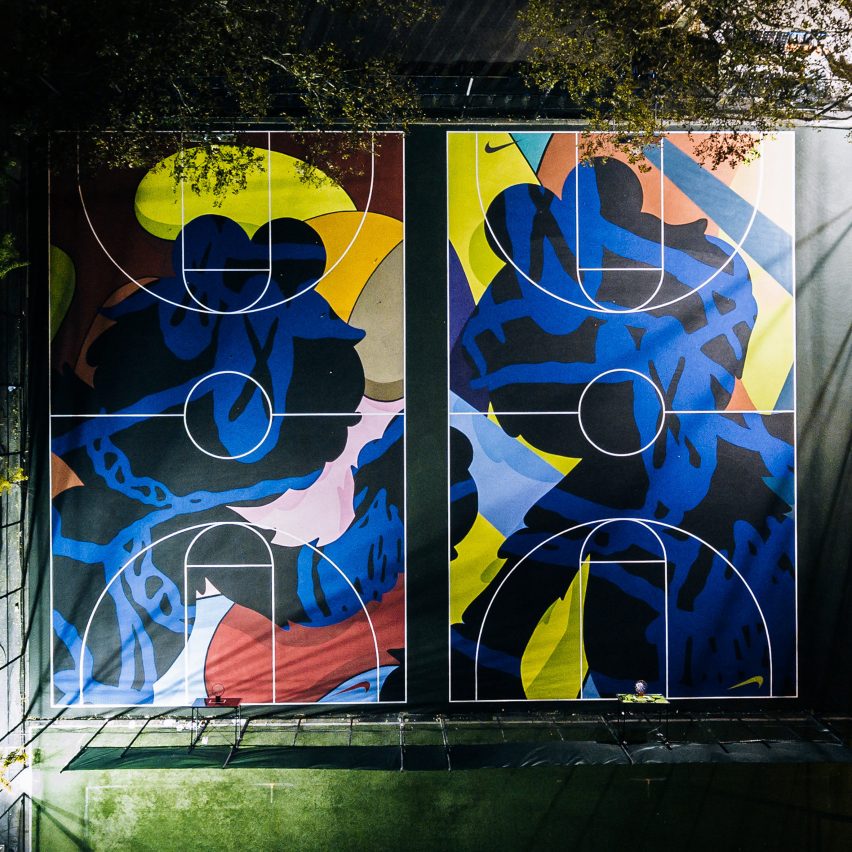
Kaws covers New York basketball courts in colourful murals

Stanton Street basketball courts by Kaws and Nike

Nike has enlisted Brooklyn-based artist Kaws to paint his signature motifs across two basketball courts in New York City. Read more

http://ift.tt/2eZCPV7

Sergey Makhno Designs a Family Home in Kiev, Ukraine

Eclectic Skyline Residence by Sergey Makhno (2)

Eclectic Skyline Residence is a residential project designed by Sergey Makhno. It is located in Kiev, Ukraine. Eclectic Skyline Residence by Sergey Makhno: “The interior history reminds of a melodrama. Eclecticism is sensual and emotional, based on the contrast transitions from white to black. Entering a living room, you realize the apartment is for a big family. A large table sprawled near the window. Hosts will have sunny breakfasts and..

More…

Fence House / mode:lina architekci


© Marcin Ratajczak

© Marcin Ratajczak
  • Architects: mode:lina architekci
  • Location: Borówiec, Poland
  • Architect In Charge: Paweł Garus, Jerzy Woźniak, Kinga Kin
  • Area: 290.0 sqm
  • Project Year: 2016
  • Photographs: Marcin Ratajczak

© Marcin Ratajczak

© Marcin Ratajczak


In Borówiec near Poznań, once again a house designed by mode:lina™  studio was built. Form of this house: two blocks with a sloping roof and an asymmetric garage cube, is a contemporary interpretation of the traditional style. It is complemented with simple, raw materials: bricks, concrete and sheet in shades of gray.


Floor Plan

Floor Plan

The street facade has the least windows, protecting the inhabitants from the noise and gives them peace. In addition, various kinds of fences give them the sense of security. That’s where the house got the name from: the Fence House.

The shape of this building was dictated by its function. Household members, parents and two children, wanted to live independently. Hence the idea of dividing it into two parts. Separate area on the first floor allows adults to enjoy tranquility while kids can go crazy in their “own house”.


© Marcin Ratajczak

© Marcin Ratajczak

Ground floor is a common part for all inhabitants. There’s the unique kitchen extended into the garden and a large living room with mezzanine, reaching the attic. An unusual feature is the window in the hallway, which exhibits the owner’s unique car inside a graphite garage cube.


© Marcin Ratajczak

© Marcin Ratajczak

Window openings allow you to look inside from one zone to the another. Huge glazing connects the kitchen and the dining area with the garden and the surrounding forest.


© Marcin Ratajczak

© Marcin Ratajczak

The living room is a large, open space, where the irregular window theme appears, exposing the natural exterior. The most interesting part of the room is a mezzanine with library, based on the large steel beams. Bookshelves were built with old oak beams, one of Poznan’s old townhouse.


© Marcin Ratajczak

© Marcin Ratajczak

By chance, the chosen parcel is adjacent to the already existing House On The Rocks.


© Marcin Ratajczak

© Marcin Ratajczak

http://ift.tt/2eVp0Uu