Want to know how BIG’s VIA 57 West was designed? Let Bjarke Ingels explain it you himself in this new 360 degree video from creative production house Squint/Opera.
Shot in incredible 4K video, the video uses motion graphics and CGI overlays to take you through the building’s construction while Ingels provides commentary on the design of the”courtscraper,” winner of the 2016 International Highrise Award.
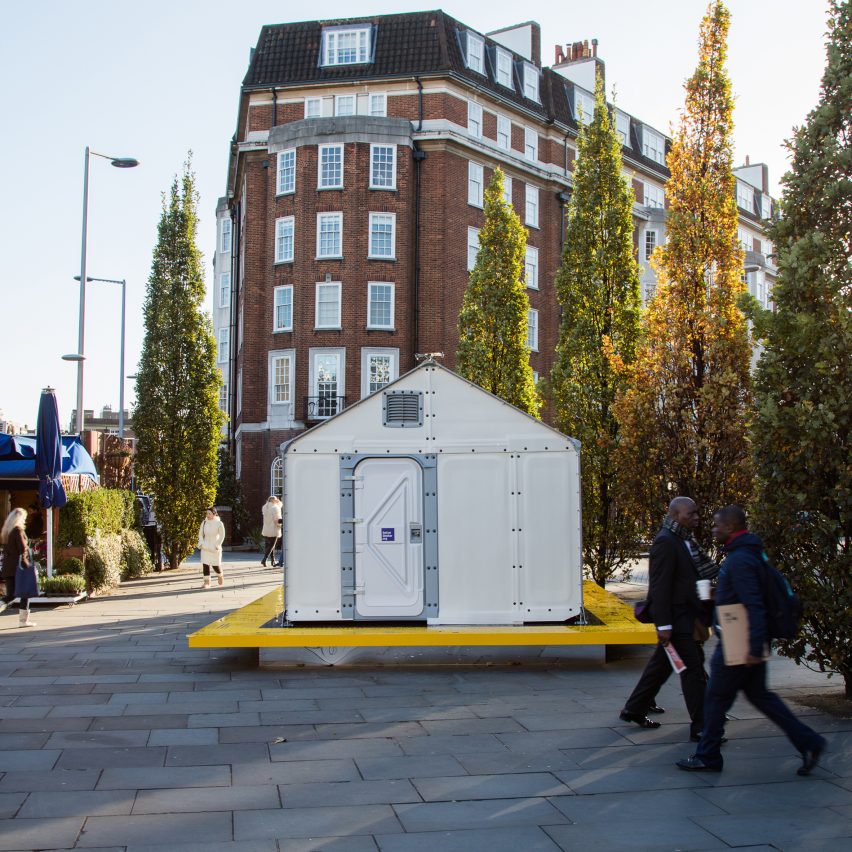
Ahead of its opening later this month, the Design Museum has installed one of IKEA‘s flat-pack refugee shelters outside a London tube station. Read more
The Cielo Mar residence is a collaboration project between NY-based firm Barnes Coy Architects, who created the original concept & design of the home, and SARCO Architects Costa Rica who performed the design development, final plans and construction management of the project.
The home is a three-story upside-down design, created on a bluff with a sharp slope at the end facing the ocean. The home appears from the road as a simple, one-story structure with a sloping and curving wall, and really hides the rest of the home dug into the hillside. The main level of the home is done in the middle level, where all social spaces, outdoor areas, master bedroom and pool are all located. In the lower level the home houses additional guest rooms, a gym and a media room.
The shape of the home was inspired on a bow-and-arrow idea, with a concentric shape housing the main social area, and some bedrooms on the opposite end, which represent the bow. The arrow is represented by an entrance canopy that continues outward as a cantilevered steel bridge over the swimming pool.
The bridge became the central element of the outdoor space, under which was created a space for outdoor dining, used by the family and guests throughout the year except when it rains. The bridge also provided the structure from which to attach retractable shading, created by the use of boat sails full with sailing hardware to retract the sails in and out. When furled up, the sails are neatly tucked away in their rollers attached to the underside of the bridge.
The exteriors of the home are modern, natural and muted at the same time, with accents of color in the exposed steel structural elements. Extensive deck areas are done in natural Ipé wood from Brazil, with the swimming pool was finished in volcanic stone. Exterior volumes are comprised of either glass curtain walls done in wood-framed window system, the kitchen & bar box clad in Porcelain tiles to replicate cor-ten steel, and the “Bento Box” at the other end clad in Ipé wood siding. All exterior railings are custom-fabrication 316 Stainless Steel with stainless braided wire for horizontals.
This home was a massive construction and engineering undertaking done by SARCO Architects in many aspects. The swimming pool, for example is of varying depth with 9ft. depth at the deepest end, and still this is elevated around 7ft. off the ground. The structural anchoring of the pool to prevent from failure during earthquakes included 3 massive 10X10X10ft reinforced concrete anchors dug into the rock hillside, with reinforced concrete beams attaching the anchors to the pool’s floor structure. The engineering ingenuity and safety measures were all in good measure, as in late 2012 the home went through a 7.6-Richter Scale earthquake whose epicenter was around 60 miles away from the home, with no damages.
The steel bridge was manufactured off-site in two sections and trucked to the site to be hoisted in place by two cranes and welded on site to the inverted-A steel support. The bridge cantilevers a total of 29ft from this point, aided by 1-inch thick solid stainless-steel bar tensioners to both sides of the support.
The entire home was fitted with first-generation LED lighting, design led by NY-based Gary Novasel at PATDO Light Studio. At the time this was the first full LED-equipped home in Costa Rica.
Visualizations of the last full-scale skyscrapers in Moscow’s new International Business Center (“Moscow City”) have been revealed. Designed by an international team made up of HOK (USA), FXFOWLE (USA) and SPEECH (Russia), the two “Neva Towers” will provide additional residential and office space to the skyscraper district, which includes many of Europe’s tallest structures, including Europe’s tallest building, Federation Tower (sometimes called Vostok Tower); and one of the world’s tallest twisting buildings, Evolution Tower.
Located on a triangular site in the northwest of Moscow City, the two rectangular towers rise from a 4-story podium, arranged to create an open plaza and green space surrounding the buildings that will be free from future development. The landscaped space will serve as the entry point to the towers, as well as to the aboveground and underground retail galleria and parking deck.
Courtesy of Renaissance Development
Program types will be split between the two skyscrapers – the taller of the two buildings will reach a height of 338 meters and will contain 77 floors of residential units, while the shorter tower will provide 63 floors broken up between office and apartment levels. In total, the project will add 1,210 new apartment units.
As they rise, the towers retain a classic form that gradually steps back to a fully glazed top tier to give the structure a visual lightness and provide the penthouse apartments with panoramic views of the city.
Courtesy of Renaissance Development
“The tower configuration is expressly laconic: the shape of the flat high-rise buildings is modified by slight shifts of the central parts forming a sort of a core of the towers, which is enveloped on both sides by three tiers tapering upwards,” explain development group Renaissance Development.
“The facades of both towers are decorated with pylons getting narrower from the bottom up. Such design imparts a special appeal to the structure, being both effectively up-to-date and recalling the legendary specimens of the 20th century high-rise construction.”
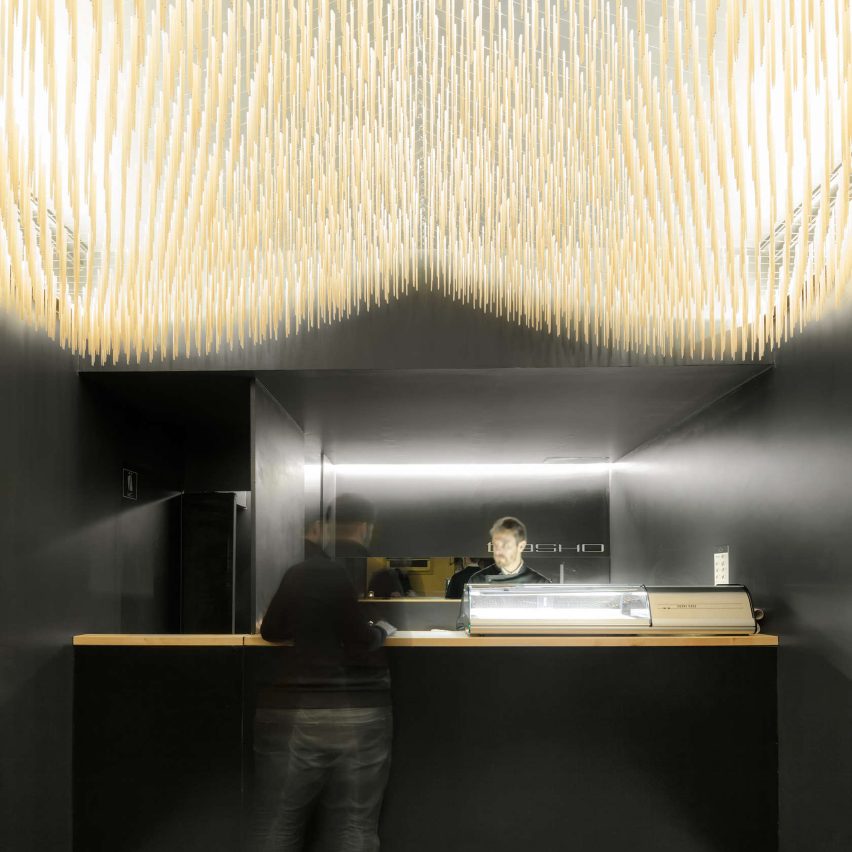
A+Awards: over 8,000 wooden chopsticks hang above diners at this “sober and simple” sushi bar in Portugal, which was designed by architect Paulo Merlini and lauded at this year’s Architizer A+Awards. Read more
From the architect. The house is located in one of the so characteristic Estoril neighborhoods that had their origin in a summer occupation and expanded along the edge of the so called Costa do Sol. It is an orthogonal grid, with dense articulation, narrow streets and small scale plots.
The house has a personal relation with the Client: it represents the journey of a lifetime of a family that has lived in several places around the world.
Model
This idea combined with the need to overcome the obstacle created by the blind wall of the neighbor building, resulted in an ascetic movement from the land that searches the light and views of the valley in the east and the sea to the south.
Section
This promenade around the patio runs through different moments of the house: the ground floor patio, the social area (living room, dining room and kitchen), private area (rooms and offices) and a terrace, including a roof top garden.
It is the extension of this route into the house that defines the entire inner and outer space. The patio result of this continued movement gallery ramp and are defined two distinct altimetric volumes separated from each other through half floor height.
From the architect. The main objectives of the house are two. Firstly; that it integrates the forest in the daily experience of the user and Secondly; that it receives as much light and sun as possible during the entire day. For that purposes the program is fit in a 2Y letters diagram that creates not only double orientations for entering sun at different times of the day but also exposes the inhabitant to views that surround him. In other words, the extremely extended perimeter of the house and it bifurcations, in opposition to a compact organization, potentiates the experience of been, not in front of the exteriority, but within it. More specifically, of been among the sun and the trees in a parietal relationship.
Regarding the materialization of the project, timber was chosen not only because it is a local material that could anchor the house to the place by affiliations with the natural and the cultural, but also because the wooden structures, in opposition with other kind of material ensembles, are naturally built using infinite linear elements that as a result, resemble the sense of infinity that is present in forests and could enter in a sort of vibration with the exterior. In this respect, the structural and the architectural plans were done simultaneously and in a permanent conversation. At the end it is hard to distinguish one from the other.
Whit regard to the relation with the ground, the above-mentioned 2Y diagram negotiates the slope in different manners. Sometimes it underlines and rests upon the ground and others it contrasts with the soil, stressing the artificiality of the architectonic body.
With respect to the exterior treatment of the skin, the objective was to create a constant vibration with the mostly green exterior that, as it is well known, can be achieved using a red colour.
The KulturRegion Stuttgart successfully wrapped its three-week Aufstiege (“Ascents”) Light Art Festival in October. Curated by Joachim Fleischer, the festival showcases work by over 40 artists from 10 countries. The 37 installations were available for viewing nightly from 8 p.m. to midnight across 25 cities near Stuttgart, and particularly popular exhibits have been extended.
For example, artist Karolina Halatek’s light sculpture Terminal will remain on display until November 21 in Gerlingen. Hatalek works at the intersection of visual, architectural, and sculptural objects, describing her art as an invitation for drama and reflection. Situated like a UFO in the Gerlingen’s town square, the installation emphasizes the duality between light’s powerful realness and its intangibility. Terminal is simultaneously separate from its site and open to it, setting a stage for interaction with its spectators.
Other extended works include Max Frey’s “In the River,” which can be viewed at the Eugenstaffel for the next ten years; “Vertex” by Susan Helenmiller, Martina Kändler, and Katharina Heubner, which will become a permanent addition to the Schlossbergplateau stairway; and “Runners 10” by Christine Camenisch and Johannes Vetsch, which will remain at the subway station for another year. The festival encourages people to explore the region, using light to highlight new paths and places for those who are unfamiliar. The installations aim to provide opportunities for people to discover and participate in their built environment.