From the architect. Living in the hustle and bustle of city, working hard day and night for life and career, when stop and look back, the blue sky, green grass, beautiful mountains and open fields of childhood still linger in people’s mind. So people are eager to get away from the multifarious city, and return back to the long-lost nature to freely breathe the fresh air. Mr. Zhang, the owner, grew up in the countryside thinks that both apartments and villas nowadays are too small in size. Story height of commercial housing is becoming lower and lower and makes people feel uncomfortable. The site of this project is very quiet, he loves this piece of land. Due to his longing for natural environment and original life, he has been wishing to own a paradise-like house in a valley far away from the city where he and his families could enjoy a quiet and leisurely life.
The site is located on a wild hillside surrounded by mountains and forests and facing the sea. Its geomorphic feature is unique and the surrounding environment is tranquil and peaceful. Built at the foot of the mountain and beside the forest, the hut hides in the valleys and retains and uses to the greatest degree the natural rocks and trees. This makes it blends well into the surrounding natural scenery. Though it is just inches away from the downtown, it brings people who live in it an experience of living secluded from the world, just as the verse puts: why I live far away from where others dwell? Because you hear no secular noise.
Site Plan
The design style of the interior space is simple, elegant and natural; it shows respect for nature and gives people a feeling of cutting off from the noisy city and returning back to real tranquility and peace. The plain wall is mainly made of natural materials such as bluestone, slate and solid wood etc. and without excess decoration. It reflects the essence of space and materials and presents a space where nature coexists with human. Through reasonable functional planning and use of simple lines and structures, and together with adopting simple and natural furniture as decoration in the space, a simple but cozy and warm living space is built.
Affected by factors such as construction conditions on the hillside, the special structures and construction period, etc., construction craft failed to reach the desired result and there are some flaws. Yet, on the whole, the completed hut reflects the life attitude pursued both by the owner and designer: return to nature, be humble, simple, unadorned and pure.
Floor Plan
The essence of design is to weaken design, which means that the designer should forget about the design and even return to a state of void. When the formal language of design recedes, the inherent concern in humanity for life in the universe becomes apparent. Humans, as intelligent beings, observe what is beyond matters and directly tug at human hearts. This is a type of life which is simple, humble, natural, unadorned, and pure.
Thus, it’s important to preserve and apply natural mountains, rocks and trees to the largest extent possible, so that accidentalness and inevitability will merge into one. Eminent Monk Da De say: “Live in the mountain, and you will attain the Buddha Fruit. Live in the city, and the city will turn into a hell.” By attaching thoughts to mountains and rocks and forgetting all mundane things, all mortal beings can become Buddha.
For the International Edition of the CEMEX Building Award 2016, 62 finalists from 20 different countries in North America, South America, Asia and Africa will compete in 5 main categories and and 4 special prize categories. The award, given by CEMEX— the Mexican multinational building materials company—recognizes the best architecture and construction projects that highlight innovation aesthetic and constructive uses of concrete.
The projects that are now set to compete at a global level range from a cultural center in Poland to a school and Spain and even a dam in the US. See this year’s finalists below and see the previous winners here.
RESIDENTIAL HOUSING
Los Samanes House / Arq. Carlos Campuzano Castelló Anapoima, Colombia
Los Samanes House / Arq. Carlos Campuzano Castelló. Anapoima, Colombia. Image Courtesy of CEMEX Building Award
Vistas a la Colina / Grupo Leumi San José, Costa Rica
Technical Institute for Training and Productivity / Departamento de Diseño e Infraestructura del Instituto Técnico de Capacitación y Productividad, Ing. David Lepe Cervantes Salamá, Guatemala
Alternative Routes El Quimbo Hydroelectric / Consorcio Obras Quimbo (CSS Constructores S.A., CASS Constructores &CIA S.C.A., Sonacol S.A.S.) Garzón, Colombia
Alternative Routes El Quimbo Hydroelectric / Consorcio Obras Quimbo (CSS Constructores S.A., CASS Constructores &CIA S.C.A., Sonacol S.A.S.). Garzón, Colombia. Image Courtesy of CEMEX Building Award
Bridge over Tárcoles River / Camacho & Mora Alajuela, Costa Rica
New Assiut Barrage & Hydro-power Plant. Assiut, Egypt
New Assiut Barrage & Hydro-power Plant. Assiut, Egypt. Image Courtesy of CEMEX Building Award
Dubai International Airport, Concourse D / Dar Al Handasah Dubai, UAE
Dubai International Airport, Concourse D / Dar Al Handasah. Dubai, UAE. Image Courtesy of CEMEX Building Award
Technical Institute for Training and Productivity / Departamento de Diseño e Infraestructura del Instituto Técnico de Capacitación y Productividad, Ing. David Lepe Cervantes
Comprehensive Renovation of the Streets in Colonial City / Arquitectura, Urbanismo y Cooperación S.L. Santo Domingo, República Dominicana
Comprehensive Renovation of the Streets in Colonial City / Arquitectura, Urbanismo y Cooperación S.L.. Santo Domingo, República Dominicana. Image Courtesy of CEMEX Building Award
Deca Homes Resort and Residences / 8990 Housing Development Corporation Davao, Filipinas
Deca Homes Resort and Residences / 8990 Housing Development Corporation Davao, Filipinas. Image Courtesy of CEMEX Building Award
Technical Institute for Training and Productivity / Departamento de Diseño e Infraestructura del Instituto Técnico de Capacitación y Productividad, Ing. David Lepe Cervantes Salamá, Guatemala
From the architect. This project is a renovation and extension to an old 1880’s Victorian brick house in an old suburb of Melbourne Australia. The new building at the rear of the house consists mainly of one large L shaped open plan kitchen, living and dining area with large glass doors across the rear verandah porch, as well as other utilitarian rooms.
Floor Plan
The predominant materials used are white bricks, which continue internally on the fireplace reflecting the outside within, as well as a cedar timber verandah and blackbutt hardwood floorboards. The external skillion roof forms dominate the internal spaces and include highlight windows in the voids, and are a nod to the varied mix of industrial and residential building forms and garages and outhouses in the immediate area.
The interiors are largely subdued and done in a simple natural white palette, set off with a plain grey concrete credenza, honey coloured timbers and a smoky grey tint mirror splashback. Suspended pendant concrete light fittings also add to the mix.
Section
The old front part of the house has also been renovated and upgraded throughout including new bathrooms and side windows. Some of the old fruit trees were retained and landscaped around with grass to suit the new backyard layout.
Product Description.The external bricks I used were Austral bricks from the La Paloma range in a white “Miro” colour principally to match the existing rendered brick house which is painted off white, and to keep the new work light and clean and to set it off against the green grass.
– Do you know who I’m presenting the conference with this afternoon? – Of course I do. Paulo, one of the best architects in Brazil. – For me, the best worldwide.
I heard by chance this conversation between Eduardo Souto de Moura, 2011 Pritzker Prize, and Joanna Helm, our Content Director from ArchDaily Brazil, in the gardens of Ibirapuera Park, as I waited to enter the auditorium for the activities of X Ibero-American Architecture and Urbanism Biennial (X BIAU). In that same afternoon, a small crowd occupied all the seats to watch and hear Souto de Moura and Paulo Mendes da Rocha sharing the stage.
Paulo Mendes da Rocha turns 88 today and 2016 has been what one can call an enviable year for him, at least in his professional life. This year alone, he was awarded three major international architecture prizes: the Golden Lion for Lifetime Achievement of La Biennale di Venezia, The Praemium Imperiale of the Japan Art Association, and the RIBA Gold Medal 2017. Besides that (as if it wasn’t enough), Paulo Mendes da Rocha has already been awarded the Lifetime Achievement Prize in the first Ibero-American Architecture and Urbanism Biennial in 1998, the Mies van der Rohe Award for Latin-American Architecture in 1999 (for his project for the Brazilian Sculpture Museum – MuBE) and 2000 (a retrofit project for the Pinacoteca de São Paulo), and, perhaps, the most important, the Pritzker Architecture Prize in 2006.
Although Paulo’s shelf of trophies and medals is beginning to run out of space, his daily life has seen little change. The same office, the same room, the same clothes even his humanistic ideas have not changed. In several interviews, that he has participated in the last few years we can clearly see his ideals of architecture and city. “Nonsense”, “absurd” and “aimlessness” are often the words related to the importance given to cars in the public space and submission of urban space to capital, unfortunate aspects of almost every contemporary city and specially aggressive in São Paulo, a city where we can find some of Mendes da Rocha’s most famous works.
Rambling at length in several interviews, Paulo is emphatic when he says “we know what we don’t want to do.” Sixty-two years on the road of architecture may be enough for him to be sure about what he does not want, or what he must avoid with his architecture. But, what does Paulo want, after all? Open to unpredictability and singularities of context, he does not respond accurately.
But he does give hints. Hints that can be found in the series of interviews, articles and news below on Paulo Mendes da Rocha, our Golden Lion.
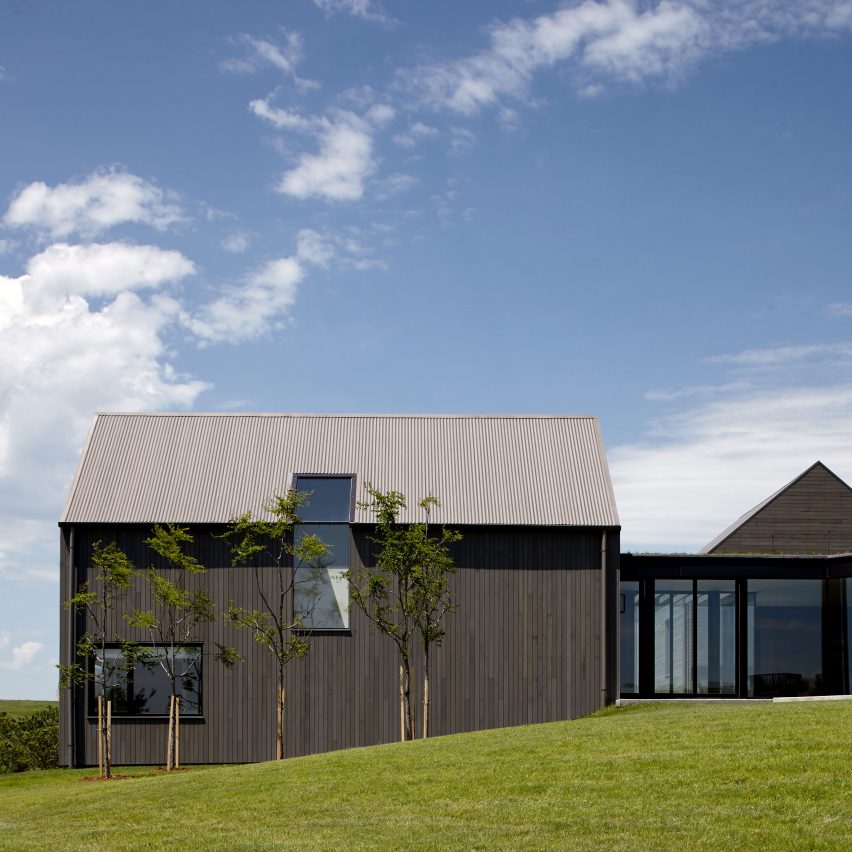
American studio El Dorado took cues from traditional farmhouses to design a rural dwelling composed of cedar-clad volumes topped with pitched metal roofs. Read more
The first stage of Columbia University’s new Manhattanville Campus, consisting of two buildings by Renzo Piano Building Workshop, is nearly complete, with a move-in and grand opening slated for spring 2017.
The Piano-designed Jerome L Greene Science Center and Lenfest Center for the Arts are the first two buildings to be completed within the larger campus masterplan, conceived by Piano in collaboration with SOM, that will eventually encompass nearly 19-acres between 125th and 133rd streets in northwestern Manhattan.
The 450,000-square-foot Science Center constitutes the single largest building ever constructed by Columbia University, and contains open-plan laboratory areas and interactive spaces, encircling a core of meeting and collaborative spaces. An abundance of natural light penetrates deep into the building via double-skin glass walls, which have been designed to eliminate noise from nearby subway and highway bridges.
“I’m suspicious about metaphors,” remarked Piano. “But if it is a palace, it is a palace of light.”
At ground level, a community wellness center, education lab, exhibition area, retail and restaurants will invite the public to use the building as well.
Next door, the 60,000-square-foot Lenfest Center for the Arts will provide flexible space for a variety of artistic interventions, including more 4,000 square feet of column-free exhibition space, a 150-seat theater for film and digital projection, an adaptable performance space for experimental productions and a 4,300-square-foot lecture and presentation space. The four main program elements feature double-height spaces, with support services and offices located on the mezzanine levels. Unique exterior “column-like structures” will distribute loads to the outside of the building, allowing interior spaces to remain open.
The 8-story building has been clad primarily in painted aluminum, with large expanses of double-height windows strategically located to provide performance areas with targeted natural light. The ground floor, however, has been fitted with a completely transparent custom-glazed curtain wall to promote a connection to the campus and provide views to activities within.
The next phase of the campus masterplan consists of a third building by Renzo Piano Building Workshop, the 56,000-square-foot University Forum and Academic Conference Center, which is currently under construction and expected to be completed by 2018. Soon to begin construction is the a new home for the Columbia Business School, designed by Diller Scofidio+Renfro in collaboration with FXFowle around a one-acre publicly accessible green space.
Future phases will include the adaptive reuse of several former industrial buildings including an auto finishing plant for Studebaker Motors and a Sheffield Farms dairy facility. All buildings on the campus will eventually be connected through an underground system leading to a 75,000-square-foot energy plant, which will provide all buildings with electricity, chilled water and high-pressure steam.
“Underground, there is continuity among the various buildings,” said Piano, “but above ground the buildings belong to both the campus and the city.”
From the architect. AlexAllen studio’s recent renovation of a house located in New Paltz, New York, is a practice in simplicity, efficiency, and low maintenance. Originally designed by John Bloodgood in the 70’s, the single-family residence was clad in T-111 siding without insulation and in desperate need of an exterior renovation, a new roof and a mechanical systems overhaul. Adding to this challenge, the client had requested to use materials that would require little to no future maintenance.
For this reason, AlexAllen Studio selected Shou-Sugi Ban wood as the visual focal point of the exterior. This ancient Japanese technique of preserving wood by charring its surface, is highly resistant to the elements, attractively weathers over time and requires almost no maintenance. Fiber cement paneling was also chosen for its weather resistance, sustainability and its cost-effectiveness. The new exterior reflects the interior spaces with the Shou-Sugi Ban highlighting the House’s main double-height living space. A reveal running around the House divides the wider cement panels at the base from the narrower cement panels above and also marks the House’s the second level.
Ground Floor Plan
2nd Floor Plan
AlexAllen Studio stripped the exterior and windows down to the studs in order to fully insulate, replaced the windows with triple glazed windows and installed a new mini split system to replace the old electric baseboard heaters. The new siding acts as a rain screen and added sun screens further protect the House from the elements.
The result is an aesthetic and performative upgrade that would require little to no future maintenance while retaining the integrity of the existing floor plan and interior spaces.