This article was originally published in Redshift and is republished here with permission.
In 2001, the Taliban destroyed the Buddhas of Bamiyan in central Afghanistan using dynamite, anti-aircraft guns, and artillery. After weeks of incremental destruction, nothing of the statues remained.
That sad turn of events was the impetus for the founding of CyArk, a nonprofit that uses technology to ensure sites of rich cultural heritage remain available to future generations. Since 2003, they have used laser scanning, photography, photogrammetry, and 3D capture to record nearly 200 sites around the globe.
A laser scan of Al-Madrasa al-Jaqmaqiyah (currently serving as the Museum of Arabic Epigraphy) in Damascus, Syria. Courtesy DGAM/CyArk. Image via Redshift
“With no real three-dimensional or engineering-type record of those structures in Afghanistan, they are just gone,” says Elizabeth Lee, managing director of CyArk. “So we started to go out and capture this information for monuments around the world, so that if anything happens to the physical monuments, we have that record available for future reconstruction efforts.”
Unfortunately, CyArk cannot just focus on capturing sites before the ravages of time, the environment, or natural events erase them from the landscape. Now groups like ISIS have put sites in Syria at the top of CyArk’s priority list, as they try to digitally preserve cultural landmarks that may not exist much longer.
“It certainly increases the urgency and adds a clarity of purpose,” Lee says. “We’ve seen a huge increase in intentional destruction. We were founded in response to a singular intentional destruction, but what we’ve seen over the last 18 months, in terms of specifically targeting these sites, really brings into focus what we’re trying to do and why it is so important to have this information captured.”
And it’s not just about the loss of the historical structures themselves. “That building or that piece of art is something that previous generations left behind as a way of communicating their experience and their worldviews, and when we lose that object, we lose that line of communication to people in the past,” Lee says. “That’s why I think the work that we’re doing right now, and mobilizing these teams in conflict areas, is more urgent than ever because we are losing [sites] at an increased rate.”
Reality-capture training at the Sursock Museum in Beirut, Lebanon. Courtesy CyArk/UNESCO. Image via Redshift
Capturing Sites Within Syria. Initially, CyArk trained Syrian teams in Beirut, Lebanon, to get them familiar with using the technology (including FARO scanners and Autodesk AutoCAD and Recap 360 Pro software) necessary to capture a site.
“It’s a safer region to work in,” says Ross Davison, field manager for CyArk. “It allows them to get better at the entire process and make it quicker, so that when we are going to higher-risk areas, places where you do see active conflict, they can be very efficient in the way they do go about the work.”
Following the training, the teams returned to Damascus, Syria, to start the work. The time it takes to document a site depends on its size and the resolution at which you capture it, with most sites ranging anywhere from one to three days, and larger sites up to two weeks. The upside of the technology is that sites in high-conflict areas can be documented almost without notice.
Reality-capture training at the Sursock Museum in Beirut, Lebanon. Courtesy CyArk/UNESCO. Image via Redshift
“You can send a really small task force, and the technology has come so far at this point that if you deploy two people—one with a camera, one with a scanner—you can get an entire site documented almost unnoticed in a couple days,” Davison says.
Geghard Monastery in Goght, Armenia. Courtesy CyArk/TUMO. Image via Redshift
The risk level at these sites prevents CyArk from using nonhuman technology such as drones to capture the data, since it would draw too much attention to the work they are doing. “They’re loud, noticeable, and easy to track back to their source,” Davison says.
Reality-capture training at Geghard Monastery in Goght, Armenia. Courtesy CyArk/TUMO. Image via Redshift
Racing Against Time. CyArk also spends a lot of time working with local culture-heritage professionals, architects, archaeologists, and surveyors—so they are not only capturing the site, but also empowering people who live in the region with the tools to preserve their history.
“A lot of times organizations will go abroad to work on a project, but once it’s done, all of the information and technology involved with it leaves the country,” Davison says. “If you don’t have the infrastructure or the people in place who actually know how to employ it, it’s not going be a sustainable program.”
As a nonprofit, the other thing CyArk needs to sustain is the financial means necessary to capture as many sites as possible.
“There is endless demand in terms of need to do this work,” Lee said. “The training that Ross did with 5 Syrians tripled into 15 Syrians in a couple of months, and they’re so hungry for this technology and willing to go into these zones that are heavily conflicted because the preservation of their culture and history is so important to them. So it is this race against time.”
Reality-capture training at Geghard Monastery in Goght, Armenia. Courtesy CyArk/TUMO. Image via Redshift
A Moment of Awe. But even when time is precious, these antiquities and what they represent are sometimes too powerful not to stop and take it all in. One time, Davison was leading a training effort in Armenia, teaching a few dozen people to capture a monastery, when the gravity of his surroundings truly hit him.
“We were working on a monastery that was actually carved out of rock, but for the first hour, I was getting a group of high school kids in line and showing them all this stuff,” Davison says. “I was talking about exposures because the inside of the monastery is quite dark, and I was looking around, stopped for a moment and was like, ‘Oh my God, this is incredible.’ It took a hot second, and then I was like, ‘Oh yeah, exposures!’ You really do find yourself being shocked at how amazing these places are every time you go out.”
Reality-capture training at Geghard Monastery in Goght, Armenia. Courtesy CyArk/TUMO. Image via Redshift
Lee says the feedback they received about their work, as well as the selection of potential target sites, tell the same story: “These sites hold meaning,” she says. “They’re really powerful symbols of culture and history, and for people who want to rewrite history, the elimination of some of these things is critical to their message. Having this record is so important because it’s a counter to that hate and that rewriting of the narrative.”
Reality-capture training at Geghard Monastery in Goght, Armenia. Courtesy CyArk/TUMO. Image via Redshift
British designer Aitor Throup has been announced as G-Star Raw‘s new creative director, following three years as a creative consultant to the brand. Read more
Dezeen promotion: Italian brand Pedrali presents office furniture designed to create more effective open-plan workplaces at this year’s Orgatec trade show in Cologne. Read more
J House is a private home located in Herzliya Pituah, Hertsliya, Israel. Completed in 2015, it was designed by Pitsou Kedem Architects. J House by Pitsou Kedem Architects: “The story of the J House originates from its surroundings. The view from the street to the entrance reveals a resolute stone path, a sidewalk, asphalt and an outdoor wall, all forming one complete composition. After a moment, tension is created by..
From the architect. This is a dynamic garden house which I built at my parental house. The house can be easily adjusted to any weather type, mood or occasion. It is mainly built in Douglas wood.
Background: My mother was looking for a prefab garden house. When she told me about this I suggested that I would design and build the house for her. She was immediately enthusiastic about the idea and provided me the next day with an endless wish list of what the house should be like. All within the 20.000 euro budget and the governmental restriction of a 25m2 footprint.
Just a short version of my mother’s wish list: A place where she can write her book, a place where she can give a large dinner (25-30 people) in the middle of nature, a place where she can give parties, a BBQ place for friends and family-days, an extra sleeping place for guests, place where she can feel away from home in her own garden, a ‘camping’ spot, an outdoor/nature experience, a place where she can sun and chill out next to the pond, a place where her grand children can play and sleep over, a stage where (grand) children can perform (music, theatre) for audience (she loves theatre), a special place, a terrace with windscreen to enjoy early spring sun, a place where she can sleep under the stars any time, a place where she can paint and adjust the light the way she wants to, a place where she can listen to music in nature, bird watching, a place where inside and outside become one (she usually opens up all doors and windows in the house even when temperatures are below 10 degrees Celsius), meditation place, a fun object, a story-telling place, mediation place (she is a therapist), a philosophizing place, game playing, tea house, a place where she can work.
Well, my mother is a very special kind of person, believe me. She is also a very pure person. She wants the pure experience, no fake, no half work. She loves to experiment and is very much attracted to the unconventional. So I was looking for a design with a lot of flexibility, if possible; a design that has the flexibility of clothes. You should be able to get away with and change layers of the house almost as easily as changing clothes when desired. The house should allow for the freedom to adjust it to any wish and weather type at any moment.
The house is completely closed, providing a warm and cosy shelter when weather is rainy, windy, cold or stormy. An excellent place to philosophize at the fire place, play games, write, story telling etc.
Scheme
Top right: When the weather is a little warmer and sunnier; the wood protective shell can be slide open to enjoy maximum light and experience nature to the fullest – still being protected from rain and wind. Imagine waking up, sliding the shell away and going back to bed; enjoying the slowly rising sun. Furthermore, this mode allows for adjustable natural light for all types of activities. The doors at the left and right face of the house (East and West) can be opened up for a cool breeze if necessary.
In case the weather gets real good and sunny, the glass shell can also slide open which creates an outdoor living space. Bed, fireplace and furniture are instantly in the middle of nature. Think of how you can sleep under the stars, go sunbathing (with windscreen), give a BBQ party, or just relax and enjoy your freedom while being perfectly comfortable.
Bottom right: This mode is the party dinner mode. By sliding the glass shells out; a 45m2 indoor space is created. This provides enough space for a ten meter long table and at least 30 guests.
Elia is a holiday home located on Mykonos, Greece. It was designed by React Architects. Elia by React Architects: “On the south side of the island of Mykonos is the holiday home that we designed and renovate.The colors and forms are combined appropriately simplifying the volumes of the house, similar operations were performed outside in order to unify the exterior spaces using stone elements and materials that strengthen this logic…
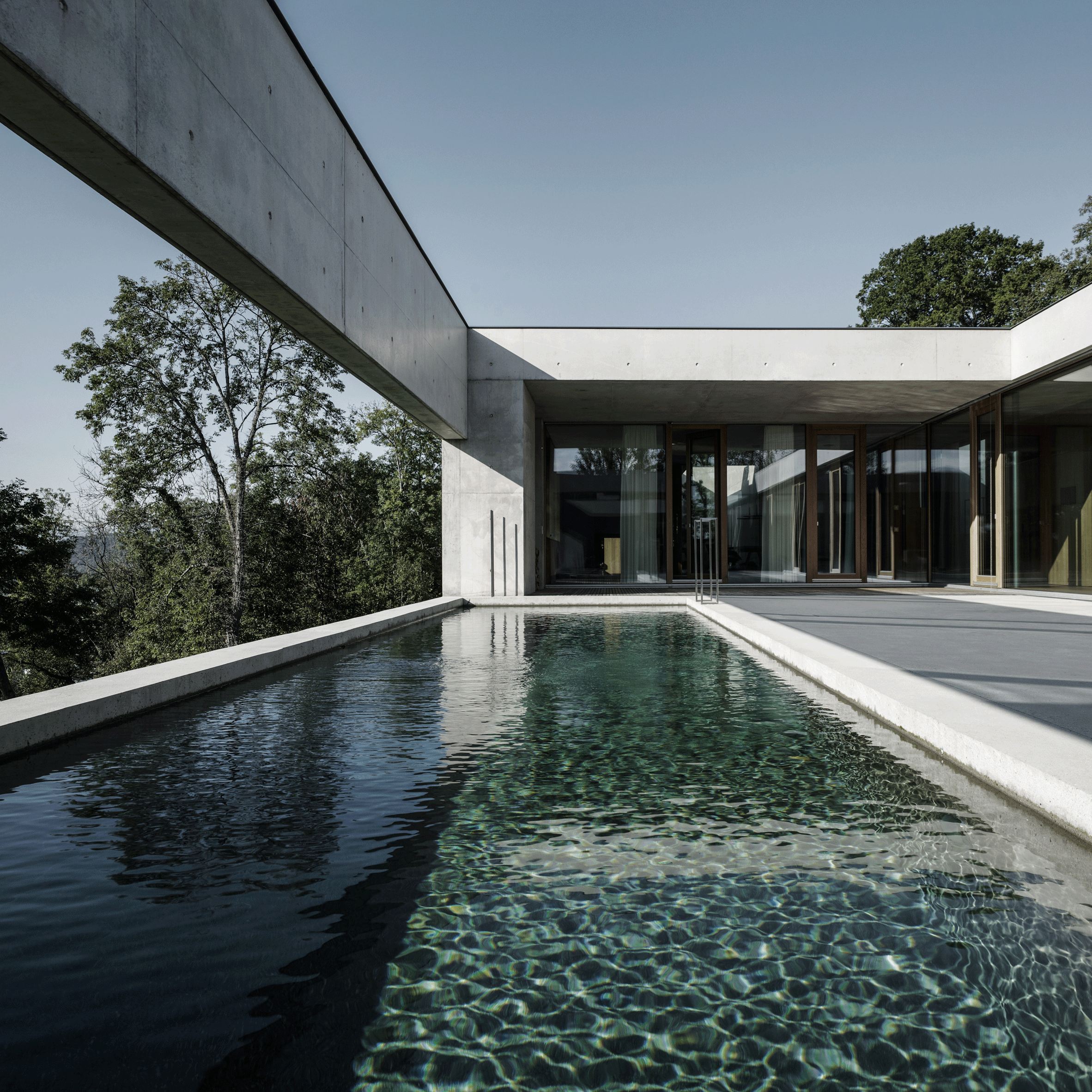
A slender swimming pool runs along one side of this concrete house in western Austria by Marte.Marte Architects, and offers bathers views towards the Rhine Valley. Read more
What can only be described as the ultimate “man cave”, Inhouse Brand Architects has converted the unused lounge area of a Cape Town residence into an industrial-inspired dream pad for the family’s lucky teenage boy and his friends.
Taking into account the youngster’s various interests such as skating, surfing and socialising, the Inhouse team aimed to create a trendy, multifunctional space. The project was steered by Creative Director Aidan Hart, and Associate Director Jenine Bruce, who chose a modern industrial aesthetic for this youthful interior.
Polished concrete flooring encompasses the entire room and sets the foundation for the interior scheme. More notably, a fully functional concrete skate bowl plays a major part in the design.
This impressive structure was no easy feat. Initially, the bowl was supposed to be built in a stepped down recess, but after realizing that the structure would be too unstable to support the weight of the framework, Inhouse had to come up with an alternative solution.
During a six-week process, a revised plan was put into action. An entire floor level was removed; timber fins were crafted in the newfound space to create the frame; flexible plywood and polystyrene were incorporated to shape the backing; sand and rubble were used to fill the level that was taken out; and finally, cement was poured into the structure to solidify the bowl shape.
Plan
Although the process took longer than initially planned, the end result is a deeper and more functional skate bowl – one that will most certainly keep the teen and his friends entertained for hours!
To embellish this remarkable feature, emerging South African street artist, Jack Fox, applied his signature illustrations to the walls surrounding the bowl. The celebrated artist worked without a set design and completed the impromptu artwork in a twelve-hour, non-stop operation.
Another striking design feature comes in the form of a grandiose, curved timber wave that cascades from the ceiling down to the floor to create an extraordinary zone for watching movies. This “wave” is crafted out of steel fins that are clad with timber and lit up with three LED strips. It is kitted out with surround sound to produce a genuine movie theatre experience.
The bar area comes equipped with a stylish black Smeg fridge and cleverly positioned surfboard rack, which is not only a functional feature but also displays the seventeen-year-old’s most prized possession. The bar itself, which measures four and a half metres, is fashioned from ground and polished concrete, perfectly matching the flooring. Clad with timber, the bar exudes a robust masculinity.
Next to the bar and adjacent the timber wave is comfortable booth seating. Framed with timber and upholstered in inviting shades of indigo, this nook provides an enticing ‘chill’ spot.
Industrial track lighting is installed throughout the space. Soft LEDs are embedded overhead in both the booth seating area and the timber wave, to create ambient lighting. Lastly, steel cage pendant lights are suspended over the bar and contribute to the room’s urban-like aesthetic.
Product Description.The skate-bowl, bar and flooring are all constructed from concrete, making it the principal material used throughout the space. The ample use of concrete allowed Inhouse to convey an industrial aesthetic that relates to the urban “man cave” interior scheme. Florstore on Trend provided the polished concrete flooring, which set the foundation for the overall look and feel of the room.
Cyprian Apartment is a residential project designed by Stamatova Kalina. It is located in Sofia, Mladost, Bulgaria. Cyprian Apartment by Stamatova Kalina: “Project Cyprian is implemented in Panorama building by Arteks engineering, situated in one of the most preferred residential area in Sofia – Mladost. The luxury surrounding presupposed modern and chick interior design, so Arch. Kalina Stamatova turns out to be the most suitable professional for the task. A..