Architecture

Apple Regent Street / Foster + Partners

© Nigel Young
- Architects: Foster + Partners
- Location: London, United Kingdom
- Project Year: 2016
- Photographs: Nigel Young
© Nigel Young
From the architect. The re-imagining of Apple Regent Street in London marks the continuing evolution of Apple, going beyond retail to create richer, more dynamic experiences for visitors. Its innovative design creates a relaxed environment, while incorporating Apple’s new features and services. The design is the result of a close collaboration between Apple’s teams led by Jonathan Ive, chief design officer and Angela Ahrendts, senior vice president of Retail and Foster + Partners.
© Nigel Young
Regent Street is one of the most famous shopping streets in the world, and the site where Apple opened its first retail store in Europe in 2004. The new store occupies the same building, with the Grade II listed historic façade now restored and preserved. Built in 1898, the building was the studio of Victorian mosaicist Antonio Salviati of Venice, who was responsible for the exquisite mosaics at the Albert Memorial Chapel in Windsor and St Paul’s Cathedral in London.
Ground Floor
Stefan Behling, Architect at Foster + Partners said, “The new Apple Regent Street is about a respectful dialogue between old and new – carrying forward a heritage of craftsmanship in a contemporary way. Contained within its historic fabric, is a new grand ‘town square’ with trees that bring nature into the interior spaces. Everything from the vast luminous ceiling to the sculptural stone handrails create an experience that is warm and inviting, providing a calm backdrop for everyone to experience Apple’s incredible products, in addition to a diverse and vibrant programme of events. It is a place for people to meet and collaborate, and most of all, it will be an exciting experience that goes beyond retail.”
© Nigel Young
Characteristic of the new Apple Flagships, the interior space is a 7.2-metre double-height grand hall – forming a ‘town square’ like space that is flexible and welcoming. The design enhances transparency from the street and floods the store with natural light, dramatically improving the visual connection between the two levels. The interior front facade, with its full height arches clad in Portland stone, can be appreciated in its full extent. The store also features the longest Luminous Ceiling Panels in the world that cover the entire ceiling. The custom-made lighting panels emit a pure, even, white light, and have the capability to absorb ambient noise.
Section
Using a warm palette of materials including stone, wood and terrazzo that is sympathetic to the historic nature of the building, the store has a calm setting, with the increased height allowing for the addition of twelve Ficus Ali trees on the ground level, bringing nature to the interior spaces. The grove of trees have planters – designed by Apple’s ID Studio and Foster + Partners – that double as a comfortable place to sit and rest. The signature Apple display tables are set against the backdrop of the new Avenue – the completely redesigned wall display that allows people to touch, feel and try out the Apple products and accessories in an engaging and hands-on way. Located in the middle of the space, The Forum is a new learning environment, where experts from various fields can come to entertain, inspire and teach. It occupies a prime position in the store with a vast video wall that acts as an animated backdrop for the entire store.
© Nigel Young
Along the side walls, a staircase on either side of the screen draws one up to the new mezzanine level set amongst the treetops. The walls and staircases are made from sandblasted stone, while the balustrade – seemingly carved in to the wall – has a smooth, curved, and honed finish that is pleasant to touch. The stone walls and balustrade were created by a combination of handcraftsmanship and CNC robotics, and were dry assembled at the manufacturing site to make sure each piece fit perfectly before installation.
© Nigel Young
Overlooking the grand hall, the mezzanine hosts the Apple’s Geniuses, where visitors can get assistance to setup their device or answers any product related queries, and the Boardroom – a place for meetings, conversations and partnerships that can be used by app developers, digital entrepreneurs and other small start-ups to become part of the Apple family.
Photo Set by Paul Clemence Captures the Intriguing Details of Herzog & de Meuron’s 56 Leonard St.

© Paul Clemence
Photographer Paul Clemence of ARCHI-PHOTO has shared images of 56 Leonard Street by Herzog & de Meuron. Nearing completion, the 60-story residential tower will be the tallest structure in Tribeca when it opens later this year. The concept of 56 Leonard Street is to disrupt the monotony of typical high-rise city buildings with a more varied articulation achieved by stacking recognizable individual houses. Shifted floor slabs create differentiated corners, cantilever, and balcony conditions that provide apartments with their own unique characters. Developed from the inside out, the pixelated rooms are arranged such that the base of the tower reacts to the street conditions and ripples upward to merge with the sky.
Read on for the full photo set.
© Paul Clemence
© Paul Clemence
© Paul Clemence
© Paul Clemence
© Paul Clemence
© Paul Clemence
© Paul Clemence
Diamond-shaped latticework covers Victoria Gate shopping centre by Acme
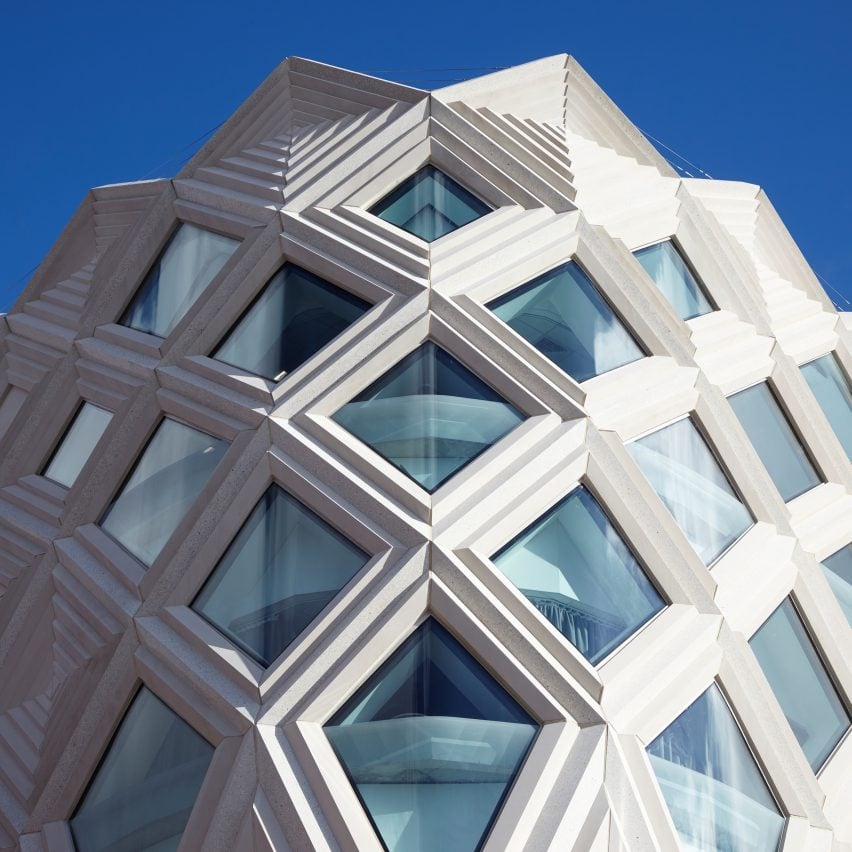
London firm Acme has completed a shopping centre in Leeds, England, featuring a white latticed concrete facade and an interior modelled on old-fashioned arcades. Read more
Job of the day: designer at rAndom International

We’re launching job of the day, your daily dose of the best architecture- and design-based career opportunities, as chosen by Dezeen editors. Our first pick is for a designer at interactive design studio rAndom International, which installed an experimental Rain Room at the Barbican in London. Browse all of our other architecture and design roles on Dezeen Jobs ›
Fashion designer Richard Nicoll dies suddenly aged 39

British fashion designer Richard Nicoll has died aged 39 following a suspected heart attack. Read more
Ultra-lifelike figure shows potential future of virtual reality

Although it looks like a real woman, the ultra-lifelike figure in this music video is actually a digital model created using high-resolution 3D scans. Read more
ZROBYM Architects Visualize a Stylish Duplex Apartment in Minsk, Belarus

Duplex Apartment is a digital project completed by ZROBYM Architects. The home would be located in Minsk, Belarus.
AIA Announces Recipients of Innovation Award

©Adrian Smith + Gordon Gill Architecture, © Keitaro Yoshioka, © Mortenson Construction, © Dana Wheelock
The American Institute of Architects (AIA) has selected this year’s winners for the TAP/CCA Innovation Award, which highlights new practices and technologies that advance project delivery and life-cycle management of buildings. Categories for the awards, conferred by the AIA’s Technology in Architectural Practice (TAP) Knowledge Community and the Construction Contract Administration (CCA) Knowledge Community), include Stellar Design, Project Delivery & Construction Administration Excellence, Academic Program/Curriculum Development, and Exemplary Use in a Small Firm. Voting is open from now until November 18th for favorite projects among the winners.
Category A: Stellar Design
Award Citation: Astana Expo City 2017 (Astana, Kazakhstan) / Adrian Smith + Gordon Gill Architecture
Astana Expo City 2017 (Astana, Kazakhstan) / Adrian Smith + Gordon Gill Architecture. Image © Adrian Smith + Gordon Gill Architecture
Currently under construction, Astana Expo City 2017 will embrace the exposition’s theme, “Future Energy,” with the aim of reducing the overall energy demand of the site by using both passive and active strategies. All opportunities for power generation were investigated and several were incorporated into the building-design guidelines, including high-performance glazing; energy piles that will reduce energy demand and provide temperature modulation during winter; energy storage capacity that can meet two days of emergency demand; 100% of rainfall from a 100-year storm event managed on site; and 90% of waste generated on site will be diverted from a landfill.
Honorable Mention: Epic Deep Space Auditorium (Verona, WI) / Cuningham Group Architecture, Inc.
Epic Deep Space Auditorium (Verona, WI) / Cuningham Group Architecture, Inc.. Image © Dana Wheelock
Situated on an 811-acre site, Deep Space is Epic Systems Corporation’s largest auditorium, seating up to 11,400 guests and was completed in less than 24 months. To create the rolling roof forms and building façade, a combination of hand sculpted and laser-cut models were developed concurrently in programs suited for generation of complex shapes. The final physical model was a large scale clay model that was 3D-scanned in order to produce a digital point cloud which was integrated with BIM software and became the engine that drove the other technical delivery tools of the project. The auditoriums 8-acre green roof provides visual and physical connections to the surrounding Wisconsin landscape.
Category B: Project Delivery & Construction Administration Excellence
Award Citation: Froedtert & the Medical College of Wisconsin Center for Advanced Care (Wauwatosa, WI) / Mortenson Construction & Cannon Design
Froedtert & the Medical College of Wisconsin Center for Advanced Care (Wauwatosa, WI) / Mortenson Construction & CannonDesign. Image © Mortenson Construction
Utilizing the latest Virtual Design and Construction (VDC) building tools and technology, the design team developed and pioneered new ways to add value and communicate with each other. By implementing a one-model approach, the team was able coordinate in advance of construction, which reduced duplication of modeling efforts, and greatly accelerated the development of fabrication models. Compared to a previous project with the same construction management/architect team, the one-model approach resulted in a 50% reduction in Request for Information (RFI) and an 18% reduction in Architect Supplemental Instruction (ASI), as well as the addition of five floors per the owner’s request with no change to the original completion date of the project.
Category D: Practice-Based or Academic Research, Curriculum, or Applied Technology Development
Honorable Mention: Glazing & Winter Comfort Tool (Boston, MA) / Payette
Glazing & Winter Comfort Tool (Boston, MA) / Payette. Image © Keitaro Yoshioka
The Glazing and Winter Comfort Tool is based on existing scientific research that aims to improve the design community’s understand of the triggers of thermal discomfort in the wintertime. It was developed to be simple and intuitive so that architects and engineers can design glazed facades that provide the desired levels of transparency, comfort and energy performance at an ideal cost. The development of the tool involved contributions from building scientists, designers and web developers. Previously, the only way to understand which façade properties negatively or positively impact occupant comfort involved a costly and time-intensive Computational Fluid Dynamics simulation. The Glazing and Winter Thermal Comfort Tool was conceived to facilitate this decision-making process quickly and inexpensively early in the design.
Category E: Exemplary Use in a Small Firm
Award Citation: Youth & Opportunity United (Evanston, IL) / Studio Talo Architecture
Youth & Opportunity United (Evanston, IL) / Studio Talo Architecture. Image © Douglas Snider, Studio Talo Architecture
Youth & Opportunity United (Y.O.U.), a 45-year-old non-profit, youth development agency requested renderings of their new headquarters for a community outreach and fund-raising campaign. The architects understood that the youth, not the building, needed to be the campaign’s focus, so they created multiple 360-degree virtual reality video renderings of spaces in the building, populated with video avatars of young people served by the organization acting as tour guides, explaining how Y.O.U. and the new building would impact their lives. Through the dynamic video rendering, community members and donors experienced Y.O.U’s mission, rather than just their plans.
News and project descriptions via: American Institute of Architects
The House of Prayer / Fránek Architects

© BoysPlayNice
- Architects: Fránek Architects
- Location: 570 01 Litomysl, Czech Republic
- Architect In Charge: Zdeněk Fránek
- Project Year: 2010
- Photographs: BoysPlayNice
© BoysPlayNice
The fifth façade, i.e. the roof of this building is the bearer of all essential information about the building. It has been abstracted to its maximum. A roof without any details is like a way running into infinity. The means of showing the way was a fair-face concrete outside the building and plywood board inside of it. Vertical movement and its visual representation is a dilemma of most religious buildings. The connection between Heaven and Earth need not necessarily be a monologue; it can be an invitation for a journey, and for a gradual ascent up from the dirt of this world. In this case, the ascent to the light, which has been depicted by excellent Czech graphic artists with their minimalistic illustrations. The symbol at the end of the journey has its strong haptic light quality as a clear target.
© BoysPlayNice
Floor Plan
© BoysPlayNice
A simple paper puzzle reminds me the eastern inspiration I got while working on this task. Eastern and western cultures meet here in a universal unity. The program of the building is to serve the religious and social life of the community, which is the investor. The preacher and his family occupy the second floor. The house was built for half the original budget.
© BoysPlayNice

