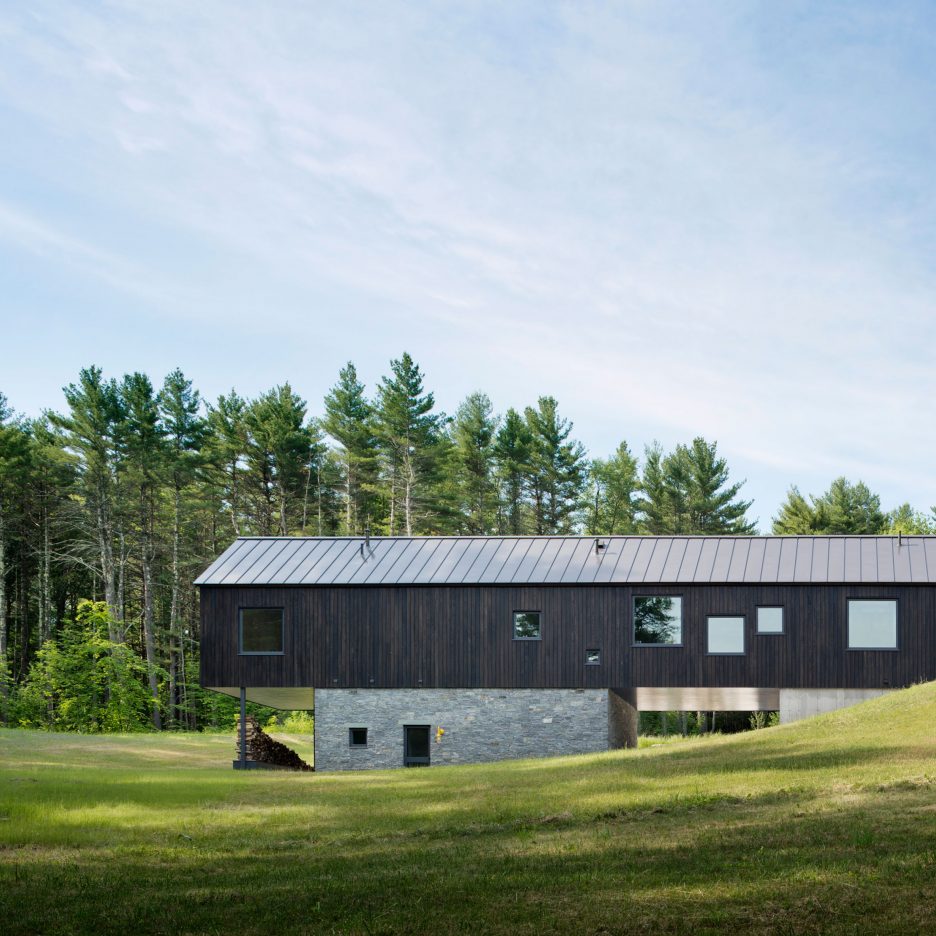
A long cypress-clad volume that projects from a hillside in rural Massachusetts forms this home, designed by US studio O’Neill Rose Architects for a nature-loving couple (+ slideshow). (more…)
A long cypress-clad volume that projects from a hillside in rural Massachusetts forms this home, designed by US studio O’Neill Rose Architects for a nature-loving couple (+ slideshow). (more…)

From the architect. A key conceptual driver of the project was the relationship of the new to the old. It was important that the extension both complement and contrast with the original house. As a result, we clad the extension in Silvertop Ash, an Australian hardwood timber, to complement the weatherboard cladding of the original house. But, whereas, the weatherboard was painted white, we stained the new cladding in a black stain as a contrast.
This project involved the re-configuration and extension of an Edwardian weatherboard house in the Melbourne suburb of Balaclava to provide for the evolving needs of a young family.
Located on a prominent corner within the neighbourhood, the design leverages the opportunities of its multiple frontages and its condition of being experienced ‘in the round’ to animate and engage with the streetscape. The organisation of the house is expressed in ‘black and white’ on the west elevation which faces the side street, with its didactic expression of the relationship of new and old. The new extension is a deformed box, clad in timber and stained black to contrast with the original, white weatherboard Edwardian cottage at the front. A plywood canopy folds into the side of the original house to carve out a carport: serving to conjoin the two main volumes of the house. The north façade registers the sectional profile of the spaces behind, expressed by a pink fascia ribbon that frames the life within.
The massing of the extension responds to various parameters. Rather than a dumb box at the back of the house, it seeks to complement the original house by drawing on the form and geometry of the bay window and the roof-form. The extension is pushed down on the south to minimise its visual impact on the original house. The form on the northern face is shaped to incorporate solar control – effectively forming a self-shading facade without the need for applied sun shading.
The internal planning of the house has been structured around a series of separate zones. The original house at the front comprises a parents’ zone including the master bedroom with WIR and en suite bathroom as well as a generous study / home office. The ground floor of the extension comprises a living and dining zone connected to the kitchen and laundry, oriented to the north and opening out to the garden. The third key zone occupies the first floor of the extension and comprises the children’s bedrooms which are oriented to the north and open out onto a shared balcony overlooking the garden. Off street parking has been located within the footprint of the original house which creates a highly efficient floor plan that maximises the size of the back garden.
The house has also been designed to incorporate passive design principles. Key rooms and spaces are oriented to the north with effective solar shading, with a minimisation of windows facing east and west. Windows have been strategically located to encourage cross-ventilation. Reverse brick veneer construction has also been adopted in the living space to incorporate thermal mass into the house

Installation art collective Limelight has transformed the Parliament Building of Romania into a eye-popping, psychedelic light show for the iMapp Bucharest International Video Mapping Competition. Titled “Interconnection,” the video utilized projection mapping (also known as spatial augmented reality) techniques to render the world’s third largest building in a blaze of shape-shifting, technicolor graphics and animations. Taking home top honors at the event, the projection required the use of 104 video projectors to cast the 23,000 square meter surface of the Parliament’s front facade in over 1 million ANSI lumens.
According to its creators, “the projection mapping shows the interconnectedness of all things from micro to macro as well as the outer and the inner universe. Conjuring emotions and feelings, the amazing display of color, light and sound aims to reopen the dialogue between the internal and the external, through a cinematic journey from the state of separation to the state of eternal openness.”
Check out animation stills and the full video performance after the break.
News via Limelight Projection Mapping.

ArchDaily is looking for a motivated and skilled architecture-lover to join our team of interns for Winter 2016/2017! An ArchDaily internship is a great opportunity to learn about our site and write articles about historically significant architecture projects.
Interested? Then check out the requirements below.
If you think that you have what it takes, please fill out the following form by Friday, October 14th 9:00 AM EST. We will contact potential candidates (and only potential candidates) for follow-ups during the following week. Late submissions will not be accepted!
ArchDaily internships are compensated.

From the architect. The owner is a philosophy professor and a well-known nature writer. She commissioned the studio as a retreat for herself and for visiting writer friends. Her first request was for a roof that would let her hear rain falling.
The writing studio site is a small piece of land along the Marys River about 20 minutes from the owner’s home in town. The studio sits just uphill from riparian wetlands that are part of a project to restore hydrological and ecological function to the whole Marys River watershed.
Thewriting studio is designed to reveal the ecological complexity of the site to visitors and in this way it is successful: Small tunnels under the studio bring rare reptiles and amphibians into view through the floor-level window. The water collection basin that doubles as the front step draws in birds and deer. At midday, the silhouettes of these animals project from the water onto the interior ceiling. Windows on the west and north sides frame different bird habitats—the tops of fence row trees and the patch of sky at a hilltop updraft. The roof diaphragm amplifies rain sounds and the collection basin is a measure of past rainfall.
Two major intentions underlie careful design detailing: 1) that the studio be able to be constructed without road access, without electricity on site, and without major excavation and 2) that the building be removable and recyclable at the end of its useful life.
The way the studio is designed in three separate construction stages made it possible to shop fabricate most of it and then to walk the parts to the site for assembly. The first stage of construction was the site-poured foundation piers that are cast to spread the weight of the building on the ground and to drain water away from the steel frame. The second stage, the steel frame, was shop fabricated and dropped in a single piece onto the piers by a track drive front loader. Stainless steel bolts connect dado-grooved cedar 2x6s to the frame and the final tongue-in-groove cedar and glass enclosure layer floats in those grooves and on rubber engine seats. There are no irreversible connections. The wood enclosure can be updated or recycled piece-by-piece as necessary. The steel frame can be removed the same way it arrived and can be reused or recycled.
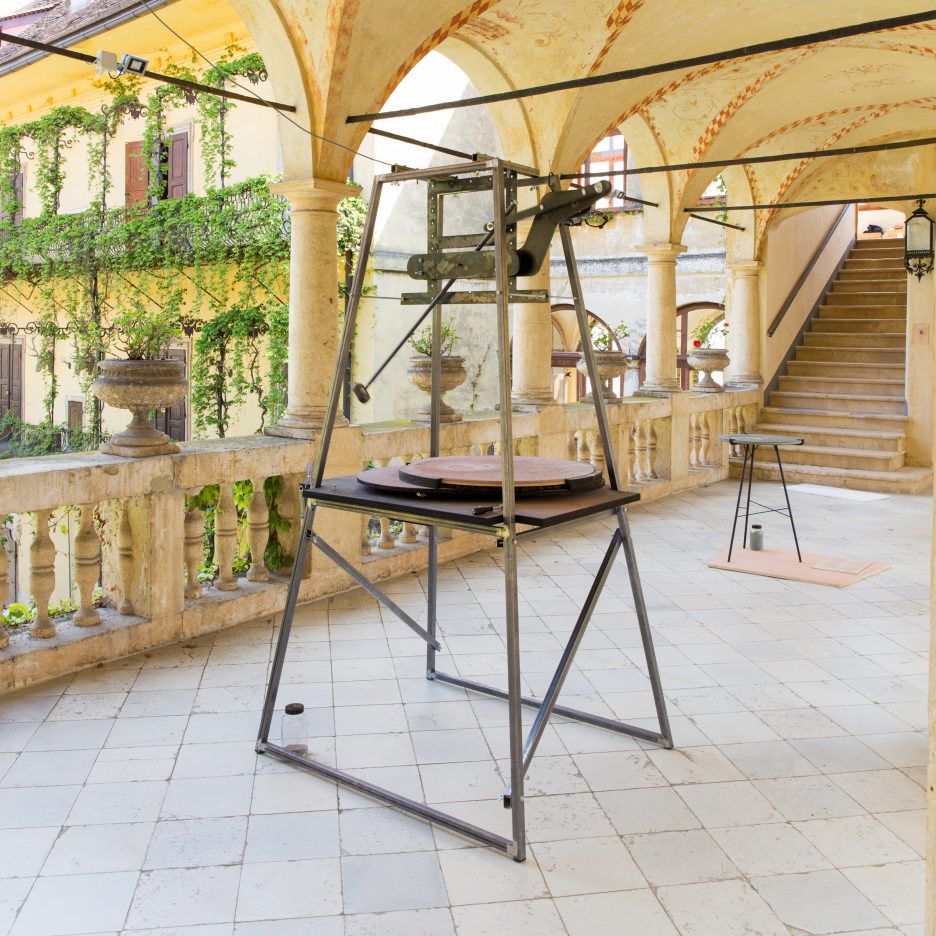
Vienna Design Week 2016: a pendulum swinging back and forth for a week crafted the colourful recession in this table, designed by Austrian studio Mischer’Traxler. (more…)

The winners of the 2016 Leading Culture Destinations Awards have been announced. Presented this past weekend at a ceremony in London, the LCD Awards are given annually to recognize the success of “museums, art organizations, and cultural destinations from around the world [that] are investing in iconic architecture, cross-sector collaborations, [and] audacious programming […] to diversify the experiences offered to visitors and establish their global reputations.”
This year, awards were presented in four categories: Leading Cultural Destination of the Year; Best New Museum of the Year (for museums opened in the past 15 months); Best Soft Power Destination of the Year (a new award for 2016, given to destination who exhibit ‘excellence, relevance, transparency, accountability and sustainability’); and the Traveller’s Award for Best Place to Visit.
The overall winner for 2016 was Diller, Scofidio + Renfro’s Broad Museum in Los Angeles. Continue reading to see the full list of winners.
Museum Architecture of the Year: The Broad Museum, Los Angeles / Diller, Scofidio + Renfro
Exhibition of the Year: Proportio, at Palazzo Fortuny, Venice, curated by Axel Vervoordt and Daniela Ferretti
Museum Shop of the Year: Louisiana Museum, Copenhagen
Restaurant of the Year: LouLou, Musée des Arts Decoratifs, Paris
Digital Museum of the Year: Rijksmuseum, Amsterdam
Europe: Tate Modern Switch House extension, London / Herzog & de Meuron
North America: The Broad Museum, Los Angeles / Diller, Scofidio + Renfro
Central and South America: Museu do Amañha (Museum of Tomorrow), Rio De Janeiro / Santiago Calatrava
Africa: Sinthian Cultural Centre (THREAD), Senegal / Toshiko Mori
Asia Pacific: Design Museum Dharavi, India
Best Soft Power Cultural Activation Award: The Cultural Spring, Sunderland
Best Soft Power Cultural Organisation Award: The Canadian Museum of Human Rights, Manitoba / Antoine Predock
Best Soft Power Cultural District Award: La Ponte Ecomuséu, Villanueva de Santo Adriano, Spain
Cultural City of the Year: Québec City
Art Hotel of the Year: Durslade Farmhouse, Hauser & Wirth, Somerset, England / Laplace, Piet Oudolf
Learn more about the awards here.
News via the Leading Culture Destinations Awards, DailyMail.
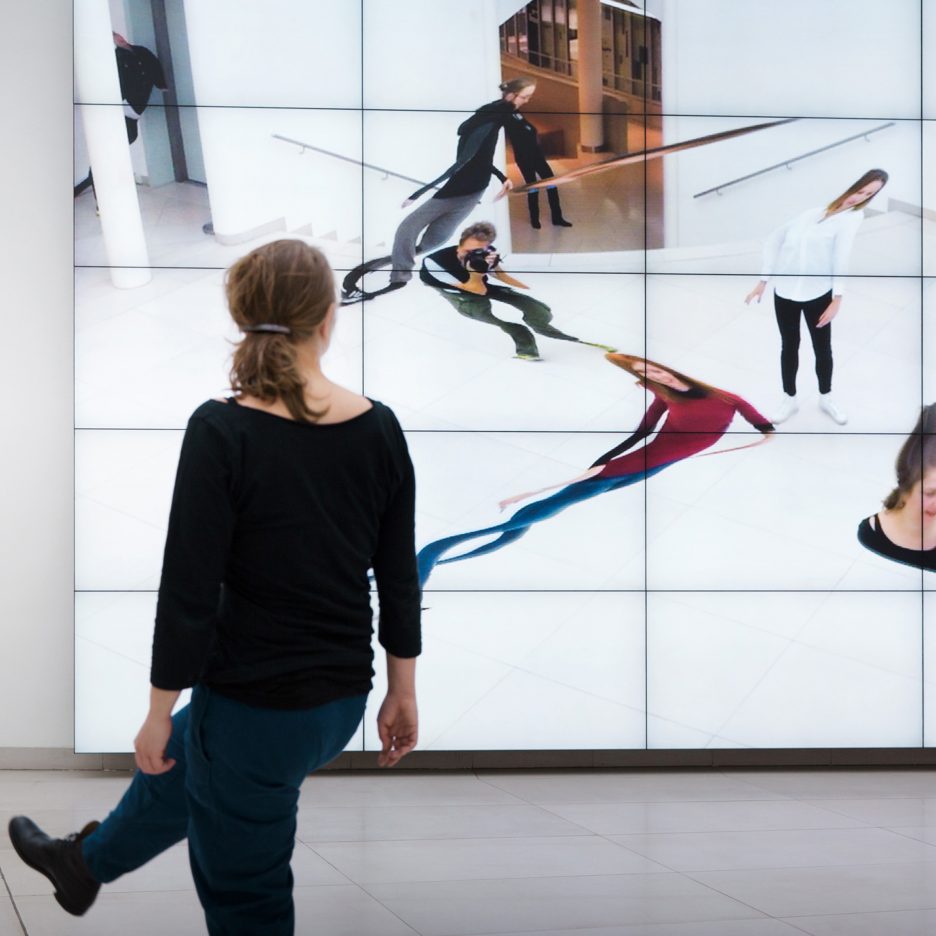
Dezeen promotion: the programme for this year’s Istanbul Design Biennial has been announced, featuring over 70 projects that explore the relationship between design and the human species over the last 200,000 years. (more…)

+tongtong Transforms Traditional Toronto House into Tasteful Modern Home that Honors East-end Neighborhood
Multidisciplinary design studio +tongtong recently completed a renovation and addition to a traditional Victorian house in Toronto. The house was transformed into an open and bright modern home through a series of strategic moves and incisions.
The specifications were to build a modern family home that expands the area of livable space while remaining true to the vernacular of the neighborhood. This challenge was met with an emphasis on natural materials and light. Inspired by rural living and the original build date of the home, industrial materials accentuate re-imagined architectural qualities in an unmistakable contemporary space.
Grey and black Zinc used throughout both the exterior and interior of the home is a material that blends traditional aspects with the new contemporary scheme. Inside, a vertical shaft brings light from large skylights down 3 floors illuminating the ground floor while animating a zinc wall and ceiling above the kitchen.
As for +tongtong principal John Tong’s favourite element of the house, “I really embrace the slot between the two floors. It turns the 2nd floor hallway into a bridge that connects all of the floors. This is key to bringing light down to the first floor.”
On the 3rd floor, the entire gable has been replaced with an expansive triangular glass window affording views of the neighbourhood and downtown skyline in the distance. A custom-made triangular blind shades the window and retracts into a millwork unit when not in use.
In the kitchen, an original window at the side of the house was reconfigured proportionally to retain its original breadth. This now horizontal window extends along the kitchen and integrates seamlessly within the millwork of the dining room. The kitchen counter also extends providing the means for a countertop vent-free ethanol fireplace in the dining room. Throughout the home, millwork such as that found in the transitional space between the kitchen and dining room defines overlapping function.
Outside, the rear facade of the home has been entirely transformed to maximize views of the expansive elm tree behind the house; while in front, a large glass pop-out opens up the home to the street while being protected from the sun and elements by a new zinc awning reminiscent of bygone neighbourhood corner stores. The landscaped berm and retaining walls create a layer of privacy between the public street and the private home which provides a small area of refuge in front of the home for children to play, complete with theatre seating to watch the spectacle of life unfold.

I want you to let me do all the ideas I still have in my head.
In the latest installment of the In Residence series, NOWNESS visits the last house designed by legendary Mexican architect Luis Barragán, Casa Gilardi. By the time current homeowner Martin Luque and advertising agency partner Pancho Gilardi approached Barragán to ask for a house design in 1975, the architect had already formally retired. He originally declined to take on the project – until he made a visit the site, where he was captivated by a remarkably beautiful jacaranda tree. Changing his mind, Barragán remarked, “Don’t chop down this tree, because the house will be built around it.”
Check out the video to learn the rest of the story behind the masterwork and to see the vibrant house as it stands today.
Video via NOWNESS.
Clásicos de Arquitectura: Casa Gilardi / Luis Barragán
//cdn.embedly.com/widgets/platform.js
 Sig Nordal