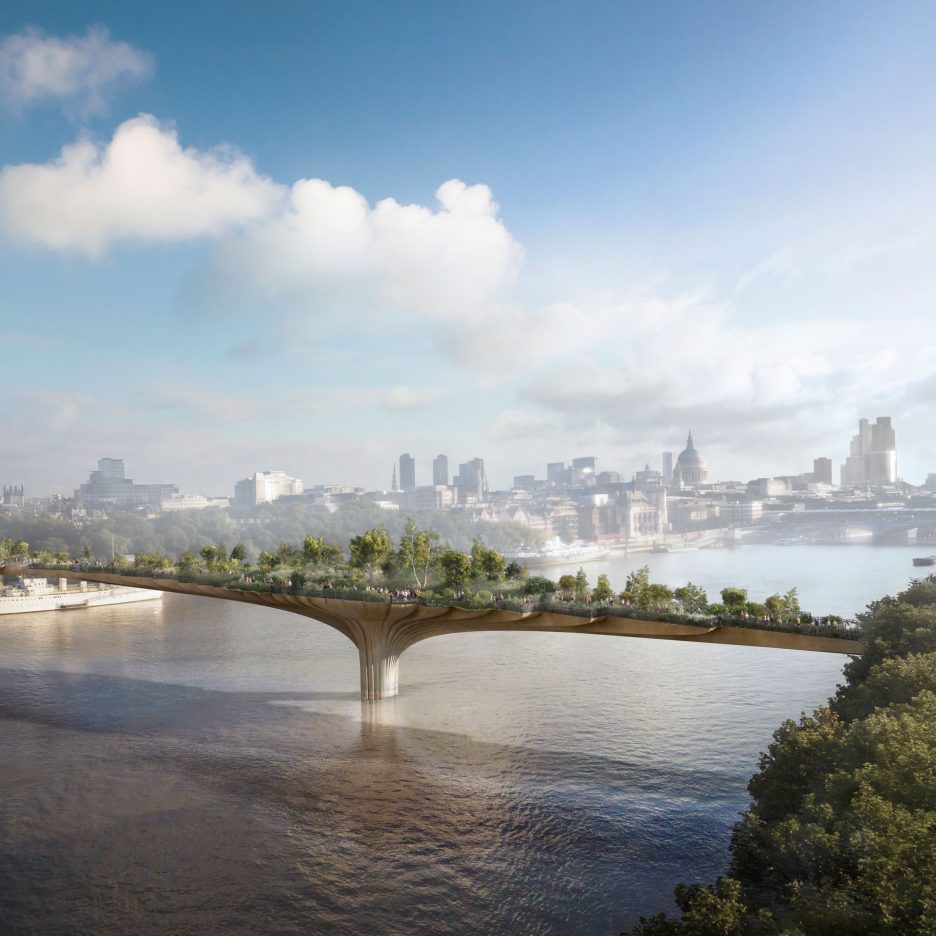
The controversial Thomas Heatherwick-designed Garden Bridge is to come under further scrutiny, as London mayor Sadiq Khan has announced a review to assess whether the project provides value for money. (more…)
The controversial Thomas Heatherwick-designed Garden Bridge is to come under further scrutiny, as London mayor Sadiq Khan has announced a review to assess whether the project provides value for money. (more…)

14 Cobalto was designed by brothers Mauro & Matteo Soddu from Tramas & STUDIOTAMAT, respectively. The home is located in Cagliari, Italy. Photos by: Cédric Dasesson

Competition: Dezeen has teamed up with Not-Another-Bill to give away four three-month subscriptions to its design gift service (+ slideshow). (more…)

Museum De Pont is renovated and expanded with 1.100m2, designed by Benthem Crouwel Architects. Also, visitors to museum De Pont now enter the forecourt through the new entrance gate, consisting of several interconnecting passages. The open structured passages, so called ‘follies’, each have their own specific function. The gate is part of the adaptation of the entire forecourt and was donated to the museum for their 20th anniversary by the municipality of Tilburg.
Expansion of the Museum
The new wing of the museum is adjacent to the museum garden and hosts mainly film, photography and video art. The exhibition space is 20 by 27 meters. The new hall provides additional exhibition opportunities for the growing collection of the museum. The new restaurant has an adjoining lounge – including a fireplace, which connects beautifully to the museum garden. The restaurant has been enlarged and has a central location between the old building and the new wing. The characteristic line of sight along the original outer wall of the museum remains intact and is well adapted to the current museum route. Because of top windows, which make the spaces spectacularly bright, the ceiling almost seems to levitate. The museum shop is enlarged and is connected to the library. The recent adjustments create a much more logical sequence of public functions: entrance hall, bookstore, library, restaurant, lounge with terrace and museum garden.
Follies
Already in 1990 the municipality of Tilburg commissioned an urban plan for this location, also with the goal to create a worthy entrance to the street. The urban plan has been executed in phases and now, a characteristic gate has been completed. The five follies share the same design idiom. The height of the follies is related to its surroundings and is determined by its functions: driveway for busses and cars, entrance for pedestrians and a bicycle parking station. The passages are made of concrete, in a cut-away diagonal structure, and are coated with a ceramic material. This durable material has the same industrial look as the expanded metal façade of the museum. The contours of the gate are an interpretation of the original buildings around the museum. There is also a new layout for the car park, because of the increasing number of visitors. With the redesign, particularly the entrance gate, the original structure of the area is restored. Advertising facilities are integrated into the follies, as well as lighting, making the forecourt a pleasant area at night.
De Pont since 1992
Museum De Pont is located in a former wool mill. In 1990-1992 Benthem Crouwel Architects rebuilt the monumental factory from the thirties to a space where contemporary art can come into its own. The highlight of the factory is the large bright main hall – with on one side the intimate wool-storage rooms. In the hall are twelve skylights over the entire length of the building, which provide natural lighting and atmosphere in this unique space.

The following essay by Kazys Varnelis was first published by Volume Magazine in their 49th issue, Hello World! You can read the Editorial of this issue, Going Live, here.
During the last decade, the idea of a technological singularity has passed from science fiction to a plausible prediction of the proximate future. In its simplest terms, a technological singularity will take place when an artificial general intelligence (AGI), capable of modifying its own code, advances so rapidly that subsequent technological progress (and as a result history itself) become as unpredictable and unfathomable as what happens within a black hole. In the most radical vision, the ‘hard takeoff’, within hours or even minutes of artificial intelligence developing the capacity for recursive self-improvement, the intelligence advances so greatly that it fundamentally transforms life on Earth.
The idea of the singularity is borrowed from astrophysics. Singularities lie at the center of black holes, one dimensional points of infinite density where the laws of physics cease to apply. But the singularity’s effects are hidden by the event horizon of the black hole, beyond which light and information can no longer escape. To an outside observer, as a space probe approaches the event horizon, its radio signals appear to slow down and the probe never makes it past the boundary. From the probe’s perspective, however, it passes through the event horizon and into the black hole. Inside, as generally accepted models of astrophysics suggest, the probe becomes distorted by the forces of the singularity ultimately before collapsing into its one dimensional space.
The technological singularity remains somewhere ahead of us, and while there is considerable debate about whether we will ever reach it, recent advances in development of machine learning suggest it might be real after all. To not stand idle, we need to think how to imagine the unimaginable. What might architecture after the event horizon look like?
This may not be such an impossible question to answer, as the event horizon may very well be behind, and not in front of us, With the emergence of the internet, a critical shift in spatiality has taken place. Once measured in tens of thousands of kilometers, the distance across the Earth is now measured in milliseconds. We mortals are unable to recursively improve ourselves or think at the speed of light as an AGI might, yet we have nevertheless entered into a previously unimaginable world.
Architects have found it difficult to respond to these changes, embracing neo-expressionist formalism and star power as a compensation for the discipline’s loss of control over space. How can a discipline that always thought of light switches and electric sockets as after-thoughts think about connections made in the electromagnetic spectrum?
Arthur C. Clarke stated that “any sufficiently advanced technology is indistinguishable from magic.” To understand the implications of this statement for architecture, let’s look to, of all places, the Wizarding World of Harry Potter (WWoHP) at Universal theme parks in Florida. For Jean Baudrillard, Disneyland was the most real place in America, hiding the fact that America itself was a simulation.[1] But the Disney park model, as opposed to Universal, is oriented around the rides; Main Street is a confused stage set, a nauseatingly sweet and nostalgic backdrop melting in the subtropical sun where nothing happens save a periodic parade. In contrast, WWoHP’s Diagon Alley—which perversely appears far more real than the actual set used for filming the Harry Potter movies at Warner Brothers Studios—is a model for the future sentient city. After purchasing a rather expensive wand containing an infrared reflector at the tip, a visitor can wave the wand in a particular motion at predefined spots where concealed infrared triggers and receivers lurk, thereby producing some kind of effect, like causing a book in a shop window to open up and reveal its dark secrets, a magical umbrella to rain down water, or invisible ink to reveal itself on a scroll. Invested with the capacity to respond to those with the knowledge of how to interface with them, Diagon Alley’s surfaces and objects show us a world full of computation, aiming to be indistinguishable from magic.
The singular device of the last decade, the iPhone, gives us another glimpse of how technology aims to become indistinguishable from magic. When off, it resembles the monolith from Stanley Kubrick’s 2001: A Space Odyssey; a mute black object. But like the monolith, it contains within it a universe of information and experiences. Activated by placing one’s thumb on the home button, then operated through a series of gestures or voice commands, the iPhone is an object that transforms from one thing into another, from mute object to rich world. iPhones and the like are only transitional objects toward a world that is itself aware and reacts to our actions.[2]
As architects, we have been obsessed with giving form to a physical world. But now either approaching, passing through, or already beyond the event horizon, we are becoming subject to the effects of extreme spatiotemporal compression. Thinking of the Internet of Things as merely extending data gathering capacities—telling you what the temperature of the chicken in the oven is or when your wash is done—trivializes the capacities of the sentient environment engulfing us. Within the near future we will abandon screens and keyboards for the environment as interface, operated by gestures and spoken incantations that will seem indistinguishable from magic. New spatialities will emerge as the spatial compression leaks and merges with the physical world (Pokémon Go is an early, yet overdue step in this direction). If architects wish to be more relevant than buggy-drivers or stable keepers in the twentieth-century metropolis, we need to accept that this is the future, and learn how to face it.
References
[1] Jean Baudrillard, Simulacra and Simulation (University of Michigan, 1994).
[2] Donald W Winnicott, ‘Transitional objects and transitional phenomena’, International Journal of Psychoanalysis, 34, 1953, pp. 89-97.
Volume is an independent quarterly magazine that sets the agenda for architecture and design. With going beyond architecture’s definition of ‘making buildings’ it reaches out for global views on designing environments, advocates broader attitudes to social structures, and reclaims the cultural and political significance of architecture. Created as a global idea platform to voice architecture any way, anywhere, anytime, it represents the expansion of architectural territories and the new mandate for design.

Saint-André Residence is a residential project designed by naturehumaine. It is located in Montreal, Canada. Saint-André Residence by naturehumaine: “The Saint-André residence is located on a heritage street of Le Plateau Mont-Royal, and the project consisted in adding a modern extension on the back alley side while retaining the character of the built environment on the street side. We transformed the early-20th-century duplex into a single-family dwelling, with the intent..

Jagtens Hus is situated on Mols peninsula in the eastern part of Jutland, Denmark, and is the new domicile for the Danish Hunter Association. In the two main longhouses you find the association’s administration, laboratory, education facilities, cantina and a build-in “hunting lodge”, all of which is closely linked to the surrounding nature. The black buildings are kept neutral and rough, to make room for the woods, the meadow and Kalø Inlet all of which embraces the domicile.
A raw concrete centre runs through the buildings underlining the robustness in the constructions and making room for the hunters sometimes dirty work after the hunt. As a contrast to the concrete, large black surfaces unfold from the centre, creating outdoor corridors alongside the buildings and opening up the large window sections. The windows give the 60 employees a beautiful and natural light and at the same time open up to a breath taking view of the nature which thereby plays a significant role at every single workstation. Large, south facing sectional views creates a scenic view from the 2nd floor. The view changes from the beautiful terrain to the endless horizon when the employees sit down at their tables.
The architect has deliberately designed the buildings so that the details are hidden, leaving them calm and rough in their expression, this puts the surroundings at the centre of attention. During the construction of Jagtens Hus the surrounding landscape have been adapted with local vegetation, that will be left untouched and wild, this will create a beautiful natural scenery around the new domicile.

Casa Pizarro is a private home designed by A53 & Marc Mazeres. It is located in La Barceloneta, a neighborhood in the Ciutat Vella district of Barcelona, Spain. Casa Pizarro by A53 & Marc Mazeres: “The project concerns the refurbishment of an apartment in Barceloneta that suffered through a number of different interventions over the years and had lost its beauty and charm. Our team was challenged to apply a..

From the architect. For many decades now, excavations at the complex of Palaeolithic (the period of mammoth hunters) settlements have unearthed a huge number of stone and bone tools and artwork, as well as the skeletal remains of anatomically modern humans. This puts Pavlov and Dolní Věstonice high on the list of the world’s leading archaeological sites. The site reminds us of a past historic age and is both part of the universal cultural heritage and a symbolic integral element of the local culture, fundamentally forming a relationship between the local population and the region. It has embodied cultural values that the local population takes pride in and establishes their relation to the country.
This outstanding and attractive architecture and exhibition covers an area in excess of 500 m2 and combines contemporary audiovisual technology with traditional museum displays. It allows the public to become acquainted with the most important discoveries that scientific research has uncovered here. In addition to photographs and documents that detail the history of the various digs at these sites, the museum will also display the actual finds and explain the spiritual world of these ancient people. Special emphasis will be placed on topics such as hunting, the everyday life of hunters, their art, and their burial rituals, as well as other aspects of their world.
The Archeopark has a delicate location in the sense of broader urbanistic considerations. It is located on the border between the village boundary and the open countryside and forms part of the Pálava hills’ impressive scenery. The majority of the construction is situated underground, with just the white concrete towers projecting above ground.
The architectonic solution is based on the location’s conditions and formed according to three principal aspects:
1.The construction site is part of a national cultural monument, limiting construction to the area already archaeologically excavated and researched, with the only exception being the “in situ” exposition.
2.We assumed the archaeological excavations are located 4–5 meters under the current terrain.
3.The construction site is part of a protected landscape area (PLA).
Based on these aspects, the concept of an underground construction arose together with the loose paraphrase of “limestone rocks standing out from green meadows and vineyards”.
The main exhibition area—as well as the administrative, technical and social areas—is hidden in the hillside. The skylight tower projects to the exterior, as does the conical entrance and the look-outs to Děvičky and the lake below. The intention is for the building to be reminiscent of the shape of a cave. Regarding the materials, up-to-date means are used to express monolithic reliefs with concrete, oak wood and glass.
The entrance area is defined by gabion walls and forms when entering the Archeopark. This zone is multifunctional: It could be used also for open-air activities, such as theatre performances or further background for archaeological works.
This open-air landscape project accommodates spatial and functional use of the area while subtly contributing to the scenery under the Děvín hill.
 Sig Nordal