Lakeland Elementary School is one in a set of four elementaries designed under the same archetype for Federal Way Public Schools. DLR Group’s design for this school re-thinks what a school should look like. From the outside the bright colors and translucent “bars” break the mold of typical school design.
Inside there are a variety of different sized learning spaces, the majority of which are not customized to a specific purpose, maximizing possible uses and flexibility. The literary commons features bookshelves with built in reading nooks. Interior finishes are simple and raw, allowing this school to be built at a significantly lower cost per square foot than other schools at the time. Structure and utilities were intelligently placed to maximize options and minimize expense in any future renovation.
Lakeland Elementary is designed to serve 450 students in 44,000 SF. Classroom spaces are balanced with small group break-out areas. The literacy commons doubles as the main circulation space and features a library, reading nooks, story-time area, computers, and a group presentation area. A moveable wall between the music room and cafeteria allows for performances. Also included are office space and a kitchen. Outdoor amenities include outdoor classroom, play fields, and covered play areas. Daylighting, efficient heating system and flexible design helped meet WSSP sustainability goals. DLR Group provided planning, architecture, engineering and interiors services.
Construction is now underway on Skidmore, Owings & Merrill’s (SOM) OH-1 redevelopment project in the Ohtemachi District of Tokyo, Japan. Covering a 20,000 square meter (215,000 square foot) site, the project constitutes one of the largest revitalization projects in Tokyo’s history. The complex includes two high-rise, mixed-use buildings containing a luxury hotel, commercial office space, retail and cultural facilities, and is centered around a park and public area that will visually connect the development to the adjacent Imperial Palace East Gardens.
A product of their context and SOM’s design approach – “balancing tradition and innovation” – each of the project’s two towers takes on its own scale, massing and materiality. The 160 meter tall Tower A faces the Imperial Palace, and harmonizes with its historical context, employing techniques inspired by traditional Japanese craftsmanship in its granite and glass cladding.
Facing the Ohtemachi district, the 200 meter tall Tower B features a glass and steel skin as it rises from the city to “establish a strong presence on the skyline as an emblem of contemporary Japan.”
In total, the towers will contain a total floor area of 360,000 square meters. Included in that number is a flexible event space overlooking the park and plaza area that will be equipped host a range of events from musical performances to international conferences. Both towers have been designed with a range of sustainable features to reduce energy consumption.
On the western section of the site, the 6,000 square meter (64,500 square foot) park will feature a reflecting pool and plaza landscaped with native flora, as well as a new setting for the historic Masakado’s Shrine located on site. OH-1 will also provide direct access to several metro lines, ensuring its accessibility via the Tokyo public transportation system.
Once completed, OH-1 will serve as a new corporate headquarters for Mitsui & Co, one of the largest general trading companies in Japan. The project is the next in a line of collaborations between SOM and developer Mitsui Fudosan, who together have created a series of major developments throughout Tokyo totaling more than 2 million square meters.
“We are thrilled to partner once again with Mitsui Fudosan on this transformative project, which will revitalize Ohtemachi to become not only a world-class business center, but also the heart of a vibrant, 24-hour neighborhood,” said Mustafa Abadan, SOM Design Partner. “Our design bridges Tokyo’s past and future—honoring the historical and cultural signi cance of its site, and at the same time, signaling Japan’s stature at the forefront of technology and innovation.”
A row of brightly coloured beach huts and an elevated promenade will be integrated into this sea wall designed by Snug Architects to protect the coastal English town of Milford-on-Sea (+ slideshow). (more…)
From the architect. Restoration of a town house overlooking two streets with a minor different in altitude between both. The main façade has been maintained along with the two main bays forming the existing construction, with a new side annex being added to this that contains the rear façade and where the garage is housed. This new construction has been taken advantage of in order to create a basement floor intended for installations, washroom and storeroom.
The courtyard, still reduced in size, once again becomes the focal point of the dwelling. The space containing the living room – kitchen – dining area is projected towards the interior of the courtyard with a staggered section glass house.
London Design Festival 2016: “you can have surround sound with your chandelier, vase and centrepiece” in the world imagined by the 28 designers contributing to the Electro Craft exhibition (+ slideshow). (more…)
A year after the ancient city of Palmyra, Syria was destroyed by the Islamic State, a 3D-printed recreation of one of its most iconic structures has begun its world tour. Originally erected in London’s Trafalgar square in April, on Monday, the replica of Palmyra’s Arch of Triumph was unveiled in its new location outside city hall in New York City.
Two-thirds the scale of the original, the reconstructed arch was carved from Egyptian marble blocks using a team of Italian stone-carving robots, which followed a 3D model of the arch assembled from photographs taken of the structure prior to its demise.
For centuries, the 1,800-year-old arch served as the entrance to the Temple of Bel, the center of religious life in Palmyra. Even after the city’s abandonment, the monument remained an important example of Roman architecture in the Middle East.
The Arch of Triumph will remain in New York for one week as it coincides with the United National General Assembly, before traveling to its next location in Dubai.
The project is the result of a collaboration between archaeologists at Oxford University’s Institute for Digital archeology (IDA) and United Nations Educational, Scientific and Cultural Organization (UNESCO) to preserve the historic architecture of threatened or destroyed sites through the digitization and recreation of their artifacts.
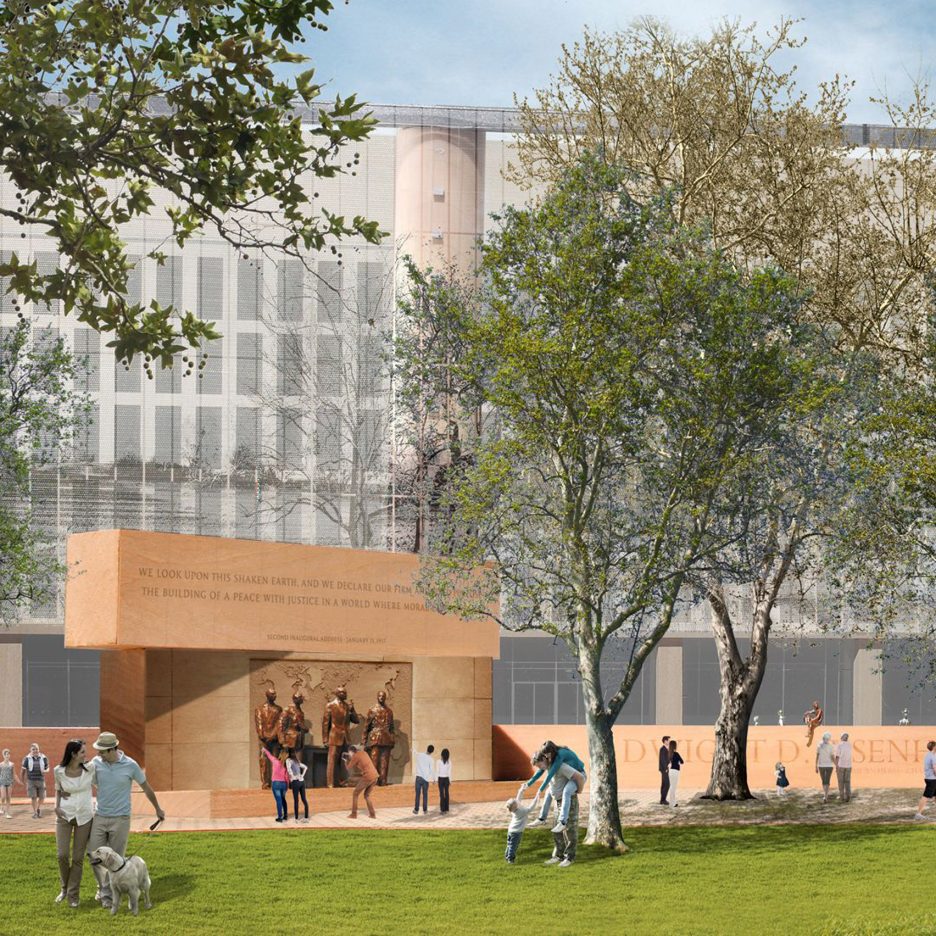
The Eisenhower family has withdrawn is rejections to the Frank Gehry-designed memorial, proposed for Washington DC to honour the 34th president of the United States (+ slideshow). (more…)
Aukett Swanke has completed No 1 Forbury Place, a 185,000sqft Grade A office development that brings Central London design standards to Reading, Berkshire.
Developed speculatively by owners M&G and development manager Bell Hammer on a site adjacent to Reading railway station, the entire building was let last year to Scottish and Southern Energy ahead of completion, making it the largest letting in the Thames Valley for over a decade.
It will be followed by a second phase on the adjoining site. Together, they will form a landmark for both Reading’s newest business district, and for the city as a whole.
Aukett Swanke‘s design responds to the historic urban context of the neighbouring Forbury Gardens through the massing and sculpted form of the Forbury Place buildings. Laid out over eight storeys, the building has large flexible floorplates, which narrow to the upper levels to form a roof terrace that overlooks Forbury Gardens. The terrace is protected from nearby Forbury Road by extra-tall glass balustrades that provide uninterrupted views beyond over the Thames Valley, the Cotswolds and countryside to the south.
Plan
The design incorporates a structural diagrid that gives a distinctive and dynamic identity to the new building. The glazed east and west façades are protected from solar gain by vertical fins that twist to create a pattern that becomes increasingly solid towards the centre of the building. This gives a sense of movement for those passing by the building, with further animation provided by the varying effect of different light conditions on the bronze-coloured blades. These blades are held in place by bespoke brackets designed by Aukett Swanke in collaboration with specialist fabricators. They also provide the inspiration for a dramatic feature wall of twisted blades in the double-height reception area.
Inside, generous 26,000 sqft floorplates are well lit by both the external floor to ceiling windows and a full height central atrium. The latter is supported by a slender steel frame that echoes the external structural diagrid. Feature bronze profiles at each floor level help create a kaleidoscopic effect to views up through the atrium when combined with the reflected light from the roof.
A century since the founding of the National Memorial Association and the start of a campaign by African-American war veterans for a monument of African American culture, the National Museum of African American History and Culture will finally be opened on September 24th. The Museum took $540 million and four years to build, resulting in a striking, and refreshingly unorthodox, architectural construction on Washington DC’s National Mall. The Freelon Adjaye Bond/SmithGroup JJR team, led by Ghanaian-British architect David Adjaye, defiantly broke the white-marble-Corinthian-column convention, opting instead for a bronze-coated aluminum façade bound to provoke a reaction from the critics.
“The most impressive and ambitious public building to go up in Washington in a generation” – Christopher Hawthorne, LA Times
Hawthorne celebrates the building’s architectural character and beauty of the façade’s “shifting personality” in different qualities of light. However his praise for the NMAAHC does not stop at the building’s aesthetics. Hawthorne highlights the museum’s bold mission to, on one hand, provide a beautiful design, while on the other uplifting the African American culture on a site dominated by white monuments:
The museum’s skin — has that typically benign architectural term ever been more charged? — allows it to stand apart from the Mall’s white-marble monuments like a rebuke.
Due to the history of the museum, the site and the nation in which it is built, the political and cultural prominence of the NMAAHC is hard to ignore. Hawthorne acknowledges Adjaye’s vision to use this to the building’s full advantage, while at the same time applauding the architects’ respect for the museum’s context:
The building itself is perhaps the most powerful display of all, a careful, strategic and sometimes defiant exploration of the relationship between black culture and government prerogative, which is another way of saying it is a piece of architecture supple enough to please the archivist and the activist alike.
Half of the building has been “buried” underground, as a result of Washington’s height regulations. Not only does this produce a neat design above-ground, but also helps to communicate the progression of African American history:
The NMAAHC is undeniably an imposing architectural object, monumental and temple-like. Yet it also suggests something that has been unearthed, a box pulled from the ground and dusted off; much of its 420,000 square feet of interior space is buried below street level.
“Although credited as lead designer, Adjaye is one of four architecture practices responsible for the project, a cocktail of divided responsibilities that feels like too many cooks.” – Oliver Wainwright, The Guardian
Wainwright is the only critic to point out the difficulties that can arise from having many voices involved in the design process. Clearly, he attributes some of the museum’s limitations to these circumstances, providing an explanation for some critics, who have been disappointed by the comparison of the building with original visualizations:
The whole project, then, was co-ordinated in the cloud, using BIM modelling software, and there are moments where you sense the left hand might not have quite understood the right hand’s intentions, areas that appear to have slipped through the contractual cracks.
Although Wainwright, like Hawthorne, pays tribute to the museum’s success in holding its own on such a sensitive site, he goes on to comment on what he sees as several architectural shortcomings of the NMAAHC. These include the bronze coated aluminum façade, initially intended to be fully cast in bronze, as well as the intention to have much larger surfaces of the perforated metal, which have instead been replaced by smaller repeated elements:
These choices don’t ruin the effect, but they lend the building a slight cheapness – a feeling that gets more pronounced when you step inside.
Some of these drawbacks resulted from lack of funding, as well as structural difficulties. Wainwright recalls the architects’ original design proposals, expressing a clear disappointment in the materialized result:
The circulation areas, housed in the gap between the outer facade and the gallery levels within, promised to be a dramatic sequence up escalators and along cantilevered landings, veiled by the lacy mesh. The result feels half-baked. From the inside, the cumbersome steel structure needed to hold up the facade takes up most of the view, while the impact of specially framed vistas to nearby monuments is lessened by clunky fixings.
However, on the whole Wainwright concludes that the building, while not perfect, works adequately in its setting:
Despite some clunks, the result has a compelling, spiky otherness, standing on the Mall as a welcome rebuke to the world of white marble monuments to dead white men.
“As a freestanding largely symmetrical object, the new museum has something in common with its neighbors, but as a dark-clad structure that eschews classical columns for apparently floating horizontal layers, it does not.” – Rowan Moore, The Guardian
None of the critics can avoid discussing the building’s intricate relation to its site, and Moore is no exception. His review of the NMAAHC is very much in line with that of Wainwright’s, remarking on the dissonance between the original renderings and the aluminium reality:
It is not flawless, as it sometimes feels assembled or panellized more than crafted. The bronze-colored screens are not the delicate, seamless things suggested in computer visualizations. The build-up of the exterior cladding – glass wall plus screen plus substantial fixings for the latter – impedes the sense of connection between inside and out.
Despite this, Moore focuses on the building’s conceptual vision and achievements. In accordance with the other critics, he emphasizes the building’s strength that lies in its complexity. Due to the intricate nature of the NMAAHC, certain imperfections can be hard to avoid, but on the whole the architectural novelty hits the mark:
There are moments of gawkiness that can be engaging or uncomfortable, depending on your taste. But it achieves its main, difficult task, which is to be both American and African American, and to be of its location but also different from it.
“Architecture and identity rarely fuse as convincingly as they do here.” – Justin Davidson, NY Mag
Davidson, like many of the other critics, comments on the division between the museum above and below ground, going into more detail about its successful role in serving the African-American story the museum wants to tell:
Visitors enter a broad, open lobby that serves as the museum’s midpoint, both overture and interlude between the historical journey below and the celebratory galleries above.
However in contrast to his fellow critics, Davidson seems to take no issue with the compromised bronze structure, strongly endorsing the aluminum façade which he calls “the most seductive aspect” of the building’s design:
Its dark bronzed skin broods in the glare of morning, glows in the late afternoon sun, and at all times contrasts with the marble-white uniformity of Washington’s official architecture. You could hardly ask for a more literal, or more effective, architectural assertion of a building’s mission.
The bronzed panelled canopy is an extrapolation of railing designs wrought by slaves, reflected and rotated to create a pattern covering the building. Davidson notes not only the beauty and practicality of the structure, but also its symbolic relevance that seems to orbit the not yet opened, yet already historic, monument:
Standing on an indoor balcony, we look out at the capital campus through a clarifying scrim. Adjaye has reframed the nation’s preeminent icon as an object behind glass — an ambiguous symbol best comprehended in the context of black America’s story.








 Sig Nordal