
Exchange Building is a private residence renovated by Callender Howorth. It is located in Shoreditch, London, England. Exchange Building by Callender Howorth: “Set in an old exchange building in Shoreditch, the latest Callender Howorth project involved the complete renovation of a spacious penthouse apartment. Our client wanted to create a home that felt like a “New York loft,” so we worked hard to make the most of the large spaces,..
Tiny houses would be built atop an ex-military bunker in Froscen Architects proposal
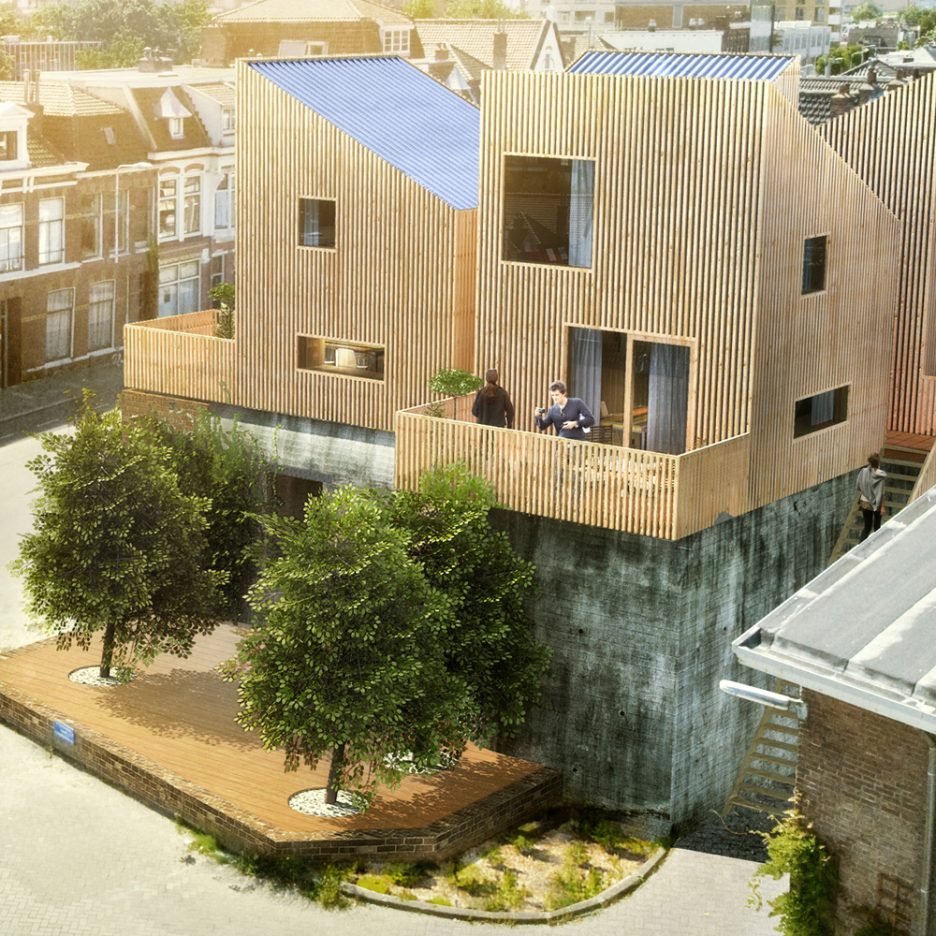
Four micro homes are mounted on the roof of a second-world-war bunker in this proposal by Froscen Architects for the Dutch city Leiden (+ slideshow). (more…)
Domein Oogenlust / architecten|en|en

© BASE Photography
- Architects: architecten|en|en
- Location: Hees 4, 5521 NV Eersel, The Netherlands
- Project Management: Franken PM
- Project Year: 2014
- Photographs: BASE Photography
© BASE Photography
The Oogenlust domain proves that matters can also be solved differently. A generic, almost banal program composed of dock shelters, offices, a showroom, storage and a greenhouse is combined in an estate that already received an enormous number of visitors, unanimously impressed by its appearance and atmosphere.
© BASE Photography
Eco Chique
The strength of Oogenlust is the ensemble, in which a large program is completely harmonized with nature. Here nature takes over the role of technology, for instance through solving sun shading by means of wisteria hanging over the facades or the breathing and moisture-regulating clay walls. The love for pure, natural materials has been the common ground between the client, the architect and the building parties, culminated in the finished project.
© BASE Photography
The most particular feature of the project is the fact that the former headquarters building belonging to the company was relocated to the new site. The red cedar cladding of this building is re-used as facade panelling for the new exhibition building. All the new company functions are executed to allow disassembly, in analogy with the relocated company building.
© BASE Photography
Plan
© BASE Photography
Nature has been the starting point for all aspects of the design, on all levels. The biodiversity of the domain has been enhanced by introducing several types of indigenous trees around the meadow. The large pond at the entrance provides, besides the collection of rain, also the water necessary for the company’s technological work.
Elevation
Details
From an architectural point of view, the Oogenlust estate is a composition of several built and scenic elements that generate a hybrid: a built scenery or a scenic building. Starting from the parking place on Steenselseweg, one walks over the bridge crossing the pond, under the building, to an enclosed area named “the plaza” hosting all the formal entrances in the complex. From this plaza the route passes by the greenhouse, the workshops, the meadow and pine forest where it articulates itself to the public routes between Eersel and Steensel.
© BASE Photography
A California-Design Home in Elsternwick, near Melbourne, Australia

Elsternwick House is a private home based on the “California” design and located in Elsternwick, a suburb of Melbourne, Australia. It was designed by InForm. Elsternwick House by InForm: “Based on the ‘California’ design, this family home centres around the open plan kitchen, meals and living zone which affords uninterrupted views of the landscaped backyard and pool. The deep wrapping eaves and external loggia area provide both refuge from the..
Norwegian Mountaineering Center / Reiulf Ramstad Arkitekter

© Søren Harder Jensen
- Architects: Reiulf Ramstad Architects
- Location: Åndalsnes, Norway
- Area: 900.0 sqm
- Project Year: 2016
- Photographs: Søren Harder Jensen, Courtesy of Reiulf Ramstad Architects
© Søren Harder Jensen
The Norwegian Mountaineering Center is anchored in an innovative interpretation of nature’s fantastic dimensions and the dramatic experience of mountaineering. The design of the building is based on its function as a mountaineering center and gathering place for both locals and visitors.
© Søren Harder Jensen
Plan
© Søren Harder Jensen
Section
© Søren Harder Jensen
This provides the structure with a characteristic volume communicating its contents with exciting and unique geometrical expression. Its outer skin is clad in a uniform surface, highlighting its originality and situation next to the train tracks of Raumabanen and the station area in the Åndalsnes town center.
Courtesy of Reiulf Ramstad Architects
Bert & May and Darkroom collaborate on geometric-patterned tile
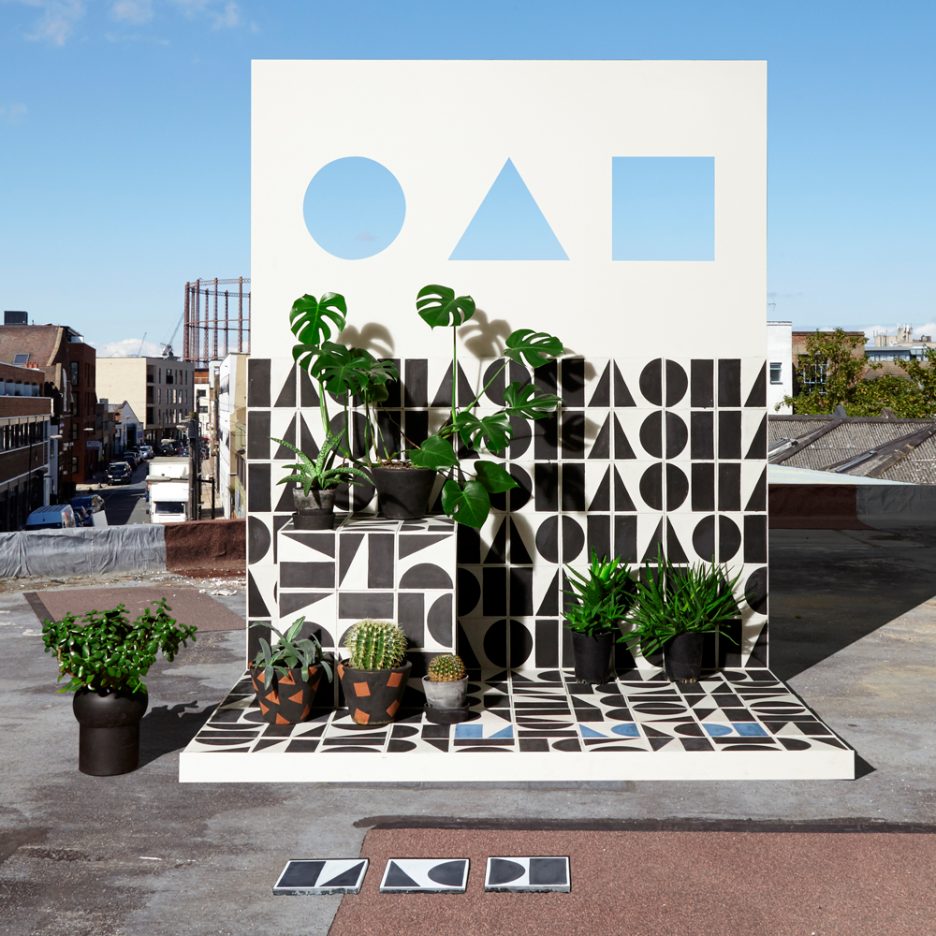
London Design Festival 2016: Bert & May has partnered with London design label Darkroom to create a range of handmade tiles featuring simple geometric shapes (+ slideshow). (more…)
House of Holly Osmanthus / Takashi Okuno

© Shigeo Ogawa
- Architects: Takashi Okuno
- Location: Ehime Prefecture, Japan
- Area: 314.79 sqm
- Project Year: 2016
- Photographs: Shigeo Ogawa
© Shigeo Ogawa
This u-shaped home surrounds an inner courtyard containing a holly osmanthus that has been cherished for many generations. It is designed to allow the tree to be viewed from any part of the house including the living room, dining room, the front entrance, and Japanese-style room.
© Shigeo Ogawa
The Japanese-style tatami room is planned to be used as a guest room. While it follows certain traditional aspects such as the sizes of the wood used and vertical length of the entranceway, by using as few parts as possible to keep the appearance simple, the aim is for one’s gaze to naturally be drawn to the greenery beyond the window to the right of the tokonoma (alcove). To maintain a dignified look, electronic equipment is functional yet kept discreet by integrating it into the architecture.
© Shigeo Ogawa
Diagram
© Shigeo Ogawa
The living area is designed for the family’s daily activities. It is created with finishing and details that give a sense of “softness” to accommodate the everyday life. The vicinity around the open ceiling is designed to be the gathering area for the family to relax, play, cook and dine in. The screen used for watching movies for fun was successfully and sleekly concealed by using a combination of wood and steel.
© Shigeo Ogawa
Respecting ancestors, cherishing the present, and connecting to the future.
Imparting the message of austerity into the free and flexible living space of today.
© Shigeo Ogawa
Materials used for the finishing are diatomite, marble flour, washi (Japanese paper made of grass and tree fibers) wallpaper, and solid wood. Insulation is made with cellulose fiber. By using natural materials throughout the building, a healthy environment has been created.
© Shigeo Ogawa
Shreyas Retreat / The Purple Ink Studio

© Shamanth Patil J
- Architects: The Purple Ink Studio
- Location: Bengaluru, Karnataka 560001, India
- Design Team: Akshay Heranjal, Aditi Pai, Jaikumar
- Area: 20000.0 ft2
- Project Year: 2016
- Photographs: Shamanth Patil J
- Client: Shreyas yoga retreat / inner challenges pvt ltd
© Shamanth Patil J
From the architect. Designed as a ‘Retreat within Retreat’, the 20,000 Sqft spa block is a new ‘insert’ at a well-known Yoga Retreat in Indiathat offers spectacular layers of spaces and experiences.
© Shamanth Patil J
The Architectural Vision is planned as a sustainable model, focusing strongly on the connect of man in the realm of nature. The main block disappears into the earth and is half submerged to connect to the isolating quality of the earth, with the light and air movement planned from a series of sunken courts. The approach to the main area slowly opens up a plethora of spaces which are programmatically planned to suit the smooth spatial transitions of the guests.
© Shamanth Patil J
Section
© Shamanth Patil J
The entire feel is organic with natural light washing the exposed walls and ceilings with a spectacular play of light and shadows. The spaces are further held together with a strong design language of Hand crafted jaali screens, solid wood doors and openings which merge the interior and exteriors, quite literally.
Plan 1
Plan 2
The Guest Lounge area opens up to a Central Court with water body on one side, and to a Sunken Court on the other. Private Consultation rooms are part of the main spaces, but are silently tucked away beside the water body.
© Shamanth Patil J
The spa block is seen as a semi-detached sequence that utilizes the adaptive approach with each unit fitted to the purpose it serves. Each spa room (measuring upto 600 sqft) is positioned to offer spectacular views of the site / surroundings, whilst concealing the guests from the outside with local exposed brick jaali works as the shell. The structure’s porous cell conceals a softer environment inside and the private open to sky lounge spaces (for after treatment relaxation) bringing in natural daylights into all spaces. With the spa offering an array of treatment options with the 10 massage rooms, one can experience the holistic Ayurveda treatments based on age-old therapies, or choose from the Oriental and western offerings from the menu.
© Shamanth Patil J
The landscape merges the geometry of network of the surrounding paths to form break-away spaces for the guests to lounge. These buffer zones create smooth transitions from the exterior, to semi covered spaces, and also offer a beautiful play of light.
© Shamanth Patil J
With each block growing from the sunken gardens into the sky, often blending into a series of greens, the organic approach seamlessly fuses the inherent sense of lightness expected from a space so serene. The feel is further exaggerated on the upper level, in the 2000 sqft Meditation and Yoga pavilion, with large openings on the east, allowing natural sunlight to create a powerful setting for the Yoga sessions at sunrise. The Large Pavilion opens up further to a series of private Yoga and Meditation Spaces offering beautiful varied settings using the natural play of light and shadows of the sun against the roof jaali’s / screens.
Elevated walkway and visitor centre added to 12th-century abbey ruins by Binario Architectes
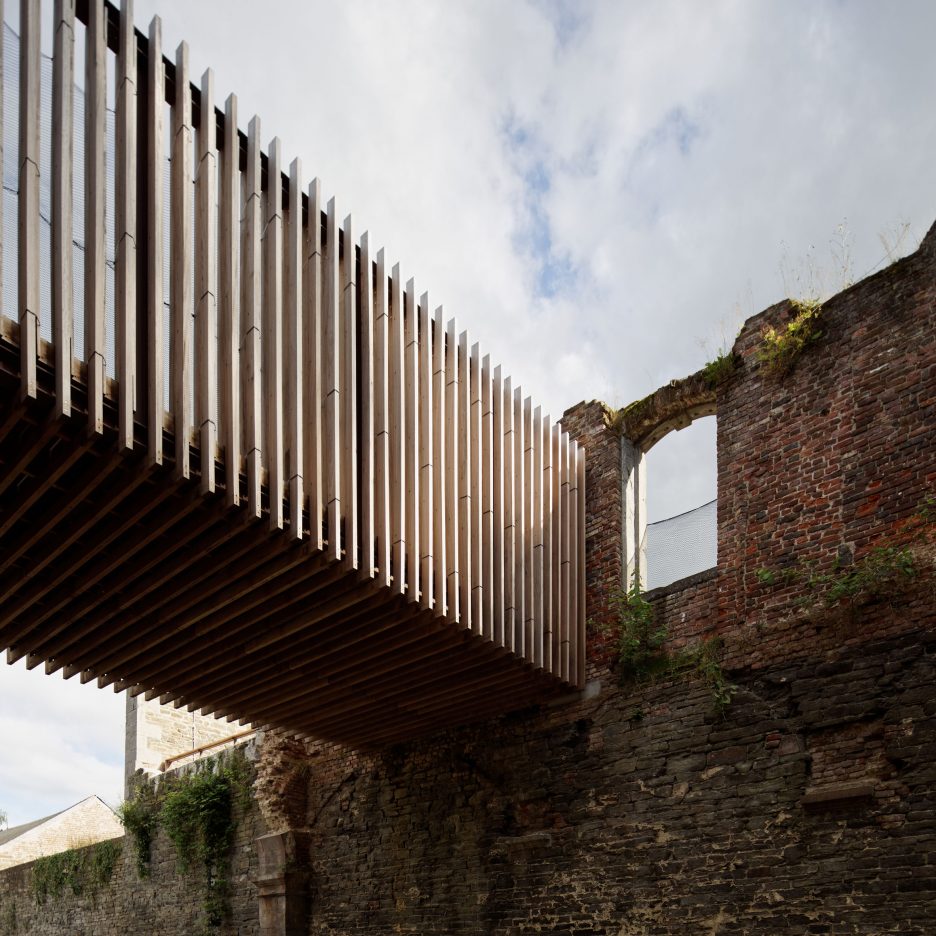
Binario Architectes has used Corten steel, concrete and wood to create a series of new additions to the Villers Abbey in Belgium, including a visitor centre and an elevated pathway (+ slideshow). (more…)
Sayanomoto Clinic / Yamazaki Kentaro Design Workshop

© Naoomi Kurozumi
- Architects: Yamazaki Kentaro Design Workshop
- Location: Saga, Saga Prefecture, Japan
- Architect In Charge: Kentaro Yamazaki
- Area: 308.58 sqm
- Project Year: 2014
- Photographs: Naoomi Kurozumi
- Book Direction: BACH / Yoshitaka Haba
- Structural Design: ASD / Ryuji Tabata, Takayuki Tabata
- Facility Design: EOS plus / Kazuhiro Endo
- Landscape: Takio Inada
- Graphic Design: musubime / Takehiro Kawase
- Floor Area: 308.58 sqm
© Naoomi Kurozumi
From the architect. We were approached to design a mental health clinic in Saga City specializing in the treatment of patients with dementia. As in other towns and regions, Saga’s aging population has created a greater need for healthcare for the elderly. Ordinarily, healthcare facilities are planned and constructed on the advice of medical professionals with the sole consideration of creating a space for efficient and safe treatment of patients.
© Naoomi Kurozumi
Plan
© Naoomi Kurozumi
In this clinic, however, a special “Learning” common space was created intended for patients living with dementia and their families.
This “Learning” space is not meant to directly treat the illness but rather to provide visitors with a starting point for facing the condition of dementia.
© Naoomi Kurozumi
In addition to an outdoor garden designed to recreate the local scenery of rice fields and mountains using local flora, a 30 meter bookshelf was constructed containing pictorial books intended not so much to be “read” but rather to be “seen” and impart an impression on the reader.
© Naoomi Kurozumi
By creating a common space where patients, staff and families can interact, we seek to connect people through “Learning.”
© Naoomi Kurozumi
 Sig Nordal