10 DESIGN has won a competition to design China Resources Land’s (CR Land) “Hengqin Wanxiang World,” a 2.3 million square meter (25 million square foot) mixed used development to be located in Zhuhai, China. The complex will include destination retail locales centered around an “Experience Central Square,” which will serve as a venue for a variety of cultural and performance programs. Construction on the massive development is set to begin this month.
Courtesy of 10 Design
“To realise CR Land’s vision, the design team created an ‘Experience Central Square’, which marks the nexus of the river and mountain geometries that surround the site,” said Ted Givens, Designer Partner at 10 DESIGN. “This large central hub becomes the active heart of the masterplan unifying 4 neighbourhoods and providing a vibrant retail and cultural destination.”
Courtesy of 10 Design
Courtesy of 10 Design
The immense scale of the project meant design needed to begin at the urban scale. To create pedestrian-friendly routes that connect to the urban fabric, the project features a central green belt linking to different activated streets, a convention center and waterfront walkways.
“In addition to the ‘Experience Central Square’, the energy of the city centre is ignited by the diverse mix of amenities including the Central Green Belt – Wanxiang Avenue, Retail Axis, Waterfront Promenade, National Pavilions, Expo and Convention Centre,” explained Miriam Au Yeung, Project Director and Partner at 10 DESIGN.
Courtesy of 10 Design
Courtesy of 10 Design
Givens added, “Sustainable design is a key driver for the master plan design. The first concept is to minimise the energy requirements through simple passive solar principles. Another goal is to reduce the reflectance and light pollution generated by the project through maximising the solid areas of the tower façades. With the proximity to the river, treating the storm water run-off through bio swales and abundant garden spaces is also very critical to achieving an eco-responsible design.”
Courtesy of 10 Design
Courtesy of 10 Design
CR Land in cooperation with Macao’s New Fenghong Real Estate Development and China Resources Trust have set aside 50 billion yuan for the construction of the development, which is expected to create approximately 50,000 new jobs and generate nearly 1 billion yuan in tax revenue each year – promoting the economic growth of the surrounding region, which includes nearby Guangzhou, Hong Kong and Macao.
Design Team: Ted Givens, Design Partner; Miriam Auyeung, Partner and Project Director; Barry Shapiro, Partner
Competition Team: Joyce Lo, Peby Pratama, Ray Lam, Ewa Koter, Daniel Wang, Xuan He, Yang Wang, Ismael Sanz, Jocelyn Zheng, Mujung Kang, Ruizhao Zhang, Thomas Chan, Dian Feng, Kenton Sin, Ketty Shan, Martin Lai
London Design Festival 2016: the London Design Festival has officially begun. With hundreds of events, installations and talks scheduled over the course of the nine days, we’ve picked out five key trends already emerging from the event. (more…)
From the architect. The Campus includes Dyson’s existing headquarters and factory alongside new built facilities: the D9 research and development building, the Lightning Café and The Hangar, which provides sports and leisure amenities for Dyson employees. The existing elegant and minimal buildings – originally designed by WilkinsonEyre – have also undergone extensive internal changes to allow Dyson’s continuous growth.
The practice’s design approach aims to create a new technology campus that is set to be a leading creative hub for UK’s top engineers and designers where new forms of working environment emerge. The D9 has been conceived as a minimal, reflective glass pavilion within a rural landscape setting. A central atrium brings daylight into the two floors and breakout spaces. The interiors are designed to facilitate flexible working, combining conventional desk space with laboratory facilities to allow for collaborative discussion and brainstorming.
As part of the brief, the surrounding landscape has been enhanced to create more privacy and prevent direct views into the building. The greenery connects to the existing Nature Walk, which surrounds the perimeter of the site, offering Dyson employees the opportunity for quiet outdoor reflection. The Campus now provides 129 advanced research laboratories and new collaborative spaces for the engineers to develop Dyson’s sophisticated technology pipeline.
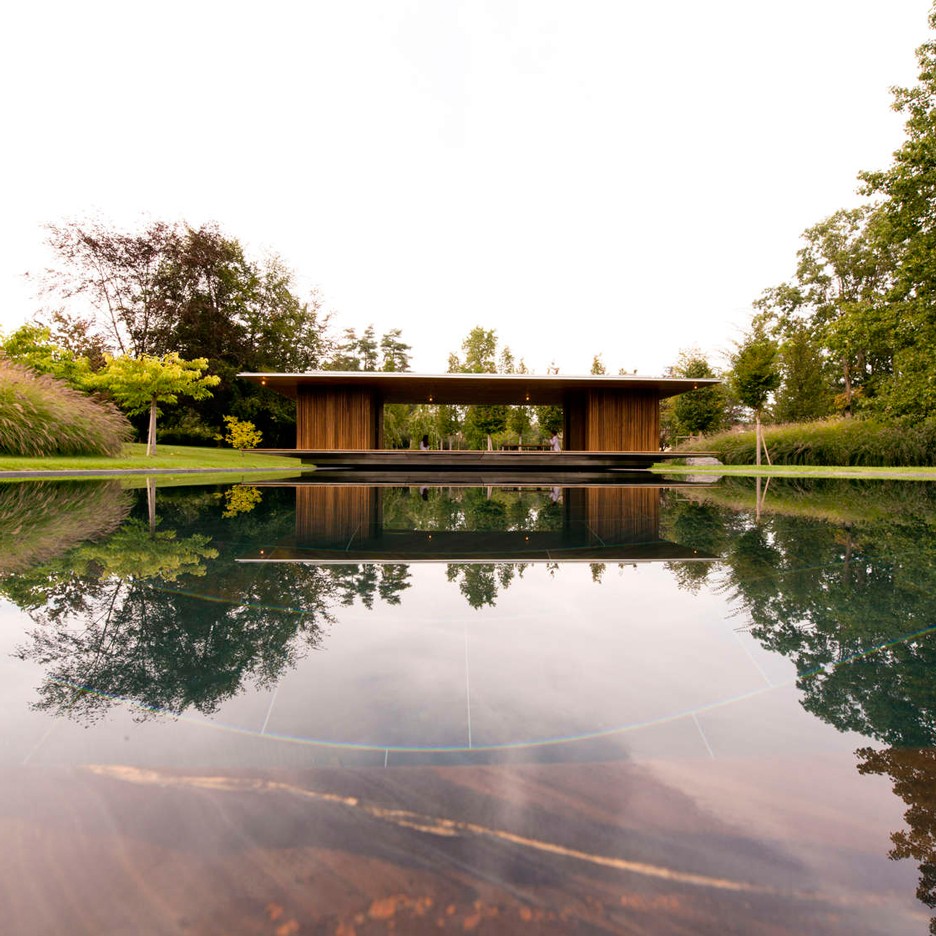
A+Awards 2016: artificial mist envelops this wooden meditation pavilion near Geneva, which earned its designers GM Architectes Associés an Architizer A+Award earlier this year (+ slideshow). (more…)
This single-family house is located on a former cooperative workers’ estate and replaces a building designed in 1948 in the spirit of the garden city. Its close proximity to the airport meant that the municipal building regulations largely ceased to have effect. The resulting restriction to a slightly larger replacement building and the distance guidelines created a lengthwise rectangular plan and volume.
A slight rotation of the upper floor in comparison to the two floors below articulates the building and brings it into scale with its surroundings. This moment of phenomenological irritation is moved into the foreground while solutions to specific details are handled with discretion. A window grid is implied by slightly set back, niche-like surfaces. The use of fewer window types and a restrained formwork pattern allow the storey-high twisting to emerge as a distinctive motif of the façade.
Inside the building, the modest dimensions and the decision to eschew hallways create a sense of intimacy. In each room, the corporeal building envelope of insulating concrete is omnipresent. In contrast stands the separation of the external elements of the composition. The house, the showcase balcony of steel construction and the garage as a precast concrete element are spread loosely across the plot. These necessary functional elements create an immediate context within the surrounding greenery.
Materialisation in insulating concrete allows a systematic to be achieved in the solution of the necessary building details. The structural elements of the façade and the interior are all part of the cast shell. The formal severity inside and out is not an aesthetic end in itself. It aims rather to provide an economical use of moments of irritation and serves to channel the viewer’s attention.
Driven by an intrigue in the ruination of Roman architecture, Brazilian architect, and photographer Olympio Augusto Ribeiro has undertaken a fascinating comparative analysis of Giovanni Battista Piranesi‘s architectural etchings and the scenes as they stand today. Travelling to each of the Italian sites brought to life in Piranesi’s drawings, Ribeiro has managed to recreate the original angle and shot, eventually compositing them together to create collages which cross time periods.
Piranesi’s drawings show different architectural styles side by side, and it was this coexistence that urged Ribeiro to investigate what has changed in Rome and Tivoli since their conception. The project, officially dubbed “Piranesi Project (In search of Giovanni Battista Piranesi’s Rome, 1720-1778)” took Ribeiro two months to photograph, meticulously recreating the images across Rome, Villa Adriana, and Tivoli.
Courtesy of Olympio Augusto Ribeiro
Ribeiro explains in the project bio that history was always the most intriguing part of architecture school, allowing him to further expand on his existing fascination with the renovation of Roman ruins.
The history lessons stimulated my curiosity about the transformations undergone by the ancient Roman Empire, and its transmutation into a new reality in which the old aesthetic glory had to live within the dark ages. During my studies in restoration I began to understand the process of their dilapidation, the history of their reconstruction, and how the ruins came to be in our time. However, I lacked the understand of how these 2000 years of transformations resulted in this mixture of styles and overlapping – said Ribeiro.
Courtesy of Olympio Augusto Ribeiro
Piranesi created The Piranesi Prints some 1500 years after the fall of the Roman Empire. They illustrate the coexistence of medieval villages, baroque architecture, and Roman ruins, and are commonly heralded as a strong influence to neoclassicism. Piranesi’s poetic and artistic flair allowed him to portray the buildings in a kind of “ruin fantasy,” and the expressiveness of the etchings make them all the more fantastic.
Courtesy of Olympio Augusto Ribeiro
Upon returning to Brazil, Ribeiro began to compose the collages, merging Piranesi’s mid-18th-century drawings with his digital, color photographs. He said that “I allowed myself my artistic freedom, but worked carefully to respect the original Piranesi work.”
Courtesy of Olympio Augusto Ribeiro
Check out the full gallery below for the exhaustive photograph analysis, and see for yourself how the sites have evolved.
Architects are often noted for having bad work-life balance, a lot of stress and little free time. How can you take time off while still improving your skills as an architect? Can that time off even give you an extra edge? Compared to other fields, architecture stands out as a field in which you need to “know a little bit about everything.” Thus, in order to live up to our name we must also do a little bit of everything, and as they say, a little goes a long way. So with that in mind, here are 11 activities which, while not obviously architectural, just might make you a better architect.
1. Playing Video Games
Video game developers have free rein when imagining and designing cityscapes and other spaces that frame the virtual universe. Such spatial experiences may never be realized in our physical world, but can still provide an entirely new perspective on the possible relationships between our bodies and our surroundings. They can go a long way in challenging your spatial problem solving, especially when Virtual Reality really takes off and becomes an ordinary tool in every architecture firm.
2. Reading Fiction
Fiction is possibly the easiest way for humans to put themselves in someone else’s shoes. As architects, this is a great tool for empathizing with different viewpoints in society, as well as understanding subjective spatial experiences and the emotions tied to them. A great example is “The English Patient” by Michael Ondaatje, a novel with characters from a range of socioeconomic and cultural backgrounds with memories strongly tied to spaces. Architects are sometimes accused of having little understanding of people, an issue which fiction could help to solve.
3. Watching TED Talks
An architect founded TED, however that isn’t why it’s on the list. As architects, we need to know how to defend our projects and ideas, making knowledge of rhetoric an essential part of the profession. TED speakers know how to construct an engaging argument within a relatively short amount of time, making them both entertaining and educational to watch. The wide variety of topics on offer will also undoubtedly help to build that wide knowledge base which is crucial to architectural practice. To get started, check out The 20 Most Inspirational Non-Architecture TED Talks for Architects.
Consistent physical activity has been proven to reduce stress, something that most architects have an excess amount of. Not only will it improve your workflow, it will also serve as a productive break when you need some time away from the drawing board (or computer screen), as studies have shown that walking actually improves creativity.[1] It’s important to maintain a healthy work-life balance in an industry that often demands long hours, especially when many of those hours are spent craned over a laptop with bad posture in an uncomfortable chair. A healthy body will make that time more pleasant and you will feel less fatigued by the end of it.
5. Taking Stuff Apart
When we experience stress, frustration and disappointment, many of us feel a primal urge to destroy the objects of resentment that surround us: that good-for-nothing laptop that’s slowing down your work process, or that annoying flickering lightbulb that’s giving you a headache. Most of us will, quite reasonably, resist this urge; you would not be a very popular coworker if you threw your laptop across the room every time it froze up. However, there is a certain satisfaction to be gained from taking things apart once they’re already broken or will no longer be used. More important is the understanding of how objects are put together and function. Although smartphones and toasters don’t exist on the same scale as buildings, there is something to be learned from the details of assembly. In the future, when that 3D Printer or those VR Goggles aren’t cooperating, you’ll be the company’s most valuable asset.
6. Painting and Photography
In the process of painting or capturing and editing a photograph, there are three fundamental elements to keep in mind: color, light and composition. Unsurprisingly, these elements are just as crucial when it comes to architecture. Being experienced with these components within another context can give you an edge and an alternative way to approach the design process. In addition to this, you will be far more acquainted with the details of your surroundings. By taking the time to paint or compose a particular photograph, one observes features with more care than if one were just to look at them.
When hosting dinner parties, creating a pleasant atmosphere and experience for your guests is of utmost importance. This doesn’t only require good social skills, but also a knowledge of cosy lighting, comfortable seating areas, and deliciously smelling food. In other words: sensory experiences that make people feel at ease. Architecture affects all our senses—perhaps with the exception of taste—yet architects often seem to get caught up in the visual elements of a building. Understanding how tactile architecture, for example, can affect people’s comfort in, and enjoyment of, a building is a huge advantage for an architect. Because if we aren’t creating spaces that people feel good in, what is the point of our profession?
8. Living in Nature
Living in nature, temporarily or otherwise, is one of the most certain ways of falling in love with and fully appreciating our natural world. The large-scale impact that comes with being an architect means that we play an enormous role in conserving and sustaining our environment—a huge and unavoidable responsibility given the current situation of our planet. A vital aspect of sustainability lies within context and understanding the specific location on which a building is being designed. Experiencing the environment first-hand develops a deeper respect for how different climates are capable of assisting our architecture.
9. Travelling on a Budget
In our modern world, being a tourist has become such a popular pastime that the purest forms of cultural exposure are being compromised. Travelling on a budget, however, can give you that extra push to get to know locals and their cultures while looking for a place to stay or learning about the history of a place. By travelling you build a personal relationship with a range of contexts, gaining a deeper understanding for the individual qualities of different locations. Read more about the genius loci of architecture and the fight against global solutions in this interview with Ricardo Bofill.
10. Social Volunteering
As is made clear with the word “social,” this activity encourages interacting and forming relationships with people, an important part of architectural practice. Architects design spaces for people to enjoy and feel happy and safe in, but in order to fully understand what this can mean for individuals it is necessary to understand people’s needs and preferences. Social volunteering is a great way to make a positive impact in your community, while gaining a broader understanding of different spatial needs within society.
Learning how to play an instrument requires the development of one’s understanding of rhythm, repetition and slight variations that sound pleasant and appeal to almost all human beings. How can these properties be translated into space? That’s a question you might be able to answer after a few months of playing the trumpet.
Now, go have a well-deserved break, and come back a better architect than ever.





 Sig Nordal