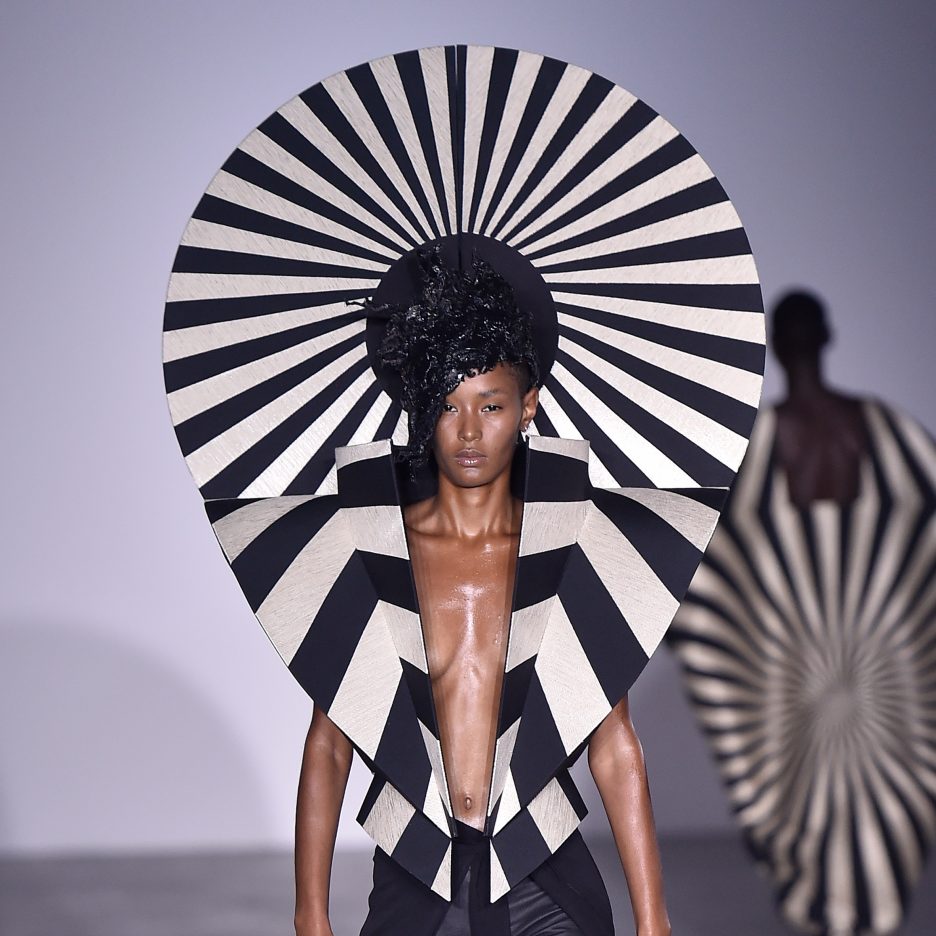
British fashion designer Gareth Pugh has based his latest collection on costumes he created for a sun-themed opera, using golden triangles and black stripes to depict rays of light. (more…)
British fashion designer Gareth Pugh has based his latest collection on costumes he created for a sun-themed opera, using golden triangles and black stripes to depict rays of light. (more…)

Villa Melana is a residential project designed by Studio 2 Pi Architect & 02 Architecture & Mech. Engineering in 2014. It is located in Pera Melana, Greece. Villa Melana by Studio 2 Pi Architect & 02 Architecture & Mech: “It all started as a simple snapshot; At a very steep site with clear view towards the sea a holiday retreat protects its inhabitants from the sun heat and the strong..

When you think of original designs, you know that you’re talking about something unique and special. An innovative design that can change our perception and visual culture: that is exactly what the German designer Elisa Strozyk does with Wooden Textiles, a product line that mixes wood with fabric.
The designer shows us that innovation remains a fundamental part of design. She imbues wood with living properties and turns it to a flexible fabric with unpredictable movements, changing its color and texture. It’s an astonishing use of this traditional material to create new forms and experiences.
Wooden textiles seeks to convey a new tactile experience. We’re used to experiencing wood as a hard material. We know the feeling of walking on a hardwood floor, touching a table or just feeling the bark of a tree. But we don’t usually experience a wooden surface that can be manipulated or molded by our hands.
Elisa Strozyk explores ways to provide textile-like properties to wood, making it soft and flexible. The result is a material that is half wood – half fabric, a mix between stiffness and flexibility, challenging what is expected of this type of material. It smells and looks familiar, but it feels strange since it is able to move and come to life in unexpected ways. Strozyk explains:
The world around us is increasingly intangible. We’re used to writing emails now instead of letters, online shopping, downloading music and pressing virtual buttons on touch screens. We live in a society of images, a visual culture full of color; advertisements, television and Internet. It doesn’t allow us to feel. Giving surfaces we want to feel the importance they deserve we can reconnect with the material world and increase the emotional value of an object.
The process to transform wood into a flexible surface involves breaking it up into triangular pieces and manually attaching them to a textile base. Depending on their size and shape, each piece displays different behaviors in terms of flexibility and malleability.
This geometric pattern can be used to create numerous objects, such as rugs, carpets, coverings, upholstery, clothing and even furniture.
Dyed – Wooden – Textiles
For this collection wood is stained with a special technique, emphasizing the natural growth patterns in the wood.
A collection that alludes to plaid fabrics like tablecloths and table runners, using fading color patterns. It is an exclusive collection for the Gestalten Pavilion store in Berlin.
Colored – Tablerunners
Fading plaids – Tablerunners
Miss – Marple
This ceiling lamp shows the use of wood in an unconventional way. The grid of triangles makes a flexible display that can be manually transformed into three-dimensional shapes. Although it generates light in the darkness, the outer surface becomes more evident with daylight, becoming a sculptural object.
The potential of this carpet lies in its flexibility. It can be rolled up and easily transported. The ability to move it implements a potential for change. It can be placed on the floor, sculpted in a dramatic way, or placed it on the wall.
Limited Red
Grey Black Birch
Mostly Red
Ashdown
Mortimer
Sherwood
Wentwood
Septagon – Bar – Cabinet
With its sculptural three-dimensional surface and the exceptional heptagonal shape, this mounted “bar cabinet” resembles a “wooden crystal.” The inside of the case is covered with a layer of light sensitive padouk, whose bright red fades with each opening of the cabinet door.
The flexibility of Wooden Textiles has attracted interest from other designers in the textile world, which has allowed for various collaborations, where dresses and other garments made of wood were created, and which can be seen at the end of this video:
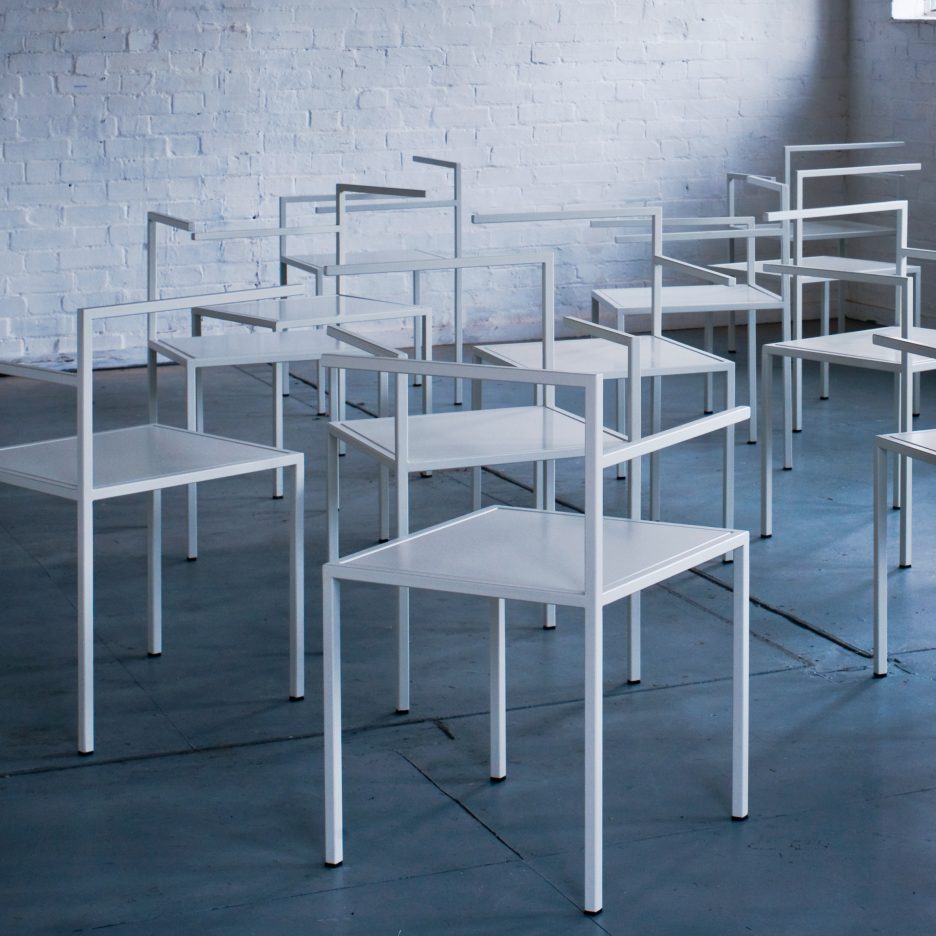
Dezeen promotion: interior design company Nobody & Co has launched a series of playful products, including chairs with missing parts and a modular table that can be rearranged. (more…)

The project forms part of a larger renovation to a freestanding villa located high up on the slopes of the Vlakkenberg. The clients required a pavilion within their extensive and beautiful garden, from which to appreciate the natural landscape around them.
Site and Context
The site consists of a series of terraces, oriented north- south and falling to the east. The house is located over two terraces and overlooks the garden terrace below. There are significant mountain views to the north and sweeping views of the peninsula to the east. South-east winds are severe in summer.The existing garden terrace contained an ostentatious water folly at its southern end, comprising a water cascade falling in to a pond with elaborate fountains. This feature is on axis to a large pool on the far end of the terrace, separated by a large expanse of garden.While this garden folly appealed to the new owners’ sense of humour, they requested that it be ‘toned down’ and incorporated into a meaningful outdoor relaxation area for the appreciation of the back of Table Mountain to the north, a view they love, but cannot really appreciate from the house.The siting concept was to locate the new pavilion both as a termination of the garden, as a backdrop to the water feature and as an evocation of the mountain across the valley. It required both solidity and presence, transparency and lightness.The earth banks behind the pavilion were manipulated to form a natural basin
Design Intentions
The pavilion attempts to address a complex question: how to create a meaningful dialogue with place when the surroundings are both de-natured and powerfully ‘natured’. This requires that the relationship between architecture, nature and modernity is carefully considered. The building is intended to be of nature: to contain a distillation of landscape which then allows it to be naturally contained by its surroundingsWe limited our consideration to the timeless, the simple, to charting the movement of the sun, the changing quality of light during the day, the mystery and magic of the landscape at night. To stillness, emptiness, possibility.The intention is to say as much as possible with as little as possible and to leave as much as possible unsaid…
Concept
An abstract sculpture, which is a distillation of nest and tree canopy, floating over the flat plane of the garden. The abstract form is neither purely aesthetic nor purely rational. It is conceived to be elemental, of itself, more of an object than a building, which can compete in its perceptual power with the strength of the surrounding natural landscape on the one hand and the artificiality of its immediate surroundings on the other. The notion of change, the passing of time expressed through the day and the year, is tracked by a perimeter aperture which mediates an ever changing and subtle play of light on the rough concrete walls of the building.
Design Realisation Organisation & Accommodation
The accommodation comprises a number of seating areas, both under cover and in the open and a barbeque area. A small kitchen, storage and bathroom block are included due to the distance from the house and complete a flexible entertainment place for individual and large scale gatheringsThe pavilion is arranged on intersecting axes. The major axis was an existing one between the existing water feature and the swimming pool. It is expressed by the timber floor plane and is really the axis which connects to landscape on both sides. The cross axis, is defined by the shelter and adjacent services block.The placement of the building was calculated to create a series of outdoor places with different spatial qualities to allow for a layered and varied experience.
Structure & Material
The materials are minimal- concrete, timber and textured plaster.The entire canopy structure is of self-compacting reinforced concrete, with a Penetron additive. The shuttering was pine planking, planed all round. This smoother surface treatment was specified, in order not to disturb the overall unity of the form in the raking sunlight.

Guazuma House is a private home located in Villahermosa, Tabasco, Mexico. It was designed by Alberto Zavala Arquitectos in 2015. Photos by: David Cervera
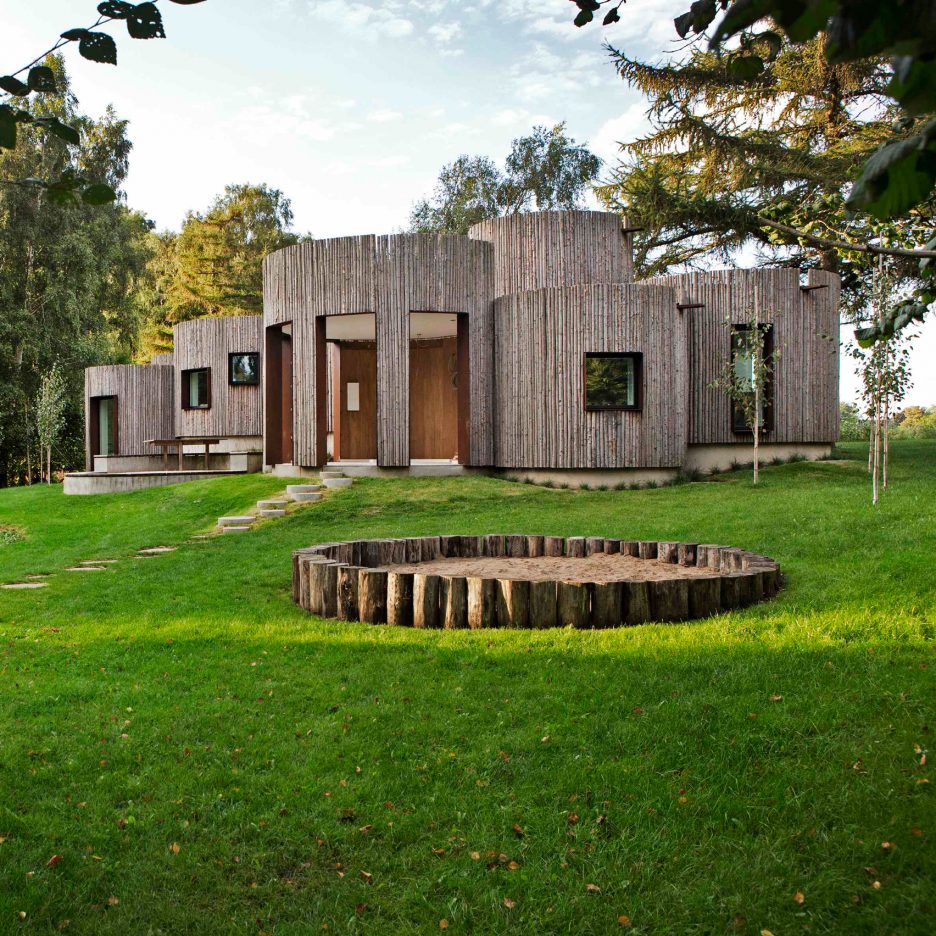
Nine cylindrical volumes interlock to form this holiday home on the Danish island Møn, which is covered in thousands of spruce logs and lined with beach pebbles (+ slideshow). (more…)

The prefabricated timber-frame house stands on a slope with views over the hilly Alsatian countryside. The cubature of the detached house reflects the skilful orchestration of the local building code specifications, with the interior divided into split levels in order to create four independent levels.The roof and short façades are clad in a skin of copper-titanium-zinc alloy, while spaced wooden slats were used on the long sides. The façade materials accentuate the idiosyncratic volumetry of the wooden house. The structure is formed by a wooden shell mounted under the roof, which serves as the upper storey.
The over-height space between the shell and building envelope is the highlight of the house and at the same time its centre. This area is connected to the outdoors via a large window. Narrow skylight-slits in the roof and along the integrated shell bring light into the sculptural interior. At its core it is a wooden installation that divides and connects the entrance, cloakroom, kitchen, dining area, living room and lounge. The precise carpentry work makes the functions in these areas disappear into an all-enveloping abstract sculpture.
Access to the upper floors in the installed shell is gained via seamlessly built minimalistic stairs made from solid wood steps. The bedroom, study and bathroom are separated by built-in wall cabinets. The walls and doors are aligned with no projections.

The Rotterdam Suite is a private residence designed by 123 DV. The 2,690-square-foot loft is located in Rotterdam, The Netherlands. The Rotterdam Suite by 123 DV: “Great Expectations What would you expect, when entering a 250 m2 (2690 sq ft) loft at De Rotterdam, the biggest building of The Netherlands, (designed by OMA/Rem Koolhaas), at the height of 143 meters (469 foot), on the 43rd floor? Rotterdam seen from the..

On Zeeburgereiland in Amsterdam, right before the Piet Hein tunnel, a growing student population has been livening up the area. Here Studioninedots designed an iconic block with 364 student apartments. Passersby this summer caught glimpses of the first residents enjoying the sunshine on the shared terraces that form the stepped roof.
Zeeburgereiland is rapidly developing into an urbanised part of Amsterdam, and the city-wide demand for student housing is addressed here on the 134-metre-long site on IJburglaan. Studioninedots utilised the organisation of the outdoor spaces as a way to facilitate a collective culture and the dynamic use of the building. A major strategy relocated the terrace, which was originally allocated on the quiet but unattractive north side of the building, to the roof.
By stepping the block down southwards, this created space for shared terraces, enabled variety in the apartment layouts and formed an iconic urban silhouette. The clever positioning of the stepped terraces enables the building to function as a barrier against traffic noise for the residences behind.
Double height glass entrances mark access to the apartments. Complementing the roof terraces is a green zone that lines the front facade, filled with hollyhocks that lean against the brick piers. The terraces of the ground floor apartments open onto here.
The dimensions of the piers vary, widening towards the centre of the building, which appears as a triptych. Each with its own rhythmic quality, the different sections together accentuate the overall upturned form: the building smiles.
Our cities are becoming more compact. In this context Studioninedots sees an increasing need for better collective spaces and public spaces. Its architecture creates characteristic spatial interventions on dense urban sites that function as catalysts for meeting, exchange, connection and activities between people – in this case, between students.
 Sig Nordal