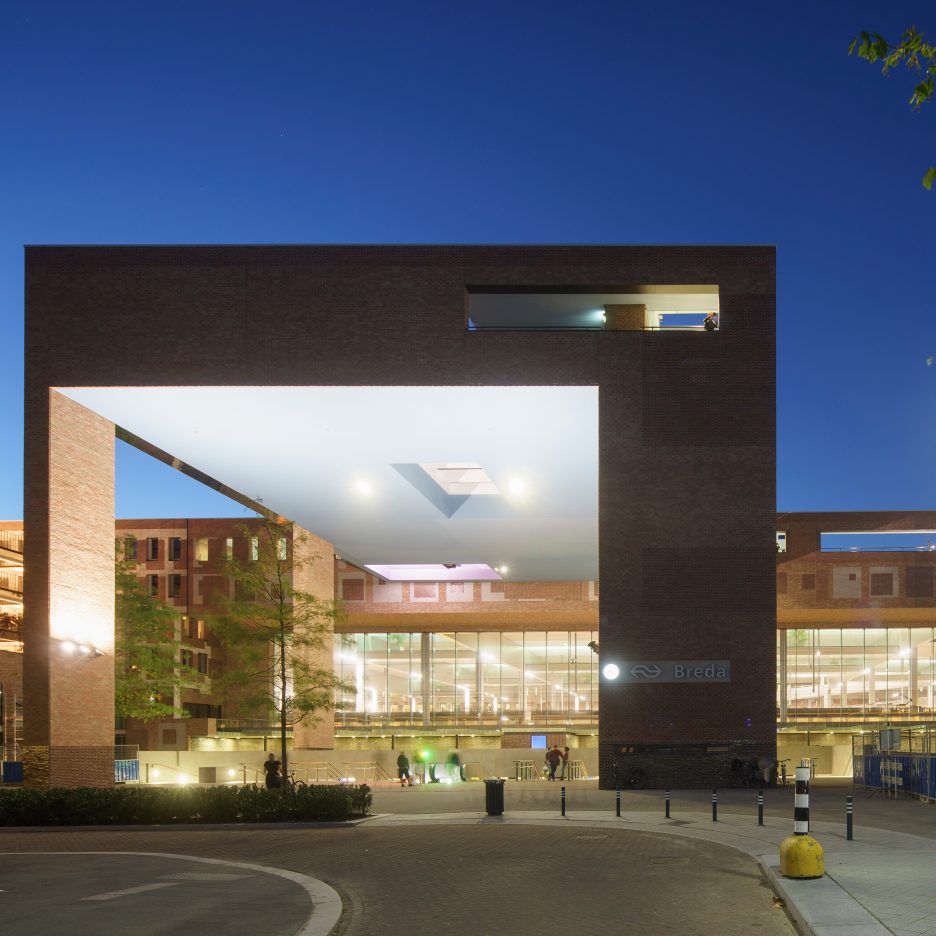
Koen van Velsen Architects has created a new transport hub in Dutch city Breda, featuring a huge entrance canopy and a variety of brickwork styles (+ slideshow). (more…)
Koen van Velsen Architects has created a new transport hub in Dutch city Breda, featuring a huge entrance canopy and a variety of brickwork styles (+ slideshow). (more…)

Sonoma Residence is a private home designed by Turnbull Griffin Haesloop Architects in 2016. The 4,890-square-foot home is located in Sonoma, California, USA. Sonoma Residence by Turnbull Griffin Haesloop Architects: “The site, a meadow dotted with magnificent oaks, gently slopes down to a spring fed pond creating an unusually lush landscape. The owners requested that the house be designed for outdoor/indoor summer living. They wanted guests to have easy access..

Building a single-occupancy home over a former water cistern was the starting point of the project. The site, subsequently altered over time, reached its final configuration circa 1955. It has two levels, facing south, and has remained unaltered since then. The site is part of a low-density suburban environment, which belongs to a development model distinctive of peripheral areas, characteristic of the first third of the 20th century as the summer stays residential areas in the mountain range of Madrid. The site contains typical scrubland vegetation, increased with non-native but suitable species, conditioned by the region´s dry continental climate (very warm summers and very cold winters).
It was initially an underground cistern connected to a well that supplied the main and original building of the state. It presented informal floor plan geometry, probably due to the adaptation to a rocky ground. The unevenness of the ground propitiated the surfaced of the southern side of the fabric, which adopted the image of a strong retaining wall that confined, on this side, an upper paved platform where is located the well head, and which was occasionally used as space for celebrations. When the cistern no longer fulfilled its mission, it started to be used as a warehouse and storage room for all sort of objects and utensils, but without any other adaptation than an entrance aperture. The interior constructive and structural configuration was then revealed. This was the first re-appropriation, yet the place continued maintaining its initial ethos as an accessible exterior space, that hides, underground, a warehouse.
The final re-appropriation occurred with the transformation of the site in order to address the commission. Neither the immediate environment nor the toponymy is modified; quite the opposite, the pre-existing is accepted as a possible trace pattern (the curved glass façade follows the trace of the former step to be maintained). On the former paved platform emerges a perched object that moves forward and overhangs facing south over the novel empty space produced by the unevenness of the terrain. The inferior ground level is slightly lowered in order to, with the creation of a new enveloping wall, create a veranda that is placed outside the former platform atmosphere, and that now boasts being, at once, interior and exterior.
The upper floor of the house occupies the new prefabricated volume built with cross-laminated timber made of large, multi-layered panels of spruce-pinefir (SPF) lumber sitting on top of a new metallic structure that does not interfere structurally with the old massive structure; composed of natural stone, ceramic brick and concrete. This volume shapes a big open space that works simultaneously as living/dining room and kitchen, communicating the house with the common garden. The lower level, partially buried, includes the private and intimate spaces, fragmented rooms of retreat, opened to a patio and to the aforementioned private interior-exterior porch veranda facing a pre-designed artificial landscape unlike the natural picturesque of the common garden.
A building envelope of the new volume has been designed with a high degree of thermal insulation concerning a distribution of blind/open planes that optimizes natural lighting and cross ventilation (in response to the oriented geometry embedded within the existent landscape and to the a new landscaping strategy as a summer/winter passive conditioner); in addition to those other conditions particular to the pre-existing cistern volume (massiveness, natural ventilation, distribution of window spaces and apertures, spaces semi buried and `cave or grotto effect´; reinforces the energy concept of the house, fundamentally based on passive measures.
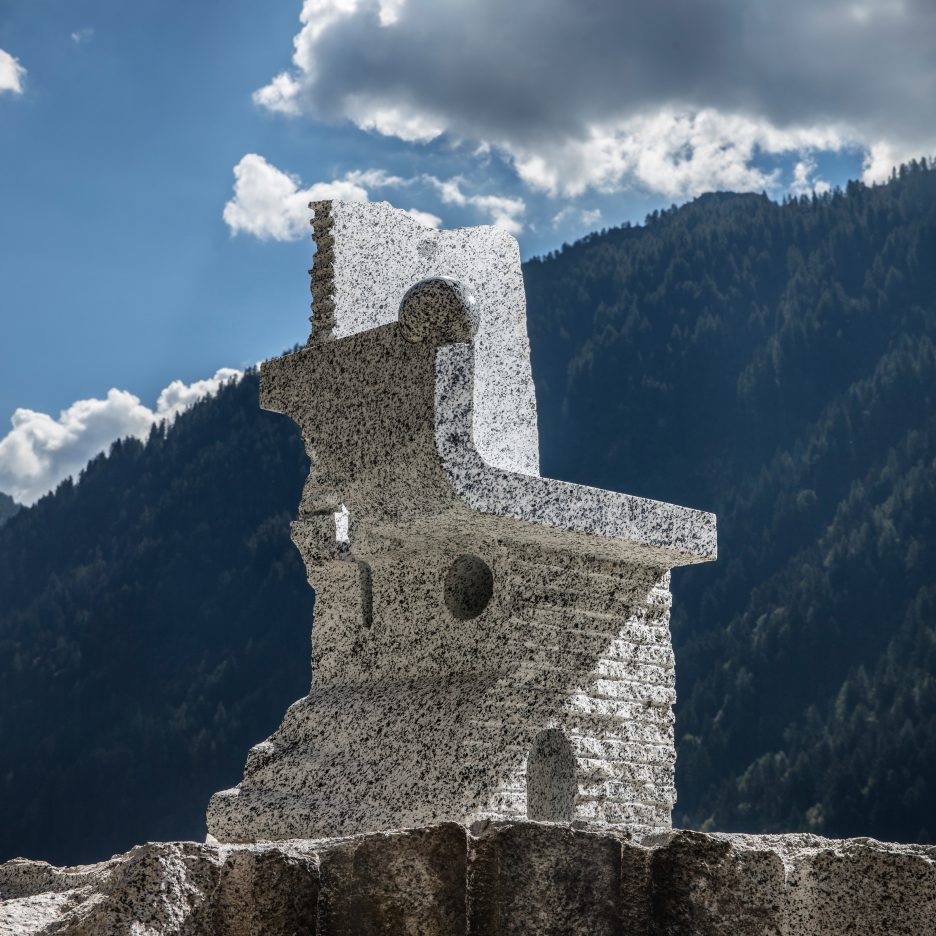
London Design Festival 2016: British designer Max Lamb worked with experts from Italy’s mountainous Trentino region to produce the monolithic Campione chair (+ slideshow). (more…)

The school sits in a neighbourhood with constant construction activity and a godown is in its immediate vicinity. Creating a learning space for a young age group on such a site required that the school be an enclosed and protective space. The site factor played a key role in the design, along with the Reggio-Emilia education approach itself, on which the school is based.
Unlike the longstanding notion of everlasting buildings, it is not uncommon to see built spaces being renovated or redone entirely to keep pace with people’s changing needs. The permanence of a building may no longer be a prerequisite in its design. This being accepted, it is necessary to allow material recovery and recycling, or reconstruct the same building elsewhere – anything but create debris that will occupy landfills.
Various building techniques make the design economical and recoverable to the maximum – chappadi granite stone slab foundation, paver block flooring, paper tube partition walls, and bolted steel supports – creating a structure that can be transposed. The external fabricated façade is a tack-welded mild steel frame with panels of perforated metal sheet, pinewood, reflective glass, operable louvres and sliding windows, planned with regard to light and ventilation. CSEBs made of soil from different sites in the locality create pleasing patterns which harmonize with the floor colours. GI sheet is used in consideration to the roof slope, with a false ceiling of bamboo mat plywood for thermal and sound insulation, which further imparts a sense of warmth. Preference of a hand-crafted material such as bamboo mat over the conventional plywood allows a valuable skill to be preserved.
Exploratory learning is encouraged through a permeable design of the interiors – walls of varying heights enclosing curvilinear classrooms and common spaces under a skylight-dotted roof. The roof is supported on eight columns, each in the form of a branching tree. This tree form, while being a structural element, allows the roof to be perceived from a height that children can relate to. It is also a reinterpretation of learning under a tree, a common sight in rural parts of the country.
The building consists of four classrooms, a studio and a childhood stimulation centre around a central piazza, with filter spaces allowing transition between the rooms and the piazza. The toilet is designed with consideration to the young age group, cubicles scaled appropriately for children as well as their need to be supervised. Open drains in the wash area and urinal walls are incorporated for ease of use and maintenance.
The building consists of four classrooms, a studio and a childhood stimulation centre around a central piazza, with filter spaces allowing transition between the rooms and the piazza. The toilet is designed with consideration to the young age group, cubicles scaled appropriately for children as well as their need to be supervised. Open drains in the wash area and urinal walls are incorporated for ease of use and maintenance.
Light durable furniture made of honeycomb boards and paper tubes further encourages kids to explore and play with the environment. The versatility of the material permits a variety of configurations.
Rainwater is harvested from the entire roof area, filtered and collected in the sump tank which overflows into a groundwater recharge well, effecting water security. Solid waste from the school is disposed of in twin leach pits which are effective in returning nutrient to the soil.

From the architect. Kunshan Electronic and Bicycle Pavilion project are located on the north side of Qianjin Road in Kunshan Development Zone, which close to the Xiajia River and the City Park. On the side of the river is the center of the city five-star hotel revetment.
1. In the aspect of design philosophy: according to the project design requirements, three perspectives of digital, ecological, exhibition have been showed as a design concept for the project.
First of all, the architectural form, space and display device should reflect the background of contemporary digital technology, conforming to the concept of digital architectural form. Besides, it should embody the sense of building technology and futuristic, which can bring infinite imagination and possibility to people. In the meantime, the building could promote the vitality of the city and symbolize take-off development of the economic and technological development Zone in Kunshan.
Secondly, the architectural form reflects green ecological design concept from the shape coefficient, landscape construction, lighting, ventilation and so on. Flexibility and stepped landscape architecture has not only become the landscape part of the outdoor park environment, but also provided minimized sunshine occlusion and comfortable wind environment for the park. Architectural forms adopted the landscape building body about “a convex a concave and one yin one yang,” and therefore the building itself is both the form of architecture and also the landscape. The roof of architecture is not only a building structure but also a landscaped road, for example. Indoor and outdoor functional space by overlapping each other can form close indoor and outdoor spatial interaction, including ground, overground, multi-dimensional, multi-level.
Moreover, the basic element of the building space form is a circular, oval. According to the combining relationship between each other, it forms logo shape of the building, which incarnates architectural carrier features as athletic display features.
2. In the design of operation: architectural form from the initial idea to the final completion, in fact, is constantly modeling of the process with the limitation of the comprehensive conditions. Combined with a variety of software, the architecture form design has been completed with non-linear geometrical characteristics.
First, in the process of building shape gradual completion, architects designed by using Rhino, Grasshopper, Ecotect, Revit etc software to solve synthetic problems, such as shape optimization, integration issues professional coordination, shape positioning, environmental analysis and so on. Final optimized architectural shapes have been accomplished by parametric control adjustment model, spatial orientation and expand curtain wall design approach.
At the beginning of the construction of the nonlinear geometric design, according to the inner logic of parameterized, the construction geometry can be adjusted by designers. Besides, architectural shape has been carried on tests about wind pressure and speed by using Phoenics software. Then combined with parametric geometry adjustment, the architectural design has been optimized. Existing buildings defuse the wind speed of the building itself and surroundings and reduce wind shadow zone area. At the same time, the sunshine analysis has been completed to optimize the building orientation and form a high-quality exhibition space.
Then, aim at the problem of structure adjustment caused by structure control boundary, curtain wall control boundary and architectural form adjustment, designers discussed how to combining with the architectural form conception, which could make sure the key controlling factors of the architectural form to establish the finished surface, structure control boundary and correlation model method of the internal structure of axis. In addition, both the division of building façade and the axis of the structure model of the space are participated and achieved by parametric design software.
Finally, the spatial orientation of the building outer contour coordinate points can generate automatically to provide spatial orientation reference on-site construction.

This building is for the company of GO.medi-tech, developing medical appliances and making, suppling rehabilitation assist equipments and aging friendly goods. The Office of GO.medi-tech is composed of a commercial space for rent at first floor and spaces for the company such as offices, a lounge, a manufacturing room and a storage at second, third and fourth floor.
This building, sit in small site about 150 sqm, is located in Taejeon-Dong, Buk-gu, Daegu, South Korea, and there is Maecheon Station, third of Daegu Metro, in the south and Palgeocheon, the upper region of the Geumho River, in the west. Also, there is a neighboring commercial district and a residential area in the north and east.
The shape of building is decided by following law for right to sunshine of north residential area. Also, entrance spaces, which mean main, commercial and parking entrance, are linked with levels of site naturally. Because of that, inside of first floor was able to be a flexible space and has various ceiling heights.
The core of building is suited at the best position by considering a shape of building and a location of main entrance, and then we tried to make a pleasant space of stairs by using wires instead of rails. At the space of between our building and a adjacent building, we secured a privacy of the site by making scenic plantings. The lounge of third floor for accepting various purposes is arranged near a north terrace because of an intention for feeling a city scenery closely. In addition, a storage closet, planed patterns that can be possible to penetrate, created a bright atmosphere of inside space.
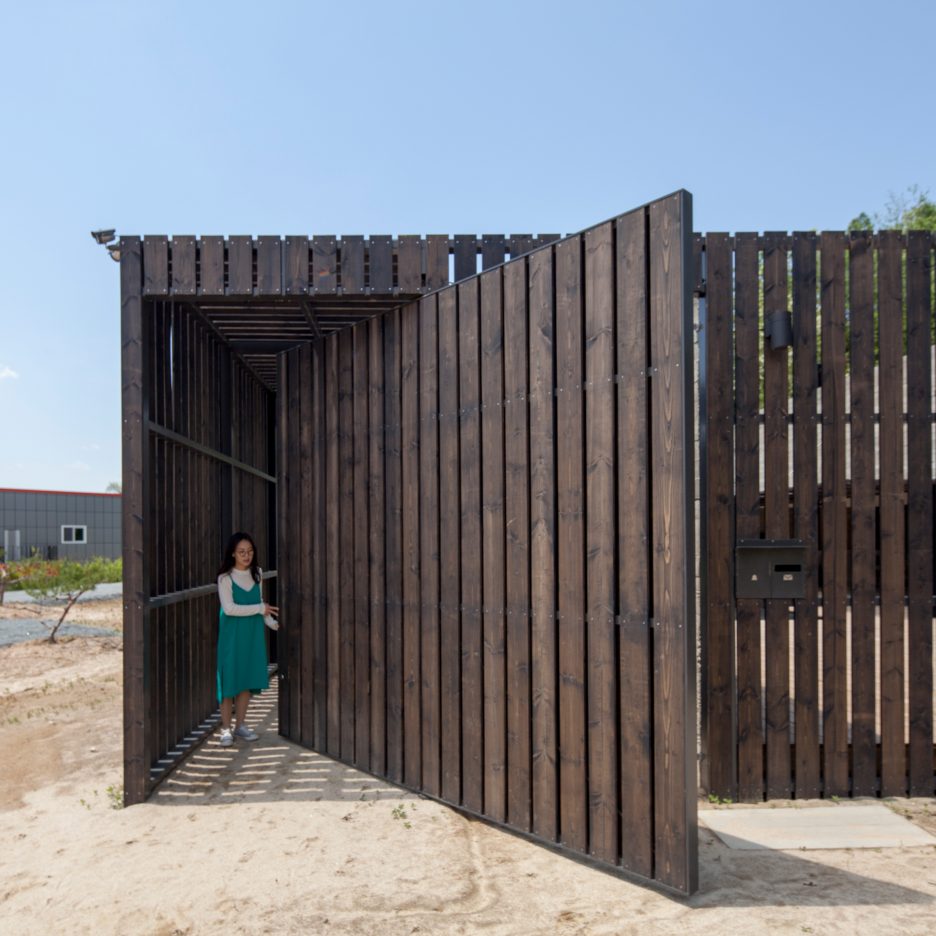
Dandelions are used to make medicine within this timber and concrete complex that architects office Archihood WXY has built in South Korea (+ movie). (more…)
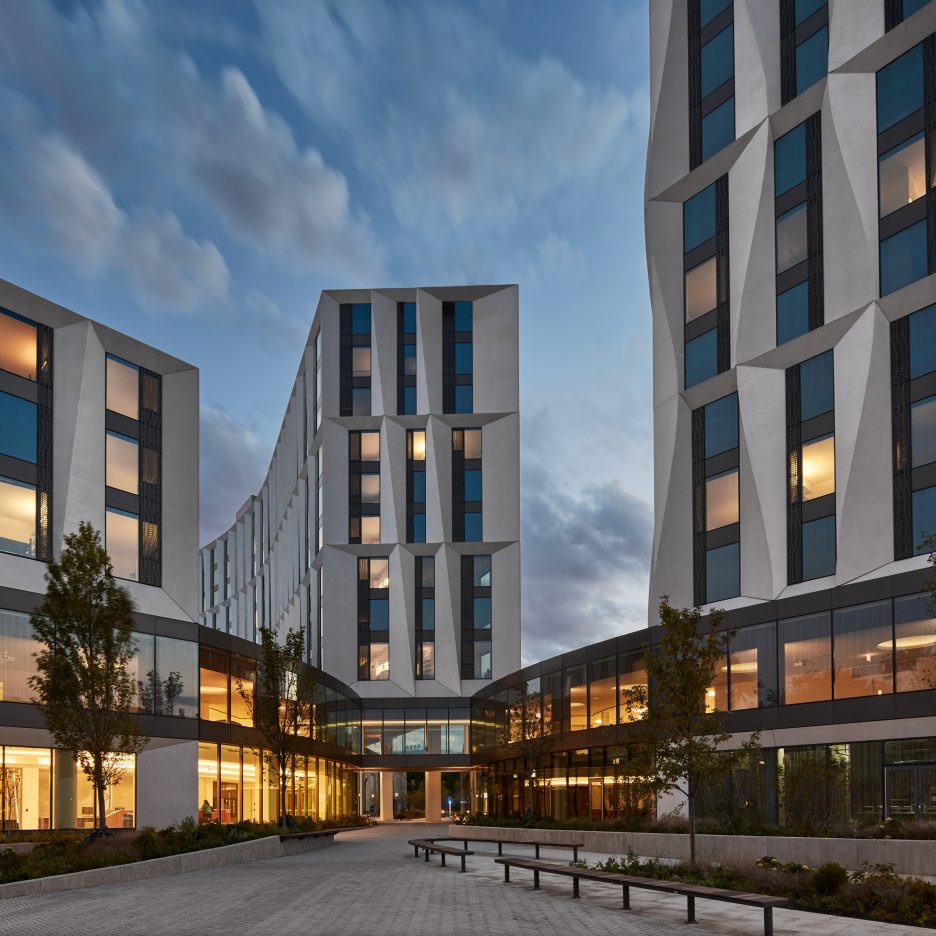
US firm Studio Gang has completed a student residential complex for the University of Chicago that features towers sheathed in glass and sculptural white concrete panels (+ movie). (more…)

The Flinders Lane Pub is a completely new pub built on the south side Flinders lane, opposite to the entrance to the 101 Collins St office tower. The shell around the new pub is the remnants of the Rosati Bistro, itself a Melbourne icon 20 years ago.
The proposed pub is made up of 5 levels, 4 of which are accessible by patrons.
A public bar greets patrons from Flinders Lane, which gives way to an open courtyard. Central to the project is the garden courtyard beneath a glass roof. The courtyard is host to mature trees, terraced seating and an open bar and kitchen.
The laneway bar lies beneath, connecting the courtyard and Duckboard Place to the rear.First floor offers a private dining room and balcony overlooking the courtyard and offering views back across the city’s north. The second floor shares this view across a double height ceiling space and an ornately decorated function space.

