Cais das Artes / Paulo Mendes da Rocha & METRO. Image Courtesy of Paulo Mendes da Rocha
The Japan Art Association (JAA) has named Brazilian architect Paulo Mendes da Rocha as the winner of the 2016 Praemium Imperiale International Arts Award. Often credited as a founder of the Brutalist movement in São Paulo, 2006 Pritzker Prize Winner Mendes da Rocha was praised by the jury for his commitment to honoring “locality, history and landscape” in his projects and his ability to utilize “simple materials like concrete and steel to structure space to maximum effect.”
The recipients will be awarded at a ceremony in Tokyo on October 18, 2016. Imperial Highness Prince Hitachi, honorary patron of the Japan Art Association, and his wife Imperial Highness Princess Hitachi will present each Praemium Imperiale winner with a specially-designed gold medal, along with a testimonial letter and a 15 million yen (approximately $143,000) prize.
Design of the architectural project for the Barroca Museum began in 2014 and featured as its core premise the reorganisation of a building located on the Barroca Estate just outside the Portuguese town of Mora.
The building, that had been recently restructured before this intervention, had retained its origins within the Alentejan vernacular architectural style of which it represents a fine example. It is composed of a long, single storey volume, located in a raised area of this agricultural estate, which previously served as the manger for the estate. The structure is characterised by extensive sections of white wall, with controlled openings throughout the construction. The gable roof is held in place by wooden trusses that endow the space with the amplitude of a pavilion. The finishings are typified by the whitewashed plastered walls and the red ceramic paving, which recall the traditional architectonic language of this region.
The project undertaken defined the installation of an exhibition about the history of the local council based upon hitherto unpublished photographic records that illustrate and highlight the social and economic transformations ongoing in the region ever since the early 20th century.
The exhibition layout redesigned the existing spatial logic and in accordance with the diverse specific requirements of the exhibition content. Conceptually, the project was designed with a strong reference to the surrounding built and natural environments in a play on the interior-exterior relationship.
Exhibition Floor Plan
The intervention extended to the construction of a volume within the interior of the main nave, which stands apart from the walls and the ceiling to become an object unbound in the centre of this space. This self-standing, white structure proves reminiscent of the outer sections of stone masonry and functions as a replication of the existing construction logic.
This volume gets intersected across the two axes transversal to the surrounding space in alignment with the metric of the existing openings and thus enabling the circulation of visitors inside and outside of the exhibition as well as the controlled entrance of natural light. These divisions result in three distinct spaces which, in turn, correspond to the three main exhibition sections.
There are also occasional pieces of fixed furniture that act to embed the diverse programs of the museum space of which the reception and store are examples.
In the interior, various means of support and stands ensure visitors accompany the pace of the exhibition and fostering the interaction of the public with the exhibited content. The green colour of the furniture reflects back to the natural exterior environment in continuity with the premises established in the general project concept.
La Muralla Roja, Alicante, 1973. Image Courtesy of Ricardo Bofill
To the uninitiated, Ricardo Bofill might come across as something of a chameleon. Comparing the post-modernism of his projects in Paris of the 1980s, his recent glass-and-steel towers, and the stark stoicism of his own home and studio which he renovated in the 1980s, one would be forgiven for thinking that there is no consistent thread present throughout his work. However, as Bofill reveals in this interview from Vladimir Belogolovsky’s “City of Ideas” series, his designs are actually rooted in concepts of regionalism and process which, while recently popular with the architectural community at large, have underpinned his architectural mind since his twenties.
Vladimir Belogolovsky:Your office, a former cement factory, La Fabrica, built back in late 19th century here in Barcelona is fascinating. Would you say it is a manifesto project and is it a work in progress for you or is it finished?
Ricardo Bofill: No, this is not a manifesto. This place is my home. I have lived and worked here for over 40 years. It is not finished and it will never be finished. I think architecture can never be finished. It always needs more work. We started this project by doing demolition, destruction, and deconstruction work first. I loved this place when I first discovered it because it was never planned or designed. Instead, it developed over many years, expanding and rebuilding every time new technology was introduced. It was an homage to industry. The factory reminded me of vernacular architecture. It was industrial vernacular that attracted me. Also there were so many surreal moments such as stairs and bridges going nowhere and arches and porticos in the most unexpected places… I started with a very romantic idea to bring nature into this industrial place. There are plants everywhere. There is a whole ecological layer planted on top of the original industrial complex.
La Fabrica, Sant Just Desvern, Barcelona, 1975. Image Courtesy of Ricardo Bofill
VB:The reason I suggested that this place might be a work in progress is because this conversion from factory to your home and office is very eclectic with elements from industrial architecture, Brutalism, Spanish vernacular, as well as Surrealism and Post-Modernism.
RB: Sure, but what you call Post-Modern elements are in fact historicist. They all came before Post-Modernism. My idea at the time was to recuperate some of the elements from historical Catalan architecture such as elongated arched windows from medieval times in Barcelona. And you know, every time I travel to such places as traditional towns in Japan or a desert in the Middle East, or Italy, I bring some of those influences back here and you can trace many such references. These memories are very important to me.
La Fabrica, Sant Just Desvern, Barcelona, 1975. Image Courtesy of Ricardo Bofill
VB:So you keep transforming this place over time.
RB: Constantly. As you said, it is a work in progress. And it will always be a work in progress, absolutely. And I like the space itself here. It is very raw and clean, there is almost nothing decorative here. It is a world within itself. Nothing is really designed here. What I had in mind when I was transforming this place was a monastery, as a perfect place for concentration. From here, I started more than 1,000 projects.
La Fabrica, Sant Just Desvern, Barcelona, 1975. Image Courtesy of Ricardo Bofill
VB:I read that you employ here not only architects and designers but also mathematicians, musicians, poets, filmmakers, philosophers, sociologists… Could you talk about this interdisciplinary approach to architecture?
RB: Architecture is a professional discipline. Fundamentally and artistically, architecture is about space and the relationship between time and space. Architecture needs to have a relation to the genius loci of every place. In other words, to its spirit and DNA. Architecture cannot be translated from one place to another. Architecture should be specific to every place. So what I try to do with this multidisciplinary approach is always to invent new projects, new styles. I want to reinvent myself. I don’t want to copy myself or repeat endlessly certain shapes, like some other architects… I want to adapt to local conditions and traditions. Architecture needs to be open to other disciplines. Architecture can’t be isolated. And since all other disciplines evolve, architecture should maintain a close relation to them to evolve as well.
Single-family house in Ibiza, Ibiza, Spain, 1960. Image Courtesy of Ricardo Bofill
VB:What was your first project?
RB: I was still a student, just 18, studying architecture at the School of Fine Arts in Geneva, Switzerland. My real passion ignited when I discovered the work of Frank Lloyd Wright and Alvar Aalto. I related to organic architecture, buildings that integrated with nature, buildings that didn’t have any facades; the facades expressed the complexities within buildings.
My father was an architect and developer, and I first learned about architecture and construction from him. We traveled together throughout Spain and to Italy to study vernacular architecture and all my first projects we did together. I learned everything from him and I was directly involved in building projects. I worked with builders and artisans, and many things I did with my own hands. I was also influenced by various utopian ideas, so early on my work was on the border between utopia and reality.
My first project was a small holiday house in Ibiza, a very organic house with thick curving walls and small windows that captured the genius loci. Then I did projects in Barcelona, France, Algeria, Central Africa, and so many other places… In Russia, India, China, Japan, the United States… And in every place my architecture is different and related to the place. What I learned from these very different experiences is that architecture cannot be translated from one place to another.
La Muralla Roja, Alicante, 1973. Image Courtesy of Ricardo Bofill
VB:Let’s go back to the time when you joined your father’s practice in the early 1960s and started working on many experimental residential projects. At that time, you said you didn’t like Le Corbusier because of his preprogrammed universal cities. You built your own prototypes such as Barrio Gaudí in Reus Tarragona (1968), La Muralla Rojain Alicante (1973), and Walden-7 (1975) here right outside of your office. With these projects, you were exploring Spanish vernacular and critical regionalism, correct? Were these early projects your reaction to Modernism?
RB: Well, I always said that Corbu was the one architect who killed the city. He had a total disregard for history. He hated the city. He wanted to divide the city, segregate it into zones for living, working, commerce, and so on. He thought of cities and buildings as machines. My views were always the opposite. Every city is a much more complex place, a conflicting, contradicting, and corrupt place. Cities need to be repaired and cured, not demolished and built from scratch. Cities started 10,000 years ago, but for Le Corbusier history did not exist. His manifestos looked only forward. But it is clear that people prefer to live in historical centers, not in new cities. I try to find alternatives to simplistic Modernism by bringing back the spirit of the Mediterranean town.
Walden-7, Sant Just Desvern, Barcelona, 1975. Image Courtesy of Ricardo Bofill
VB:Speaking of Walden-7 and other early experimental projects you said that every one of your projects was different because you did not want to produce simply “beautiful” architecture, but experimented with process. Could you elaborate on that?
RB: I like the kind of architecture that is simple, based on natural forms, and built of noble but not expensive materials. I don’t like excess, luxury, rich forms and materials. I like minimalist and sensual architecture. Architecture is all about the process. Methodology is the key component of the creative process. There is no fixed method. Every project should have its own method. Some projects are based on preconceived ideas, while others are all based on the process. It is important to have engines inside of yourself to provoke change and provoke evolution. To be unsatisfied and critical of your own work is very important to keep this internal engine constantly running. As far as my early works in the 1960s and 1970s they were very interesting in their own right, but when I was faced with a much bigger scale of a whole city such as in France or in other parts of the world those early projects were no longer relevant. Again, many architects repeat themselves, they are not critical of their work; they continue pursuing the same project all over the world. They develop a style. They don’t evolve. I don’t like satisfied people. I prefer to be critical with myself.
Walden-7, Sant Just Desvern, Barcelona, 1975. Image Courtesy of Ricardo Bofill
VB:You said that you were one of the pioneers of Post-Modernism. But once Post-Modernism became established and became a style you were no longer interested. Is that right?
RB: You are exactly right. At the time, we did not know the name of this movement, but the idea that I had was to recover some of the historical elements of architecture, the tradition that was cut off in the 1920s and 1930s. Then architecture became tabula rasa. History became forbidden. Le Corbusier and Mies van der Rohe were followed blindly all over the world. So this turn to history was welcomed. But when Post-Modernism became accepted and popular in the United States and worldwide it also became a style. And with time it became ironic and even vulgar. Once it became a movement, I was no longer interested.
Les Arcades Du Lac. Le Viaduc, Saint-Quentin-En-Yvelines, Paris, 1982. Image Courtesy of Ricardo Bofill
VB:You prefer to call the work you have done in the 1980s modern classicism, as opposed to Post-Modernism. Why is that?
RB: Post-Modernism became popular after the 1980 Venice Biennale and for a while, we were all very enthusiastic about it. But soon I realized that I was really interested in modern architecture as far as such aspects as efficiency and minimalist treatment. But I was also very interested in Classical architecture and I wanted to combine these interests. I wasn’t interested in neoclassicism, which is about applying academic rules of classical architecture, which is repetitive and boring. So I was trying to combine the best of Modernism and the best of Classical styles. I still like classical architecture. I like its notions of sequence of spaces, system of proportions, its strive for perfection, even if it is never achievable. Still, this is architecture of culture that fights architecture of barbarians, architecture without rules, architecture of chaos and deconstruction. I like architecture that gives a sense of tranquility and serenity. But today I try to avoid following any particular style. I am not inspired by classical vocabulary, just its spirit. Instead, we incorporate new technology, ecology, and our own history to write architecture like a novelist would write a book.
Les Espaces D´Abraxas, Le Palacio, Le Théâtre, L´Arc New Town Of Marne La Vallée Region Of Paris, France, 1982. Image Courtesy of Ricardo Bofill
VB:Are you still an idealist? When you think of the future of the city what kind of urbanism and architecture do you imagine?
RB: Yes, the whole world is being urbanized at an incredible speed and new mega cities are popping up everywhere. But the qualities we need to be concerned with are what we like our old cities for: being compact, pedestrian, sustainable, ecological, efficient as far as waste management, and so on. But all of these should be local solutions. There should be no global solutions.
Nansha New City, Guangzhou, China, 1993. Image Courtesy of Ricardo Bofill
VB:What projects are you working on now?
RB: We are working on many projects now, such as the Barcelona Football Club stadium remodeling competition [editor’s note: since this interview was conducted, the competition was won by Nikken Sekkei], a new residential building in Miami, new towers in Asia, new towns in Africa… And we are working on a new city in China. It will be ten million square meters city for 200,000 people in the Southern part of China.
VB:That is a huge project…
RB: And very very complicated, as you can imagine…
VB:But wait a minute, you have become a Le Corbusier of China!
RB: No, no, no, no… [Laughs]. No, because we believe in a very different approach, a very distinctive, integrated, and personal way of design. I am not designing this city from start to finish. We are proposing the masterplan, the process, many different elements of the process. I proposed my vision for this city but there are many nuances in how it is being planned. I am not proposing one preconceived image with a particular typology of buildings. It is not like, here is the line and everyone should be inside this line. No. For example, Barcelona can serve as a great model for a new city. Here we have a strong masterplan but at the same time every 20 meters, we have very distinctive buildings. Urban vision and good architecture work well here. Urbanists from all over the world come here to learn from Barcelona. We have incredible variation within continuity.
The Pyramid, Spanish-French Border, 1976. Image Courtesy of Ricardo Bofill
VB:In the 60s and 70s there was a fierce battle between a new generation of architects and modernist ideas of Le Corbusier, Gropius, Mies, and other grand masters. Who do you think won this battle and is it still important? Because as you said, the current state of confusion is probably bigger than ever. It is only natural for young architects to fight against the older generation but what we have now is a fight against each other. There are so many voices.
RB: Yes, so many architects are fighting each other except us. We are good friends with all of them. [Laughs.] Architecture has become extremely competitive. Autonomous thinking is being lost. The ideology is often replaced by the clients’ requirements. It is replaced with fashion and the star system. It is hard now for young architects. We need to refocus. We need to focus on urban design. There are many distinctive and interesting architectural objects. But it is not enough to put together all these objects to make a lively city. This is a new challenge – to come up with a new urban vision and address architecture’s relation to nature and changing climate.
VB:It seems that now we have more problems and more questions than in the 1960s.
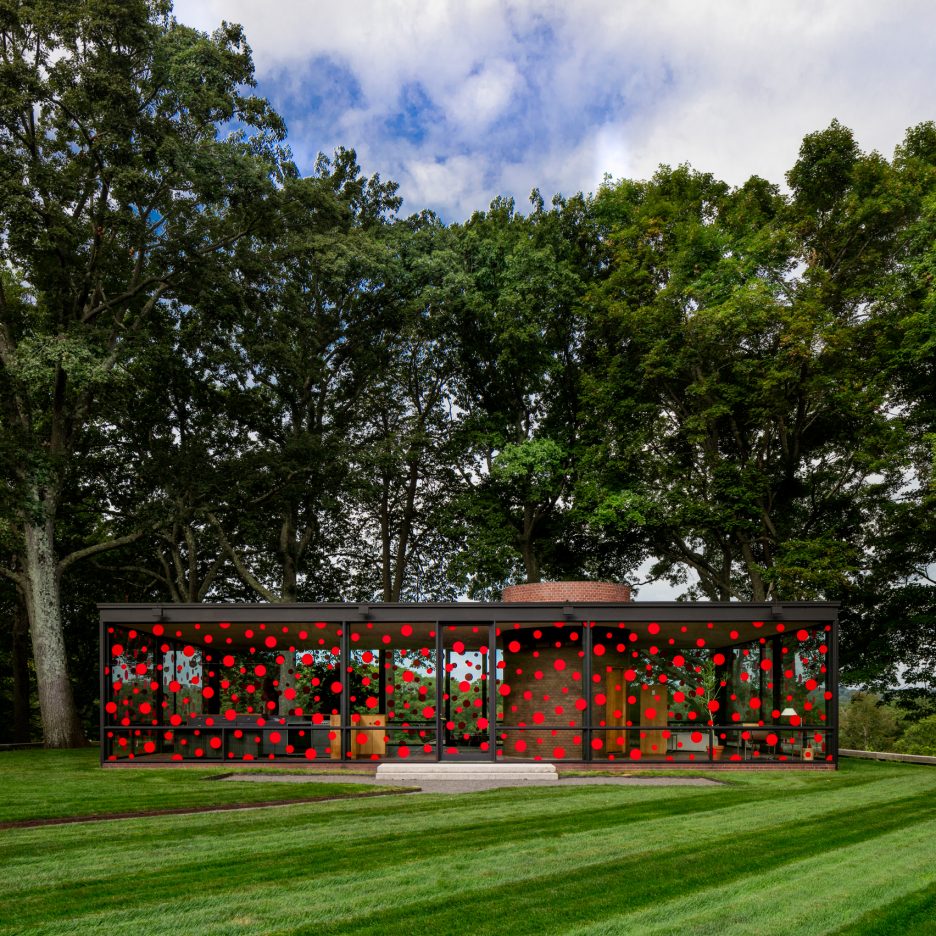
Japanese artist Yayoi Kusama has continued her residency at the iconic Glass House in Connecticut by sticking red polka dots all over its transparent walls (+ slideshow). (more…)
The Center of Mathematics at the University of Karlsruhe was built in 1964 and needed to be refurbished both architecturally and energetically. Located close to the historic center and due to its location on the edge of the university campus the building works as “showcase” of the university to the city. The rectangular, five-storey building encloses an elevated mezzanine patio, open to the east and west on ground floor.
The refurbishment and extension of the building focuses primarily on the exchange of contaminated components such as PCB-contaminated blankets, system walls with formaldehyde and spandrel panels made of asbestos. The house has gotten a new facade with significantly improved thermal insulation and energy efficient building services. The use of daylight was improved and the building is passively air-conditioned. To expand the usable area to 2.200 m², a recessed mezzanine was topped. The new roof is a lightweight steel structure; the courtyard is covered with a light foil. It works as a heat buffer which minimizes energy loss in the winter and creates a a pleasant, cool climate in the summer.
Section
On ground floor all public areas of the faculty are accommodated – such as tutorial and seminar rooms, group work areas, cafeteria and the faculty library. In addition to office space for the institutes there are also located seminar and meeting rooms and project areas in the upper floors. Whereas in the basement seminar rooms, PC pools and a part of the faculty library are provided. The concept of the building pursues to improve communication. It combines art and architecture. Max Bill’s „family of five hemispheres“ was cleaned during the construction phase and integrated harmoniously after the completion.
A department store in Shenzhen, China, is currently undergoing a major transformation into what the architect describes as an “a new sustainable and iconic design for the city.” Designed by Aedas, the Shenzhen Luoho Friendship Trading Centre will include a new skyscraper and a “vibrant and porous” 7-story retail podium. Integrated landscaping and green balconies turn the development into an “urban oasis” in the heart of the city.
Courtesy of Aedas
The project sits in the central zone of Luohu, and partially takes its formal attributes from the surrounding urban fabric. The sweeping, staggered profiles of the retail podium respond to the bustling streets surrounding the Centre, as if the podiums were sculpted by these dynamic forces. The design also takes reference from naturally occurring forms, as described by Aedas in their press release:
Architectural form drew inspiration from nature and imitates a beautiful Calla Lily. The curtain wall wraps around the tower and resembles the elegant petals as the translucent podium rooftop. The generous petal roof brings natural daylight deep into the open-air, multiple-plane retail arcade and induces air flow current for natural ventilation.
Courtesy of Aedas
The “petals” provide shading for leisure and activities in the terraces, and integrated landscape through the complex introduces crucial green space. Several green balconies dotted across the retail podium break up the visual bulk of the building. These green balconies extend along one face of the tower, increasing the building’s image as a “green oasis” in the city skyline.
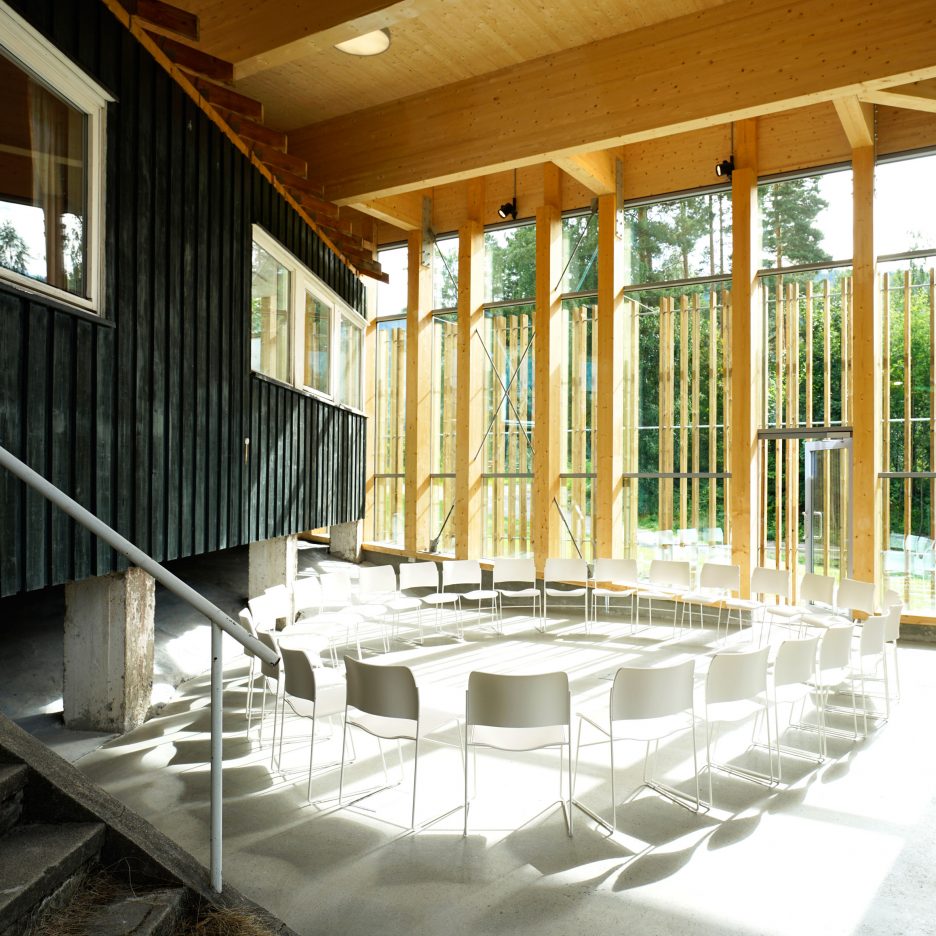
The cafe building where 13 people tragically lost their lives in the Norwegian terrorist attacks of 2011 has been enshrined within a new learning centre by architect Erlend Blakstad Haffner (+ slideshow). (more…)
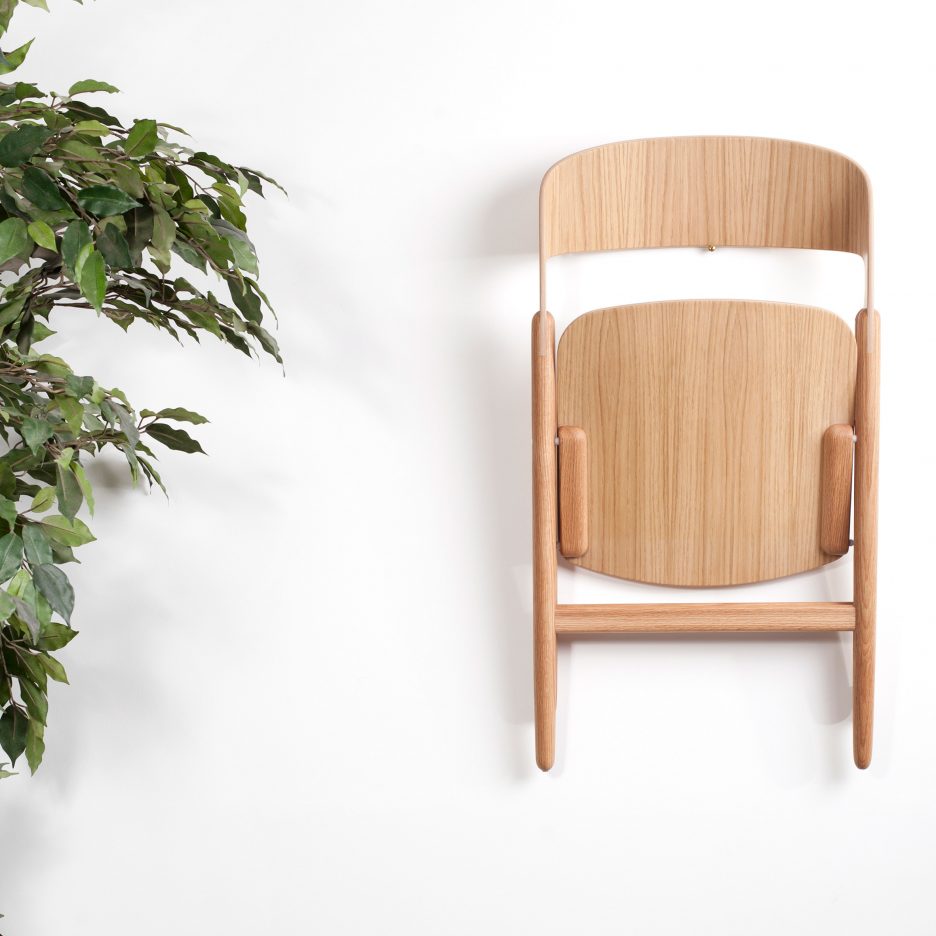
Dezeen promotion: British industrial designer David Irwin has created a space-saving wooden chair for Case Furniture that can be folded up and hung on a wall (+ slideshow). (more…)
House in the Pacific Coast is a residential project designed by Bernardi + Peschard Arquitectura. Completed in 2013, it is located in Guerrero, Mexico. Photos by: Rafael Gamo