Architecture
House Bäumle 2 / Bernardo Bader

© Archive Bernardo Bader Architects
- Architects: Bernardo Bader
- Location: Lochau, Austria
- Area: 200.0 sqm
- Project Year: 2016
- Photographs: Archive Bernardo Bader Architects
- Structural Engineer: Mader & Flatz, Bregenz
© Archive Bernardo Bader Architects
In a very narrow assembled building plot the house tries to formulate its architectural idea from the barriers and disadvantages of the split. Only by the self-conscious positioning to the access road in the south and the distance indulgence granted by a neighbor, the densification of the plot was ever possible. On this strip of land which is steeply sloping north to the Lohbach (small stream), from then on an elongated rectangular blank develops over 3 stories vertically into the air.
© Archive Bernardo Bader Architects
On the ground floor a small studio is enrolled, which uses the few level surface of the exterior area. Cooking and eating is a floor above. There you sit comfortably protected and privatized either at a table inside or in a small loggia.
© Archive Bernardo Bader Architects
Topmost are the living room and fireplace under a sheltering, uniting gabled roof.
Strategically placed openings stage different views to the lake, the river and back to the village. The fenestration of the house generates a pleasant pulse of light and darker areas. The opening portion of the façade, deeming appropriate, prevents the spatial flow out of the interior. The windows communicate in a proven way to the outside and privatize at the same time life in the house in a pleasant way.
© Archive Bernardo Bader Architects
The house has a massive core zone of concrete. Outwardly to wall and roof completes a wooden mantle from vertical wood elements. The classic theme of a solid characterful center of the house is operated, which includes the stove, the kitchen and the bathrooms. Opposite, towards the windows it becomes continuous wooden, more tender, lighter. The spatial compression of the interior widens softly, with differentiated transitions, to the exterior.
© Archive Bernardo Bader Architects
Outdoor the facade with its black coloring engages in the immediate vicinity to still prevailing images of sunburned agricultural huts. Because of the pushing back of agricultural use in Vorarlberg’s Rhine Valley, too few of these relics have remained.
© Archive Bernardo Bader Architects
Guild Architects Design a Family Home in Melbourne, Australia

Yarraville Garden House is a private residence designed by Guild Architects. Completed in 2015, it is located Melbourne, Victoria, Australia. Yarraville Garden House by Guild Architects: “This family home in Yarraville celebrates sun, seasons and togetherness, drawing in abundant light, making the most of the leafy garden, and introducing multiple spatial opportunities for family and friends to engage with. The existing home and site presented a number of challenges common..
MAX IV / FOJAB arkitekter + Snøhetta

© Felix Gerlach
- Architects: FOJAB arkitekter, Snøhetta
- Location: Fotongatan 2, 225 92 Lund, Sweden
- Landscape: Snøhetta
- Area: 52890.0 sqm
- Project Year: 2015
- Photographs: Felix Gerlach, Courtesy of Snøhetta
- Total Contractor: Peab Sverige AB
- Commission In Charge: Janis Kursis
- Design: Greger Dahlström
- Assisting Architects: Göran Hellquist and Jonas Ruthblad
Courtesy of Snøhetta
BUILDING DESIGN by FOJAB arkitekter
When electrons accelerated close to the speed of light are forced to change course from its linear direction, they release energy which transforms to soft and hard x-rays – synchrotron light – that can be used for examination of the material characteristics on molecule level. This kind of radiation was first observed in an accelerator at the laboratories of General Electrics at the end of the 1940s. The technique was further developed at Stanford University at the beginning of the 1950s. The first storage ring for synchrotron light in Sweden was MAX I built in the middle of the 1980s. The storage rings MAX II and MAX II were taken in use in 1996 and 2006. Today there are about 50 synchrotron light laboratories world-wide.
Section Render
© Felix Gerlach
In 2009 Lund University decided to build a new laboratory, MAX IV, and prepared documents for public tender. A consortium of the contractor Peab and the real estate company Wihlborgs won the tender and formed the real estate company ML4 for the construction and letting of the laboratory to Lund University. Five architects were invited to compete for the design of the buildings and the landscape. In the autumn 2010 FOJAB architects were commissioned the design of the buildings. Snøhetta architects were commissioned the design of landscape. Both architects have worked closely together to achieve a symbiotic relation between landscape and buildings.
© Felix Gerlach
MAX IV differs from other similar facilities by its extremely low emittance and focused electron ray. Electrons are accelerated in a subterranean linear tunnel and then led up to two different types of storage rings, 1.5 GeV and 3 GeV, on the ground the level. When the synchrotron light is produced by changing its course it is led along beamlines where particular wave lengths are selected for the examination of test samples in different experiment stations.
© Felix Gerlach
Section Render
Good architecture is recognized by a seemingly uncomplicated correlation between form and function. When organizing and designing the MAX IV facility we have focused on the researchers’ functional requirements and the characteristics of the location. The aim is that the high technology process of the facility is reflected by the exterior as well as the interior design.
© Felix Gerlach
MAX IV is a huge laboratory in constant development and change. All different building parts and units of the facility have their own specific requirements with regard to function, extent and life length. Some buildings and building parts are tailor made for their specific purposes, while others are given a more or less general design. Most units must be prepared for a wide range of ever changing functional requirements. First step of the de¬sign process was to map and define the specific requirements. Next step was to form an architectural language with the aim of giving the facility a distinct identity and a sustain¬able overall expression that allows changes and modifications for future use.
© Felix Gerlach
Three building typologies were defined: the large storage ring with its experiment hall, the office building of five floors, and finally, the other buildings. With the development of the facility, synchrotron beam lines from the storage ring and experiment hutches will gradually be added around the experiment hall. The ex¬tent of these additions can only be defined by the future development of the facility. The upper parts of the experiment hall and the office building are not expected to undergo changes or additions. The other buildings consist of the small experiment hall and buildings for technical support facilities, which have a great potential for change.
© Felix Gerlach
Ground Floor Plan
© Felix Gerlach
Good architecture is also recognized by a design idea that puts its spell on the whole project, landscape, exterior and interior design. The cooperation between Snøhetta and FOJAB has resulted in a symbiotic relation between landscape, exterior building design and interior building design.
The brushed aluminium of the large experiment hall, the white clad office building with its sun shading device, the white concrete facades and the waving landscape constitute a clear and lasting image for the MAX IV facility. Detail design started in July 2010. Construction started in June 2011, and was completed in June 2015. The facility was inaugurated in June 2016. Environmental Certification: Sweden’s first office building classed with BREEAM-SE – Level Excellent, EU Green Building – Level Gold and Miljöbyggnad Guld. MAX IV was awarded the Best Futura Project at MIPIM 2014.
© Felix Gerlach
LANDSCAPE by Snøhetta
Since 2011, Snøhetta has been working on the development of a unique landscape design for the MAX IV Laboratory. MAX IV is a national laboratory operated jointly by the Swedish Research Council and Lund University. The synchrotron facility is created by FOJAB architects, and Snøhetta has designed the 19 hectares landscape park. MAX IV was officially opened on June 21st 2016.
Site Plan
The landscape design is based on a set of unique parameters to support the performance of the laboratory research, including measures such as mitigating ground vibrations from nearby highways, storm water management, and meeting the city’s ambitious sustainability goals.
Courtesy of Snøhetta
The MAX IV is the first part of a larger transformation of the area northeast of Lund aiming to turn agricultural land into a ‘Science City’. The creation of a new, green public park rather than a fenced, introverted research center makes a difference in the public realm. The MAX IV site is a green site, and the image of the meadow vegetation on sloping hills as a recreational area is setting a new standard for research facilities’ outdoor areas. MAX IV has been a collaborative process together with the client, consultants and construction developer.
Courtesy of Snøhetta
The development of the landscape architecture design is based on four important criteria:
1 – Mitigating ground vibrations: Testing led by researchers and engineers revealed that traffic on the neighboring highway (E22) was causing ground vibrations that could influence the experiments in the laboratories. By creating slopes and a more chaotic surface, the amount of ground vibrations has been reduced.
Courtesy of Snøhetta
2 – Mass balance: With focus on optimizing the reuse of the excavated masses on site, a cut and fill strategy was employed. This secures the option of reversing the land to agricultural use when the synchrotron is no longer on site. By uploading the digital 3D model directly into the GPS-controlled bulldozers, we were able to relocate the masses to their final position in one operations, and no masses were transported off site.
Courtesy of Snøhetta
3 – Storm water management: The city planning department of Lund restricts the quantity of water permitted to run into the city’s pipelines, and water management inside the site’s boundaries. Dry and wet ponds are therefore designed for both the 1-year and the 100-year storm water.
Diagram
Diagram
Diagram
4 – Plant selection and maintenance: The discovery of the nearby natural reserve area at Kungsmarken made it possible to use a selection of natural species by harvesting hay and spreading it on the new, hilly landscape. The maintenance strategy includes a combination of grazing sheep and conventional machines suitable for meadow-land.
Courtesy of Snøhetta
COS and Daniel Emma celebrate the classic white shirt with set of installations

House in Atsugi / Masashi Kikkawa + Hisashi Ikeda

© Kikkawa architects
© Kikkawa architects
- Architects: Masashi Kikkawa , Hisashi Ikeda
- Location: Kanagawa Prefecture, Japan
- Area: 120.0 sqm
- Project Year: 128
- Photographs: Kikkawa architects
© Kikkawa architects
From the architect. The site is located in the suburb of Tokyo. In the old days, there were many farmhouses that life of people and nature were closely connected to each other. The owner’s family has been engaged in agriculture since ancient times. However, with a transition of lifestyles, farmhouse was replaced with the standardized housing that has no relevance to agriculture. We re-built a modern farmhouse in harmony with nature, aiming to create a pleasant house.
© Kikkawa architects
In spite of rapid urban development, we thought rural environment, that has been slightly left out brings a pleasant living environment to this house. The house was placed in a quiet location, away from the main street, to live calmly. The exterior elevation is a simple form, as it is quietly placed in the field, and it has an easy atmosphere in harmony with the landscape. This simple form resembles the memory of the old farmhouse (thatched roof house) that owners lived in their childhood.
Plan
The plan is basically one-room, the owner couple can live feeling the presence of each other. All rooms can be divided freely with sliding doors, which allow the space to be a spacious openness or with confined calmness. In addition, so that the internal space is continuous with the landscape, we set up a large window (width 12.6m) on the south side. This window lets through the cool breeze in summer, brings warm sun light in winter. As a result, the house feels the transience of nature.
© Kikkawa architects
The maximum ceiling height in the living room is about 4.8m, which holds a feeling of openness of the surrounding landscape. In order to create a calm space, it was closer to space to physical scale. For example, the living room ceiling height comes down to about 2.4m along the steep roof, and the height of all the opening is 1.8m, and placed a low height furniture.
Section
Two of comfort, such as openness and calmness are attempted to be established at the same time. We have tried to make connections, such as nature and people, people and people. And we wanted to create a space in which everyone feels comfortable.
Studio Dwelling at Rajagiriya / Palinda Kannangara Architects

Courtesy of Palinda Kannangara Architects
- Architects: Palinda Kannangara Architects
- Location: Rajagiriya, Sri Jayawardenepura Kotte, Sri Lanka
- Structural Engineer: Ranjith Wijegunesekara
- Quantity Surveyor: Sunanda Gnanasiri
- Area: 450.0 sqm
- Project Year: 2015
- Photographs: Courtesy of Palinda Kannangara Architects
Courtesy of Palinda Kannangara Architects
This is an office and residence of an architect, located by a marsh, in Rajagiriya Sri Lanka. Although located along urban fringe near a series of high-rise buildings, and close to the main road, the building is designed like a fortification. It is sealed from the Colombo heat (with specially designed double screens to limit western and southern exposure), traffic and noises of the road but once within reveals unexpected views of the adjoining marsh and is totally permeable to the natural setting. The building plays with volumes to create many areas for living, work and leisure, and also with materials and tectonic devices to create a cooler microclimate within the building, encouraging daylight, and views to the marsh, harvesting and regulating rain water, and creating gardens for biodiversity. The design also takes into account its location by the water, creating garden spaces that act as detention area during monsoons, thus preventing the living/ workspaces from flooding.
Courtesy of Palinda Kannangara Architects
Located on a small foot print of 2720sqft the building comprises of three levels – the ground area has a 4vehicle parking, kitchen, model making room and a guest suit each room opening into a courtyard. The 1st floor comprises the lobby, work space and the 2nd level has meeting area,lounge and library also a northern wing comprising of a bedroom with balcony, and an open to sky bathroom. The upper most level (3rd floor) has a living and entertainment pavilion that overlooks biological ponds that cleanse and regulate storm water, paddy fields and edible gardens.
Courtesy of Palinda Kannangara Architects
Section
Courtesy of Palinda Kannangara Architects
This green project uses built and landscape strategies to create cooler microclimate with the building.Recentstudies conducted by a student project of University of Moratuwaon the building have indicated that the indoor temperature within the building is several degrees cooler than outdoors.
Courtesy of Palinda Kannangara Architects
Sujiva Living / Somia Design Studio

© Mario Wibowo
- Architects: Somia Design Studio
- Location: Jl. Ciungwanara IV No.15, Renon, Denpasar Sel., Kota Denpasar, Bali 80234, Indonesia
- Area: 372.0 sqm
- Project Year: 2016
- Photographs: Mario Wibowo
- Design Principal(S): Widiadnyana
- Designer In Charge: Ayu Trisna Sri Hapsari.
- Interior Design: Maekayu Interior & furniture.
- Lighting : Somia Design Studio.
- Landscape: Somia Design Studio.
- Main Contractor : 2 brothers construction, Bali.
- Structure Consultant: Saka Undagi Bali.
- Mep Consultant: AMEP design.
© Mario Wibowo
From the architect. MEANING
“sujiva” (Sanskrit) means a comfortable life.
© Mario Wibowo
INSPIRATION
The abode design principle is influenced by the Balinese house principle—Asta Kosala Kosali and the tropical contemporary architecture style.
© Mario Wibowo
Asta Kosala Kosali is the organizing principle for traditional houses in Bali based on the “Nawa Sanga”—nine cardinal directions around the center point of Siva—and the mountain-sea axis and sunrise-sunset axis, whereby dividing the site into nine areas, which serves a different function each. The “Sanggah Kemulan” or main temple area as the most sacred places for praying is located in the north-east (kaja: mountain direction), whereas “aling-aling” or the entrance gate as the dirtiest place is located in the south (kelod: sea direction). The “kaja–kelod” or north-southwill be different in every part of Bali because it is centered in the sacred mountain that is believed as the dwelling place for the gods and derities, Mount Agung, which is located in the East of the Bali island.
Section
Section
Although it’s rather unlikely to apply Asta Kosala Kosali in the design—since it requires several separated buildings, thus demands a larger site area—the building design still honors the principle in a different implementation. For instance, the position of the temple area is located in the east (kangin) and the entrance gate is in the south (kelod), while the entrance direction through the main door is from the west to the east, whereby this consideration is given by the priest (pedande), the expertise in the local belief.
© Mario Wibowo
Furthermore, responding to the tropical climate condition, the building configuration embraces the modern contemporary architecture style & details. In which, the building configuration is simplified, by replacing the ornaments which are existed in traditional style to a carefully chosen building material selection, which simultaneously minimizes the budget for both construction and maintenance.
© Mario Wibowo
NEEDS
The man of the house is a principal architect for a design studio, who wants to have an ideal house for his family and a small studio for his architecture office, while his wife is a pioneer in the customer experience service field in Indonesia. The combination of both brings the design to a level, where it possesses a rare and incomparable space experience for each occupant.
© Mario Wibowo
The 40:60 ratios for the built-up area and the green area are established to cherish the indoor and outdoor relationship, subsequently resulting in more activities outside and indirectly forming more mobile and flexible working space for everyone.
© Mario Wibowo
The same ratio is also applied for the public and private zone, where the public serves as the office area and the private as the living area. To delineate both sides, a divider wall is formed to produce a significant constraint between the two contrastive functional spaces.
© Mario Wibowo
Serving as a design-oriented architecture consultant, the studio is designed to preserve a maximum number of 8 people to work under his supervision. The desired ambience for the studio is a friendly and warm working atmosphere to support the creativity in the architecture industry, whereby it doesn’t rule out the possibility for working mobile at the provided space around the site. A small meeting room is developed next door, admiring the garden view with the ultimate opening towards the garden & deck area.
© Mario Wibowo
Between the massive the divider wall, a 2.85 x 2.85 meter center-pivot door is fabricated to connect the public and private area, yet maintaining the privacy of the house complex. Right after the door rotates, the comfortable feeling welcomed you with the tropical contemporary landscape design. The soil is covered with the loose pebbles, accompanied with a row of timber deck with a floating concrete bench, functioning as the outdoor gathering space.
Plan 0
Plan 1
Despite the spacious landscape, the house is, however, designed to meet the ideal and ergonomic needs of the householders. Entering the house from the black timber frame sliding glass doors, the open living area, which consists of the living and the dining area, greets the occupant with a pleasant mood with a remarkable composition of specialized red brick wall. The border adjacent to the park is filled with glass doors and windows, making it easier for the occupant to have an inside-out experience from every corner.
© Mario Wibowo
The master bedroom is located on the east side, next to the grass-covered steps towards the garden, letting the room to have the amazing view of the garden, as well as enabling the sunlight to enters the room graciously. Next to this compact and cozy room is the master bathroom, where it provides an individual scope for the shower area and the closet area, along with the vanity counter at front.
© Mario Wibowo
On the upper floor, two common bedrooms are prepared for the upcoming members of the family, facilitated with a share bathroom and a small family lounge area, to act as the gathering space for the kids.
© Mario Wibowo
DETAIL & MATERIAL
To generate a consistent design language, three finishing material colors are chosen. For the accent, exposed red brick is selected, as it is a local product which occupies the natural character, as it is also one of the material that are regularly used in Bali traditional buildings. In contrast, the color black is also inserted to produce an elegant and masculine feel in the building. To balance out the combination of the brick and the black, cement exposed color is picked to act as the neutral color balancer.
© Mario Wibowo
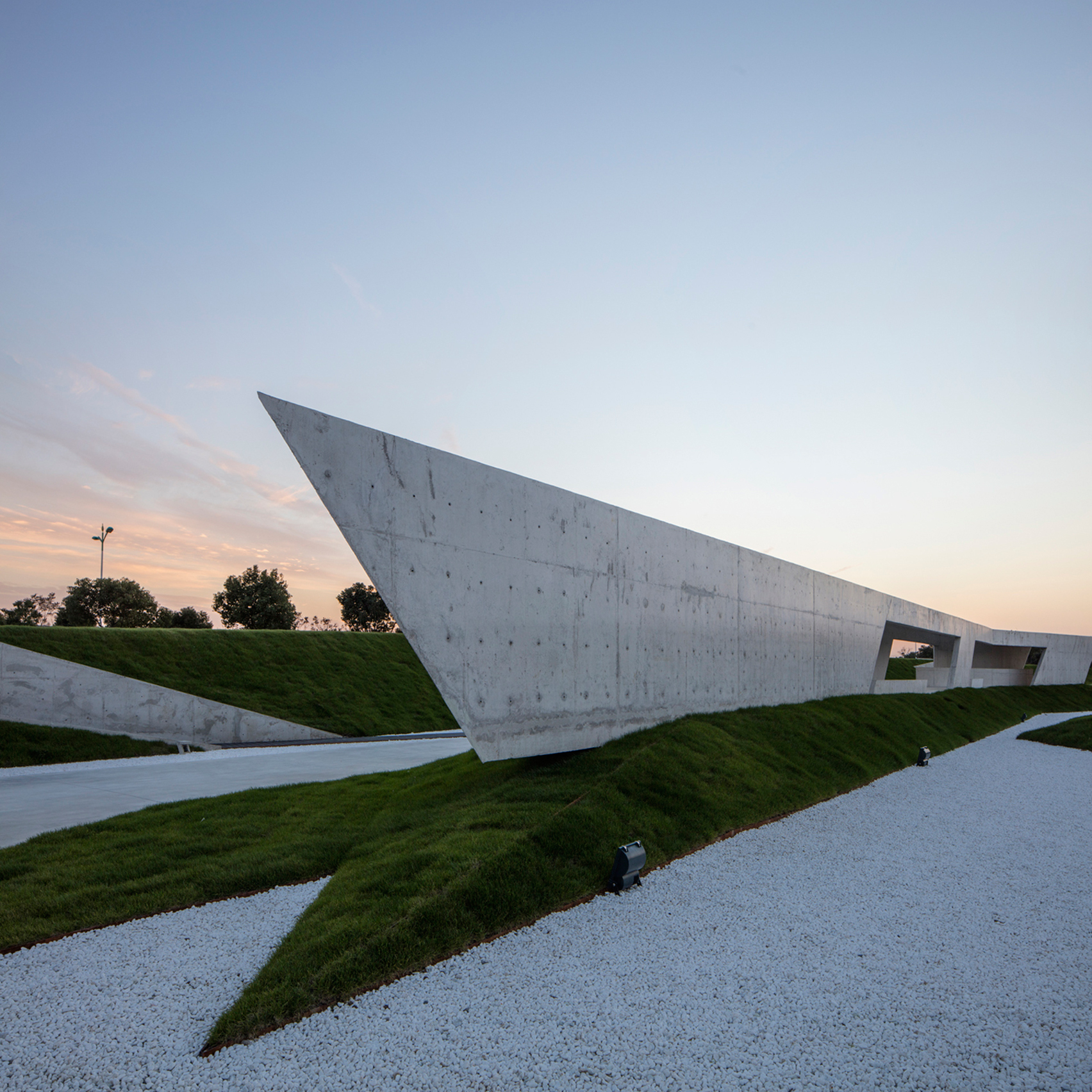
Zigzagging concrete “veranda” built in Shanghai agricultural park
Dropbox opens industrial-style cafeteria by AvroKo at California headquarters
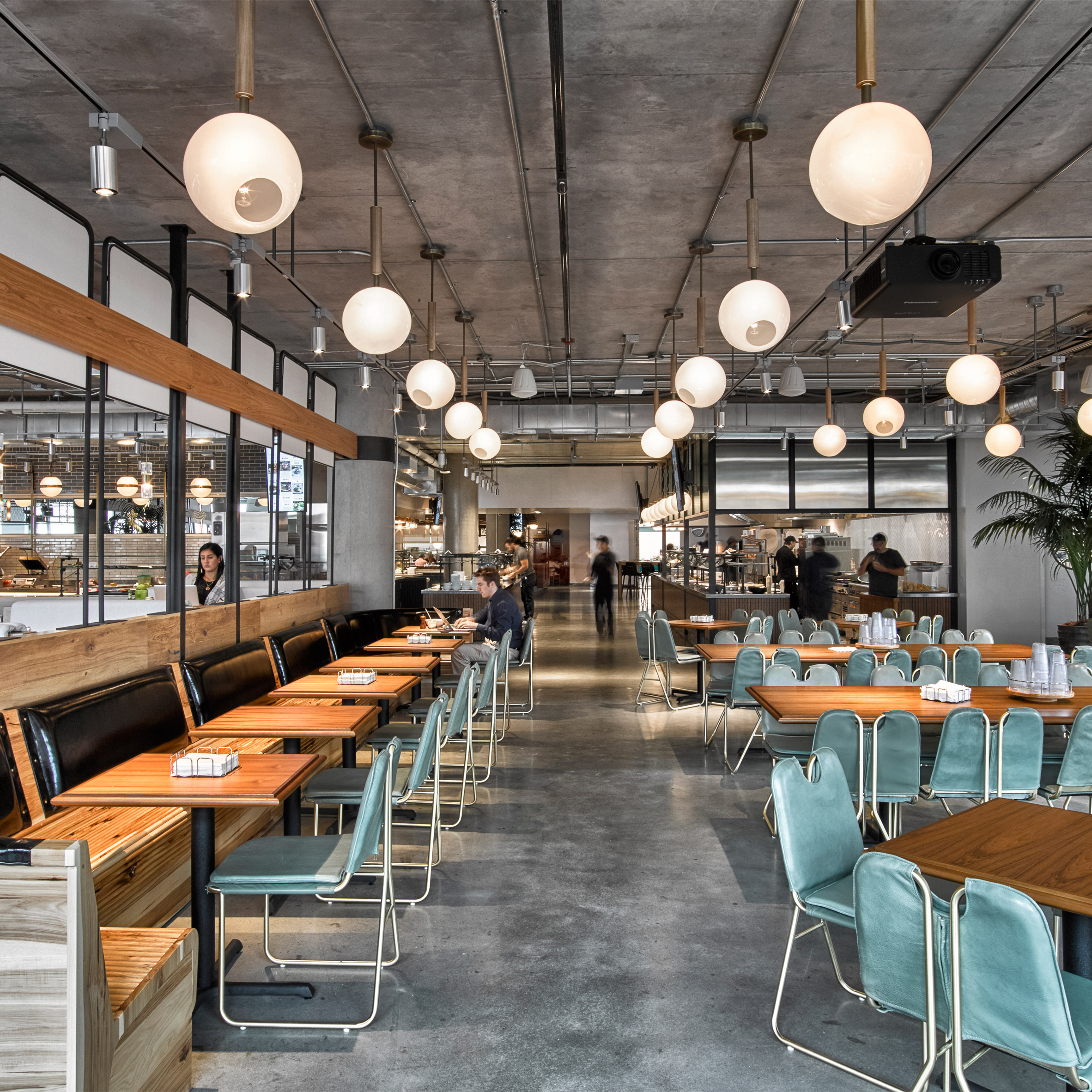
American studio AvroKo has completed a cafeteria and coffee bar in the new San Francisco headquarters for tech company Dropbox, providing a “place of comfort” that aims to keep employees from leaving the office (+ slideshow). (more…)

