
Following the success of its 01 range, Instrmnt’s 02 collection is now available to pre-order from Dezeen Watch Store. Read more
Following the success of its 01 range, Instrmnt’s 02 collection is now available to pre-order from Dezeen Watch Store. Read more

Using concrete and bricks made of raw mud, architects Solanito Benitez, Solano Benitez, Gloria Cabral, Maria Rovea and Ricardo Sargiotti built a wall able to be constructed by the two materials working in tandem. Once the concrete dries, the bricks are washed away, returning the mud back to its natural state, leaving spaces in the lines of concrete, like a kind of negative.
This artistic intervention arose from an invitation to participate in an art exhibition in Unquillo MUVA, Cordoba, Argentina from April 11 to May 3, 2014.
More information and images below.
Description by the Architects. We needed an open space close to the largest exhibition hall where we could come and go easily, which is how we ended up at the stable. It’s a building that had fortunately not been well maintained and still showed traces of time on its walls: fallen plaster and sunken mortar and bricks in all their splendor. A raised walkway 1.30 meters high separates the path from the imposing side wall.
We built a wall 17 meters long on the platform, with a mesh front facing the public and a zigzagging side (to avoid having to make reinforcements or adding any anti-seismic components) which faced the stable.
The wall was built with unfired bricks, in their airing out stage, and were laid on a layer of mortar made of sand and lime that was 3cm thick. After four days, the original bricks were pushed out with pressure washers along with any other tool that could break through the thick mud bricks.
Like a mirror image of the aging stable walls, here it’s the mortar that stayed behind, working as fibers, in the best way they know how. “Taken away” lies in a sequence (that time could only have done), and returns to the earth to in its original state. It is a brick wall forever missing its bricks.
Architects: Solanito Benítez, Solano Benítez, Gloria Cabral, María Rovea, Ricardo Sargiotti
Colaborators: Juan Camps, Santiago Ruiz, Emiliano Sánchez, Kevin Vitale
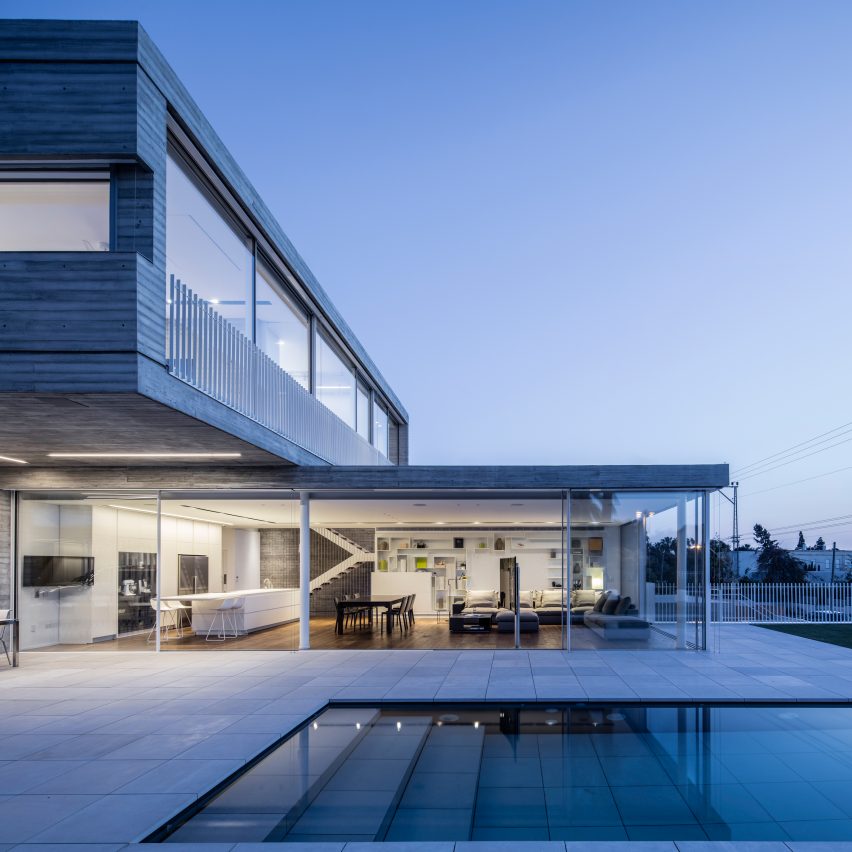
A pair of concrete and glass volumes are stacked at right angles to form a cantilever sheltering a pool terrace at this family home in Tel Aviv, designed by Axelrod Architects and Pitsou Kedem. Read more

The campus of University of Pau et Pays de l’Adour (UPPA), bearing the hallmark of its architect André Grésy, is immersed in wooded grounds and has a strong relationship with its environment. In order to comply with the project developed by the university, to coordinate the different activities, and to upgrade – in terms of quantity and quality – the material means and real estate, the building of the Faculté de Droit, Economie et Gestion – Faculty of Law, Economics & Management – and of the Institut d’Administration des Entreprises – Institute of Business Administration – is reorganized, and an extension of the research centre is created.
The world of research is constantly changing. Therefore the project developed by Patrick Mauger is open-ended.
Inside, the entrance lobby is considerably enlarged. Orientation is facilitated. Circulation flows are separated. New vertical circulation routes allow better connections between floor levels, and it will be possible to create future extensions by adapting them. These strongly-marked architectural spaces make it easy for users to find their bearings and create favourable conditions for communication. On the south, an extension with full-height glazing is added onto the existing longitudinal building, extending the developed architecture into the grounds, to accommodate functions of the programme. A wide central stairway winds around a void bathed in overhead lighting. The stairway is a real sculptural work in white concrete, and is the spinal column of the scheme, set in a stairwell of red concrete, which gives it its force and allows all users to immediately find their bearings. It is accessible from communal areas for research teachers, seminars and thesis presentations, and from the administration offices of the doctoral school, and it leads to the upper floor levels, at the junction of the documentation areas and the research centres’ offices.
Outside, the façade is revised and modernised. The horizontal bands of tiled canopies, which characterise the initial architecture, are adapted. A random mix of 5 colours of roof tiles, both enamelled and non-enamelled, livens up the façades of the new building, facilitating identification. These new tiled canopies cover housings for retractable tilting sun-shade louvers, which allow personalised control of daylight admission and optimal thermal control of solar gain.
The use of bio-sourced ecologically responsible materials – external and internal wood joinery, including parquet wood strip flooring, wood wool external insulation, and terracotta tiles – helps to limit the new building’s carbon footprint. Other active devices and measures complement the work on the environmental approach: energy recovery from all air handling units, additional night-time ventilation, a BMS – building management system – and double flow ventilation to reduce energy consumption, and optimised natural daylighting.
Product Description
Terracotta tile -A revised, modernised façade with terracotta roof tiles
The existing architecture is strongly marked by the horizontal bands of timber support frames covered with flammé red terracotta flat tiles. They provide protection from the sun and natural shade in the internal spaces which suffer from a lack of natural daylighting. To make up for this deficit and to improve the penetration of daylight, the extension’s new façades meet the aim of reinterpreting the existing architecture, while improving it and modernising its image.
Nearly 25,500 terracotta roof tiles, of the Aleonard Koramic type made by Wienerberger, were necessary for covering the new canopies:
A random mix of these 5 colours livens up the façades of the new building and allows their identification. Each of the 25,500 made-to-measure 10 cm x 20 cm terracotta flat tiles is clipped to the metal frames. All the frames, measuring 3 m x 2.15 m, are placed according to the façade grid of the timber window frames (1 m x 2 m) while maintaining the inclination and alignment on the existing canopies. According to the varying exposure, a play of solids and voids enlivens the façades of the new parts. The sun-shields are gradually perforated, depending on how close they are to the existing building: they are more dense on the north-east and north-west to link to the existing building, and less dense on the south to highlight and enhance the new research centres.
With this perforation, daylight enters the reading rooms more abundantly in the spring, autumn and winter. On the west and east façades of offices located around the perimeter, retractable tilting sun-shade louvers are fastened to the structure of the canopies. They filter sunlight and allow personalised control of daylight admissions, according to the sun’s course.
All facings on the new façades are in a variety of colours:
These colour combinations of façade materials, which can be seen by everyone from the campus, create the new image of the university.

Farangas I is a private residence designed by React Architects. Completed in 2010, it is located in Paros, Greece. Farangas I by React Architects: “The plot is located at the island of Paros in the Cyclades. It has orientation in the big side South-western with view to the sea. The project concerns a summer house with hostels and a pool. The place of the residence is to benefit of the..

Mankind has a strange relationship with the darker elements of its history. While some argue that we must consign our greatest mistakes to the past in order to move forward, others believe that ignoring, or refusing to acknowledge, our transgressions dishonors those who suffered – and leaves us vulnerable to repeating them. This ongoing debate has found its latest incarnation in western Austria, where the national government has announced its intention to demolish a seemingly unremarkable yellow house in the riverside town of Braunau am Inn – a house which, despite its unassuming façade, has gained infamy as the birthplace of Adolf Hitler.
Braunau’s unfortunate association with the Austro-German dictator began with his birth on April 20th, 1889. The fourth son of Alois and Klara Hitler, he spent only three years in the house of his birth before moving to the town of Passau on the German side of the river Inn. The fact that his residence in Braunau was so brief did little to dissuade fanatics who, longing to see the birthplace of the (who would later be known as) führer, began to elevate his former home in Braunau to that of a ‘pilgrimage site’ as early as the 1930s. When Braunau was occupied by the United States Army in 1945, it was American intervention that prevented a group of German soldiers from destroying the recently-deceased German dictator’s former home.
Over seven decades later, most residents of Braunau wish that the Americans hadn’t stood in the way of the house’s destruction. Its presence in the heart of their town is a constant reminder of a legacy that they are ashamed of; that the house has regularly been visited by successive generations of Nazi sympathizers, especially on the anniversaries of Hitler’s birth, is no small source of chagrin. Fears about this trend led the Austrian government to take up the building’s lease in 1972, after which it saw many uses as a museum, a school, a library, and the home of an organization dedicated to assisting the disabled.
In recent years, however, the house’s very existence has been placed in jeopardy. Continually frustrated by the owner’s refusal to renovate the building, and leery of its status as a de facto shrine to Hitler, Nazism and Fascism, the Austrian government took ownership of the house in July and began deliberating over its possible fate. Although the matter still requires a parliamentary vote, it is predicted that the building will be demolished and replaced by a new structure which will not carry the same association with one of history’s darkest chapters.
The impending decision has fanned the flames of a debate that has not settled since 1945. Those who would rather see the house destroyed cite its appeal to neo-Nazis as an impetus for action, a chance to strike a symbolic blow at those who continue to echo the hatred touted by their idol. “It is my vision to tear down the house,” said Austrian Interior Minister Wolfgang Sobotka, who explicitly mentioned his desire to eradicate what had repeatedly become a ‘cult site’ for neo-Nazis. Others, including Vice Chancellor Reinhold Mitterlehner, would rather see the house turned into a museum that would educate future generations about the dangers of radical extremism.
Hitler’s birthplace is only one of many sites connected to the atrocities of the Second World War to face controversy of this nature. In Poland, the Auschwitz-Birkenau memorial (formerly a Nazi-controlled concentration camp), along with an extensive catalogue of Holocaust artifacts, is under a continuous restoration program in order to maintain the authenticity of the site and, in the words of the organisation in charge, to “warn humanity against itself.” The decision to preserve Auschwitz was not universally supported, however, and even those who do believe it should remain intact are locked in an ongoing debate over the question of rebuilding parts of the memorial which, despite the efforts of preservationists, are rapidly deteriorating.
Another architectural relic of this period can be found to the south: the Palazzo della Civiltà Italiana, a gallery building originally erected to house a national exhibition celebrating the achievements of Fascist Italy under the reign of Benito Mussolini. The exhibition, however, never took place (due to the outbreak of the Second World War) and the palazzo would ultimately remain empty for decades. Although the Italian dictator may not be as infamous as Adolf Hitler, the building’s association with his authoritarian reign led to similar controversy in 2015 when the palazzo was renovated to become the new headquarters for Fendi. The fashion house, along with its supporters, argued that the palazzo’s striking, minimalist architecture was a symbol not of fascism, but of the company’s commitment to its native Italy. Architectural writer Owen Hatherley, meanwhile, proclaimed that while the architecture itself may be aesthetically pleasing, its creation by twisted minds meant that it was, and should be, “tainted.”
Across the Atlantic, similar debates began almost before the dust settled following the terrorist attacks of September 11th, 2001. Less than a month after the tragedy, people across the United States—and indeed, across the world—began voicing a wide variety of opinions as to just what should be done with the site of the World Trade Center buildings. Some argued that the original complex should be replicated exactly, an idea derided by others as an absurd form of denial in the wake of very real devastation. Although preservation of the original buildings were not possible, the struggle of finding a balance between “moving on” from a painful moment in human history, and respecting the lives lost as a result of that moment, is much the same.
Until the Austrian government makes its final decision, the future of Hitler’s birthplace remains uncertain. Even once a verdict is reached, however, it is unlikely to quell further debate – and may, if anything, simply fuel the fire. Whether the unassuming yellow house in Braunau is torn down or not, the atrocities committed by one of its former residents will not—and cannot—be erased from history. What Austria’s leaders must decide is whether to obliterate a symbol of one of history’s most reviled figures, or to preserve his birthplace as a reminder that his actions must never be repeated.
In front of the house stands a stone bearing a short inscription:
Für Frieden Freiheit und Demokratie. / Nie wieder Faschismus. / Millionen tote mahnen. [For peace, freedom, and democracy. / Never again Fascism. / Millions of dead warn us.]
In the end, it is respect of their legacy, not Adolf Hitler’s, that complicates this debate. As to whether that legacy is best respected through symbolic destruction or solemn preservation remains contentious.

For Casa Cor Rio 2016, the most important architectural and interior design event in Brazil, Gisele Taranto Arquitetura was challenged to create six different designs for a dining room. The 26th edition of the event takes place in a house surrounded by Burle Marx gardens in Gávea, an affluent residential neighborhood located in the South Zone of the city of Rio de Janeiro. Ovoo Dining Room by Gisele Taranto –..

From the architect. This is a two-story building of the early 20th century, a typical village house of the Peloponnese with the main living areas on the upper level and the lower level used separately for agricultural functions.
The adaptation of the building into a contemporary vacation house was based on two main principles. On the one hand the spaces were arranged in a fluid and continuous way, without setting firm boundaries. On the other hand it was important to underline the differentiation of the two levels.
The upper and the lower level create a distinct dipole, the former as an area of winter living and the latter as the summer counterpart. The upper level is the reminder of the old main house and preserves the formal elements and the hierarchical arrangement. The ceiling and the walls are painted green, forming a dialogue with the surrounding mountains. The green box organizes the living area. The old terrazzo is fully preserved as a reminiscent of the old plan. All the new floors that define the new functions are structured around it.
The lower level vividly illustrates the initial stonewalls and all the subsequent structural interventions of the building. The various and diverse elements are whitewashed and unified. The space is divided into three cascading sub-areas aiming at different levels of privacy.
The dipole is also present at the facades. The lower level is whitewashed unlike the upper part where the render remains intact, revealing the footprint of time.
The main quality of the old building lies in its cross section, a non-visible condition. The contemporary intervention reveals that quality and turns it into an everyday experience.
Product Description. One of the main features of the interior is that the space is green all around and the floor materials define the different areas. Three different materials (forged cement, cement tiles and oak wood) are arranged around the old L shaped terrazzo.

Apartment ST is a private home located in Jūrmala, Latvia. Completed in 2015, it was designed by OPEN AD – Architecture and Design. Apartment ST by OPEN AD – Architecture and Design: “A flat near the seaside which the owner only uses during the summer. The interior is bright, inconspicuous and well lit, with high-quality furniture and considered functionality. Valuable materials have been used in a simple way and with..

Industrial designer Kim Ramain-Colomb’s brightly packaged Habibi cosmetics range is based on traditional Moroccan makeup. Read more

